
Denver, CO – July 20, 2026, 11:53 AM – The world of high-performance skiing has long relied on a blend of art and science, with expert human testers providing invaluable, yet inherently subjective, feedback on equipment. This dynamic is set for a significant transformation with the official launch and ongoing refinement of the Ski and Snowboard Tester at the Outside Lab at the University of Colorado Denver. Introduced earlier in 2026, this state-of-the-art robotic system promises to complement human intuition with objective, repeatable data, fundamentally reshaping how skis are evaluated, understood, and ultimately, chosen by consumers.
For decades, the annual SKI Test has been the gold standard, where seasoned professionals spend intensive weeks on snow, meticulously dissecting the nuances of each ski model. Their insights, captured in vivid descriptions—how a ski "locks into a carve," its "eagerness" or "playfulness," or the "muscle" required to bend it—have guided countless skiers. However, even among the most experienced testers, impressions can vary. What one tester perceives as "stiff," another might describe as "responsive" or simply "stable." This inherent variability, while a testament to the complex interaction between skier, snow, and equipment, has also created a persistent challenge in achieving universal comparability.
The Evolution of Ski Testing: From Intuition to Instrumentation
The pursuit of objective metrics in sports equipment is not new. From wind tunnels for aerodynamic cycling gear to biomechanical labs analyzing running shoe performance, scientific methodologies have steadily encroached upon traditionally subjective domains. Skiing, with its intricate physics of flex, torsion, and edge geometry, has presented a particularly complex puzzle. Early attempts at mechanical testing were often rudimentary, failing to replicate the dynamic forces experienced on snow. The "hand bend" test, a common shop floor assessment where one attempts to gauge a ski’s stiffness by pressing down on its center, is a prime example of an imprecise, if well-intentioned, method. It fails to account for the actual points of force application during skiing and the varying flex profiles along the length of the ski.
The genesis of the Outside Lab’s Ski and Snowboard Tester emerged from this recognition: to provide a robust, data-driven counterpart to human perception. "Our goal was never to replace our incredibly skilled human testers," explains Trevor Young, Lab Manager at CU Denver’s Outside Lab. "Their ability to interpret subtle snow conditions, varying terrain, and their own unique skiing styles is irreplaceable. What we sought was to give their expert impressions a quantifiable foundation, a second dataset that speaks in numbers rather than adjectives." This dual approach, merging qualitative human experience with quantitative machine precision, represents a significant leap forward in equipment analysis.
Since its introduction earlier in 2026, the machine has undergone rigorous fine-tuning. Run after run, hundreds of data points have been collected, analyzed, and cross-referenced to ensure consistency and repeatability—the bedrock of scientific measurement. The ambition is clear: to move beyond debates over whether the Nordica Enforcer 99 or the Blizzard Rustler 9 "takes more effort to roll onto edge" by providing concrete, measurable answers. Such questions, which have fueled countless discussions and even "arguments" among test crews, can now be addressed with precise data, offering clarity where previously only nuanced feeling existed.
The Outside Lab at CU Denver: A Hub for Innovation
The University of Colorado Denver’s Mechanical Engineering department, home to the Outside Lab, is strategically positioned for such innovation. Located in a state synonymous with world-class skiing, the institution fosters a strong connection between academic research and practical application in outdoor sports. The lab’s commitment extends beyond merely testing; it aims to understand the fundamental mechanics of sports equipment, pushing the boundaries of design and performance. This collaboration with SKI Magazine underscores a shared dedication to providing the most accurate and comprehensive information to the skiing community.
Deconstructing the Ski: Precise Geometric Measurements
The testing process commences with a meticulous, full-length scan of the ski. Utilizing contactless scanning technology, the machine takes readings at precisely defined intervals from tip to tail while the ski rests unconstrained. This initial phase is crucial for establishing the ski’s baseline geometry, providing a detailed digital blueprint that reveals far more than manufacturer-published specifications.
- Overall Geometry and Dimensions: The scanner captures the ski’s exact length and width at various points, allowing for verification against manufacturer claims and revealing subtle variations that impact performance. These readings are plotted on high-resolution graphs, offering an unprecedented level of detail regarding the ski’s true shape.
- Sidecut Radius: The "hourglass" shape of a ski’s edge, known as its sidecut, is paramount to its turning characteristics. The machine precisely measures the sidecut radius (or radii, for skis with multi-radius designs) and, crucially, identifies where these curves are centered underfoot and where they blend. This data provides objective insights into how readily a ski initiates a turn, differentiating between what a tester might describe as "easy turn initiation" versus a "sluggish" feel. Understanding the precise effective edge length—the portion of the edge that truly engages the snow—further refines this analysis.
- Camber Profile: Often overlooked in specifications, camber—the gentle upward arch of a ski when laid flat—significantly influences its feel and performance. The scanner captures the complete camber profile, detailing its peak, overall shape, and the presence of "early-rise" or rocker at the tip and tail. Early-rise, common in freeride-oriented skis like the Blizzard Rustler 9, contributes to a looser, more playful feel and enhanced floatation in soft snow. By providing an actual measurement and shape to this profile, the lab can quantify what testers intuitively describe as "playful" or "lively," offering a direct link between engineering design and on-snow sensation. This detailed profile also illuminates how a ski distributes pressure along its length, affecting grip and stability.
Dynamic Performance: Load Testing the Ski’s Response
Following the static geometric scan, the skis move to dynamic load testing, which measures how they respond under force—a critical indicator of their behavior on snow. The setup is designed to mimic real-world conditions as closely as possible. Skis are clamped at points corresponding to average men’s (26.5 BSL) and women’s (24.5 BSL) boot sole lengths, ensuring the ski flexes as it would with a skier’s foot actually in the binding. A precision scanner then positions itself along the ski’s centerline, or between the clamps for skis with off-center mounts, ready to record deflections.
Two primary load tests are conducted: bending stiffness and edge engagement.
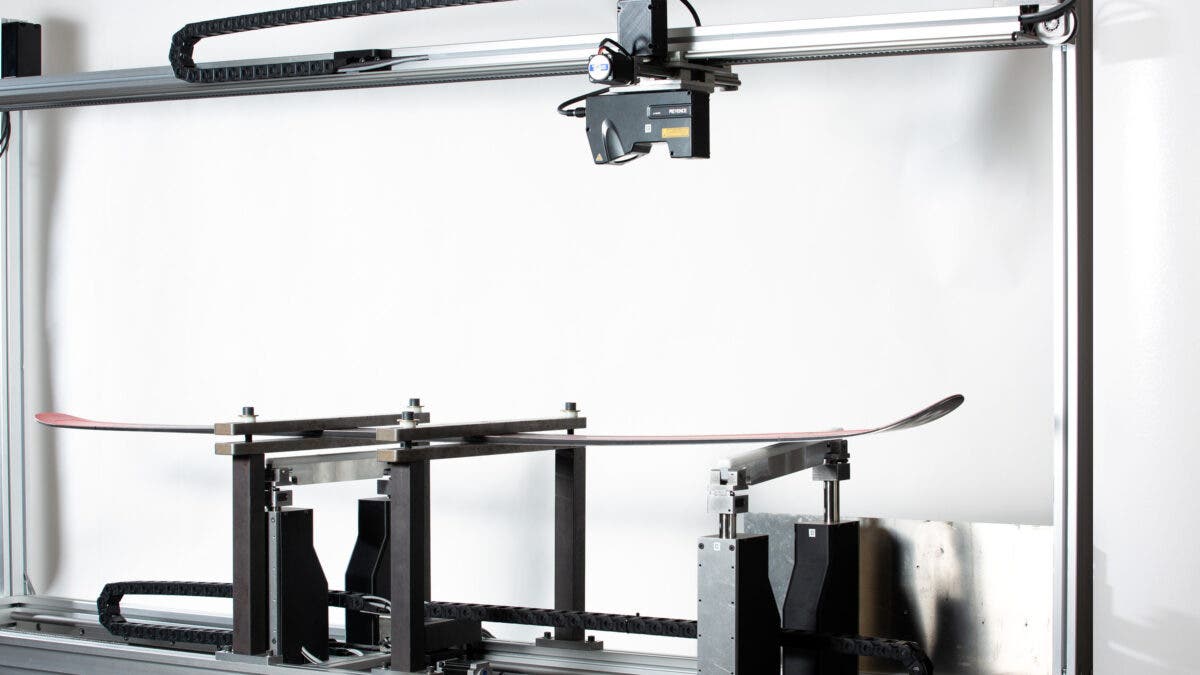
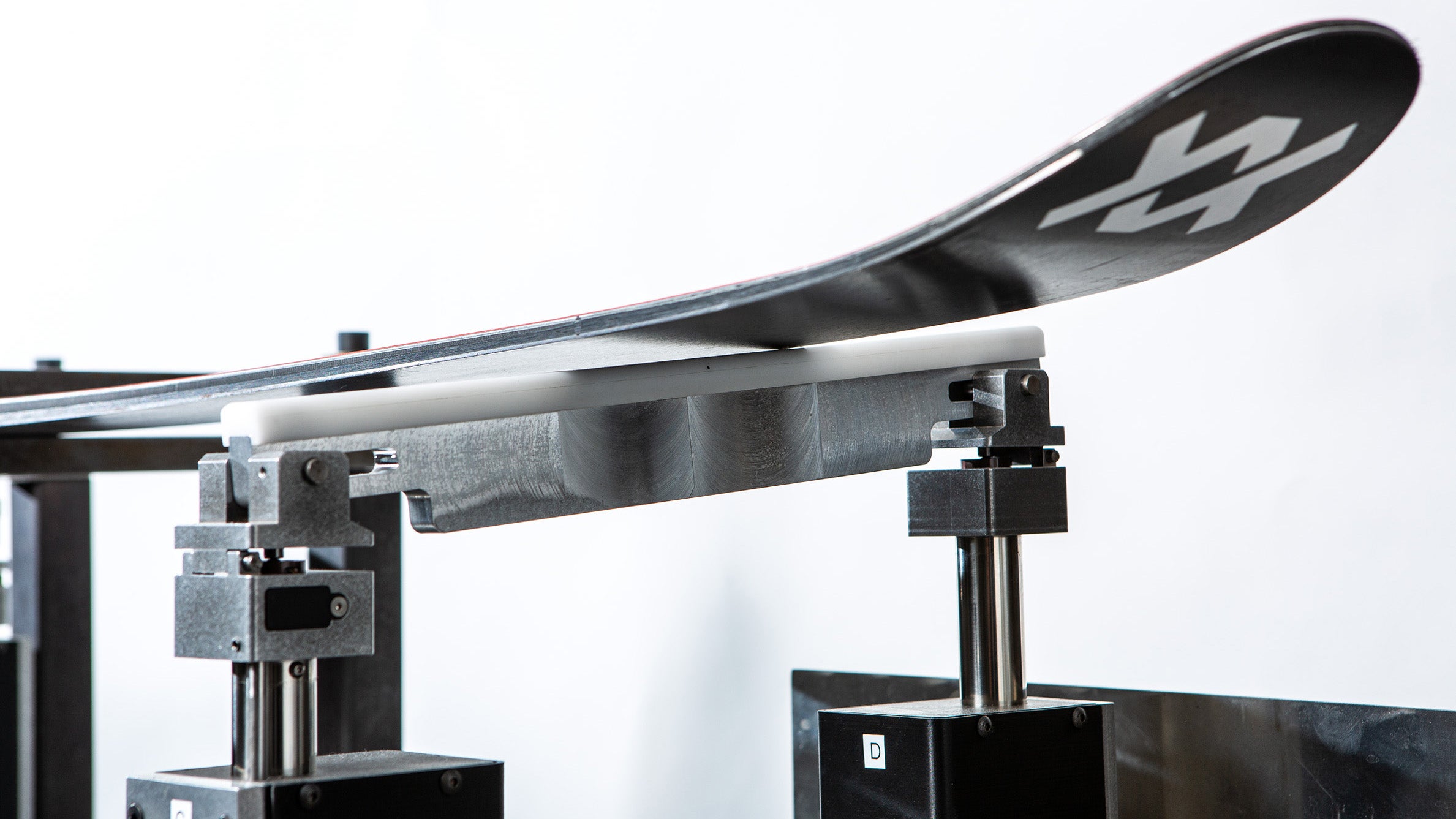
- Bending Stiffness (Flex Profile): This test directly addresses the "stiffness" of a ski, a quality frequently misjudged by subjective methods like the "hand bend" test. The Outside Lab’s machine employs mechanical actuator arms that precisely apply a repeatable amount of force at the ski’s tip and tail contact points. A calibrated load cell confirms the exact force applied. The scanner then measures the ski’s deflection from its resting shape. Crucially, this test is performed at multiple points along the ski’s length, recognizing that stiffness often varies from tip to tail. This multi-point analysis provides a comprehensive "flex profile," replacing a single, often misleading, subjective impression with a detailed quantitative curve. For example, when a tester describes the Völkl Mantra 88 as "stout underfoot," the lab can now provide exact deflection figures for its tip, mid-section, and tail under a standardized load, offering an objective validation of that perceived "beefiness." This data helps explain how a ski absorbs terrain, initiates turns, and maintains stability at speed.
- Edge Engagement (Roll-on-Edge Effort): This measurement directly quantifies the effort required to roll a ski onto its edge—a sensation vital for carving performance. Unlike traditional "torsional stiffness" tests, which often involve twisting the ski at a single point (a motion rarely replicated precisely on snow), this test simulates the more natural "roll" motion. Actuator arms angle the "bridge" connecting them, applying force to only one edge of the ski. The machine then measures both the ski’s deflection and its subtle twist in response. By comparing this data to the baseline scan, the lab calculates the precise force needed to engage the edge. This provides an objective metric for what a human tester might describe as a ski that "carves like it’s on rails" or "fights you into the turn." This measurement is particularly relevant for understanding a ski’s responsiveness and precision in groomed conditions and its ability to hold an edge on hard snow.
Implications for Ski Reviews and Consumer Empowerment
The integration of this lab data marks a pivotal moment for SKI Magazine’s renowned equipment reviews. Going forward, every review will feature a new layer of objective analysis, sitting alongside, rather than replacing, the invaluable on-snow impressions of expert testers. Consumers will benefit from this hybrid approach by gaining:
- Enhanced Clarity: No longer will terms like "stiff" or "playful" rely solely on interpretation. They will be supported by precise numbers, allowing for direct comparison across models and categories.
- Informed Decision-Making: Skiers can now match their personal preferences (e.g., preference for a softer tip for easy turn initiation, or a stiffer tail for powerful exits) with concrete data, leading to more confident purchasing decisions.
- Deeper Understanding: The lab data provides insight into the engineering principles behind a ski’s feel, helping skiers understand why a particular ski behaves the way it does.
- Personalized Recommendations: In the future, this data could even facilitate more personalized recommendations, allowing skiers to input their preferences and receive objective matches.
Impact on Ski Design and Manufacturing
Beyond consumer benefits, the data generated by the Outside Lab has profound implications for ski manufacturers. This objective feedback loop can:
- Accelerate R&D: Brands can use the precise measurements to validate design choices, fine-tune prototypes, and optimize materials, leading to faster innovation cycles.
- Improve Quality Control: Consistent, repeatable testing allows manufacturers to ensure that production skis consistently meet their design specifications, reducing variability.
- Innovate with Precision: By understanding exactly how design elements (e.g., core materials, layup, sidecut blend points) translate into measurable performance characteristics, engineers can develop new technologies with greater confidence and accuracy.
- Bridge the Gap Between Design and Feel: Designers can now correlate their CAD models and material choices directly with quantifiable performance metrics, moving beyond trial-and-error prototyping.
The Broader Horizon: Standardizing Performance Metrics
The pioneering work at the Outside Lab at CU Denver sets a precedent that could ripple across the broader sports equipment industry. As consumers increasingly demand transparency and data-driven insights, similar initiatives may emerge in other sports. The establishment of standardized, objective performance metrics could lead to:
- Industry Benchmarks: A common language for discussing and comparing equipment performance.
- Fairer Comparisons: Reducing reliance on marketing jargon by providing verifiable data.
- Enhanced Athlete Performance: Allowing elite athletes to select equipment tailored precisely to their biomechanics and performance needs.
In conclusion, the Ski and Snowboard Tester at the Outside Lab represents more than just a new machine; it embodies a philosophical shift in how we approach sports equipment evaluation. By marrying the irreplaceable expertise of human testers with the undeniable precision of objective data, SKI Magazine and CU Denver are not merely enriching ski reviews; they are laying the groundwork for a new era of understanding, innovation, and empowerment for skiers worldwide. The future of ski performance analysis is here, a synergy of feel and fact that promises to elevate the entire sport.

