
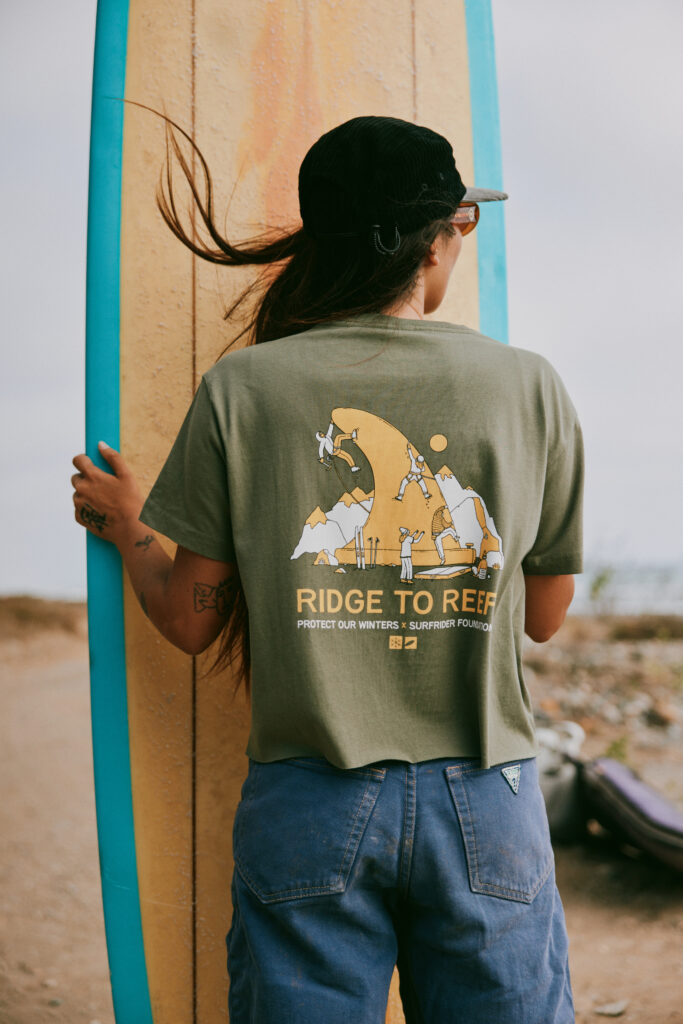
The convergence of mountain and maritime environments has long been a defining characteristic of the outdoor experience, yet the legislative and environmental threats to these landscapes have rarely been more pronounced. In a strategic effort to unify the voices of winter sports enthusiasts and ocean advocates, Protect Our Winters (POW) and the Surfrider Foundation have announced the launch of the "Ridge to Reef" collection. This collaborative initiative features the work of California-based artist Dominic McLeod, the founder of Dom Fish Designs, and aims to leverage visual storytelling to drive climate advocacy and protect public lands and waters from extractive industries. The partnership underscores a growing movement within the outdoor industry to bridge the gap between disparate sporting communities—snowboarders, skiers, surfers, and cyclists—into a singular "Outdoor State" capable of influencing federal environmental policy.
The Artistic Vision of Dominic McLeod
Dominic McLeod’s involvement in the Ridge to Reef project is rooted in a lifelong connection to the diverse topography of Southern California. Raised in Ojai, McLeod grew up at the geographic intersection of rugged mountain ranges and the Pacific coastline. This proximity fostered a worldview where the transition from "ridge" to "reef" was not a boundary, but a continuum. According to McLeod, the environments are inextricably linked, forming a unified experience for those who recreate within them. His artistic journey began in a traditional classroom setting, where he developed a reputation for character illustration, eventually evolving into a professional career focused on capturing the unique subcultures of the outdoor world.
McLeod’s creative process for the Ridge to Reef collection involved a meticulous synthesis of outdoor culture and advocacy messaging. The workflow typically begins with discovery sessions and the curation of moodboards, followed by the transition of physical sketches into digital formats via iPad. His work is characterized by its ability to capture the "grit and humor" of the surf lineup and the mountain trail. For this specific collaboration, McLeod focused on "cross-pollination," a philosophy born from a personal period of adversity. After a severe ankle injury sidelined him from surfing for ten months, McLeod turned to bike packing, an experience that challenged his own self-identification as a single-sport athlete. This shift is reflected in the collection’s artwork, which often merges iconic symbols of different sports—such as integrating a surfboard fin into a mountain climbing scene—to visually represent the interconnectedness of the environments POW and Surfrider seek to protect.
Historical Context and the Evolution of the Partnership
The collaboration between POW and the Surfrider Foundation is built upon a historical foundation of mutual respect and shared objectives. The Surfrider Foundation, established in 1984 by a group of surfers in Malibu, California, has spent decades advocating for coastal preservation, water quality, and beach access. Protect Our Winters was founded much later, in 2007, by professional snowboarder Jeremy Jones, who observed the diminishing snowpack in his home mountains and recognized the need for a political voice for the winter sports community.

The link between the two organizations is deeply personal for Jones. Growing up as a surfer on Cape Cod, Jones was first introduced to environmental activism through Surfrider Foundation decals on the vehicles of local surfers. He became a member of the foundation at age 14, a formative experience that shifted his perspective from being a consumer of the landscape to a "protector." This "action over apathy" ethos remains the driving force behind POW’s modern operations. The Ridge to Reef collection represents a full-circle moment for the organizations, formalizing a partnership that recognizes that the carbon emissions affecting mountain snowpacks are the same drivers of ocean acidification and sea-level rise.
Environmental Threats: Offshore Drilling and Climate Data
The primary impetus for the Ridge to Reef collection is the escalating threat of offshore oil and gas expansion. The Department of the Interior’s management of the Outer Continental Shelf (OCS) has been a focal point of intense political debate. Current proposals for offshore drilling threaten to disrupt marine ecosystems, endanger coastal tourism economies, and lock the United States into decades of additional carbon production. According to data from the Bureau of Ocean Energy Management (BOEM), offshore oil production accounts for a significant portion of domestic energy, but the environmental costs are substantial. Major spills, such as the 2010 Deepwater Horizon disaster, demonstrate the catastrophic potential for long-term ecological damage to fisheries and coastal habitats.
Furthermore, the "ridge" side of the equation faces equally dire statistics. Climate data from the National Oceanic and Atmospheric Administration (NOAA) indicates that high-elevation snowpacks in the Western United States have declined significantly over the last half-century. In some regions, the spring snowpack has decreased by over 20%, shortening the winter recreation season and threatening the water security of downstream communities. By linking these two issues, POW and Surfrider aim to highlight that the preservation of "the wild places we love" is a holistic struggle against the fossil fuel industry’s expansion on public lands and waters.
The Economic Power of the Outdoor State
A key component of the advocacy strategy employed by POW and Surfrider is the mobilization of the "Outdoor State"—a demographic of outdoor enthusiasts that carries significant economic and political weight. According to the U.S. Bureau of Economic Analysis (BEA), the outdoor recreation economy accounted for approximately $1.1 trillion in gross economic output in recent years, representing 2.2% of the U.S. Gross Domestic Product (GDP). This sector supports nearly 5 million jobs across various industries, including manufacturing, retail, and tourism.
By framing outdoor enthusiasts as a unified economic bloc, the Ridge to Reef initiative seeks to translate recreation into political leverage. The collection serves as both a fundraising tool and a badge of identity. One hundred percent of the proceeds from the sales are allocated toward advocacy efforts aimed at defending public lands. This financial model ensures that the community’s "stoke" for the sports they love is directly converted into the capital necessary for lobbying, legal challenges, and public awareness campaigns.
The Philosophy of Imperfect Advocacy
One of the most notable aspects of the Ridge to Reef campaign is its embrace of "imperfect advocacy." This pragmatic approach, championed by both McLeod and the partner organizations, acknowledges the inherent contradictions of modern life. McLeod notes that an individual can drive a gas-powered vehicle to a trailhead and still be an effective advocate for the planet. This philosophy is designed to lower the barrier to entry for climate activism, moving away from "purity tests" that often alienate potential supporters.
"You don’t have to be a mathematician or a climate scientist to contribute," McLeod stated during his sit-down with POW. "You just have to be willing to use the skills you do have." This sentiment reflects a broader shift in environmental communication, focusing on inclusivity and shared values rather than shame or technical jargon. By utilizing art as the medium, the campaign reaches individuals through their passions, making the daunting prospect of climate change feel more personal and manageable.
Broader Implications and Future Outlook
The Ridge to Reef collection is more than a seasonal merchandise drop; it is a case study in how niche communities can coalesce around a common cause. The success of such collaborations suggests a future where environmental advocacy is deeply integrated into the lifestyle and culture of the outdoor industry. As policy battles over offshore drilling and land conservation continue in Washington D.C., the ability of organizations like POW and Surfrider to mobilize a diverse, cross-disciplinary base of supporters will be critical.
The intersection of art, sport, and activism provides a unique platform for cultural representation. By visualizing a future where the mountain and the ocean are protected as a single, interconnected system, Dominic McLeod’s work helps to solidify the identity of the Outdoor State. As the effects of climate change become increasingly visible on both the peaks and the coasts, the message of the Ridge to Reef collection serves as a reminder that the community is expansive and its collective force is a necessary counterweight to the pressures of extraction and environmental degradation.
Moving forward, the partnership intends to continue using these creative avenues to fund their respective missions. The Surfrider Foundation’s focus on plastic pollution and coastal preservation, combined with POW’s focus on systemic policy change and renewable energy, creates a comprehensive front for environmental defense. The Ridge to Reef initiative stands as a testament to the idea that while the landscapes may differ, the fight to protect them remains the same. Through this collection, the organizations invite the public to move beyond their specific sport-based silos and join a broader movement dedicated to the wild places that define the outdoor experience.

