
For decades, vintage marketing materials, resort signage, and local lore have proudly reinforced a singular ethos regarding Utah’s legendary Little Cottonwood Canyon destination: Alta is for skiers. As one of only three ski resorts in the United States that maintains a strict skiers-only policy—alongside Vermont’s Mad River Glen and Utah’s own Deer Valley—Alta is universally recognized as a bastion of traditional alpine skiing culture. However, historical retrospectives reveal that the resort’s relationship with snow sports was far more complex during the nascent era of modern winter recreation. Far from being an absolute, immutable law since the resort’s founding in 1938, the ban on single-board riders was preceded by a brief, experimental period in the early 1980s when snowboarding was not only present on the mountain, but tolerated under specific conditions.
The full scope of this forgotten chapter was brought to light during a comprehensive retrospective event hosted by the ACE (Alta Community Enrichment) Community Enrichment Center. The presentation detailed the complicated evolution of snowboarding within the resort’s boundaries, touching upon the early days of tolerance, the insurance and operational hurdles that triggered the ban, the legal challenges mounted by frustrated riders, and the grassroots counterculture movements, such as the infamous Alta Snowboard Team, that emerged in response.
Early Days and the Evolution of Snow Surfing
To understand Alta’s brief flirtation with snowboarding, one must examine the broader timeline of the sport’s genesis in the Wasatch Range. In 1972, innovators developed the foundational concepts of modern "snow surfing," culminating in a patent awarded in 1974. By 1975, pioneer Dimitrije Milovich utilized an early prototype to descend Mount Baldy, utilizing equipment engineered by Winterstick. These early designs bore little resemblance to modern snowboards; lacking metal edges, they were essentially wide, buoyant powder boards optimized exclusively for deep, untracked snow rather than hard-pack or groomed runs.

As other pioneers like Tom Sims and Jake Burton Carpenter began refining board designs with edges and bindings for enhanced versatility across varying terrain, the snow-surfing movement gained momentum. During the early 1980s, Alta Ski Area—largely undiscovered by the massive global tourism market that defines modern Utah skiing—adopted a surprisingly permissive stance toward these early boarders. Because insurance policies and liability frameworks of the era were ill-equipped to categorize single-board equipment, and because the resort’s chairlifts featured steep unloading ramps that posed safety hazards for boarders, Alta implemented a pragmatic compromise. Snowboarders were permitted to ride the chairlifts while wearing skis, carrying their boards until reaching the summit. Once at the top, they could detach the skis, strap into their boards, and descend the mountain.
The Catalyst for the Ban
This experimental coexistence, however, was short-lived. The limitations of edge-less and early-generation snowboards meant that riders were severely restricted to powder conditions. Consequently, early snowboarders gravitated heavily toward unmanaged, out-of-bounds terrain and steep, avalanche-prone backcountry zones where skiing was restricted regardless of snow stability, such as the notorious Snake Pit.
Within just a few years of permitting the practice, resort management enacted a blanket ban on snowboards. While formal corporate statements at the time focused primarily on equipment safety, lift-loading dynamics, and liability concerns, industry analysts point to the unique topography of Alta as an enduring factor in the policy’s longevity. Alta’s trail network relies heavily on narrow, technical traverses to connect major basins and return skiers to base areas. In the 1980s, early snowboards offered poor maneuverability and edge-holding capabilities on flat or icy catwalks, creating significant bottlenecking and collision hazards with traditional alpine skiers.
Even as snowboard technology advanced exponentially throughout the late 1980s and 1990s—introducing steel edges, highback bindings, and carving shapes that rivaled skis in performance—Alta’s management chose to uphold the ban, preserving the distinct cultural identity of the ski area.

Legal Challenges and Counterculture Resistance
As snowboarding exploded in popularity during the 1990s, transforming from a fringe subculture into a dominant demographic force across North American mountains, the friction between excluded riders and resort operators intensified. The tension in Little Cottonwood Canyon eventually boiled over into the legal system. In the mid-1990s, a high-profile lawsuit was filed against Alta Ski Area, challenging the constitutionality and legality of the resort’s skiers-only policy on the grounds of discrimination and public accommodation laws, given that parts of the resort operate on United States Forest Service (USFS) land.
The legal battle drew national media attention, raising complex questions regarding the rights of private businesses operating on public lands under special-use permits. Ultimately, the courts ruled in favor of Alta Ski Area, affirming the resort’s right to manage its operations, safety protocols, and recreational activities as it saw fit.
Rather than dampening enthusiasm, the persistence of the ban catalyzed a vibrant counterculture within the local winter sports community. The era birthed the underground "Alta Snowboard Team," an unofficial collective of local riders who engaged in dawn-patrol poaching, backcountry descents adjacent to resort boundaries, and the distribution of iconic stickers and t-shirts bearing satirical team logos. These items became badges of honor among Wasatch Range locals, symbolizing a rebellious spirit against the rigid stratification of ski resort access.
Modern Perspectives and Access Realities
Today, the debate surrounding single-board access at Alta, Mad River Glen, and Deer Valley occupies a unique niche in the modern ski industry. While the vast majority of North American ski resorts embraced snowboarding by the turn of the 21st century—culminating in historic conversions by historic holdouts like Taos Ski Valley in 2008 and Mount Bohemia later on—the remaining three resorts view their policies as vital to preserving a specific heritage and skier demographic.
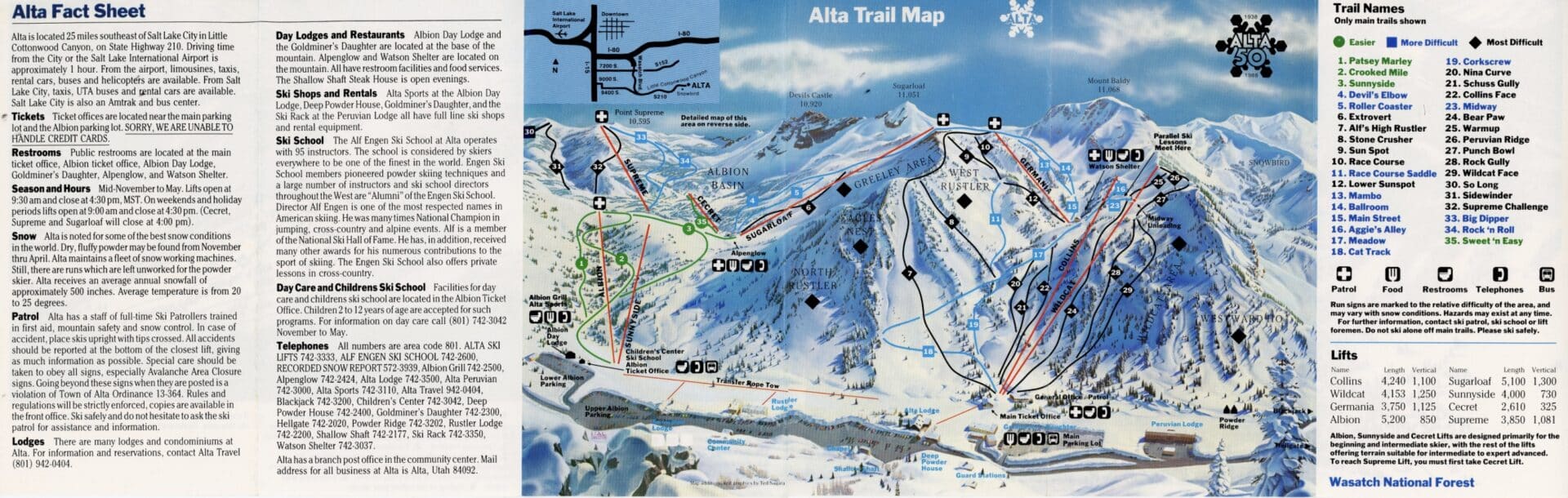
For snowboarders determined to experience the legendary powder of Little Cottonwood Canyon under Alta’s peaks, logistical pathways exist outside the resort’s operational boundaries. Snowboarders frequently access Alta’s terrain by crossing the ridgeline from adjacent Snowbird—which permits snowboarding across its entire footprint—though they must adhere to outbound travel rules and cannot utilize Alta’s lift infrastructure for return trips. Additionally, splitboarders and backcountry enthusiasts routinely earn their turns in Alta’s terrain during the shoulder seasons after the ski area officially closes for winter operations.
The revelations brought forth by the ACE Alta Community Enrichment historical archive underscore a broader truth about the evolution of winter sports: ski resort policies are rarely static, and the boundaries dividing skiing and snowboarding were once far more fluid than modern convention suggests. As the ski industry continues to navigate shifting demographics, climate pressures, and evolving guest expectations, the historical anomalies of Little Cottonwood Canyon remain a fascinating study in how specific mountain communities chose to curate their unique slice of alpine history.

