
The wearable technology landscape has long treated winter sports as an afterthought, typically bundling skiing and snowboarding into generic workout modes that merely measure heart rate, approximate calorie burn, and log basic descent metrics. However, Huawei’s newly announced WATCH GT 7 challenges this convention by introducing a remarkably comprehensive suite of features engineered specifically for mountain environments. Moving far beyond traditional fitness tracking, the device functions as an offline trail map, an advanced GPS route recorder, and a granular performance analyzer. By bridging the gap between consumer electronics and specialized mountain navigation gear, Huawei aims to capture a lucrative segment of winter sports enthusiasts who demand high-level utility directly from their wrists.
The development of the WATCH GT 7 represents a significant pivot in how consumer tech manufacturers approach seasonal outdoor activities. For years, winter sports athletes have relied on bulky standalone GPS units, smartphones vulnerable to freezing temperatures, or rudimentary smartwatch apps that drain batteries rapidly while offering limited topographical data. Recognizing this gap in the market, Huawei’s engineering teams spent considerable time refining the software and hardware integration for the GT series. The integration of offline resort maps and proprietary positioning algorithms signals an ambitious effort to provide actionable, real-time value to skiers navigating unfamiliar terrain, bypassing the need to constantly pull freezing phones out of insulated pockets.
At the core of the WATCH GT 7’s mountain-focused capabilities is an extensive, pre-loaded database of ski resort maps. Users can download detailed resort cartography prior to heading out, ensuring that navigation remains fully functional even in areas with spotty cellular reception or dead zones common in deep mountain bowls. Once stored locally on the device, these maps render trail names, difficulty ratings, and lift stations directly onto the watch face. This capability transforms the wearable into a miniature trail guide. Navigating massive, interconnected resort networks—such as those found across the Alps or North America—becomes significantly more intuitive when trail markers and lift locations are accessible with a single glance.
The breadth of Huawei’s supported resort network is staggering. The current global database encompasses 3,171 ski areas across 59 countries, providing localized data for a vast majority of the world’s most popular winter destinations. North America alone accounts for a substantial portion of this database, with 531 supported resorts in the United States and 173 in Canada. European markets are equally well represented, featuring 272 resorts in Switzerland, 229 in Austria, 225 in France, and 150 in Italy. Furthermore, the inclusion of 415 resorts in Japan caters heavily to the booming international tourism market centered around deep powder destinations like Hokkaido. This expansive geographic coverage ensures that frequent travelers and destination skiers can utilize the same familiar interface regardless of which continent they are skiing on.
Beyond static mapping, the WATCH GT 7 introduces sophisticated motion analysis that fundamentally changes how performance is recorded during a day on the slopes. Traditional fitness trackers often lump all outdoor activity together, resulting in skewed data that combines active descent time with passive lift rides and rest periods spent warming up in a lodge. The WATCH GT 7 addresses this inefficiency through an automated segmentation system. The watch autonomously distinguishes between active skiing, time spent riding chairlifts or gondolas, and periods of rest. This automated filtering ensures that metrics regarding total run time, average speed, and distance reflect actual time spent in motion, offering a cleaner, more accurate profile of a skier’s day.
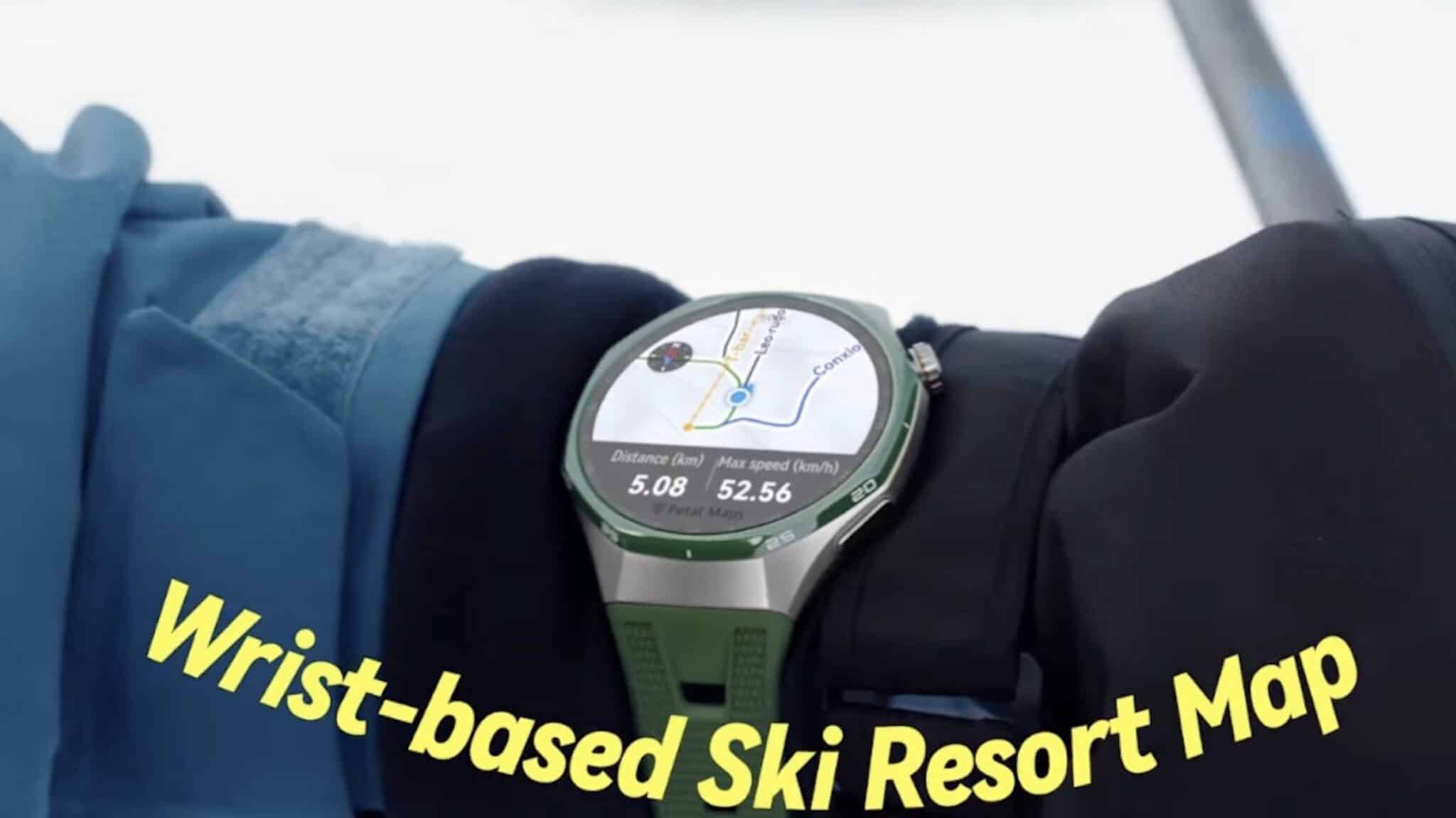
The granularity of the device’s performance tracking extends into biomechanical metrics that are rarely seen outside of professional training equipment. During outdoor descents, the watch records speed, vertical drop, run counts, and total distance. More uniquely, it incorporates turn-type analysis, tracking total turns, turn frequency, and specific turn mechanics. To quantify the physical load experienced during aggressive skiing, Huawei has integrated G-force measurements. By tracking acceleration and physical force through turns, the watch provides data that corresponds directly to the dynamism and tightness of a skier’s line. While casual recreationalists may view G-force tracking as a novelty, competitive racers and advanced skiers seeking to refine their technique will likely find value in quantifying their rotational forces and edge-to-edge transitions.
Underpinning these advanced tracking features is a hardware and software positioning overhaul. The WATCH GT 7 utilizes Huawei’s proprietary Sunflower Positioning System alongside an advanced AI-XDR algorithm for location tracking. According to manufacturer specifications, this configuration delivers a 20-percent improvement in route precision during high-speed snow sports compared to the previous generation of devices. While independent field testing will ultimately verify these claims, enhanced GPS accuracy is critical in winter environments. Rapid descents, steep vertical drop-offs, heavy tree canopies, and narrow mountain canyons routinely challenge consumer GPS hardware. A more precise positioning lock directly benefits every dependent metric, from the accuracy of the trail map overlay and speed calculations to the reliability of automated run separation.
Winter sports enthusiasts are notoriously hard on electronic devices, primarily due to sub-zero temperatures that notoriously drain lithium-ion batteries. To combat this limitation, Huawei has paired its demanding mountain-sports tracking with high-capacity battery architectures. The WATCH GT 7 is offered in two primary sizes, each boasting substantial endurance figures under standard operating conditions. The larger 46mm variant is rated for up to 21 days of battery life under light usage scenarios, dropping to a still-impressive 12 days under typical conditions. The smaller 41mm model offers up to 14 days under light use and seven days of typical use. Although continuous, GPS-heavy ski tracking will inevitably draw down the battery much faster than standard daily wear, these baseline endurance metrics ensure that users embarking on multi-day ski trips will not find themselves constantly tethered to a wall charger.
The introduction of these features reflects a broader industry trend toward hyper-specialization in wearable technology. Rather than attempting to serve as a jack-of-all-trades, modern smartwatches are increasingly carving out niches by offering deep, domain-specific functionality that appeals to dedicated enthusiast communities. For the ski and snowboard market, the implications of Huawei’s new release are clear. Competitors in the wearable space—ranging from established sports watch brands to tech giants—will likely be pressured to elevate their own winter sports offerings, shifting the baseline expectation from simple step counters and heart-rate monitors to fully integrated offline mapping and advanced biomechanical analytics.
As the winter season approaches, the market reception of the WATCH GT 7 will provide valuable insight into consumer demand for specialized mountain wearables. By combining a massive offline resort database, intelligent automated activity segmentation, and professional-grade performance metrics like G-force tracking, Huawei has positioned the WATCH GT 7 as a formidable tool for the modern skier. Whether navigating an unfamiliar resort in the Swiss Alps or analyzing turn dynamics on a local hill, users now have access to a level of digital mountain integration that was previously restricted to specialized, high-end expedition gear.

