
The landscape of mountain safety has undergone a significant digital transformation with the launch of AvalancheClarity, a free mobile and web-based application designed to demystify complex avalanche bulletins for backcountry enthusiasts. Developed by British skier and guidebook author Simon Perry, the app addresses a long-standing barrier in alpine safety: the linguistic and technical density of official meteorological reports. By utilizing specialized artificial intelligence to translate and interpret bulletins from 14 European countries, the platform aims to reduce the risk of accidents caused by misinformation or the total avoidance of safety data due to language barriers.
The release comes at a critical juncture for winter sports. As off-piste skiing and ski touring continue to grow in popularity, the reliance on accurate, real-time data has never been higher. However, for many international travelers in regions like the French Alps or the Swiss Grisons, the official bulletins are often published in the native language of the host country, utilizing highly specific terminology that standard translation tools frequently misinterpret. AvalancheClarity seeks to bridge this gap by providing high-fidelity translations into English and seven other languages, ensuring that critical safety warnings are accessible to a global audience.
The Genesis of AvalancheClarity and the Language Barrier
The inspiration for AvalancheClarity stemmed from Simon Perry’s extensive experience in the French Alps. As the author of prominent off-piste guidebooks for Tignes and Val d’Isère, Perry observed a recurring pattern among international skiers. While Météo-France provides comprehensive and scientifically rigorous avalanche bulletins, the delivery of this information is often confined to technical French. For a non-native speaker, navigating the Météo-France website requires identifying the correct massif among 36 distinct regions and then deciphering jargon-heavy text.
Generic translation software often fails to capture the nuance of mountain science. Terms such as "plaques à vent" (wind slabs) or "couches fragiles persistantes" (persistent weak layers) are frequently mistranslated by general-purpose AI into literal but misleading phrases. In the context of avalanche safety, such errors can be catastrophic. Perry recognized that the information existed and was updated daily, but it remained "buried" behind a wall of linguistic complexity. The development of AvalancheClarity was driven by the goal of removing these friction points, allowing users to access localized, expert-level data in seconds.
A Rapid Timeline of Development and Expansion
The trajectory of the app’s rollout reflects the urgent demand for such a tool within the mountain sports community. AvalancheClarity was officially launched in late March 2026, targeting the peak of the spring touring season when snowpacks often become volatile due to solar radiation and fluctuating temperatures.
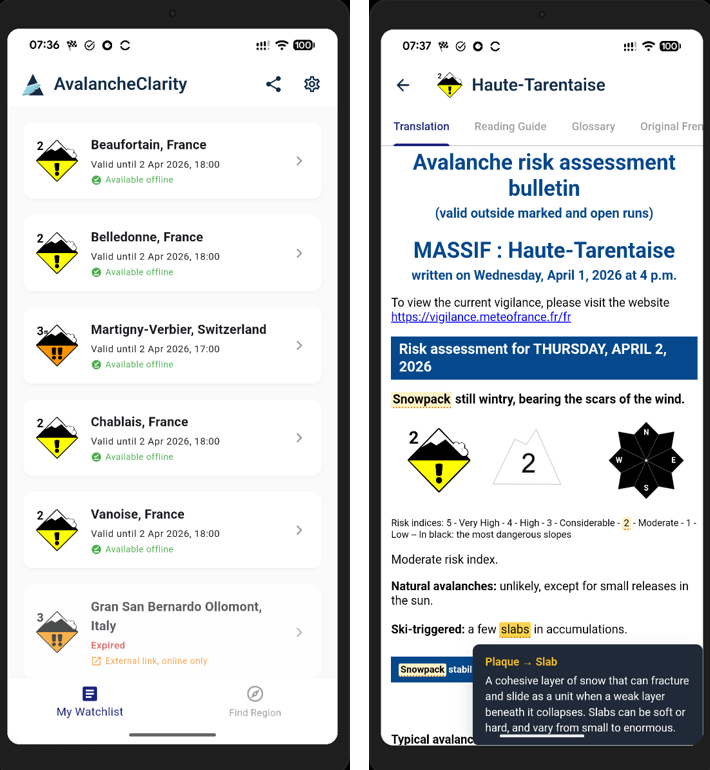
Within its first week of operation, the app recorded over 1,000 individual installations, a testament to the pent-up demand for accessible safety data. On March 30, 2026, the developer introduced an embeddable widget, allowing ski resorts, guide services, and chalet operators to integrate live, localized avalanche bulletins directly into their own websites with a single line of code.
A major milestone was achieved on April 2, 2026, with a comprehensive update that expanded the app’s reach across the entire European continent. This update integrated every avalanche bulletin area in Europe, covering 14 countries. This expansion included full coverage of Switzerland’s 134 SLF (Institute for Snow and Avalanche Research) micro-regions and all 36 French massifs. Furthermore, the update brought in data from Austria, Italy, Germany, Norway, Sweden, Spain, Andorra, Slovenia, Slovakia, Czechia, Finland, and Scotland, making it one of the most geographically comprehensive safety apps on the market.
Technical Architecture and Feature Set
The core functionality of AvalancheClarity lies in its use of AI trained specifically on the glossary of the European Avalanche Warning Services (EAWS). The EAWS has established standardized definitions for avalanche phenomena across multiple languages, and AvalancheClarity leverages this database to ensure that technical terms remain accurate during translation.
Key features of the application include:
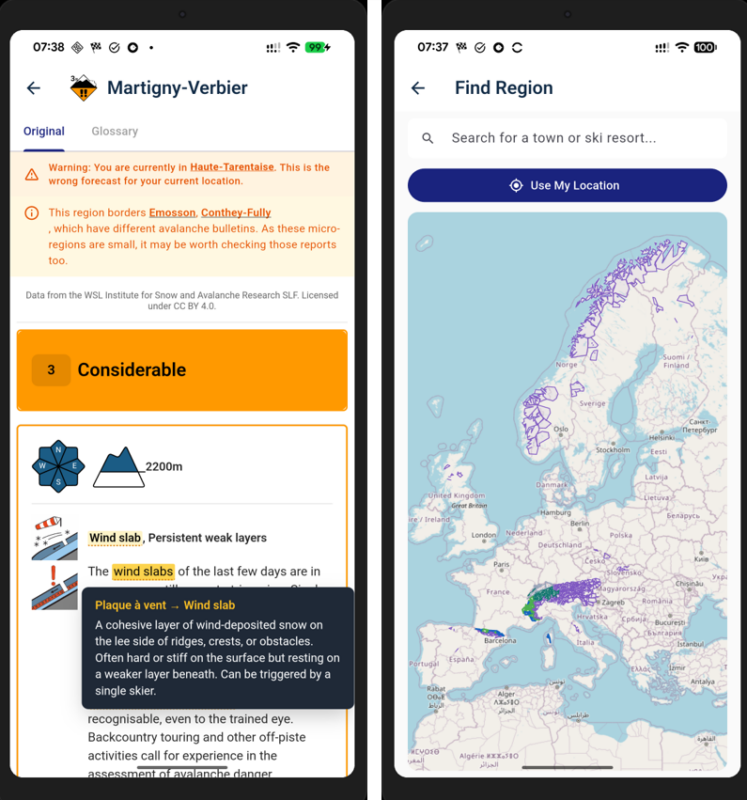
- Interactive Glossary: The app highlights technical terms within the translated text. Users can tap on these terms to receive plain-language definitions, facilitating a better understanding of the specific risks present in the snowpack.
- Offline Functionality: Recognizing that data connectivity is often unreliable in remote mountain terrain, the app automatically downloads bulletins for offline viewing. This ensures that a skier can reference the forecast even in deep valleys or high-altitude couloirs without a signal.
- GPS Integration: The "Use My Location" feature allows the app to automatically identify the relevant massif or micro-region based on the user’s coordinates, eliminating the need for manual searching.
- Real-Time Notifications: Avalanche bulletins are typically released in the evening for the following day, but forecasters often issue morning revisions if conditions change. AvalancheClarity sends push notifications the moment a revision is published for a user’s "watched" regions.
- Searchable Map Database: The app contains a searchable database of over 1,100 European ski resorts and towns, allowing users to plan their trips with precision.
Industry Reactions and Professional Endorsements
The reception from professional mountaineers and safety organizations has been overwhelmingly positive, highlighting the app’s potential to save lives. Iain Innes, a Team GB Ski Mountaineer, described the app as a "gamechanger" for those who rely on accurate information across different Alpine regions. He noted that the instant clarity provided by the app makes critical information far more accessible for international mountain users.
AvalancheGeeks, a prominent organization specializing in avalanche safety training, also endorsed the platform. They emphasized that the app’s user interface and ease of use actually surpass the official Météo-France application. In a statement, the organization suggested that even native French speakers might prefer the app due to its superior layout and absence of advertisements.
The Marmalade Ski School, which had previously been manually translating forecasts for the Three Valleys region on social media, welcomed the automation provided by AvalancheClarity. The school noted that the app provides a more efficient and consistent service for their clients and the broader community.
Supporting Data: The Impact of Information on Mountain Safety
While the app is a technological achievement, its importance is rooted in the sobering statistics of mountain accidents. According to data from the EAWS and various national mountain rescue organizations, an average of 100 people die in avalanches in the Alps each year. Studies into "human factors" in avalanche accidents suggest that a significant percentage of victims were either unaware of the current danger level or failed to understand the specific nature of the hazard (e.g., distinguishing between a wet snow problem and a wind-drifted snow problem).
Information accessibility is a primary pillar of the "Avaluator" and other decision-making frameworks used by backcountry travelers. By reducing the cognitive load required to find and translate a bulletin, AvalancheClarity increases the likelihood that a skier will check the forecast before heading out. The app’s disclaimer remains clear: it is an AI-driven translation tool and users should consult official sources when possible. However, as a secondary check or a primary source for non-linguists, it fills a critical gap in the safety chain.
Broader Implications for the Future of Alpine Tourism
The introduction of AvalancheClarity reflects a broader trend in the democratization of specialized data through artificial intelligence. By providing a free, account-free service, the app aligns with the philosophy that safety information should be a public good. The inclusion of an embeddable widget further extends this impact, allowing the hospitality and tourism sectors to take a proactive role in guest safety.
For ski resorts, the ability to display accurate, multi-lingual avalanche data on their websites can enhance their reputation as safety-conscious destinations. For independent travelers, the app provides a sense of autonomy and confidence, knowing they are not missing vital warnings due to a language barrier.
As the 2026 season progresses, the developer has indicated that further refinements to the AI models will continue, incorporating more localized dialects and expanding the interactive glossary. The success of AvalancheClarity serves as a blueprint for how specialized AI can be harnessed to address specific, high-stakes challenges in the realm of public safety and outdoor recreation. In the high-risk environment of the backcountry, where the difference between a successful descent and a tragedy often hinges on a few sentences of technical data, the clarity provided by this tool is an invaluable asset to the global skiing community.
