
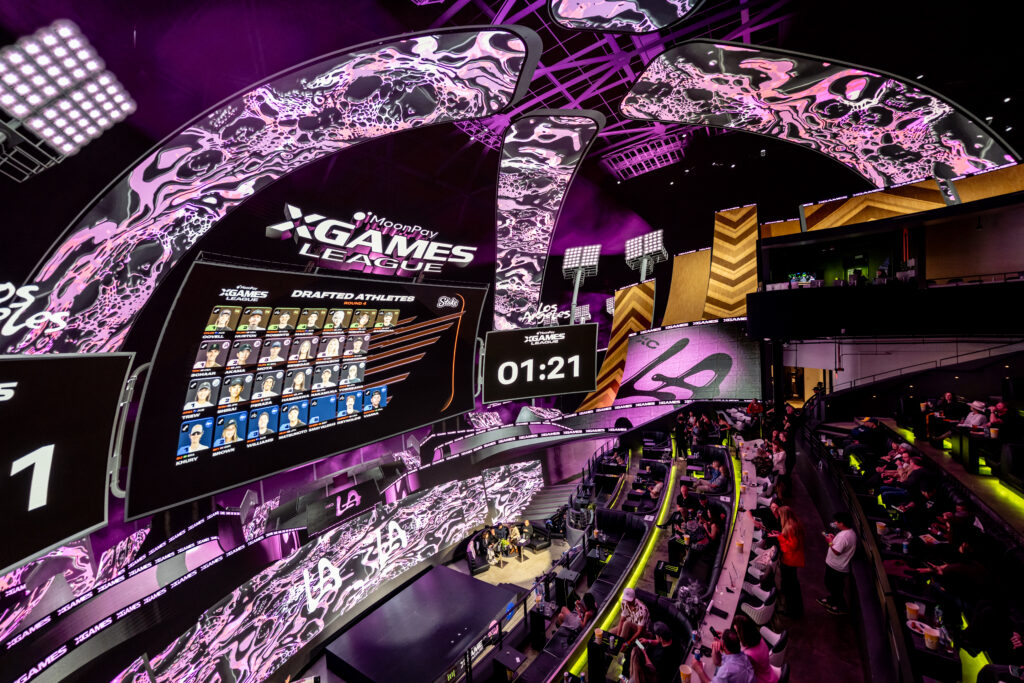
The landscape of professional action sports underwent a fundamental structural shift this week as the MoonPay X Games League (XGL) conducted its first-ever draft at Cosm Los Angeles. The event, which hosted over 50 of the world’s premier skateboard and BMX athletes alongside 500 high-level industry stakeholders, marked the official transition of the X Games from a series of independent annual competitions into a structured, year-round global league. By establishing a team-based format and a professional draft system, the organization aims to modernize the commercial and competitive framework of action sports, mirroring the structures seen in the NFL, NBA, and traditional international soccer leagues.
A New Era for Action Sports Competition
The inaugural draft took place within the immersive, high-tech environment of Cosm Los Angeles, a venue characterized by its massive wraparound LED dome and cinematic production capabilities. This setting provided a symbolic backdrop for a league that seeks to blend physical athletic performance with cutting-edge digital integration. The primary objective of the MoonPay X Games League is to provide fans with a consistent, narrative-driven competitive season, moving away from the "one-off" event model that has defined the X Games since its inception in 1995.
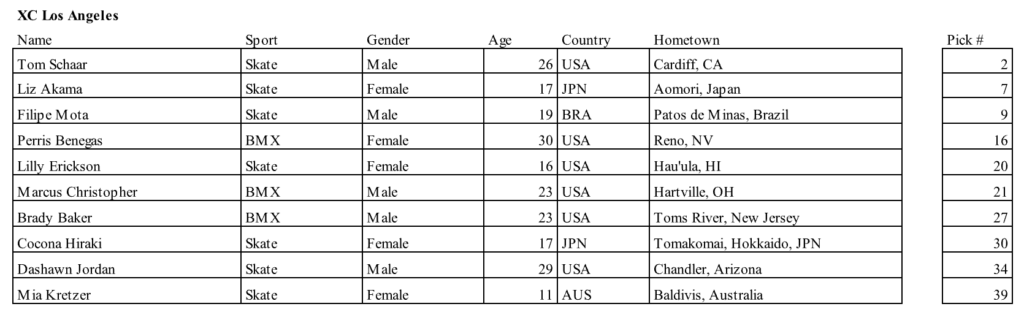
Under the new format, the league is composed of four foundation clubs, each representing a major global market: XC New York, XC Los Angeles, XC Tokyo, and XC São Paulo. These clubs are designed to foster regional loyalties and create multi-year rivalries, providing a more stable environment for athletes and sponsors alike. Each club roster is comprised of 10 athletes, maintaining a strict gender parity of five men and five women per team. This 50-50 split represents one of the most significant commitments to gender equality in professional league sports to date.
The First Round: Youth Dominance and Strategic Selections
The draft proceedings were led by four prominent figures in the action sports world, serving as General Managers for their respective clubs. The selection process highlighted a clear trend toward the "youth movement" currently dominating skateboarding and BMX.
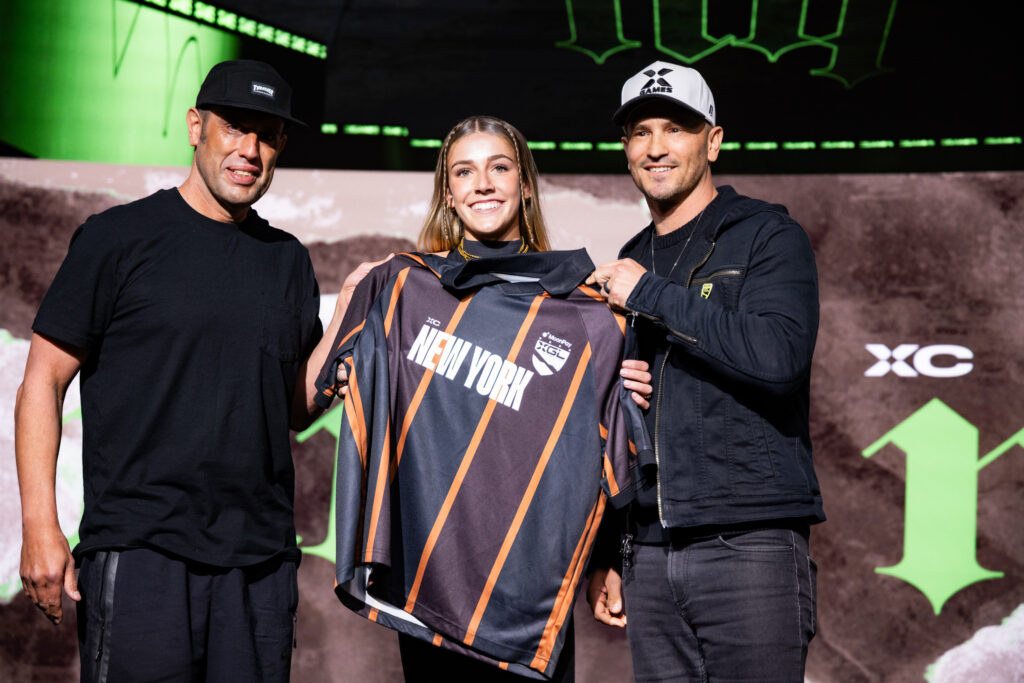
Steve Rodriguez, General Manager of XC New York, made history by selecting 16-year-old Australian skateboarding sensation Chloe Covell as the first-ever overall pick in X Games League history. Covell’s rise has been meteoric; her technical proficiency and consistency in street skating have made her a podium staple despite her young age. Following the selection, Covell expressed a mixture of humility and determination, noting that the draft represented the culmination of years of intensive training and signaled a new level of professional security for athletes in her generation.
The second overall pick saw XC Los Angeles General Manager Sharalee “Haze” Hazen select Tom Schaar. A Southern California native and 17-time X Games medalist, Schaar brings a veteran presence to the Los Angeles roster despite still being in the prime of his career. Schaar’s versatility in transition and park skating makes him a strategic cornerstone for the LA franchise.
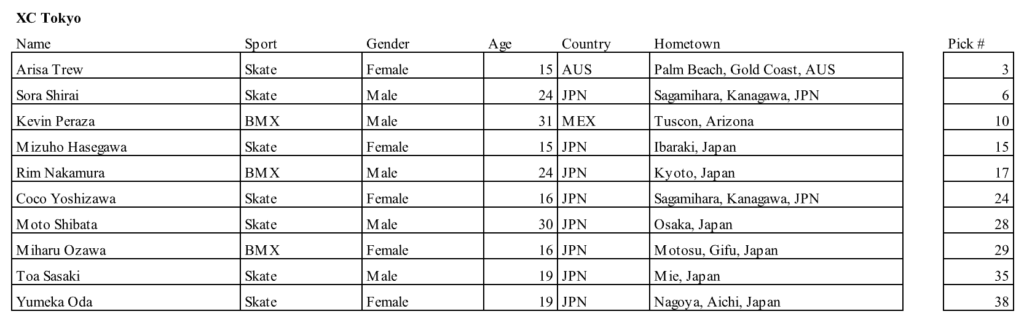
Harumi Suzuki, representing XC Tokyo, utilized the third pick to secure Arisa Trew. At just 14 years old, Trew has already rewritten the record books, becoming the first female skater to land a 720 and a 900 in competition. Her selection emphasizes Tokyo’s strategy of building a team around high-ceiling, record-setting talent.
Rounding out the first round, legendary skater and XC São Paulo General Manager Bob Burnquist selected Gui Khury. Khury, a Brazilian phenom, holds the record for the most X Games medals won by a teenager (15). By securing Khury, Burnquist has anchored the São Paulo franchise with a national hero who bridges the gap between the sport’s vertical roots and its technical future.
Structural Framework of the MoonPay X Games League
The draft involved a pool of more than 180 athletes who had officially opted into the selection process. From this pool, 40 athletes representing eight different countries were chosen over five rounds. The age range of the drafted athletes—spanning from 11 to 35 years old—underscores the unique longevity and early-onset peak performance cycles characteristic of action sports.
The league’s competitive structure is designed to reward collective team performance rather than just individual accolades. Throughout the season, athletes will earn points for their clubs based on their finishes in various disciplines across skateboarding and BMX. The team with the highest cumulative point total at the end of the summer season will be crowned the MoonPay X Games League Champion.
The Four Inaugural Clubs:
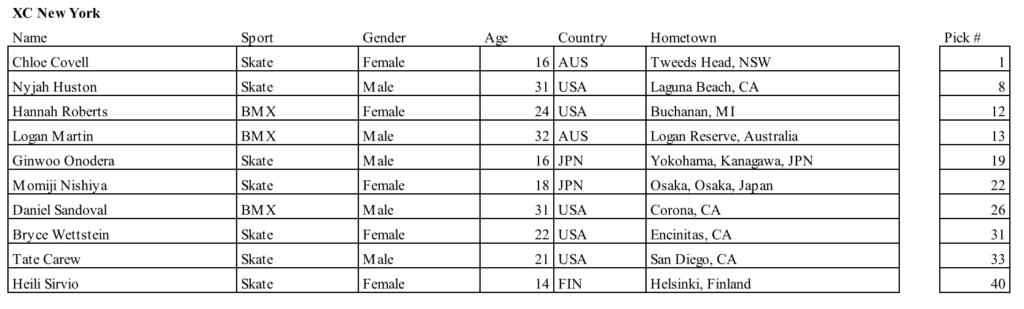
- XC New York: Managed by Steve Rodriguez. Focuses on the gritty, technical street style synonymous with East Coast skating.
- XC Los Angeles: Managed by Sharalee “Haze” Hazen. Leverages the deep history of Southern California’s skate and BMX culture.
- XC Tokyo: Managed by Harumi Suzuki. Represents the rapidly expanding Asian market and the technical precision of the Japanese scene.
- XC São Paulo: Managed by Bob Burnquist. Taps into the immense passion and talent pool of the Brazilian action sports community.
Technological Integration and Financial Innovation
A distinguishing feature of the XGL is its deep integration with digital finance and technology partners. Title partner MoonPay and founding partner Exodus have introduced financial mechanisms previously unseen in action sports. During the draft, it was announced that athletes would receive signing bonuses delivered via the Exodus self-custody crypto wallet platform.
This move serves several strategic purposes. First, it provides athletes with immediate, liquid compensation that exists outside traditional banking barriers, which is often beneficial for international athletes traveling between various global jurisdictions. Second, it aligns the X Games brand with the "Web3" movement, targeting a tech-savvy, younger demographic. Jeremy Bloom, a key figure in the league’s leadership, emphasized that the league is not just about changing how the sport is played, but how it is consumed and how its stars are compensated.
The broadcast strategy further reflects this modernization. The draft was not confined to traditional cable networks; it was streamed globally across the ESPN App, The Roku Sports Channel, YouTube, Kick, and the X Games TV FAST Channel on Amazon. This multi-platform approach ensures that the league remains accessible to a global audience that increasingly eschews traditional television subscriptions in favor of digital streaming.
Inaugural Season Timeline and Road to the Championship
The MoonPay X Games League Summer Season is scheduled to follow a rigorous international calendar, designed to maximize global exposure and test the endurance of the newly formed rosters.
- Season Opener (June 26, 2026): The season kicks off in Sacramento, California. This event will serve as the first official test of the team-based scoring system and will set the initial standings for the four clubs.
- X Games Japan (July 4–5, 2026): The league moves to Chiba, Japan. This international leg is critical for XC Tokyo and will highlight the league’s commitment to a global footprint.
- League Championship (July 24–26, 2026): The season culminates inside the Caesars Superdome in New Orleans. This large-scale venue choice indicates the league’s ambition to scale action sports to "stadium-status" events, providing a massive stage for the crowning of the first-ever XGL Champion.
Analysis of Economic and Cultural Implications
The shift to a league format carries significant implications for the business of action sports. Historically, athletes in these disciplines relied heavily on individual sponsorships and sporadic prize money. The league model introduces a level of "contractual stability" that could fundamentally change the career trajectories of professional skaters and riders. By being part of a club, athletes gain access to a more structured support system, including potential salaries, bonuses, and collective marketing power.
For sponsors, the league offers a more predictable and extended window for brand activation. Rather than a four-day window of relevance during a summer or winter "X Games," partners now have a multi-month season to engage with fans. The inclusion of city-based teams also opens the door for local sponsorships and regional media deals, expanding the revenue potential beyond the traditional national and international "endemic" skate brands.
Culturally, the XGL represents the "professionalization" of a subculture. While some purists may argue that the formalization of skateboarding and BMX into a league structure detracts from the sports’ rebellious roots, the success of skateboarding in the Olympic Games has proven there is a massive global appetite for organized, high-stakes competition. The XGL is positioned as the professional evolution of that Olympic momentum, offering a more frequent and lifestyle-oriented alternative to the quadrennial Olympic cycle.
Perspectives from League Leadership
Jeremy Bloom, reflecting on the night’s events, categorized the draft as a "defining moment" for the industry. He noted that for three decades, the X Games acted as a pioneer in celebrating individual greatness. However, the creation of teams and the fostering of year-round rivalries is intended to build a deeper emotional connection between the fans and the athletes.
The energy observed at Cosm Los Angeles—a mixture of high-stakes corporate interest and genuine athletic excitement—suggests that the market is ready for this transition. As the 40 drafted athletes prepare for the June opener in Sacramento, the focus now shifts from the boardroom and the draft stage to the concrete and the ramps, where the theoretical advantages of the team-based format will be tested in real-world competition.
The success of the MoonPay X Games League will ultimately be measured by its ability to maintain the "core" authenticity of action sports while delivering a polished, professional product that can compete for airtime and sponsorship dollars alongside the world’s most established sporting organizations. With a roster of generational talents like Chloe Covell, Arisa Trew, and Gui Khury, the league has secured the necessary star power to embark on this ambitious new chapter.
