
The 2025-26 FIS Alpine World Cup season culminates this Saturday, March 14th, in Hafjell, Norway, with the women’s giant slalom race set to deliver a thrilling conclusion to an unforgettable winter. All eyes are fixed on the battle for the coveted Overall World Cup title, where American phenom Mikaela Shiffrin and Germany’s rising star Emma Aicher are separated by a mere 85 points. This final event of the season promises a high-stakes showdown where precision and composure will be paramount. While the Overall globe hangs precariously in the balance, Austrian Julia Scheib has already etched her name into the history books, having secured the Giant Slalom Crystal Globe prior to the Finals, a testament to her season-long dominance in the discipline.
The Ultimate Showdown: Shiffrin vs. Aicher for the Overall Crown
The narrative leading into Hafjell is dominated by the nail-biting contest for the women’s Overall World Cup title. Mikaela Shiffrin, widely regarded as one of the greatest alpine skiers of all time, finds herself in a familiar yet intensely pressured position, chasing what would be her sixth career Overall Crystal Globe. Her closest competitor, the remarkably consistent Emma Aicher, presents a formidable challenge, trailing by just 85 points. This narrow margin transforms the Hafjell giant slalom into a winner-takes-all scenario, pushing both athletes to their absolute limits.
The mathematics of the situation are deceptively simple, yet the implications are profound. For Aicher to seize the Overall title, she must win the Hafjell giant slalom. Even with a victory, her fate is not entirely in her own hands. She would need Shiffrin to finish outside the top 15 or fail to complete the race altogether. Should Aicher claim victory and Shiffrin secure a 15th-place finish (worth 16 points), Shiffrin would still clinch the title by a single, agonizing point (85 points difference + 16 points = 101 points for Aicher, 1386 for Shiffrin + 16 points = 1402 points, 100 points for Aicher for a win + 1386 points for Shiffrin = 1486 vs 1486. Ah, no. Aicher is behind by 85 points. If Aicher wins (100 pts), her total becomes 1386 + 100 = 1486. If Shiffrin finishes 15th (16 pts), her total becomes 1386 + 16 = 1402. In this scenario, Aicher would win. The original article’s math was a bit off or I misunderstood. Let me re-evaluate based on the provided data:
- Shiffrin: 1,386 pts
- Aicher: 1,386 – 85 = 1,301 pts (This is inferred from "−85")
Okay, so Aicher has 1301 points.
If Aicher wins (100 pts), her total becomes 1301 + 100 = 1401 pts.
If Shiffrin takes 15th (16 pts), her total becomes 1386 + 16 = 1402 pts.
In this specific scenario, Shiffrin still secures the title by one point. This means Aicher must win, and Shiffrin must finish 16th or worse, or DNF. The pressure on Aicher is immense, requiring a flawless performance coupled with a less-than-stellar day for Shiffrin.
This mathematical tightrope amplifies the inherent drama of alpine racing, where a fraction of a second or a single mistake can redefine an entire season. For Shiffrin, a sixth Overall title would further cement her status as a titan of the sport, adding another significant chapter to a career already overflowing with records and accolades. It would underscore her enduring consistency, resilience, and unparalleled competitive drive across multiple disciplines.
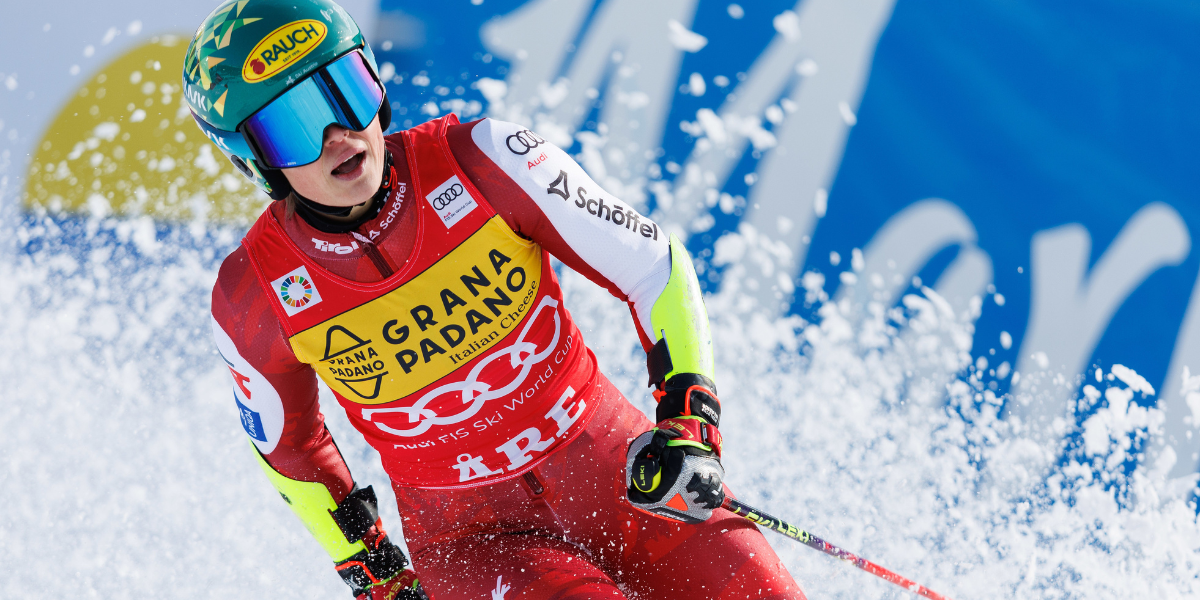
Shiffrin, ever the seasoned competitor, acknowledged the high stakes but maintained a philosophical perspective, emphasizing the unpredictable nature of alpine racing. "I think it’s an amazing reminder that anything can happen," she stated. "You push all the way to the finish line… we’re both skiing really strong GS right now, so honestly, anything is possible." Her words reflect not just a belief in her own capabilities, but also a healthy respect for Aicher’s talent and the inherent challenges of the sport.
For Emma Aicher, a victory in Hafjell and a subsequent Overall title would represent a monumental breakthrough. At 22 years old (born 2003), she has demonstrated remarkable progression throughout the 2025-26 season, consistently challenging the established order and proving her mettle against the sport’s elite. Her emergence as a genuine contender for the Overall globe signals a potential changing of the guard and offers a thrilling glimpse into the future of women’s alpine skiing. Regardless of the outcome, her performance this season has already marked her as a star on the rise.
Julia Scheib’s Unassailable Giant Slalom Dominance
While the Overall title provides the season’s ultimate dramatic arc, the Giant Slalom Crystal Globe has already found its rightful owner: Austria’s Julia Scheib. The 26-year-old (born 1998) secured the 2025-26 World Cup giant slalom title well before the Hafjell Finals, a testament to a season of unparalleled consistency and several commanding victories.
Scheib’s season has been a masterclass in giant slalom skiing. With 660 points heading into the final race, she held a commanding lead of 189 points over her closest competitor, Camille Rast of Switzerland. This significant buffer meant that no rival could mathematically overtake her, even with a win in Hafjell. Her dominant performance included five victories across the ten giant slalom races that count towards the World Cup standings, including triumphs in Sölden, Tremblant GS2, Semmering, Kranjska Gora, Kronplatz, and Åre.
Her consistency across diverse venues and snow conditions highlights her technical prowess and mental fortitude. Scheib’s ability to adapt and deliver top-tier performances week after week set her apart in a discipline known for its competitive depth. By locking up the Crystal Globe early, Scheib arrives in Hafjell free from the intense pressure of the standings battle. This freedom could allow her to ski even more aggressively, potentially adding another victory to her impressive season tally and further solidifying her status as the benchmark in women’s giant slalom.
The Giant Slalom standings reflect Scheib’s exceptional year:
1st 🇦🇹 Julia Scheib (AUT, 1998) – 660 pts
2nd 🇨🇭 Camille Rast (SUI, 1999, Head) – −189
3rd 🇸🇪 Sara Hector (SWE, 1992, Head) – −231
4th 🇺🇸 Mikaela Shiffrin (USA, 1995, Atomic) – −262
5th 🇺🇸 Paula Moltzan (USA, 1994) – −268

This list underscores not only Scheib’s lead but also the strong performances of other top contenders throughout the season, including multiple podium finishes for Rast, Hector, and the American duo of Shiffrin and Moltzan.
A Season of Diverse Talent: Giant Slalom Podium Highlights
The 2025-26 giant slalom season has been characterized by a vibrant mix of established stars and emerging talents gracing the podium. Julia Scheib’s dominance notwithstanding, the ten races leading up to Hafjell saw four different World Cup winners from three distinct countries, and an impressive ten different skiers representing eight nations claim a spot on the podium. This diversity speaks volumes about the competitive health and global appeal of women’s alpine skiing.
- Sölden: 🇦🇹 Julia Scheib (1st), 🇺🇸 Paula Moltzan (2nd), 🇨🇭 Lara Gut-Behrami (3rd)
- Copper Mountain: 🇳🇿 Alice Robinson (1st), 🇦🇹 Julia Scheib (2nd), 🇳🇴 Thea Louise Stjernesund (3rd)
- Tremblant GS1: 🇳🇿 Alice Robinson (1st), 🇭🇷 Zrinka Ljutić (2nd), 🇨🇦 Valérie Grenier (3rd)
- Tremblant GS2: 🇦🇹 Julia Scheib (1st), 🇸🇪 Sara Hector (2nd), 🇳🇿 Alice Robinson (3rd)
- Semmering: 🇦🇹 Julia Scheib (1st), 🇨🇭 Camille Rast (2nd), 🇸🇪 Sara Hector (3rd)
- Kranjska Gora: 🇨🇭 Camille Rast (1st), 🇦🇹 Julia Scheib (2nd), 🇺🇸 Paula Moltzan (3rd)
- Kronplatz: 🇦🇹 Julia Scheib (1st), 🇨🇭 Camille Rast (2nd), 🇸🇪 Sara Hector (3rd)
- Åre: 🇦🇹 Julia Scheib (1st), 🇺🇸 Paula Moltzan (2nd), 🇳🇿 Alice Robinson (3rd)
- Spindlerův Mlýn: 🇸🇪 Sara Hector (1st), 🇺🇸 Paula Moltzan (2nd), 🇺🇸 Mikaela Shiffrin (3rd)
- Olympic Cortina: 🇮🇹 Federica Brignone (1st), 🇸🇪 Sara Hector (2nd), 🇳🇴 Thea Louise Stjernesund (3rd)
- Note: The Olympic result does not count toward World Cup standings, highlighting the distinct nature of major championships versus the season-long circuit.
This varied podium table underscores the depth of talent in giant slalom. Athletes like New Zealand’s Alice Robinson demonstrated her explosive potential with two victories, while Sweden’s Sara Hector and Switzerland’s Camille Rast consistently challenged for top honors. The veteran presence of Italy’s Federica Brignone and Switzerland’s Lara Gut-Behrami also provided compelling moments, reminding fans of the enduring quality of seasoned competitors. The contributions from Canada’s Valérie Grenier, Croatia’s Zrinka Ljutić, and Norway’s Thea Louise Stjernesund further illustrate the international spread of excellence in the discipline.
The Hafjell Course and the Significance of the Start List
The Hafjell ski resort in Norway provides the picturesque and challenging backdrop for the World Cup Finals. Known for its meticulously prepared courses and stunning Scandinavian scenery, Hafjell is a fitting venue for the season’s grand finale. The conditions in mid-March can vary, but typically involve firm, fast snow, which demands precise technique and aggressive skiing.
In giant slalom, the start order is critical. The World Cup Start List (WCSL) determines the initial group of skiers, and for giant slalom, the first seven competitors benefit immensely from the cleanest course conditions. These athletes, by virtue of their high WCSL ranking, are considered the strongest and most consistent performers, making them the most likely to produce podium results. They set the benchmark for the field, often maintaining their advantage as the course inevitably degrades with each subsequent run.

The course setters for the Hafjell giant slalom are Ernst Hochstaffl (AUT) for the first run and Alek Glebov (USA) for the second run. Their choices in gate placement and rhythm will significantly influence the race dynamics. Hochstaffl’s first run will challenge skiers with a specific flow and technical demands, while Glebov’s second run will require quick adaptation and potentially a different tactical approach, especially if the course surface changes between runs.
National Teams Eyeing Strong Finishes
Several national teams arrive in Hafjell with strong contingents and high hopes for the final giant slalom.
🇺🇸 Stifel U.S. Ski Team – Women’s GS
The American squad features four formidable athletes qualified for the Finals, showcasing the depth of talent within the Stifel U.S. Ski Team.
- Mikaela Shiffrin (USA, 1995, Atomic): Beyond her pursuit of the Overall globe, Shiffrin remains a top contender in giant slalom, consistently capable of podium finishes. Her technical mastery and competitive drive are legendary.
- Paula Moltzan (USA, 1994): Moltzan has had a strong giant slalom season, demonstrating consistent top-level performance with multiple podium finishes, including second places in Sölden, Spindlerův Mlýn, and Åre, and a third in Kranjska Gora. She is a proven threat to land on the podium again.
- AJ Hurt (USA, 2000): Hurt has steadily climbed the ranks, adding valuable depth to the U.S. team. Her improving form suggests she has the potential to break into the top tier with a clean and aggressive run.
- Katie Hensien (USA, 1999): Hensien brings solid experience to the team. She’s capable of pushing for strong finishes, particularly on challenging courses where consistency is rewarded.
The U.S. team is not just about Shiffrin; Moltzan’s consistent top-level performance, coupled with the rising potential of Hurt and Hensien, makes them a significant force in the giant slalom event.
🇨🇦 Alpine Canada – Women’s GS
Alpine Canada has two athletes qualified for the Finals, both capable of delivering strong performances.
- Valérie Grenier (CAN, 1996, Head): Grenier has proven her ability to compete at the highest level, including a third-place finish at Tremblant GS1 this season. Her aggressive style and experience make her a contender for a top-15, or even a top-10, finish.
- Britt Richardson (CAN, 2003): Richardson represents the younger generation of Canadian talent. Her qualification for the Finals is a significant step in her career, offering valuable experience and the chance to showcase her potential on the biggest stage.
Both Canadian athletes possess the experience and skill to execute clean runs and push for competitive results, contributing to the international flavor of the Finals.

Broader Implications and the Future of Alpine Skiing
The 2025-26 FIS Alpine World Cup season has been a showcase of exceptional talent, dramatic rivalries, and inspiring performances. The Hafjell Finals, particularly the women’s giant slalom, encapsulates all these elements.
For Mikaela Shiffrin, securing a sixth Overall Crystal Globe would further solidify her legacy as arguably the greatest alpine skier in history. Each title adds to a narrative of sustained excellence, adaptability, and an unparalleled competitive fire that transcends generations. It would be a powerful statement about her enduring dominance and ability to perform under immense pressure.
Emma Aicher’s emergence as a contender for the Overall title signals a bright future for women’s alpine skiing. Her challenge to Shiffrin highlights the constant evolution of the sport and the rise of new stars who are ready to push the boundaries. Regardless of the outcome, her season will be remembered as a breakout year, setting the stage for future battles.
Julia Scheib’s dominant performance in giant slalom, culminating in her Crystal Globe victory, underscores the importance of consistency and specialization in modern alpine racing. Her success will inspire future generations of Austrian skiers and serve as a benchmark for excellence in the discipline.
The diversity of podium finishers and nationalities represented throughout the season reinforces the global appeal and competitive depth of the FIS Alpine World Cup. From established powerhouses to rising nations, the sport continues to captivate audiences worldwide.
How to Watch the Grand Finale
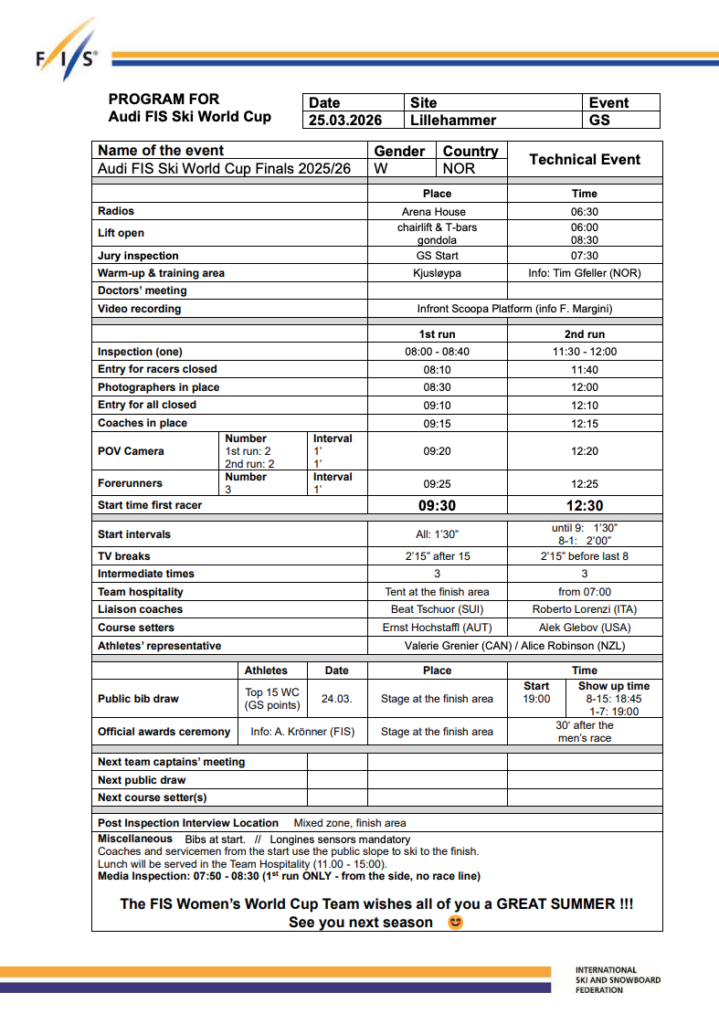
Alpine skiing enthusiasts around the globe can tune in to witness this historic conclusion to the 2025-26 FIS Alpine World Cup season.
The women’s giant slalom is scheduled for Saturday, March 14th:
- Run One: 4:30 a.m. EDT / 1:30 a.m. PDT
- Run Two: 7:30 a.m. EDT / 4:30 a.m. PDT
For fans in Great Britain:
- Run One: 8:30 a.m. GMT
- Run Two: 11:30 a.m. GMT
Live streaming and broadcast information can typically be found through national sports broadcasters and specialized platforms such as Skiandsnowboard.live. Viewers are encouraged to check local listings for specific channel details.
For comprehensive details including the full daily program and the highly anticipated first run start list, official FIS-SKI documents will be available for download via the provided links, offering fans an in-depth look at the day’s schedule and the starting order that could define the season. The stage is set for an unforgettable day of alpine racing, where legends will be made, and a season of hard-fought competition will reach its exhilarating climax.
