
The penultimate act of the 2025–26 FIS Alpine Ski World Cup season unfolded with gripping intensity in Hafjell, Norway, as Loïc Meillard of Switzerland delivered a masterful performance in the first run of the final slalom event. Clocking an unassailable time of 57.92 seconds, Meillard established a formidable lead, setting the stage for a dramatic second run. However, the true spectacle of the day, and indeed the season, remains the fiercely contested battle for the Slalom Crystal Globe, which now hangs precariously in the balance between Norway’s Atle Lie McGrath and Brazil’s Lucas Pinheiro Braathen. McGrath, who entered the finals as the season leader, found himself under immense pressure after finishing a distant sixth in the first run. Meanwhile, Braathen, starting fifth, capitalized on the challenging conditions to gain crucial ground, though not yet enough to wrest control of the coveted title. The tension is palpable, with the final run poised to crown the season’s slalom champion.
The Battle for the Slalom Crystal Globe Heats Up in Hafjell
The 2025–26 World Cup slalom season has been a captivating narrative of skill, resilience, and fierce competition, culminating in a head-to-head showdown at the prestigious World Cup Finals in Hafjell. The Slalom Crystal Globe, a symbol of consistent excellence throughout the season, is the ultimate prize for technical specialists, and its fate remains undecided until the very last gate.
Pre-Race Stakes: McGrath’s Fragile Lead
Heading into the final race, Atle Lie McGrath, a rising star from Norway, held a slender 41-point advantage over his closest rival, Lucas Pinheiro Braathen. This margin, while seemingly significant, offered little comfort in the high-stakes environment of a World Cup final, where points are awarded generously for top finishes. A victory (100 points), second place (80 points), or even a third-place finish (60 points) could dramatically alter the standings. For Braathen to overtake McGrath, he needed not only a strong performance himself but also for McGrath to falter significantly. The pressure was undeniably on both young athletes, but particularly on McGrath, who carried the burden of defending his season lead on home soil. His pre-race position of 552 points compared to Braathen’s 511 points highlighted the razor-thin margins defining their rivalry. Clement Noël (FRA), Henrik Kristoffersen (NOR), and Timon Haugan (NOR) were also mathematically in contention, albeit with larger deficits of 77, 99, and 153 points respectively, making their path to the globe significantly more challenging.
First Run Dynamics: McGrath Under Pressure, Braathen Gains Ground
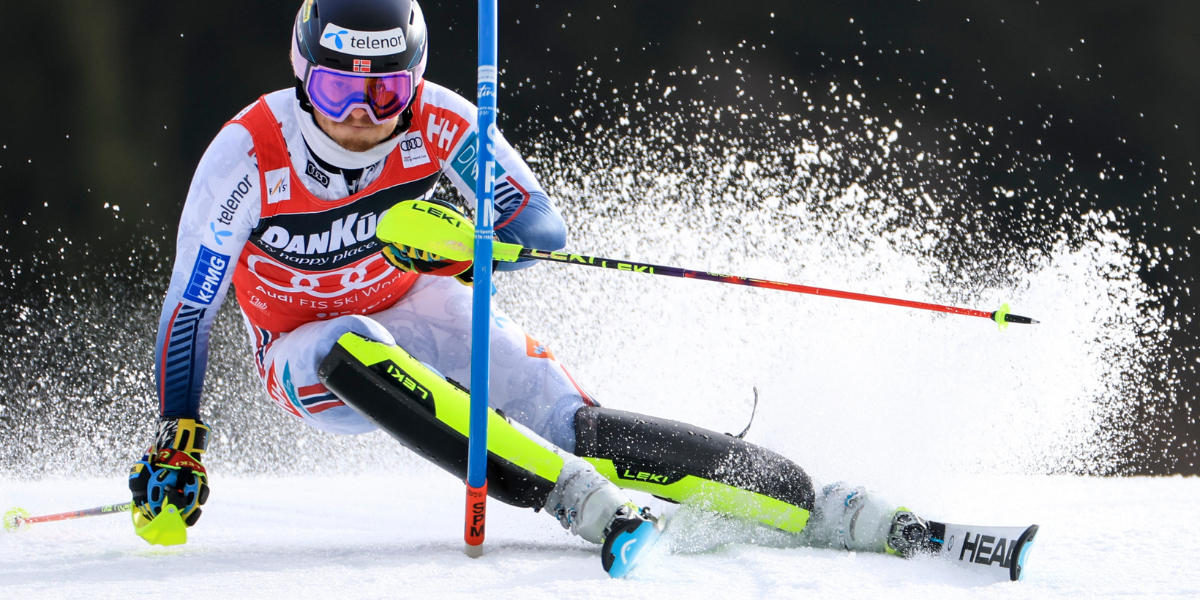
The first run provided a crucial shift in the dynamics of the globe race. McGrath, wearing bib 6 and carrying the weight of expectation, struggled to find his rhythm on a course that rapidly deteriorated. His run, finishing 1.65 seconds behind Meillard, relegated him to sixth place. This performance immediately put him on the back foot, exposing him to Braathen’s potential gains.
Lucas Pinheiro Braathen, starting immediately after McGrath, delivered a more composed and aggressive run. He managed to finish 0.50 seconds ahead of McGrath, securing fifth place. This marginal gain, equating to a current 45 points for fifth place, narrowed the gap, but critically, it was not enough on its own to overtake McGrath. For Braathen to claim the globe from his current position, he would need to climb further up the leaderboard in the second run and hope McGrath slips even lower. The first run saw Braathen gain a provisional 4 points on McGrath (45 pts for 5th vs 40 pts for 6th), effectively reducing McGrath’s overall lead from 41 to 37 points. This slight shift, while not decisive, intensified the psychological warfare, transferring a significant portion of the pressure onto McGrath as they head into the final run. The outcome now hinges on which athlete can best manage the immense pressure and adapt to what promises to be even more challenging conditions.
Meillard Dominates First Run Amidst Challenging Conditions
The Hafjell course presented a formidable challenge, and Meillard’s performance stood out as a testament to his exceptional skill and adaptability.
A Masterclass by Meillard
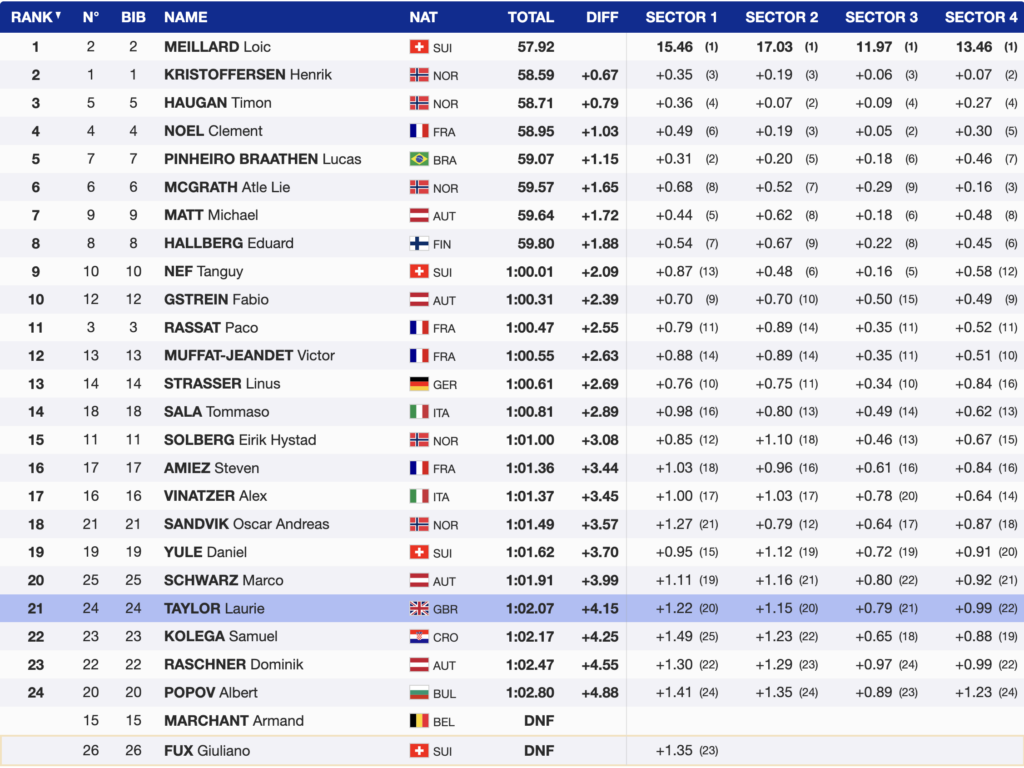
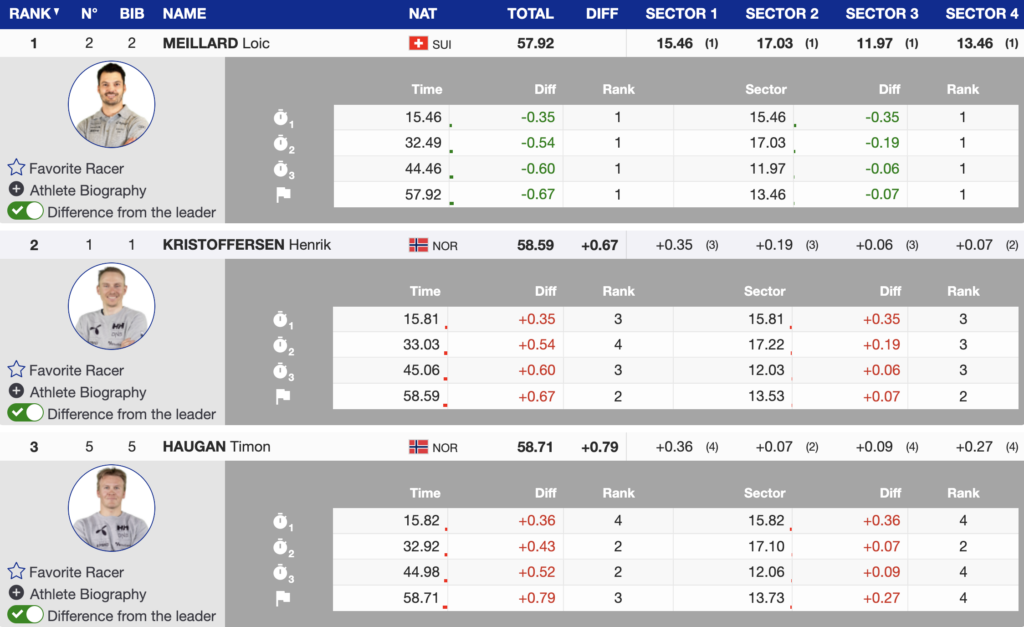
Switzerland’s Loïc Meillard demonstrated why he is considered one of the sport’s most versatile talents. Starting early on a relatively cleaner track, Meillard attacked the course with precision and power. His time of 57.92 seconds was not just fast; it was significantly faster than anyone else, being the only skier to dip below the 58-second mark. He was demonstrably quicker across every sector, showcasing a near-flawless run that left his competitors trailing. Henrik Kristoffersen, a slalom veteran, opened strongly with a time of 58.59, but Meillard immediately eclipsed this, taking a commanding lead of 0.67 seconds. Meillard’s ability to maintain speed and line through the demanding gates was a masterclass in slalom technique, setting an incredibly high benchmark for the rest of the field. This dominant display firmly positions him as the favorite for the race victory, irrespective of the globe battle unfolding behind him.

Norwegian Hopes on Home Soil
While the globe race dominated headlines, Norwegian fans had much to cheer about with strong performances from their home team. Henrik Kristoffersen, a multiple World Cup winner, opened the race with a solid run, eventually settling into second place with a time of +0.67. His experience and consistency shone through. Timon Haugan, another Norwegian, continued his impressive season despite battling chronic back pain, skiing into third position at +0.79. These performances underscored Norway’s depth in technical disciplines and fueled hopes for a potential home victory, a feat never before achieved in a World Cup slalom race on Norwegian snow. Clément Noël of France, known for his attacking style, also delivered a composed run to secure fourth place at +1.03, keeping himself within striking distance of the podium. The fact that three Norwegians were within the top six after the first run, including McGrath, highlighted the strength of the national team in this discipline.
The Impact of Deteriorating Snow
A significant factor influencing the wide time gaps and the fluctuating performances was the deteriorating race surface. Hafjell, known for its quality snow, faced unseasonably warm temperatures, leading to soft and rapidly breaking down snow. The course crew worked tirelessly, battling to keep gates standing and maintain the integrity of the track, often necessitating frequent course holds. As more skiers navigated the course, the ruts deepened, and the surface became increasingly choppy and unpredictable. This created a clear advantage for early starters, who benefited from a relatively cleaner and firmer track. Skiers with higher bib numbers found themselves contending with a more challenging and less forgiving surface, making it difficult to maintain speed and execute precise turns. This environmental challenge added another layer of complexity to an already high-stakes race, amplifying the pressure on every athlete to adapt or fall victim to the conditions. The significant time spread, with only two skiers (Kristoffersen and Haugan) remaining within one second of Meillard, vividly illustrated the impact of these difficult conditions.
Strategic Implications for the Decisive Second Run
The first run’s outcome has significant strategic implications for the second run, particularly concerning the starting order and the expected course conditions.
Advantage for Early Starters
One of the unique aspects of alpine ski racing is the reversal of the top 30 starting order for the second run. This means that skiers who finished further down the leaderboard in the first run will start earlier in the second run. Given the rapidly deteriorating snow conditions observed in the first run, this reversal is expected to grant a considerable advantage to those starting earlier. They will encounter a comparatively cleaner, firmer surface, allowing for more aggressive skiing and potentially faster times. Laurie Taylor of Great Britain, finishing 21st in the first run with a deficit of 4.15 seconds, will be among those benefiting from an early start. This scenario opens the door for significant movements up the leaderboard, as skiers from outside the top ten could post blistering times and challenge for higher positions. The strategic dilemma for the leaders, therefore, is how to manage their lead on a compromised course, knowing that fast times will be set by those who start ahead of them.
Pressure on the Leaders
Conversely, the top performers from the first run, including Meillard, Kristoffersen, Haugan, Noël, Braathen, and McGrath, will start later in the second run. They will face an even more broken-down and challenging course than what was experienced in the first run. This demands a different kind of strategy – one focused on precision, adaptability, and minimal mistakes rather than pure speed. For Meillard, the goal will be to maintain his substantial lead, skiing cleanly enough to fend off any charges from behind. For McGrath and Braathen, the pressure is magnified. Braathen, starting fifth, will have a slight advantage over McGrath, who starts sixth. Braathen will need to ski an absolutely flawless run, pushing the limits while minimizing errors, to maximize his points gain and put even more pressure on McGrath. McGrath, in turn, will be racing not only against the clock but also against Braathen’s performance. His run will require a balance of aggression and control, knowing that a single mistake could cost him the Slalom Crystal Globe. The psychological toll of knowing his rival has already laid down a time, combined with the difficult course conditions, will be immense. Coaches will be working intensely with their athletes between runs, analyzing video, adjusting tactics, and providing mental preparation for what promises to be a grueling and dramatic final descent.
National Pride and Emerging Talents
Beyond the individual battles, the World Cup Finals also showcase national strength and the emergence of new talent.
Norway’s Strong Showing and Quest for a Home Victory
Norway’s performance in the first run was exceptional, qualifying five skiers for the finals in a field of just 26 athletes. This highlights the robust development program within Norwegian alpine skiing. With Henrik Kristoffersen (2nd), Timon Haugan (3rd), and Atle Lie McGrath (6th) all positioned within the top six, the prospect of a historic home victory in a World Cup slalom race has never been stronger. The energy from the home crowd, despite the challenging conditions, will undoubtedly be a factor, providing an emotional boost to the Norwegian contingent. The collective strength of the team underscores Norway’s growing dominance in the technical disciplines, complementing their traditional prowess in speed events.
International Representation and Rising Stars
The start list for the finals is a microcosm of the global talent in alpine skiing. Alongside the established stars, the presence of Junior World Champion Giuliano Fux of Switzerland, despite his DNF in the first run, signifies the pipeline of future talent. Great Britain’s Laurie Taylor, finishing 21st, secured his spot in the second run, an important achievement for GB Snowsport. His early start in the second run offers a valuable opportunity to climb the ranks and secure additional World Cup points, contributing to the development of British alpine skiing. These international representations underscore the global appeal and competitive nature of the FIS World Cup circuit.
Notable Absences and DNFs
The challenging course conditions inevitably led to some athletes failing to finish the first run. Armand Marchant of Belgium, wearing bib 15, was the first notable DNF, unable to complete the course. Junior World Champion Giuliano Fux also succumbed to the demanding conditions. These early exits highlight the fine margins and unforgiving nature of top-tier alpine racing, where a fraction of a second or a minor error can mean the difference between a competitive time and an early exit. Each DNF, while disappointing for the athlete, is a stark reminder of the technical and physical demands placed upon World Cup skiers.
The Stage is Set: A Thrilling Conclusion Awaits
As the sun begins its descent over Hafjell, the stage is impeccably set for one of the most exciting conclusions to a World Cup slalom season in recent memory. The first run has merely intensified the drama, rather than resolving it.
Final Run Preview: Everything on the Line
Loïc Meillard holds a commanding lead in the race itself, but the broader narrative remains firmly fixed on the Slalom Crystal Globe. Atle Lie McGrath, despite his season-long consistency, finds himself under immense pressure, needing a flawless second run to defend his lead. His position in sixth place, combined with Braathen’s fifth, means the margin for error is virtually non-existent. Lucas Pinheiro Braathen, having gained a psychological and numerical edge in the first run, must now deliver an even more aggressive and precise performance to seize the globe. He knows that only a significant leap up the leaderboard, coupled with a less-than-stellar performance from McGrath, will be enough. The final run will not only be a test of raw speed and technical skill but also of mental fortitude. The athletes who can best manage the pressure, adapt to the deteriorating course, and execute their lines with unwavering conviction will emerge victorious. The anticipation builds for a dramatic showdown, promising a fitting climax to an unforgettable slalom season in Hafjell. The world watches as the final gates of the 2025–26 World Cup slalom season prepare to fall, deciding the ultimate champion.
