
The final men’s Super-G of the 2025-26 World Cup season is set to unfold in Kvitfjell, Norway, on the renowned Olympiabakken, a venue synonymous with high-speed, technical skiing. This climactic event will feature the top 25 athletes in the discipline standings, alongside the reigning Junior World Champion, all converging to compete for the final Super-G podium of what has been an extraordinary season. Swiss phenom Marco Odermatt arrives in Kvitfjell having already secured an unprecedented trifecta of crystal globes: the Super-G, Downhill, and the coveted Overall World Cup titles. With Odermatt’s historic dominance confirming his status as the undisputed king of speed and overall excellence, the spotlight now shifts to the intense battle for the final race victory and the dramatic reshuffling of the discipline standings behind him. The high stakes for those chasing career-best finishes and valuable World Cup points ensure that Kvitfjell will deliver a compelling spectacle, even with the primary titles already in hand.
Kvitfjell: A Storied Venue for Speed
Kvitfjell, nestled in the heart of Norway, has a rich history as a premier destination for World Cup speed events. Since its debut on the World Cup circuit in 1993, the Olympiabakken course has challenged the world’s best skiers with its unique blend of steep pitches, undulating terrain, and high-speed gliding sections. Designed for the 1994 Lillehammer Winter Olympics, the course is known for its fairness and its ability to reward both technical precision and raw courage. It demands athletes to maintain an aggressive line while adapting to subtle terrain changes, making it a true test of Super-G prowess. The conditions in late March often present a mix of firm, fast snow and potential spring softness, adding another layer of complexity to the race strategy. This legacy of demanding competition sets the stage for a fitting conclusion to the Super-G season, where only the most adaptable and daring will prevail.
Marco Odermatt’s Unprecedented Dominance in 2025-26
Marco Odermatt’s 2025-26 World Cup campaign has been nothing short of historic. His securing of the Super-G, Downhill, and Overall crystal globes well before the season’s end underscores a level of dominance rarely seen in alpine ski racing. This achievement places him in an elite echelon of skiers, demonstrating unparalleled consistency and skill across multiple disciplines. His journey to these titles began with commanding performances early in the season, establishing a lead that proved insurmountable for his rivals. In Super-G alone, Odermatt has been a consistent force, marrying his exceptional giant slalom technique with a newfound confidence and speed in the faster disciplines. While the pressure of securing the globe is now off, Odermatt is known for his relentless pursuit of victory. "Even with the globes secured, every race is an opportunity to push my limits and perform at my best," Odermatt was quoted as saying earlier this season, reflecting his competitive spirit. His presence in the start gate ensures that the bar for victory remains exceptionally high, forcing every other competitor to ski flawlessly.
The Intense Battle for the Discipline Podium: A Tight Finish Anticipated
While Odermatt’s supremacy in Super-G is undeniable, the fight for the remaining podium positions in the overall discipline standings is incredibly tight and promises a thrilling conclusion. After seven of eight races, a mere 27 points separate second-placed Vincent Kriechmayr from Giovanni Franzoni in fifth. This narrow margin means that a single strong performance in Kvitfjell could dramatically alter the final rankings, offering significant prestige and World Cup qualification advantages for the upcoming season.
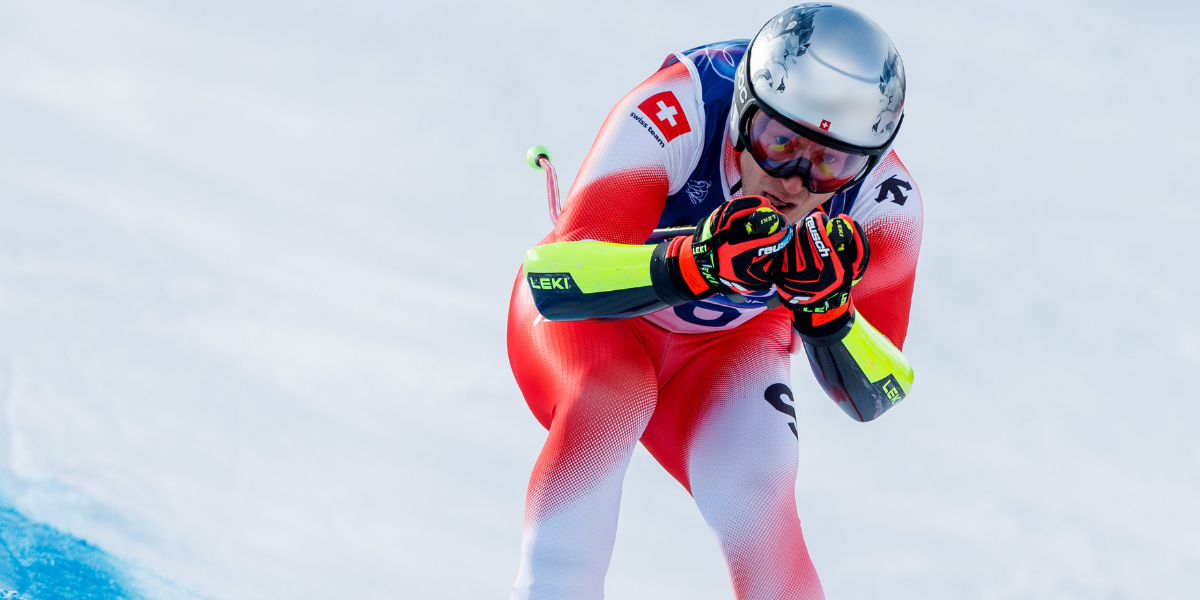
Top Five – World Cup Super-G Standings (After Kitzbühel, 6/7 races):
1st 🇨🇭 Marco Odermatt (SUI, 1997, Stöckli) – 425 pts
2nd 🇦🇹 Vincent Kriechmayr (AUT, 1991, Head) – 267 pts (158 pts behind leader)
3rd 🇦🇹 Stefan Babinsky (AUT, 1996, Head) – 243 pts (182 pts behind leader)
4th 🇦🇹 Raphael Haaser (AUT, 1997, Atomic) – 241 pts (184 pts behind leader)
5th 🇮🇹 Giovanni Franzoni (ITA, 2001, Oakley) – 240 pts (185 pts behind leader)
The standings reveal a strong Austrian contingent vying for the top spots behind Odermatt, highlighting their national strength in speed disciplines. Vincent Kriechmayr, a veteran with multiple World Cup victories, is a formidable competitor known for his aggressive style. He has shown flashes of brilliance this season, including a win at Beaver Creek and a second place at Copper Mountain. For Kriechmayr, a strong finish would solidify his position as the top challenger to Odermatt and provide a crucial confidence boost heading into the off-season.
Stefan Babinsky and Raphael Haaser have both had impressive seasons, demonstrating consistent podium potential. Babinsky, in particular, has made significant strides, consistently placing within the top ten and securing podium finishes at Wengen and Kitzbühel. Haaser, with two third-place finishes earlier in the season, is also seeking to cap off his season with a strong result. The internal Austrian battle adds another layer of intrigue, as each athlete will undoubtedly be pushing for national bragging rights in addition to their individual ambitions.
Giovanni Franzoni, the young Italian talent, represents the emerging generation. His victory at Wengen and a third-place finish at Val Gardena underscore his immense potential. Being only 27 points behind Kriechmayr, Franzoni has a real opportunity to climb the standings and secure a career-best discipline ranking. His aggressive, no-holds-barred approach could be perfectly suited for the challenging Kvitfjell course.
Season Breakdown and Podiums by Nation:
The 2025-26 Super-G season has seen a fascinating distribution of podium places, indicating the depth of talent beyond Odermatt.
Men’s World Cup Super-G Podiums – 2025-26 Season:

| Venue | 1st | 2nd | 3rd |
|---|---|---|---|
| Copper Mountain | 🇨🇭 Marco Odermatt | 🇦🇹 Vincent Kriechmayr | 🇦🇹 Raphael Haaser |
| Beaver Creek | 🇦🇹 Vincent Kriechmayr | 🇳🇴 Fredrik Möller | 🇦🇹 Raphael Haaser |
| Val Gardena | 🇨🇿 Jan Zabystřan | 🇨🇭 Marco Odermatt | 🇮🇹 Giovanni Franzoni |
| Livigno | 🇦🇹 Marco Schwarz | 🇨🇭 Alexis Monney | 🇨🇭 Franjo von Allmen |
| Wengen | 🇮🇹 Giovanni Franzoni | 🇦🇹 Stefan Babinsky | 🇨🇭 Franjo von Allmen |
| Kitzbühel | 🇨🇭 Marco Odermatt | 🇨🇭 Franjo von Allmen | 🇦🇹 Stefan Babinsky |
| Olympic Cortina* | 🇨🇭 Franjo von Allmen | 🇺🇸 Ryan Cochran-Siegle | 🇨🇭 Marco Odermatt |
(Olympic results included for context but excluded from World Cup totals.)
Podiums by Nation (World Cup only):
- Switzerland: 3 victories, 3 second places, 2 third places (8 total)
- Austria: 2 victories, 1 second place, 4 third places (7 total)
- Italy: 1 victory, 1 third place (2 total)
- Czech Republic: 1 victory (1 total)
- Norway: 1 second place (1 total)
The data clearly illustrates that Austria and Switzerland have been the dominant forces in the discipline, collectively securing a significant majority of the podium spots. However, the emergence of winners from Czech Republic and Italy, alongside a Norwegian podium, highlights the competitive depth and the unpredictable nature of Super-G. The fact that six different athletes have stood on the top step of the podium in seven World Cup races (excluding the Olympics) demonstrates that while Odermatt has claimed the globe, individual race wins have been fiercely contested. This spread of winners underscores the potential for an unexpected victor in Kvitfjell.
Key Contenders and Start Order Analysis: The Decisive Window
The start list for the Kvitfjell Super-G is a critical factor, particularly the grouping of the top-ranked athletes. The World Cup Start List (WCSL) determines the seeding, and experience often shows that the decisive runs occur within a specific bib range.
Top Ten – WCSL Super-G (Start Order):
- Bib 6 🇮🇹 Giovanni Franzoni (ITA, 2001, Oakley) – WCSL SG Rank 6
- Bib 7 🇦🇹 Raphael Haaser (AUT, 1997, Atomic) – WCSL SG Rank 4
- Bib 9 🇦🇹 Vincent Kriechmayr (AUT, 1991, Head) – WCSL SG Rank 3
- Bib 10 🇦🇹 Stefan Babinsky (AUT, 1996, Head) – WCSL SG Rank 7
- Bib 11 🇨🇭 Franjo von Allmen (SUI, 2001, Head) – WCSL SG Rank 2
- Bib 12 🇨🇿 Jan Zabystřan (CZE, 1998) – WCSL SG Rank 8
- Bib 13 🇮🇹 Dominik Paris (ITA, 1989, Nordica) – WCSL SG Rank 10
- Bib 14 🇨🇭 Stefan Rogentin (SUI, 1994) – WCSL SG Rank 5
- Bib 15 🇨🇭 Marco Odermatt (SUI, 1997, Stöckli) – WCSL SG Rank 1
- Bib 17 🇫🇷 Nils Allegre (FRA, 1994) – WCSL SG Rank 9
This group, specifically from bib 6 to 15, is widely regarded as the "golden window" where the race is most likely to be won. These skiers have consistently delivered top results throughout the season and are expected to push the limits on Olympiabakken. Odermatt, starting with bib 15, is strategically placed in the middle of this elite group, allowing him to gauge the conditions and the lines taken by his closest rivals. For Franzoni (Bib 6) and Haaser (Bib 7), an early, aggressive run could set a challenging benchmark. Veterans like Kriechmayr (Bib 9) and Paris (Bib 13) possess the experience to adapt to changing conditions and deliver peak performances under pressure. The rising Swiss star Franjo von Allmen (Bib 11) has also proven his mettle with multiple podiums and an Olympic victory, indicating he is a serious threat for the win.
The Course Setter’s Influence: A Potential Advantage for the Stifel U.S. Ski Team?

A significant element of intrigue in Kvitfjell is the identity of the course setter: Johno McBride of the Stifel U.S. Ski Team. The course setter’s philosophy and design choices can heavily influence how a race unfolds, potentially favoring skiers accustomed to a particular style or those from the course setter’s national team. While course setters are bound by FIS rules to ensure fairness, subtle nuances in gate placement and rhythm can play to specific strengths.
Stifel U.S. Ski Team – Super-G Finals starters:
- Bib 16 🇺🇸 Ryan Cochran-Siegle (USA, 1992, Head) – Mt. Mansfield Ski Academy / Cochran’s Ski Club – World Cup SG Rank 16
- Bib 24 🇺🇸 River Radamus (USA, 1998) – Ski & Snowboard Club Vail – World Cup SG Rank 25
Ryan Cochran-Siegle, an Olympic Super-G silver medalist, starts just outside the main contender group. His powerful skiing and ability to perform on big stages make him a consistent threat, and a course set by his own coach could provide a psychological or strategic edge. "Johno knows our strengths, and he’ll set a course that rewards aggressive, clean skiing," Cochran-Siegle stated in a recent interview, hinting at the team’s familiarity with McBride’s approach. River Radamus, as the final qualifier, will need to leverage any advantage from McBride’s setting and attack from a later start position, aiming for valuable points to improve his WCSL ranking for next season.
Alpine Canada’s Challenge
Alpine Canada brings two formidable athletes to the Kvitfjell Super-G Finals:
Alpine Canada – Super-G Finals starters:
- Bib 22 🇨🇦 Cameron Alexander (CAN, 1997) – World Cup SG Rank 23
- Bib 23 🇨🇦 James Crawford (CAN, 1997, Head) – World Cup SG Rank 21
Both Cameron Alexander and James Crawford are strong speed specialists capable of top-tier performances. Crawford, a former World Champion in Super-G, has shown he can win on any given day. However, starting later in the field presents a challenge, as track conditions can deteriorate. They will need to execute near-perfect runs and capitalize on any changes in the course or conditions to break into the points and potentially challenge for a top result. "Our focus is on executing our game plan and taking advantage of every opportunity on the course," a Canadian coach commented, emphasizing their aggressive approach.
The Future Arrives: Junior World Champion Victor Haghighat

The Kvitfjell Super-G Finals will also feature a glimpse into the future of alpine ski racing with the inclusion of 🇫🇷 Victor Haghighat (FRA, 2007). As the reigning Junior World Champion in Super-G, Haghighat earns a direct spot in the World Cup Finals, starting with Bib 26. This opportunity allows the prodigious young French skier to test his skills against the established elite on one of the sport’s biggest stages. His participation is not just a reward for his junior success but a crucial step in his development, providing invaluable experience and a chance to measure himself against the world’s best. His presence adds a fresh narrative to a field dominated by seasoned World Cup winners, symbolizing the ongoing cycle of talent in alpine skiing.
Broader Implications and the Road Ahead
The conclusion of the 2025-26 Super-G season in Kvitfjell, while celebrating Marco Odermatt’s historic achievements, also sets the tone for the future. Odermatt’s dominance raises questions about the competitive landscape – whether his consistent victories inspire others to elevate their game or create a sense of resignation. The tight battle for the remaining podium spots, however, demonstrates that beneath Odermatt’s towering presence, the sport remains fiercely competitive and dynamic.
The rise of young talents like Giovanni Franzoni, Franjo von Allmen, and particularly Junior World Champion Victor Haghighat, signals a promising future for alpine racing. These athletes represent the next generation poised to challenge for crystal globes in the years to come. Their performances in Kvitfjell will be closely watched for indications of their readiness to consistently contend at the highest level.
For national teams, strong performances in the final race contribute to national rankings, which can impact team quotas for future World Cup seasons and funding allocations. The strategic importance of Kvitfjell extends beyond individual glory, influencing the trajectory of national programs. The prize money associated with top finishes also provides crucial financial support for athletes and their training.
The Kvitfjell Super-G is more than just a season finale; it’s a statement. It’s one last chance for athletes to prove their mettle, to refine their technique, and to carry momentum into the off-season. When the race reaches the critical bib 7 through 15 range, the strongest skiers will undoubtedly push the limits, and the final Super-G winner of the season will emerge, adding another chapter to the rich history of alpine ski racing.
Race Logistics and How to Watch:
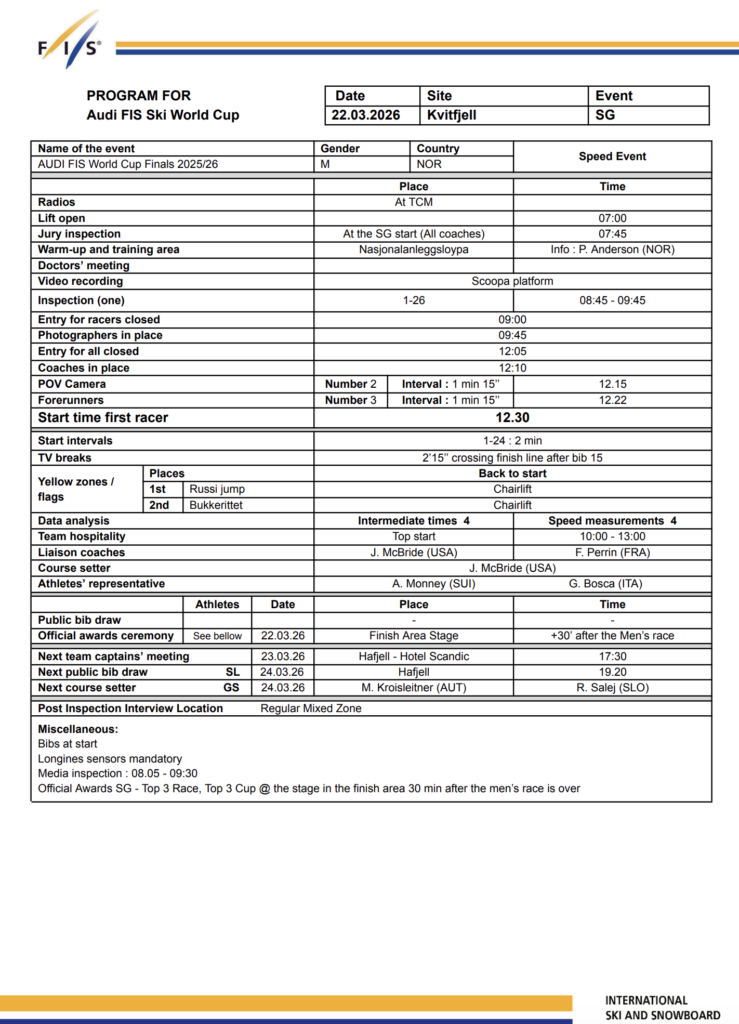
Sunday’s Super-G in Kvitfjell takes place on March 22nd, beginning at 7:30 a.m. EDT / 4:30 a.m. PDT. Fans in Great Britain can tune in at 11:30 a.m. GMT.
How to Watch:
Fans can stream the event live through platforms like SkiAndSnowboard.Live in the USA and Canada. Broadcast details for other regions will be available via national sports broadcasters.
Daily Program men’s super-G:
[Click here to download the official Daily Program PDF] (https://medias3.fis-ski.com/pdf/2026/AL/0060/2026AL0060DPRO.pdf)
Men’s Super-G Start List:
[Click here to download the official Start List PDF] (https://medias2.fis-ski.com/pdf/2026/AL/0060/2026AL0060SLR0.pdf)
The course setter for this highly anticipated event is Johno McBride (USA).
