
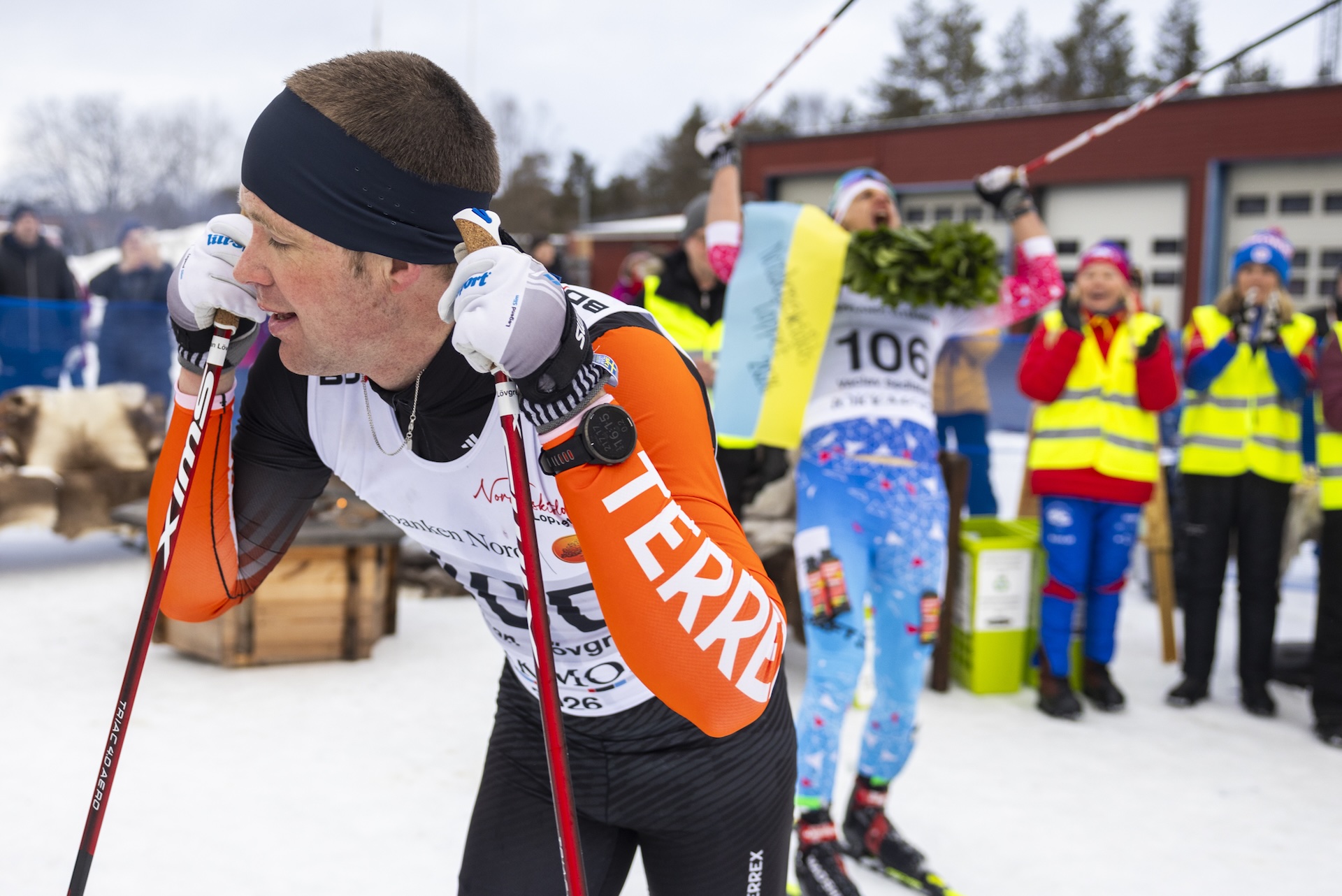
The crisp, subarctic air of Jokkmokk, Sweden, bore witness to an epic battle of endurance and will at the Nordenskiöldsloppet on Saturday afternoon. In a dramatic conclusion to the 220-kilometer classic cross-country ski race, Czech Republic’s Vaclav Sedlacek emerged victorious, edging out Swedish contender Johan Lövgren by a mere one-tenth of a second. The agonizingly close finish left Lövgren, a formidable presence in the long-distance skiing circuit, visibly disappointed, while Sedlacek erupted in jubilation, celebrating a career-defining triumph. Meanwhile, in the women’s category, Karolina Grohova of the Czech Republic delivered a commanding performance, securing a dominant victory that underscored her prowess in the demanding event.
The raw emotion at the finish line perfectly encapsulated the intensity of the Nordenskiöldsloppet. Lövgren, who had a near-ten-minute advantage in last year’s race, found himself on the wrong side of a razor-thin margin this time. His dejection was palpable, a stark contrast to Sedlacek’s unbridled joy. "I wanted to win. It feels bitter to be second," Lövgren admitted, his voice tinged with the sting of such a narrow defeat. The 220-kilometer course, a grueling test of physical and mental fortitude, had once again delivered a spectacle that resonated with fans of the sport.
For Vaclav Sedlacek, a 40-year-old veteran from the Czech Republic, this victory was more than just another race win; it was a poignant farewell to his professional skiing career. Overcome with emotion, Sedlacek described the Nordenskiöldsloppet as a "special" event, marking a "fantastic end to my ski career." His tears of joy were a testament to the culmination of years of dedication and the realization of a dream on this iconic course.
The Climax of a Grueling Race
The men’s race reached its critical juncture around the 110-kilometer mark. Sedlacek, along with his eD systems RSJ Team compatriot Thomas Bing of Germany and the determined Johan Lövgren, broke away from the main pack. This formidable trio maintained a strong pace, setting the stage for a compelling battle for supremacy.
Lövgren, known for his aggressive racing style, revealed the tactical challenges he faced. "I tried to break away several times," he stated. "But the other two are on the same team and employed team tactics, so I had to constantly work to close the gaps they created." This strategic maneuver by the eD systems RSJ Team effectively neutralized Lövgren’s individual efforts for significant portions of the race, forcing him into a reactive role.
The race appeared to be heading towards a thrilling three-way sprint finish. However, in a cruel twist of fate, Thomas Bing suffered a fall in the final turn before the finish line. While the fall prevented him from contesting the win, Bing managed to secure the third podium spot, finishing 27 seconds behind the leading duo. His resilience in recovering from the mishap to still claim a medal highlighted his grit and determination.
The top three finishers represented a strong showing from the eD systems RSJ Team, with Sedlacek and Bing showcasing the effectiveness of their team’s strategy. The official results confirmed Sedlacek’s narrow victory, with a time of 12:15:25.3, followed closely by Lövgren at 12:15:25.4. Bing completed the podium at 12:15:52.2.
The best-performing Norwegian in the men’s field was Edvard Hamilton. The 36-year-old from Sør-Fron IL/Team Oslo Sportslager finished a respectable time behind the podium contenders, underscoring the international caliber of the competition.
A Dominant Display from Grohova in the Women’s Race
The women’s 220-kilometer classic race mirrored the intensity of the men’s event, albeit with a different narrative at the forefront. Karolina Grohova, also representing the eD systems RSJ Team and hailing from the Czech Republic, delivered an utterly dominant performance. She broke away from the field after approximately 120 kilometers and maintained an astonishing pace, ultimately crossing the finish line with a commanding lead of over seven minutes.
Grohova’s victory was a testament to her exceptional form and strategic execution. Her decisive move mid-race effectively separated her from the competition, allowing her to control the remainder of the event with authority. The margin of victory was substantial, leaving little doubt as to who the strongest competitor was on the day.
The second position was secured by Malin Börjesjö of Team Internorm Trentino from Sweden, who finished with a time of 13:23:31.5. Sofia Lindberg, the defending champion and last year’s winner by over an hour, managed to secure third place with a time of 13:50:43.0. Lindberg’s performance, while still strong enough for a podium finish, was significantly distanced by Grohova’s exceptional showing, highlighting the evolving landscape of women’s long-distance skiing.
The results from the women’s race were:
-
- Karolina Grohova, eD systems RSJ Team/Czech Republic, 13:16:23.8
-
- Malin Börjesjö, Team Internorm Trentino/Sweden, 13:23:31.5
-
- Sofia Lindberg, Robertsfors IK/Team Edux, 13:50:43.0
Historical Context and Significance of Nordenskiöldsloppet
The Nordenskiöldsloppet, first held in 1930, is the world’s oldest and longest cross-country ski race. Named after the explorer Adolf Erik Nordenskiöld, the race traverses the historical Särna-Jokkmokk route, a challenging and picturesque journey through the Swedish Arctic landscape. The event is renowned for its demanding classic style, testing the endurance and technical skills of participants over vast distances.
This year’s edition, covering 220 kilometers, continued the tradition of pushing athletes to their absolute limits. The race attracts a diverse field of elite skiers and dedicated amateurs, all drawn by the allure of conquering one of the most prestigious long-distance ski events. The classic technique, requiring precise poling and efficient gliding, adds another layer of complexity to the already formidable distance.
The race’s history is punctuated by legendary performances and dramatic finishes, and this year’s event certainly lived up to that legacy. The close finish in the men’s race and the dominant performance in the women’s race are now etched into the annals of the Nordenskiöldsloppet.

Team Dynamics and Strategic Play
The men’s race provided a clear illustration of the impact of team tactics in long-distance skiing. The eD systems RSJ Team’s strategy of having their two skiers, Sedlacek and Bing, work together to control the pace and disrupt Lövgren’s efforts was a significant factor in the outcome. This approach, while sometimes met with frustration by individualistic competitors, is a legitimate and often highly effective strategy in endurance events.
Sedlacek’s victory, in particular, carries immense emotional weight. His decision to retire after this race, choosing to end his career on such a high note, speaks volumes about his dedication and his love for the sport. His performance, coupled with Bing’s strong showing, solidifies the eD systems RSJ Team’s position as a formidable force in long-distance skiing.
Broader Implications and Future Outlook
The Nordenskiöldsloppet serves as a crucial benchmark for skiers preparing for other major long-distance events, such as the Vasaloppet. Johan Lövgren’s second-place finish, while disappointing on a personal level, indicates he remains a top contender. His ability to compete at the highest level, even after a near-win, demonstrates his enduring strength and experience.
For Vaclav Sedlacek, this victory is the perfect swansong. His career will be remembered for his tenacity, skill, and this triumphant final performance. His influence on the sport may continue through coaching or other roles, but his legacy as a champion of the Nordenskiöldsloppet is now firmly established.
Karolina Grohova’s dominant performance in the women’s race sends a clear message to her competitors. Her ability to execute such a decisive victory suggests she is at the peak of her powers. Her continued participation in future long-distance events will undoubtedly be eagerly watched by fans and rivals alike.
The Nordenskiöldsloppet 2026 has once again delivered a compelling narrative of human endurance, strategic brilliance, and the raw emotion that defines elite sport. As the dust settles in Jokkmokk, the stories of Sedlacek’s emotional farewell, Lövgren’s near-miss, and Grohova’s commanding performance will undoubtedly resonate within the cross-country skiing community for years to come. The event’s rich history and demanding nature ensure its continued status as a premier test of endurance and a celebrated tradition in the world of winter sports.
The full results from the event can be accessed at https://results.neptron.se/e/nsl2026/.
