
DENVER, CO – After a rigorous 18-month development cycle, culminating in countless hours of dedicated research and engineering at the Outside Lab at the University of Colorado Denver (CU Denver), a revolutionary piece of equipment has been officially unveiled: the Outside Lab Ski and Snowboard Test Machine. This innovative apparatus is poised to fundamentally transform how snow sports gear is evaluated, measured, and understood, thereby establishing a new benchmark for assessing and reporting the crucial flex and torsional profiles of skis and snowboards. This initiative directly addresses a long-standing void in the snow sports industry, moving beyond subjective "hand bend" tests to introduce objective, quantifiable data that will empower both manufacturers and consumers.
The introduction of the Outside Lab Ski and Snowboard Test Machine marks a significant stride towards greater transparency and precision in the multi-billion-dollar snow sports market. For decades, the evaluation of ski and snowboard performance has often relied on a blend of empirical field testing, expert rider feedback, and, perhaps most notably, highly subjective manual assessments. While these methods have their place in validating real-world feel, they inherently lack the consistency and granular detail necessary for true "apples-to-apples" comparisons across diverse product lines and brands. This new machine aims to fill that critical gap, providing a scientific foundation for understanding how snow sports gear truly performs.
The Enduring Challenge of Subjectivity in Gear Testing
The journey to develop this machine was born from a recognition of significant challenges inherent in existing gear testing methodologies. Unlike many other product categories where standardized tests rigorously evaluate performance, durability, or safety—think automotive crash tests or consumer electronics benchmarks—the snow sports industry has often lagged in developing universally accepted, objective metrics for core performance attributes like flex and torsional rigidity. While certain standards exist for aspects such as binding release values or ski construction materials, a comprehensive, repeatable method for quantifying how a ski or snowboard bends, twists, and engages an edge has remained elusive.
The prevailing methods for assessing these critical characteristics have historically been qualitative. Ski shop technicians and experienced riders frequently employ a "hand bend" test, manually flexing a ski or board to gauge its stiffness. While useful for a quick, general impression, this method is prone to individual interpretation, lacks precision, and cannot quantify specific points of flex along the length or the subtle nuances of torsional stiffness, which dictates edge hold. Manufacturers, too, have largely relied on extensive prototyping, iterative design changes based on pro athlete feedback, and internal, often proprietary, testing rigs that lack industry-wide comparability. This reliance on experience and subjective feedback, while valuable in its own right, often leaves both designers and consumers without the precise data needed to optimize performance or make truly informed purchasing decisions. The Outside Lab at CU Denver recognized this as a prime opportunity for innovation, specifically in areas where such objective standards were absent or underdeveloped.
A Chronology of Innovation: From Concept to Calibration
The 18-month development timeline for the Outside Lab Ski and Snowboard Test Machine underscores the complexity and dedication involved in creating such a sophisticated instrument. The project officially commenced in late 2024, following initial discussions between the Outside publication team, specifically its SKI brand, and the engineering faculty at CU Denver. The primary impetus was the shared realization that while Outside publications provided invaluable field-tested reviews, adding a layer of objective, quantifiable data would elevate their journalistic integrity and utility for their readership.
The initial phase involved extensive research into existing academic literature on material science, biomechanics of skiing and snowboarding, and any precursor testing methodologies. This research, led by Dr. Trevor Young, Research Services Program Manager and a Ph.D. in Mechanical Engineering at CU Denver, along with Adam Trenkamp, Lab Test Editor at the Outside Lab, identified key performance gaps. They consulted with leading snow sports manufacturers, soliciting their perspectives on what data points would be most valuable for product development and industry-wide comparison. These discussions revealed a strong consensus on the need for objective measures of bending stiffness and edge engagement (torsional rigidity).
Following the research phase, the team embarked on the conceptual design process. This involved brainstorming various mechanical configurations, sensor technologies, and data acquisition systems that could accurately and repeatedly measure the desired parameters. Dr. Young elaborated on this iterative process, stating, "We went through three or four different iterations until we got to the final product that you see here today, which we believe offers us a lot of flexibility in terms of testing capability." These iterations likely involved detailed CAD (Computer-Aided Design) modeling, finite element analysis (FEA) simulations to predict structural integrity and performance, and numerous design reviews. The goal was to create a machine that was not only precise but also adaptable to the wide array of ski and snowboard dimensions, geometries, and material compositions found in the market.
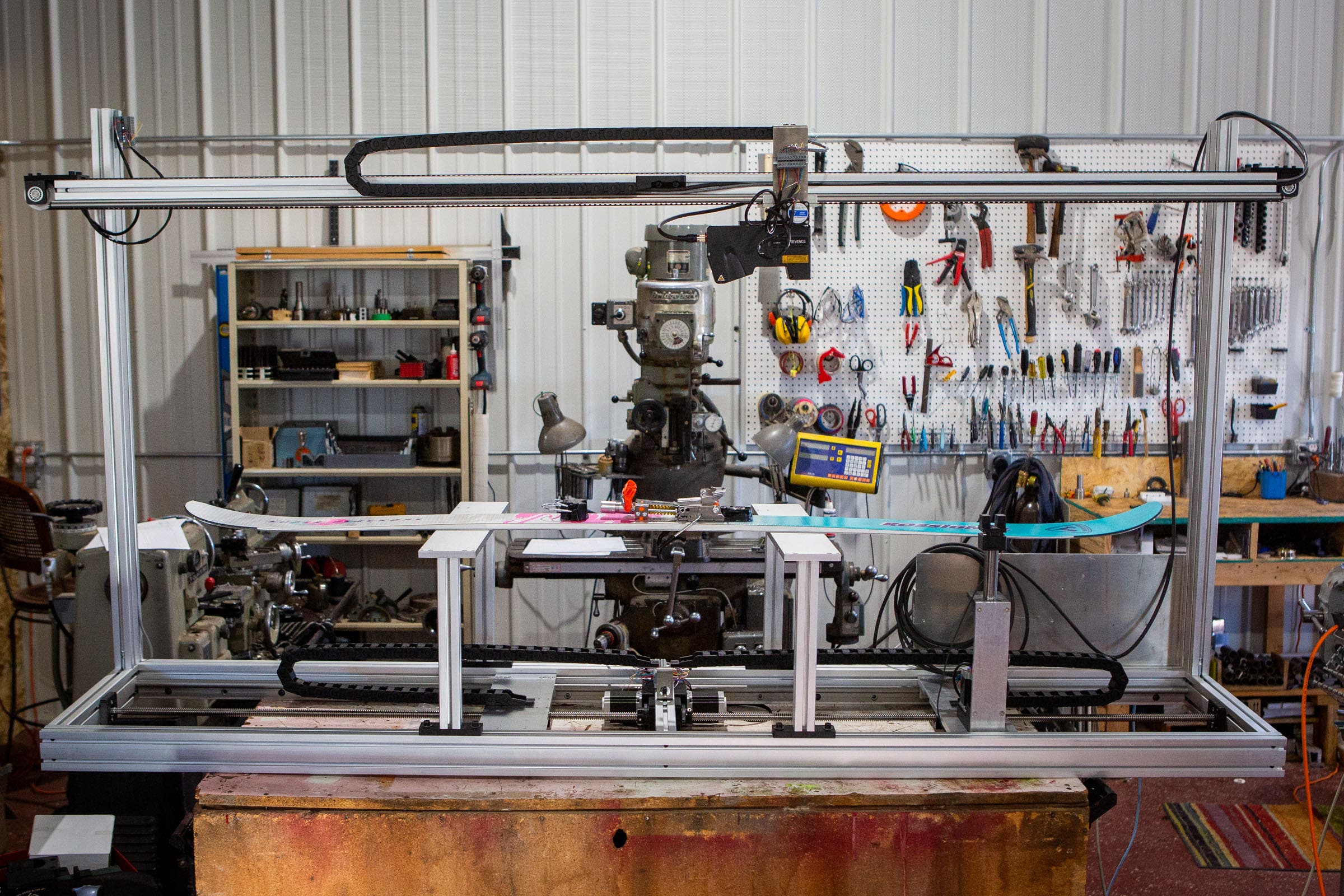
Once the final design was locked in, the project moved into the manufacturing phase. Rather than building the complex mechanical components entirely in-house, the Outside Lab strategically outsourced this critical step. The fabrication and assembly of the mechanical components were entrusted to Dave Cleveland at Custom Engineering Solutions, a specialized firm located in the Granby area of Colorado. This decision leveraged local expertise and craftsmanship, aligning with the spirit of Colorado’s vibrant outdoor industry. The proximity to "ski country" was seen as an additional benefit, ensuring the machine was built with an intimate understanding of its intended environment and application. The final months of the development cycle were dedicated to rigorous calibration, validation, and testing of the machine’s functionality, ensuring its accuracy and repeatability before its official unveiling.
Engineering Precision: Inside the Ski and Snowboard Test Machine
The core of the Outside Lab’s innovation lies in the sophisticated engineering that underpins its Ski and Snowboard Test Machine. Designed to provide a comprehensive profile of a ski or snowboard’s mechanical characteristics, the machine is equipped with advanced sensors and adjustable components that allow for a wide array of precise measurements.
One of its primary functions is the measurement of bending stiffness, commonly referred to as flex. This refers to a ski or snowboard’s resistance to bending along its longitudinal axis. The machine can perform bending tests on both the tip and tail sections, as well as along the main body. During these tests, controlled forces are applied at specific points along the length of the gear, and the resulting displacement is precisely measured. This allows for the creation of a detailed flex profile, illustrating how the stiffness varies from tip to tail. For instance, a softer tip might aid in turn initiation and float in powder, while a stiffer tail can provide powerful exit from turns and stability at high speeds. The machine’s ability to isolate these measurements provides crucial insights into how different flex zones contribute to the overall ride feel and performance characteristics.
Equally critical is the measurement of torsional rigidity, or edge engagement stiffness. This metric quantifies a ski or snowboard’s resistance to twisting along its length, which is directly correlated to its ability to hold an edge, especially on hardpack, ice, or during aggressive carving. The machine can apply torsional forces to individual edges, measuring the degree of twist under specific loads. This provides objective data on how effectively a ski or board’s edge will engage and resist deformation, a key factor in responsiveness and control. The ability to test each side independently or in conjunction with the other allows for a nuanced understanding of how asymmetrical designs or specific construction techniques influence torsional performance.
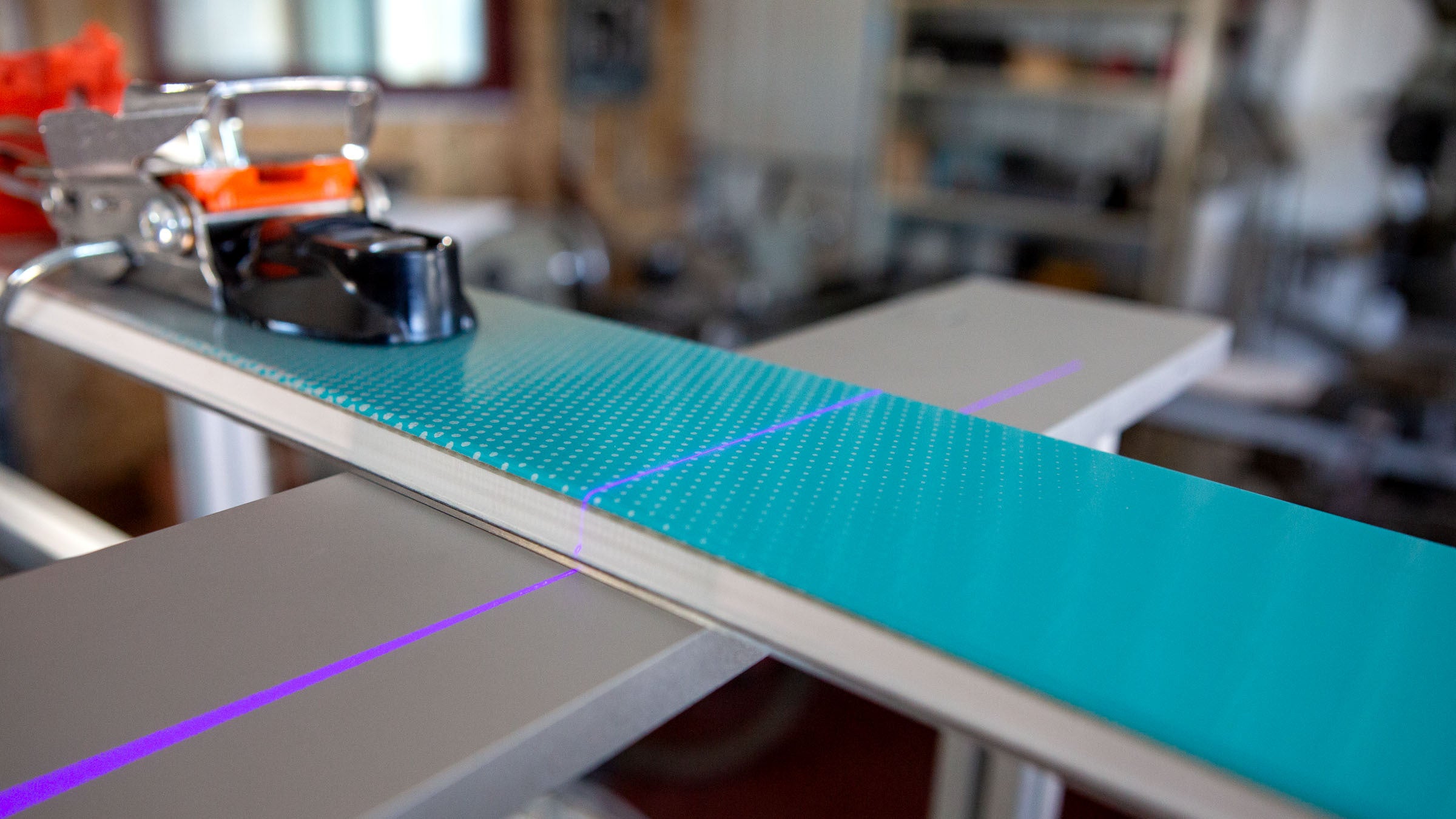
Beyond flex and torsion, the machine excels at geometric profiling. Utilizing a state-of-the-art laser measurement system, the apparatus can scan the entire contact length of a ski or snowboard with remarkable precision, down to less than one-tenth of a millimeter. This laser scanner moves along the length of the product, taking multiple cross-sectional measurements across its width. From this highly detailed data, the system can accurately back-calculate various geometric properties, including:
- Sidecut Radius: This is a crucial determinant of a ski’s or snowboard’s turning characteristics. The machine can identify single or multiple sidecut radii along the length, providing insights into how the gear is designed to initiate, hold, and release a turn.
- Width Profile: Precise measurements of the width at various points (tip, waist, tail) are captured, which directly impacts float in powder, maneuverability, and edge-to-edge transition speed.
- Camber and Rocker Profiles: The laser system can map the subtle curvatures of the base, differentiating between traditional camber (providing energy and edge pressure) and various rocker profiles (enhancing float and ease of turn initiation). This comprehensive geometric data, combined with flex and torsional measurements, paints a complete picture of a ski or snowboard’s design intent and potential performance.
Adam Trenkamp highlighted the shift from subjective to objective data, stating, "Instead of doing this [as his hand flexes a ski], we’re now going to have a machine that actually provides a number to that so we can compare all of the skis or all of the boards and really put ’em on a stiffness scale." This sentiment encapsulates the machine’s primary value proposition: replacing anecdotal assessments with quantifiable metrics that allow for direct, "apples-to-apples" comparisons across the entire market. The adjustability of nearly every component on the machine ensures that it can accommodate a vast range of ski and snowboard types, from narrow race skis to wide powder boards and varying snowboard geometries, making it a truly versatile testing platform.
Bridging the Information Gap: Impact on Manufacturers and Consumers
The implications of the Outside Lab Ski and Snowboard Test Machine extend across the entire snow sports ecosystem, offering tangible benefits to both manufacturers and the end-user.
For manufacturers, this machine represents a powerful new tool for research and development (R&D). Historically, optimizing ski and snowboard performance has been an iterative, often time-consuming process involving numerous prototypes and extensive field testing. With objective, precise data on flex and torsional profiles, manufacturers can:
- Refine Designs with Greater Precision: Engineers can now correlate specific design choices (e.g., core materials, laminate layers, edge geometry) with quantifiable performance outcomes. This allows for more targeted adjustments and faster iteration cycles.
- Validate Material Selection: The machine can help assess how different materials and construction methods influence stiffness and torsional characteristics, leading to more efficient material use and potentially new material innovations.
- Standardize Internal Testing: While the industry lacks universal standards, manufacturers can adopt the Outside Lab’s methodology for their internal R&D, creating a more consistent and robust testing protocol within their own operations.
- Benchmarking and Competitive Analysis: Brands can objectively compare their products against competitors, identifying areas of strength and opportunities for improvement based on hard data rather than subjective perception. A hypothetical industry expert might state, "Having this kind of objective data is a game-changer. It allows us to move beyond ‘feel’ and really engineer for specific performance targets, optimizing everything from turn initiation to high-speed stability." This shift could lead to a new era of performance optimization, where engineering precision drives product evolution.
For consumers, the impact is equally transformative, promising to demystify the gear selection process and empower more informed purchasing decisions. The days of solely relying on marketing jargon or a salesperson’s subjective opinion are waning. With the data generated by this machine, consumers will be able to:
- Make Data-Driven Choices: Instead of vague descriptions like "stiff" or "playful," reviews will include concrete numbers for tip flex, tail flex, and torsional rigidity. This allows skiers and snowboarders to identify gear that precisely matches their riding style, preferred terrain, and ability level.
- Compare Products Objectively: The "apples-to-apples" comparison promised by Dr. Young becomes a reality. A consumer looking for a forgiving, easy-to-turn ski for moguls can look for specific flex numbers, while an aggressive carver can seek out skis with higher torsional rigidity for maximum edge hold.
- Understand Design Intent: By correlating geometric data (sidecut, camber/rocker) with flex and torsional profiles, consumers can gain a deeper understanding of how a ski or board is engineered to perform, helping them predict its behavior on the snow.
- Reduce Buyer’s Remorse: By aligning objective data with personal preferences, the likelihood of purchasing unsuitable gear is significantly reduced, leading to greater satisfaction and enjoyment on the slopes.
- Enhance Review Utility: Outside and SKI publications will integrate this data into their gear reviews, adding a layer of scientific rigor that complements their extensive field testing. This combination of objective measurements and real-world performance feedback will provide the most comprehensive gear evaluations available. Adam Trenkamp emphasized, "We can compare across all of the products in a given brand’s line, or we can compare across brands how each of these skis or snowboards is performing. So when you’re going to buy your new ski or board, and you have an idea of how you would like your ride to feel, we can kind of help guide you to a place where you can choose a product, or a few products, that you’d like to demo with that specific performance in mind."
Broader Implications for the Snow Sports Industry and Beyond
The unveiling of the Outside Lab Ski and Snowboard Test Machine carries broader implications that could resonate throughout the snow sports industry and potentially influence other outdoor gear sectors. This initiative exemplifies the growing trend of leveraging advanced engineering and data analytics to enhance product understanding and consumer confidence in specialized markets.
One significant implication is the potential for accelerated innovation. With a clearer, objective understanding of how design choices translate into performance metrics, manufacturers may be emboldened to experiment more rapidly with new materials, construction techniques, and geometries. This could lead to a new generation of skis and snowboards that are more precisely tailored to specific performance needs, pushing the boundaries of what’s currently possible on snow. For example, a deeper understanding of how composite layups influence torsional stiffness could lead to lighter, yet more powerful, skis.
Furthermore, this development could foster greater market transparency and accountability. As objective data becomes more readily available, manufacturers will face increased pressure to substantiate their performance claims with quantifiable evidence. This could lead to a more honest and competitive marketplace, where product quality and performance are judged not just by marketing but by verifiable metrics. It also raises the possibility of eventually establishing industry-wide standards for these measurements, much like those seen in other sports equipment sectors. While the Outside Lab machine is currently unique in its comprehensive capabilities and dual ski/snowboard compatibility, its success could spur other entities to develop similar testing protocols, ultimately benefiting the entire industry.
The partnership between Outside magazine and CU Denver also highlights the increasing importance of academic-industry collaborations in driving innovation. Universities, with their research infrastructure and intellectual capital, are uniquely positioned to address complex engineering challenges that benefit specific industries. This collaboration serves as a model for how journalistic entities can partner with academic institutions to enhance the factual basis and scientific rigor of their content, providing unparalleled value to their audiences.
Finally, while the current machine is focused on skis and snowboards, the underlying principles of precise, objective performance measurement could theoretically be extended to other categories of outdoor gear where subjective "feel" currently dominates. The success of this endeavor could inspire similar initiatives for testing climbing equipment, hiking footwear, or even cycling components, further elevating the standard of product evaluation across the entire outdoor industry.
In conclusion, the Outside Lab Ski and Snowboard Test Machine is more than just a piece of advanced equipment; it represents a paradigm shift in how snow sports gear is understood, developed, and chosen. By replacing subjective assessments with precise, objective data, the Outside Lab at CU Denver is not only setting a new standard for gear testing but is also paving the way for a more informed, innovative, and transparent future for the entire snow sports community. As this groundbreaking data begins to appear in upcoming SKI and Outside reviews, consumers will gain an unprecedented level of insight, ensuring their next ride on the mountain is truly optimized for their preferences and performance aspirations.
