
Published February 26, 2026, the Outside Lab at the University of Colorado Denver has officially unveiled its state-of-the-art Ski and Snowboard Test Machine, a pioneering innovation poised to redefine how snow sports gear performance is measured and reported. After 18 months of intensive development and countless hours of rigorous engineering within the Outside Lab, this sophisticated apparatus promises to establish a new, objective standard for evaluating critical performance metrics, particularly the complex flex profiles of skis and snowboards. This launch marks a significant leap forward in gear assessment, moving beyond traditional subjective methods to provide consumers and manufacturers with precise, verifiable data.
Addressing an Industry-Wide Data Gap
The impetus behind the creation of the Outside Lab Ski and Snowboard Test Machine stems from a long-identified void in the snow sports industry: the absence of standardized, objective testing protocols for crucial performance characteristics. While certain product categories benefit from established performance and safety benchmarks, these often fall short in capturing the nuanced information vital for understanding how skis and snowboards truly perform on snow. For many years, the development and evaluation of these products have relied heavily on anecdotal experience, qualitative rider feedback, and rudimentary subjective assessments—often characterized by the informal "shop hand bend test."
Adam Trenkamp, Lab Test Editor at the Outside Lab, and Trevor Young, Research Services Program Manager and Ph.D. in Mechanical Engineering at CU Denver, recognized this critical deficiency early in the lab’s operations. "Some products have standard tests to evaluate performance or safety, but these tests don’t always provide the information we really want to know," Trenkamp noted. "Other products have no standards or industry-accepted methods to accurately measure performance; instead, development often relies on experience and field feedback." This scenario, particularly prevalent in the realm of ski and snowboard design, presented a prime opportunity for the Outside Lab to apply scientific rigor to an area previously dominated by qualitative interpretation.
The lack of consistent, quantifiable data for critical performance attributes like longitudinal bending stiffness, torsional stiffness (which dictates edge engagement), and precise geometric profiles has long made it challenging for consumers to make informed purchasing decisions based on objective comparisons. Skiers and snowboarders frequently rely on brand reputation, reviewer impressions, or limited demo experiences, often leading to uncertainty about how a product will truly perform for their specific needs. Similarly, manufacturers, while employing advanced materials and construction techniques, have often lacked the precise, objective feedback necessary to fine-tune designs iteratively and optimize performance across their product lines. The new machine is designed to bridge this gap, offering a singular, comprehensive method to measure these critical factors across diverse brands and models, thereby enabling true "apples-to-apples" comparisons and fostering greater transparency in the market. This initiative promises to elevate the entire discourse around snow sports gear, moving it from subjective opinion to verifiable fact.
The Genesis of a New Standard: Development and Design Chronology
The journey to develop the Outside Lab Ski and Snowboard Test Machine was a meticulous, multi-stage process driven by a commitment to engineering excellence and practical utility. The project officially commenced 18 months prior to its public unveiling, following an initial assessment of industry needs by the Outside Lab team.
Phase 1: Needs Assessment and Research (Initial Months)
The project began with extensive research into existing industry practices and a collaborative dialogue with leading manufacturers and gear experts. "As a lab team, we got together with the folks at SKI over at Outside and asked what kind of holes as far as information regarding ski or snowboard performance they had observed," explained Trevor Young. This consultative approach quickly confirmed the pervasive lack of standardized testing for flex and torsional properties. A primary finding was that objective data on bending stiffness (flex) and edge engagement stiffness—crucial for initiating turns and maintaining control—was "relatively minimally understood within the industry." This foundational insight guided the entire design process, prioritizing the capture of these elusive metrics.
Phase 2: Conceptual Design and Iteration (Mid-Development)
With the core problem defined, the engineering challenge was substantial. The machine needed to be versatile enough to accommodate a wide range of ski and snowboard lengths, widths, and geometries, while simultaneously applying precise, repeatable forces and capturing highly accurate measurements. The team explored several distinct design iterations, refining concepts and addressing potential limitations with each stage. This involved extensive CAD modeling, finite element analysis, and the evaluation of various sensor technologies and actuation systems. "We went through three or four different iterations until we got to the final product that you see here today, which we believe offers us a lot of flexibility in terms of testing capability," Young elaborated, underscoring the rigorous development cycle.
Phase 3: Fabrication and Assembly (Later Stages)
The construction of the machine itself was a collaborative effort, leveraging local expertise. While the conceptual design, detailed engineering schematics, and component specifications were developed in-house at the Outside Lab under the guidance of Adam Trenkamp and Trevor Young, the specialized fabrication and final assembly of the mechanical components were strategically outsourced. This critical manufacturing phase was entrusted to Custom Engineering Solutions, a specialized firm located in Granby, Colorado. This strategic partnership not only ensured high-quality manufacturing standards but also imbued the machine with a "Colorado-designed and built in ski country" ethos, aligning with the regional prominence of snow sports. The assembly process involved the integration of precision mechanical components, advanced sensor arrays, and a robust control system, culminating in a fully functional prototype ready for calibration and rigorous validation testing.
Phase 4: Calibration and Validation (Final Months)
The final stages involved extensive calibration of all sensors and actuators, followed by rigorous validation testing using a diverse array of skis and snowboards. This phase ensured that the machine’s measurements were consistently accurate, repeatable, and truly representative of real-world performance characteristics. The 18-month timeline reflects this comprehensive approach, from initial concept to a fully operational and validated testing platform.
Unpacking the Machine’s Capabilities: Precision Data Points
The Outside Lab Ski and Snowboard Test Machine is engineered to capture an unprecedented array of objective data points, providing a comprehensive understanding of a board or ski’s performance characteristics. Its highly adjustable nature allows for a variety of testing configurations, ensuring adaptability to different product types and specific performance inquiries.
Key Data Points and Measurement Techniques:
-
Bending Stiffness (Longitudinal Flex Profile): The machine can precisely measure the flex profile along the entire longitudinal axis of the ski or snowboard. This includes independent testing of the tip and tail sections, as well as combined longitudinal flex across the entire effective edge. Understanding how a ski or board flexes along its length is crucial, as it directly dictates how the product absorbs terrain variations, initiates turns, and maintains stability at speed. For instance, a softer tip might allow for easier turn initiation and better float in powder, while a stiffer tail could provide more power, pop, and finish to a carve. The machine applies controlled, quantifiable loads at various predefined points along the length and measures the resulting deflection with high accuracy, yielding quantitative stiffness values (e.g., Newtons per millimeter of deflection) at multiple points. This allows for the creation of a detailed flex curve, far more informative than a single "stiffness" rating.
-
Edge Engagement Stiffness (Torsional Flex): Perhaps one of the most significant innovations of this machine is its ability to objectively measure torsional stiffness, often referred to as edge engagement. This metric quantifies how resistant a ski or snowboard is to twisting along its longitudinal axis, which directly correlates to how effectively it holds an edge during a turn. A higher torsional stiffness generally translates to better edge grip and power transfer on hard snow or ice, crucial for high-performance carving and stability. Conversely, a more forgiving torsional flex might offer a surfier feel in powder or a more playful ride. The machine can apply precise twisting forces to specific sections of the gear, particularly along the edges, and measure the resultant angular deformation. This provides critical, repeatable data on a product’s "bite," responsiveness, and ability to resist deflection under torsional load, addressing a long-standing challenge in objectively quantifying a ski’s or board’s carving prowess.
-
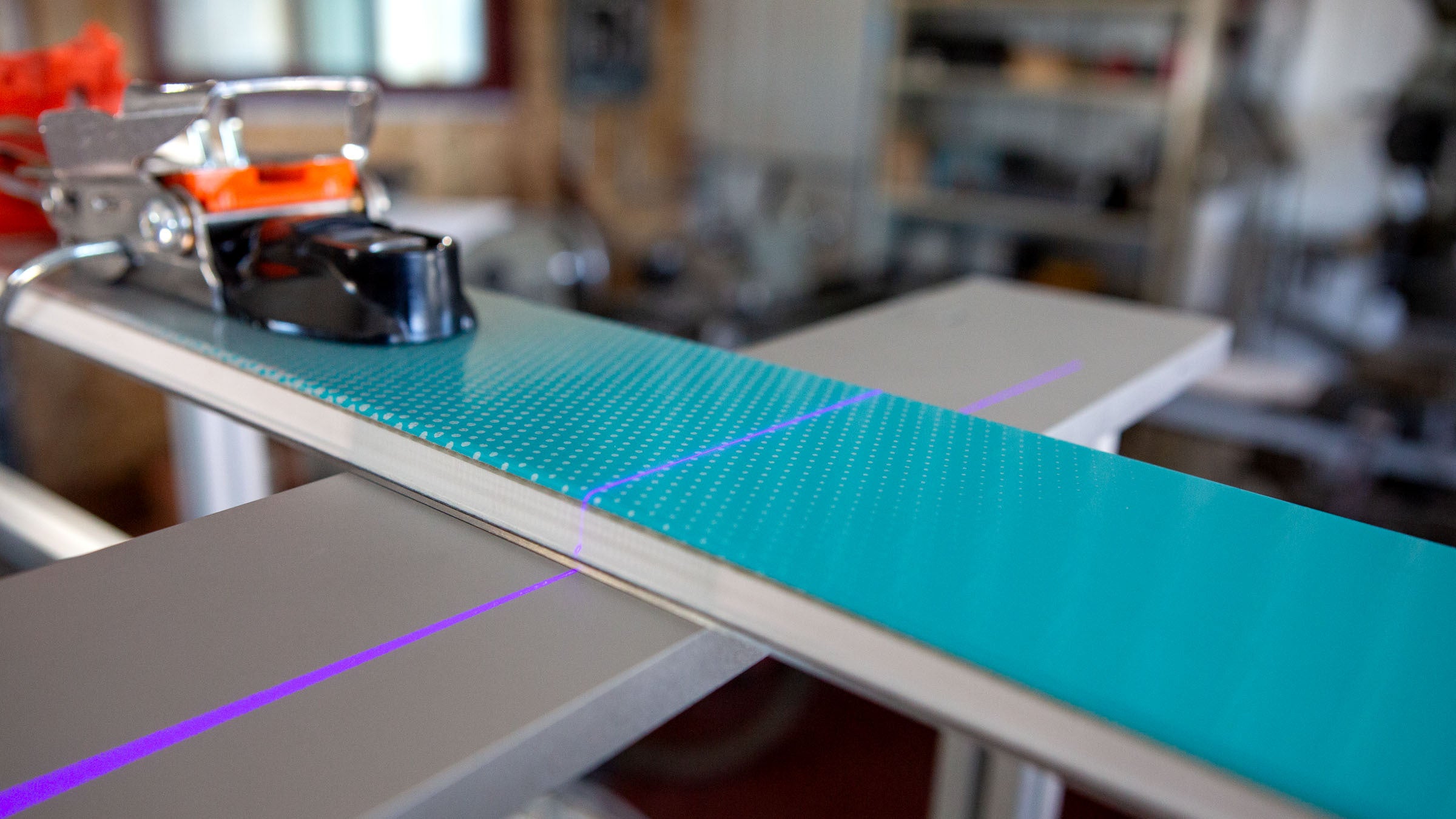
Complete Geometric Profile: Beyond dynamic flex measurements, the machine excels at mapping the precise static geometry of snow sports gear. Utilizing a sophisticated laser measurement system, it can scan the entire length and width of a ski or snowboard with exceptional accuracy, down to less than one-tenth of a millimeter. This advanced laser scanner traverses the product, capturing a dense cloud of data points that reveal a comprehensive anatomical view:
- Sidecut Radius/Radii: This refers to the curvature of the ski or snowboard’s edge. Many modern designs incorporate complex, often progressive or multiple sidecut radii, to optimize performance across different turn shapes and speeds. The machine can accurately map these intricate curves along the entire effective edge.
- Width Profile: Precise measurements of tip width, waist width, and tail width, as well as intermediate widths, are captured. These dimensions are fundamental to understanding how a product floats in powder, transitions from edge to edge, and its overall maneuverability.
- Camber and Rocker Profile: These crucial vertical profiles dictate how a ski or snowboard interacts with the snow, profoundly influencing float, turn initiation, energy transfer, and effective edge length. The laser system can accurately map these complex vertical curvatures from contact point to contact point, providing quantitative data on their extent and location.
- Thickness Profile: The machine can also measure subtle variations in thickness along the product’s length and width, which is a key design element influencing both flex and torsional characteristics.
Trevor Young detailed the precision of the system: "We use a laser measurement system on our machine that has precision down to less than one-tenth of a millimeter. What that’s going to do is take geometric measurements of the ski at predefined points… and then using that data we can do some post-processing and then back-calculate the stiffness from that information." This level of detail provides an unparalleled anatomical view of snow sports gear.
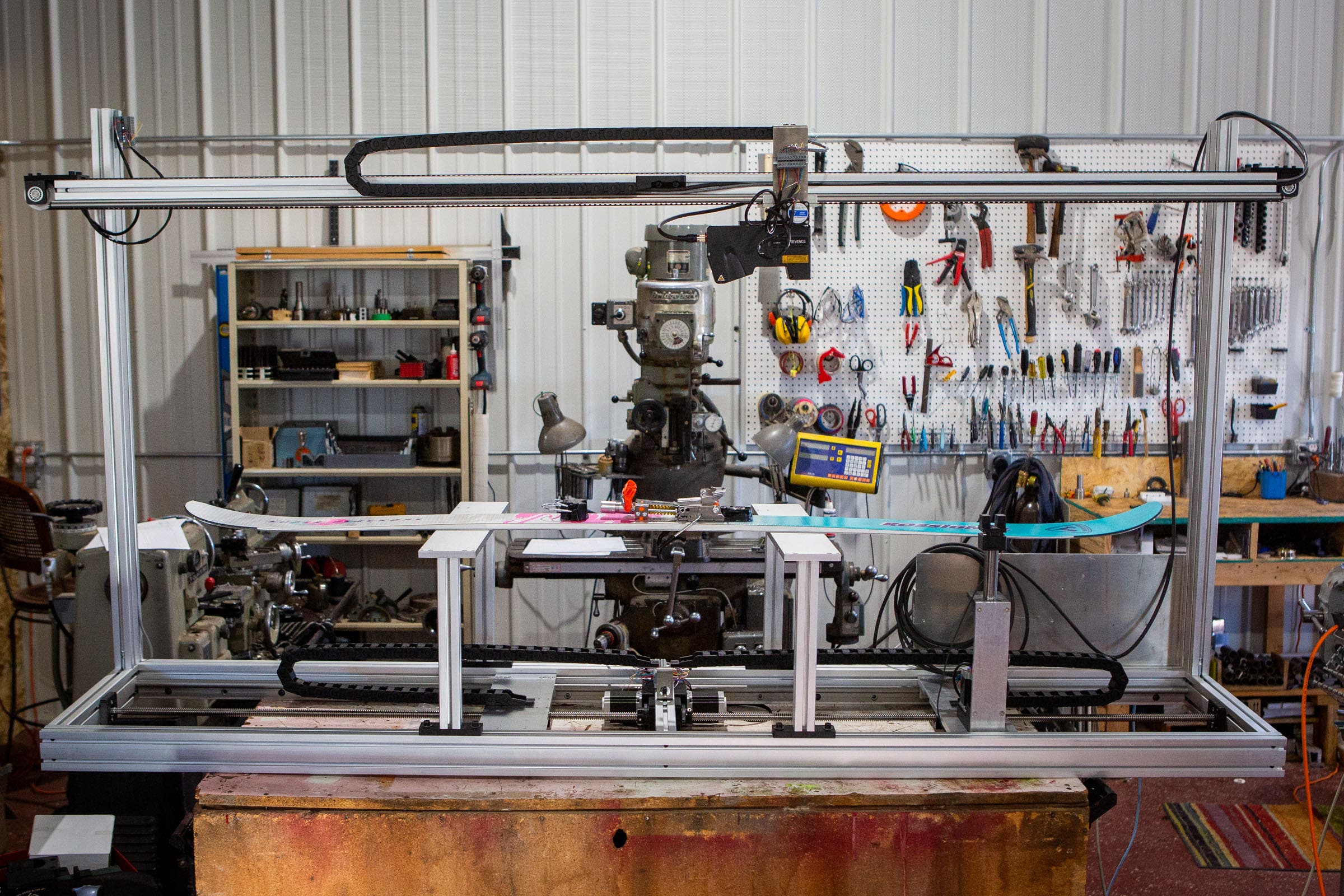
A critical design consideration, and a key differentiator from many existing commercial or proprietary testing machines, was the machine’s ability to handle both skis and snowboards. "In some cases, machines that are currently available for this type of thing are exclusive to skis and exclude snowboards," Young noted. "So with our design, we wanted to make sure that we could handle both skis and snowboards." This dual functionality significantly broadens the scope of its utility for the wider snow sports community, ensuring a holistic approach to gear evaluation.
Broader Impact and Industry Implications
The introduction of the Outside Lab Ski and Snowboard Test Machine is poised to send ripple effects throughout the snow sports industry, benefiting consumers, manufacturers, and the broader ecosystem of gear evaluation.
Empowering Consumers: For the average skier or snowboarder, the most immediate and tangible benefit will be the availability of objective, comparable data. Instead of relying solely on subjective reviews, brand loyalty, or the imprecise "hand bend" test in a shop, consumers will have access to quantifiable metrics for flex, edge engagement, and geometry. This will allow them to:
- Make Informed Decisions: Directly compare the stiffness profiles, sidecut radii, and camber/rocker patterns of different models across brands, identifying products that align precisely with their preferred riding style, terrain, and ability level.
- Match Gear to Needs: If a rider knows they prefer a softer flex for playful riding or a stiffer, more torsionally rigid board for aggressive carving, they can now filter options based on real, empirical numbers rather than subjective descriptions.
- Demystify Performance: Break down the complex interplay of design features into understandable, measurable components, leading to greater confidence in purchases and a deeper understanding of how their equipment influences their ride. As Adam Trenkamp succinctly put it, "We’re removing the shop ‘hand’ bend test and adding real values."
Advancing Manufacturing and Research & Development: For ski and snowboard manufacturers, the machine represents a powerful new tool for product development, quality control, and innovation.
- Precision in Design: Engineers can now use objective data to validate design iterations, experiment with new materials, and fine-tune performance characteristics with unprecedented accuracy. This moves development from an iterative process reliant heavily on qualitative field feedback to one guided by precise empirical evidence, accelerating innovation cycles.
- Targeted Performance: Manufacturers can more effectively dial in specific performance characteristics—such as a specific flex pattern for a powder ski optimized for float, or a precise torsional stiffness for a race board designed for maximum edge grip—and ensure greater consistency across production runs. This leads to higher quality, more predictable products.
- Data-Driven Marketing: The ability to back up marketing claims with concrete, verifiable data will significantly enhance brand credibility and provide new, compelling avenues for communicating product benefits to consumers. This fosters trust and allows for more precise targeting of specific rider segments.
- Benchmarking and Innovation: The machine will allow manufacturers to benchmark their products against competitors using a common, objective standard, fostering healthy competition, driving innovation, and potentially leading to entirely new design paradigms based on optimized data.
Elevating Gear Reviews and Industry Standards: The Outside Lab, in conjunction with its publishing partners like SKI and Outside, will integrate this objective data into its comprehensive gear reviews. This will transform the landscape of gear journalism, moving beyond purely qualitative assessments to a robust hybrid model that combines expert rider feedback with scientific measurements. This approach promises to provide the most holistic, nuanced, and insightful gear evaluations ever seen in the industry, offering a richer context for consumer decisions. Furthermore, the machine’s capabilities lay the groundwork for the potential establishment of new, industry-wide standards for measuring ski and snowboard performance. This could lead to a more harmonized and transparent evaluation ecosystem across the entire snow sports sector, similar to established standards in other sports equipment industries.
The Future of Snow Sports Gear
The unveiling of the Outside Lab Ski and Snowboard Test Machine is not merely the launch of a new piece of equipment; it is the dawn of a new era in snow sports gear evaluation. By providing objective, precise, and comparable data on critical performance metrics, the Outside Lab and CU Denver are empowering consumers to make better choices and equipping manufacturers with the tools to innovate more effectively.
"We can compare across all of the products in a given brand’s line, or we can compare across brands how each of these skis or snowboards is performing," Trevor Young summarized, highlighting the machine’s transformative potential. "So when you’re going to buy your new ski or board, and you have an idea of how you would like your ride to feel, we can kind of help guide you to a place where you can choose a product, or a few products, that you’d like to demo with that specific performance in mind." This represents a profound shift towards data-driven consumer empowerment.
The collaborative spirit between the journalistic rigor of Outside Lab and the engineering prowess of CU Denver has culminated in an invention that promises to elevate the entire snow sports experience. As this groundbreaking machine begins its work, the industry eagerly anticipates the wealth of data it will generate and the profound impact it will have on how we understand, choose, and ultimately enjoy our time on the mountain. Ski and snowboard enthusiasts are encouraged to look for the integration of this new data in upcoming gear reviews, heralding a future where informed decisions are paramount.
