
The final World Cup cross-country skiing event of the season, a grueling 20-kilometer mass start for the women, was dramatically reshaped in the closing kilometer, denying promising newcomer Karoline Grøtting a potential fairytale victory. What appeared to be a maiden World Cup triumph for the 24-year-old from the independent Team Anlegg Øst dissolved into a heartbreaking fourth-place finish after a series of unfortunate falls and a reshuffling of the lead pack in the treacherous conditions. The race, held in Lake Placid, New York, was characterized by unpredictable weather, challenging terrain, and a high degree of drama, ultimately seeing Swedish sprinters Jonna Sundling and Linn Svahn capitalize on the chaos to secure a Swedish one-two finish, with veteran Norwegian Heidi Weng completing the podium.
The 20km mass start race is known for its strategic complexities, often evolving into a tactical battle as skiers jostle for position from the outset. This particular edition, however, proved to be even more unpredictable than usual. The women’s field, featuring many of the sport’s top contenders, faced a course that had been significantly affected by recent weather, leading to sections of soft, slushy snow that proved to be a significant impediment. This challenging snow condition became a recurring theme throughout the race, contributing to several significant incidents that altered the course of the competition.
Early in the race, just past the halfway mark, a significant pile-up occurred involving several prominent athletes. Among those who fell were established stars such as American Jessie Diggins, a favorite for the win, and Norway’s Astrid Øyre Slind. The incident not only disrupted their race rhythm but also saw the peloton, which had been relatively consolidated up to that point, further condense as other skiers navigated the incident. This moment highlighted the precarious nature of the mass start format, where a single misstep or collision can have far-reaching consequences for an athlete’s race.
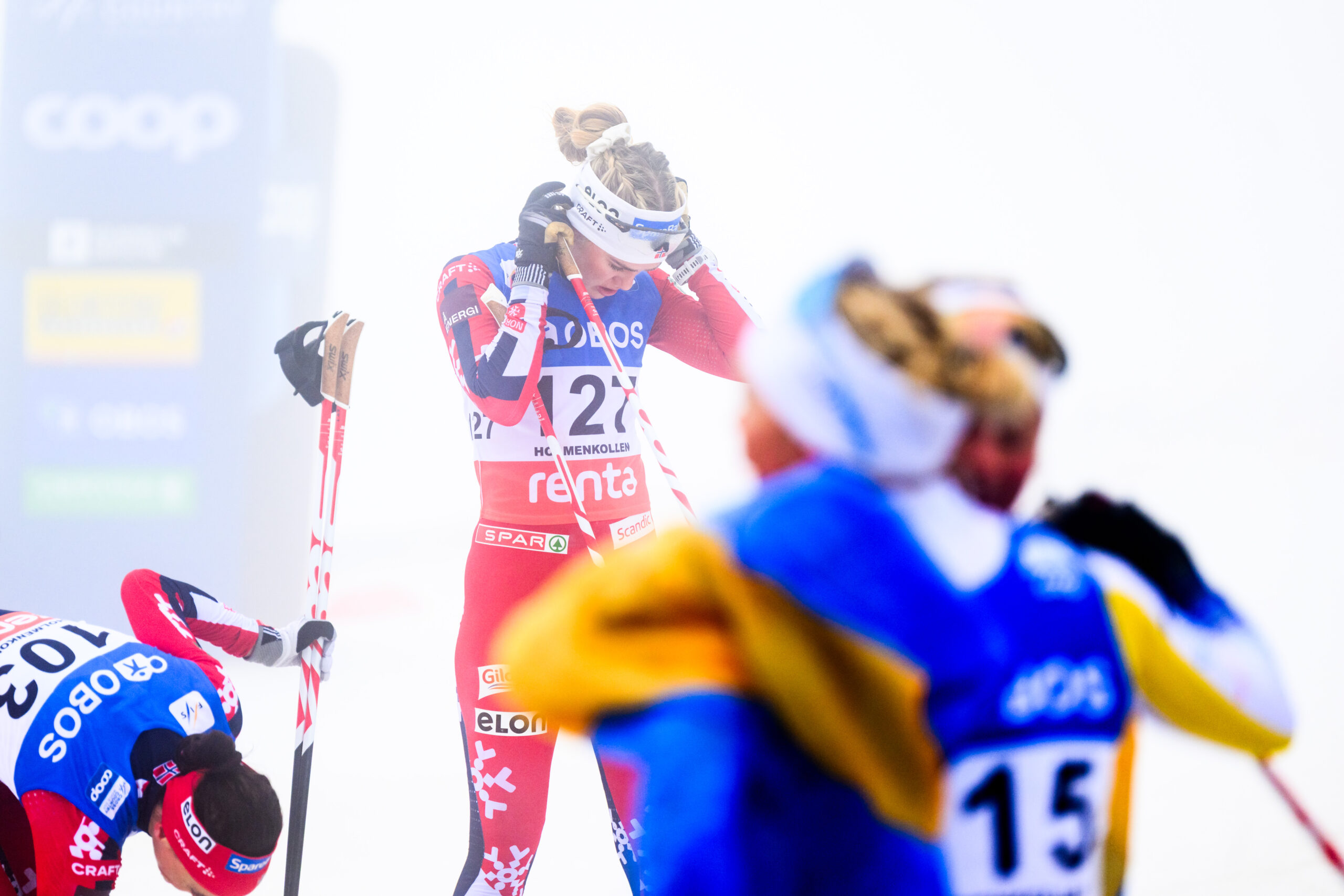
As the race entered its crucial final kilometers, it was the relatively unknown Karoline Grøtting who emerged as the unexpected leader. Grøtting, competing for a privately funded team, had skied a remarkably strong race, demonstrating impressive stamina and tactical acumen. With just one kilometer remaining, she had managed to break away from the main group and was on the verge of achieving a stunning upset victory. Her performance up to this point had already captured the attention of observers, showcasing a level of talent that suggested a bright future in the sport.
However, in a cruel twist of fate, Grøtting’s dream of a World Cup win evaporated in a matter of seconds. As she approached the final climb, she fell. This fall not only halted her momentum but also allowed other competitors to close the gap. Shortly after, Frida Karlsson of Sweden, another pre-race favorite who had been involved in the earlier incident, also fell on the treacherous terrain. The dual falls effectively ended Grøtting’s chances of victory and significantly impacted Karlsson’s final standing.
The drama did not end with Grøtting and Karlsson. In the closing stages, as athletes navigated the final ascent, Jessie Diggins, who had fought her way back into contention, also experienced a fall. Despite appearing to have regained her composure and positioning herself strategically, the American lost her balance in the soft snow, forcing her to watch as the leading group surged ahead. Diggins’ fall, much like the others, underscored the unpredictable and unforgiving nature of the conditions.
This cascade of falls and the ensuing reshuffling of the field opened the door for other athletes. Swedish sprinters Jonna Sundling and Linn Svahn, known for their explosive finishing power, seized the opportunity. They launched a decisive attack, breaking away from the remaining contenders. They were joined by the experienced Norwegian Heidi Weng, who had also demonstrated resilience throughout the race. The trio skied together onto the finishing straight, with Sundling ultimately crossing the line first, followed closely by her compatriot Svahn. Heidi Weng secured a solid third place, adding another podium finish to her impressive career.
For Karoline Grøtting, the race concluded in a deeply disappointing fourth place. While an excellent result for a relative newcomer, it was a bitter pill to swallow after having led with such a small distance to the finish. Frida Karlsson, who had been a strong contender, finished further back in 15th position, a testament to the impact of the late-race incidents.
Race Chronology and Key Moments:
- Early Race (First Half): The women’s 20km mass start commenced with a large, consolidated peloton. The challenging snow conditions were immediately apparent, requiring careful navigation from all athletes.
- Mid-Race Incident (Approx. 10km Mark): A significant pile-up occurred, involving prominent skiers such as Jessie Diggins and Astrid Øyre Slind. This incident disrupted the race flow and led to a tightening of the field.
- Grøtting’s Surge (Approx. 19km Mark): Karoline Grøtting, a relative newcomer, emerged as the surprise leader, breaking away from the main group and appearing poised for a dramatic victory.
- Late-Race Falls (Final Kilometer): In quick succession, Karoline Grøtting, Frida Karlsson, and Jessie Diggins all fell on the challenging terrain in the final kilometer, drastically altering the outcome of the race.
- Swedish Dominance (Final Stretch): Jonna Sundling and Linn Svahn, capitalizing on the chaos, launched a successful attack to secure a Swedish one-two finish. Heidi Weng followed for third.
- Final Standings: Jonna Sundling (SWE) won in 48:17.1, Linn Svahn (SWE) was second at +3.5 seconds, and Heidi Weng (NOR) finished third at +4.2 seconds. Karoline Grøtting (NOR) placed fourth.
Supporting Data and Context:
The 20km mass start is a demanding discipline in cross-country skiing, requiring a combination of endurance, tactical awareness, and the ability to handle varied terrain and weather conditions. The World Cup circuit, organized by the International Ski Federation (FIS), comprises a series of races held across different countries throughout the winter season, culminating in a grand finale. Lake Placid, a renowned winter sports venue, has hosted numerous international competitions, and its challenging courses often test the athletes’ mettle.

The performance of Karoline Grøtting is particularly noteworthy. As an athlete representing a privately funded team, her journey to the elite level often involves fewer resources and support structures compared to national team athletes. Her ability to compete at the sharp end of a World Cup race, especially in the season finale, highlights her individual talent and dedication. Her fourth-place finish, while not a win, is a significant achievement that signals her potential to challenge for podiums in future seasons.
The dominance of Swedish skiers, particularly in the sprint disciplines, has been a feature of recent seasons. Jonna Sundling and Linn Svahn’s performance in the final race of the season reinforces Sweden’s strength in depth. For Heidi Weng, her third-place finish represents a strong performance from a seasoned veteran, demonstrating her continued competitiveness against a new generation of skiers.
Analysis of Implications:
The dramatic conclusion of the women’s 20km mass start has several implications for the sport. Firstly, it underscores the inherent unpredictability of cross-country skiing, where even the best-laid plans can be undone by a single moment of misfortune. The challenging conditions in Lake Placid served as a stark reminder of the importance of adaptability and resilience in competitive skiing.

Secondly, Grøtting’s near-victory, despite the eventual disappointment, has likely elevated her profile within the sport. Her performance signals that she is a talent to watch and could potentially become a significant challenger to the established stars in the coming seasons. Her success, achieved with a private team, may also inspire other athletes facing similar resource constraints.
For the Swedish team, the one-two finish is a positive note to end the season on, solidifying their team’s strength and providing momentum heading into future competitions. For Jessie Diggins and Frida Karlsson, the falls represent a frustrating end to their season, but their ability to remain competitive throughout the year demonstrates their consistent high performance.
The race also highlights the ongoing evolution of the sport, with emerging talents like Grøtting challenging the established order. The tactical nuances of mass start races, combined with the influence of external factors like weather and snow conditions, ensure that each event offers a unique narrative and potential for surprises. As the cross-country skiing season draws to a close, the events in Lake Placid have provided a memorable and dramatic conclusion, setting the stage for what promises to be an exciting next chapter in the sport.
Full Results (Top 3 Women, 20 km Mass Start):

- Jonna Sundling, Sweden: 48:17.1
- Linn Svahn, Sweden: +3.5 seconds
- Heidi Weng, Norway: +4.2 seconds
Complete results for the event can be found at https://www.langrenn.com/event/fis-wc-lake-placid-20-km-mass-start-f/
