
The world of professional snowboarding is often defined by innovation, pushing the boundaries of what’s possible on a board, and a constant evolution of style and technique. Among the current elite, Zeb Powell stands out not only for his remarkable skill and creativity but also for his distinctive approach to equipment. Powell is widely recognized for his preference for exceptionally long, often custom-designed snowboards, particularly those featuring a fish-tail shape. Recently, a demonstration of this unconventional choice saw several fellow professional snowboarders attempting to ride Powell’s colossal 205cm board, providing a compelling visual and practical exploration of how equipment can influence performance and perception in the sport.
The Unique Appeal of Extended Snowboard Dimensions
Snowboard dimensions have historically evolved to cater to diverse riding styles. Standard boards typically range from 150cm to 165cm for adults, with lengths adjusted based on rider height, weight, and intended use (freestyle, freeride, all-mountain). The standard "waist width" also plays a critical role, influencing edge hold and boot clearance. However, certain disciplines and individual preferences necessitate departures from these norms.
Powell’s embrace of significantly longer boards, such as his noted 205cm model, deviates sharply from the mainstream. This length offers a vastly increased surface area and a longer effective edge. In theory, a longer effective edge can translate to more stability at high speeds, enhanced edge hold on firm snow, and a more planted feel during landings from significant airs. The increased surface area can also provide superior floatation in deep powder, allowing the rider to stay on top of the snow rather than sinking.
However, these advantages come with significant trade-offs. Maneuverability is drastically reduced. Shorter, quicker turns become challenging, and initiating spins or executing technical freestyle maneuvers requires a completely different approach, if not becomes practically impossible on such a large platform. The sheer weight and leverage of a 205cm board also present considerable physical challenges, demanding greater strength and control from the rider. This dichotomy between potential stability and profound maneuverability limitations is precisely what makes Powell’s choice so intriguing and the reactions of other pros so revealing.
A Demonstration of Extreme Equipment
The recent event, captured in accompanying visuals, showcased a group of professional snowboarders stepping outside their comfort zones to experience Powell’s signature equipment. While specific details regarding the exact location or the full roster of participating riders were not provided in the initial reporting, the implication is a gathering of peers curious about, and perhaps skeptical of, the practicality of such an oversized board for anything beyond specific conditions or styles.
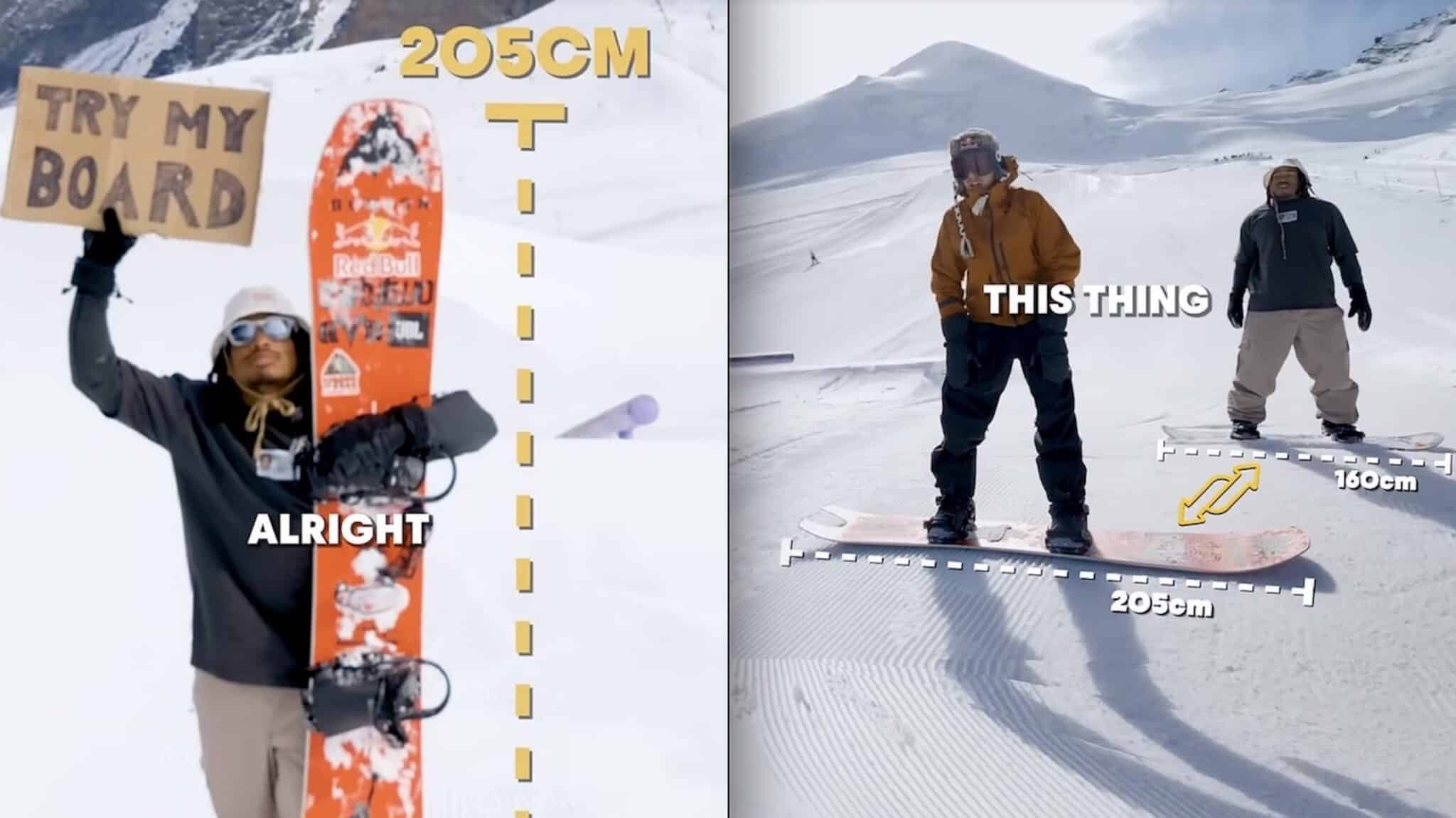
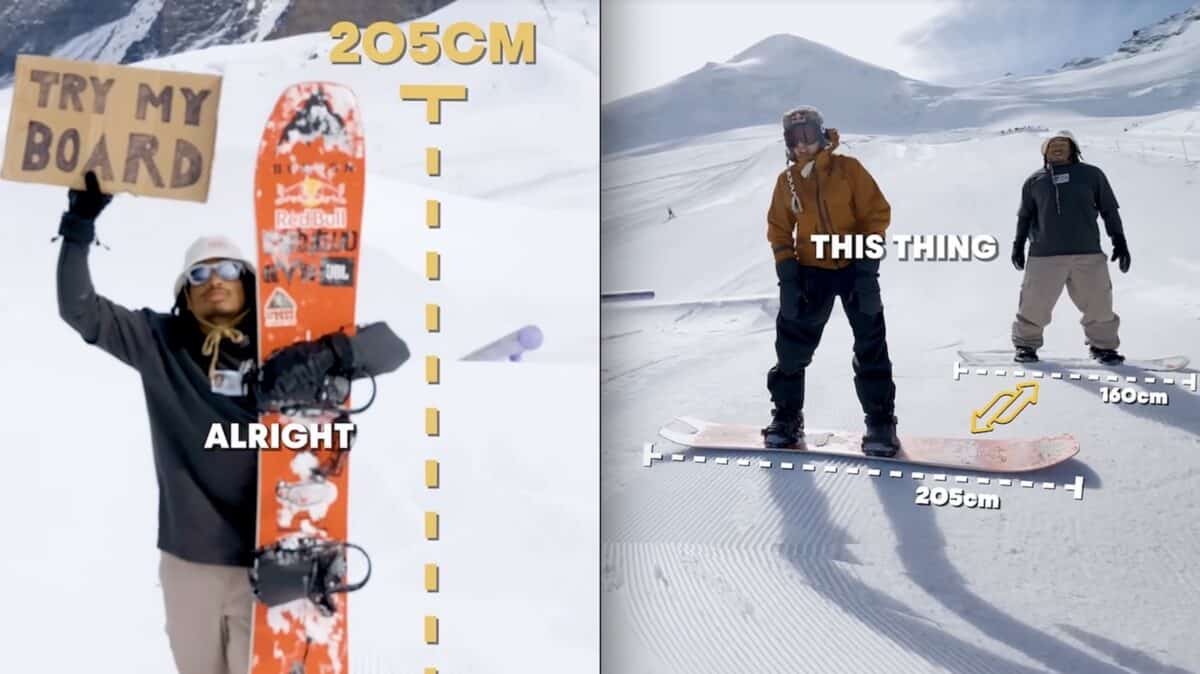
The visual evidence, particularly the accompanying image, depicts snowboarders interacting with the exceptionally long board. The scale is immediately apparent, highlighting the contrast between this board and the typical equipment they would use for their respective disciplines. The image serves as a visual anchor, underscoring the substantial physical presence of the 205cm board and the inherent challenge it presents.
The inclusion of a video embed (though the content of the video itself was not directly accessible for analysis in this context) strongly suggests that the event involved actual attempts by these professionals to ride the board. This would have provided invaluable insights into their physical and technical adjustments, their successes, and their inevitable struggles. Such a demonstration is not merely a novelty; it’s an informal, yet potent, research and development session, offering a rare glimpse into the practical implications of extreme equipment choices.
Professional Reactions and Inferred Challenges
While direct quotes from the participating snowboarders were not included in the original text, the phrase "it went pretty much exactly how you’d expect" strongly implies a range of predictable outcomes. For riders accustomed to the agility and responsiveness of standard-length boards, maneuvering a 205cm board would undoubtedly be a significant undertaking.
One can infer that initial attempts likely involved a steep learning curve. The sheer length would make edging difficult, requiring a wider stance and a more deliberate weight transfer to engage the side of the board. Quick transitions between turns would be slow and require significant commitment. Freestyle maneuvers, such as ollies, spins, or even basic grabs, would be exponentially more difficult to initiate and control due to the board’s inertia and extended length. The center of mass would be further from the rider, altering balance and leverage points considerably.
It’s plausible that some riders may have found success in specific scenarios, perhaps on a long, open slope where stability at speed was prioritized. The fish-tail design of Powell’s board, often associated with powder riding and a surf-like feel, might have offered some advantages in softer snow conditions, allowing for a more surfy, arcing turn. However, for general riding, especially in varied terrain or park settings, the board’s limitations would likely become glaringly apparent.
The reactions, therefore, would likely have ranged from amusement and surprise at the sheer scale of the challenge to grudging respect for Powell’s ability to master such equipment. It’s a testament to the individualization of snowboarding that a rider can not only excel but also inspire curiosity and experimentation with such unique gear.
Zeb Powell: A Pioneer of Personal Style
Zeb Powell’s reputation precedes him as one of snowboarding’s most innovative and dynamic athletes. His ability to blend technical prowess with a distinctive, often playful, style has garnered him a significant following. His creative approach extends beyond his riding to his choice of equipment, where he has consistently experimented with non-traditional board shapes and sizes.
Powell’s comfort and proficiency on these extended boards are not accidental. They are the result of years of practice, adaptation, and a deep understanding of how to manipulate such equipment. His mastery of these long boards allows him to execute tricks and navigate terrain in ways that are unique to his style, setting him apart in a sport that values individuality. This willingness to push personal boundaries, both in terms of physical execution and equipment choice, makes him a compelling figure in the snowboarding community.
The Broader Implications for Snowboard Design and Rider Individuality
The trend towards personalized equipment in extreme sports is a significant development. While major manufacturers often focus on mass-market appeal, athletes like Zeb Powell demonstrate the potential for highly specialized designs to unlock new levels of performance and expression for individuals.
Powell’s approach raises questions about the future of snowboard design. Could there be a resurgence of interest in longer boards for specific applications, or perhaps a more nuanced understanding of how length and shape can be tailored for individual riders rather than broad categories? The data from such informal experiments, even if anecdotal, can contribute to the collective knowledge base of snowboard design and engineering.
Furthermore, this event underscores the importance of rider individuality in sports. While standardized equipment can promote accessibility and competition, the willingness of top athletes to explore unconventional approaches can inspire others and push the sport forward. It highlights that "best" is often subjective and deeply personal, influenced by a rider’s unique biomechanics, aesthetic preferences, and the specific type of riding they wish to pursue.
The act of professional riders testing Powell’s board serves as a powerful reminder that innovation in snowboarding isn’t solely driven by technological advancements from manufacturers. It is also fueled by the vision, experimentation, and sheer determination of athletes who dare to ride differently, challenging the status quo and redefining what is possible on a snowboard. The visual of pros grappling with Powell’s enormous board is more than just a moment of curiosity; it’s a snapshot of the ongoing evolution of snowboarding, where personal vision and extreme equipment can converge to create something truly remarkable.
