
Italy concluded an extraordinary clean sweep of the speed events at the World Cup Finals in Kvitfjell, Norway, as veteran racer Dominik Paris triumphed in the men’s Super-G, securing a remarkable downhill-Super-G double. This victory not only underscored Paris’s mastery of the challenging Olympiabakken course but also capped an unprecedented weekend of Italian dominance, with four wins in four speed races, cementing their position as a formidable force in alpine skiing.
Kvitfjell’s Olympiabakken: A Stage for Legends
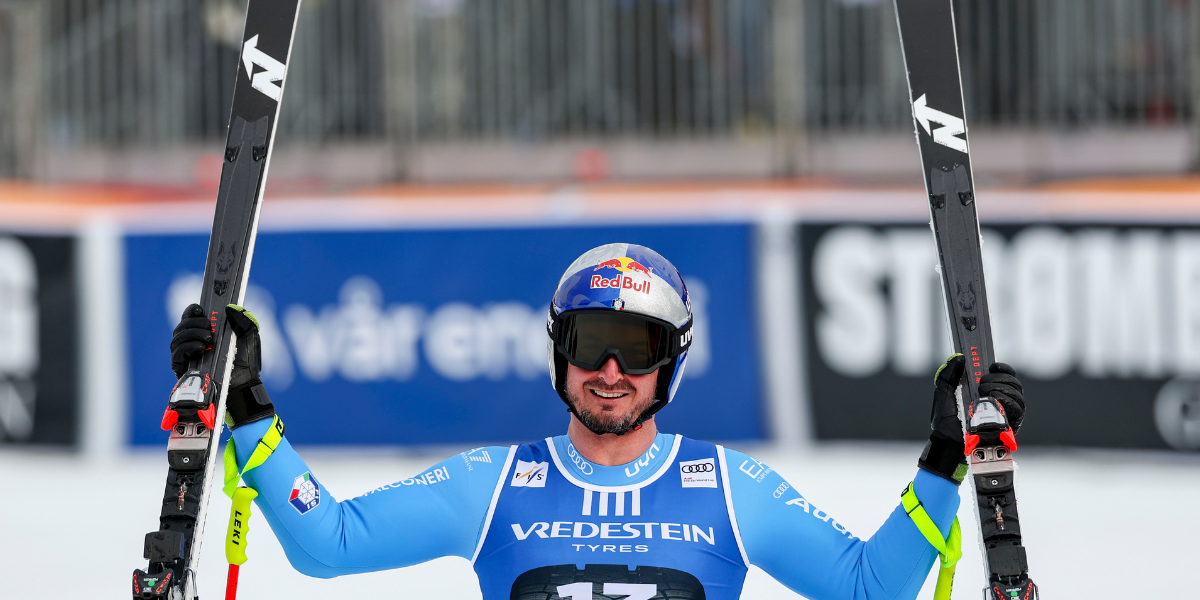
The final men’s speed race of the 2026 season unfolded on Olympiabakken, the iconic Olympic track meticulously designed by legendary Swiss racer Bernhard Russi for the 1994 Winter Games. Known for its demanding yet flowing character, combining high-speed sections with technical challenges and significant terrain changes, Olympiabakken consistently tests the limits of the world’s best downhill and Super-G specialists. The course’s reputation for fast, fair racing has made it a favorite among competitors, often serving as a decisive battleground for season titles and crystal globes. On this particular day, the conditions presented an additional layer of complexity: unusually warm temperatures for late March resulted in slushy snow, and intermittent strong winds, particularly through the middle sections, introduced an element of unpredictability that favored earlier bib numbers and adaptable skiers.
Italy’s Unprecedented Speed Sweep
The Italian team arrived in Kvitfjell with high hopes, but few could have predicted such a resounding display of strength across all speed disciplines. The weekend began with Laura Pirovano’s stellar performance in the women’s downhill, where she not only claimed victory but also secured the coveted downhill discipline globe. This was followed by Sofia Goggia’s equally impressive win in the women’s Super-G, which also clinched her the season title in that discipline. These two triumphs set a formidable precedent, building immense momentum for the Italian men. Dominik Paris then seized the opportunity, first by dominating the men’s downhill, and then, with his Super-G win, completing an astounding four-race, four-victory sweep for Italy in the speed events. This collective achievement is a powerful testament to the depth of talent, rigorous training, and strategic execution within the Italian national team, signaling a golden era for Italian alpine speed skiing. The significance extends beyond individual glory, highlighting a robust program capable of nurturing multiple world-class athletes simultaneously.
Men’s Super-G Race Analysis: A Battle of Precision and Power
The men’s Super-G competition was characterized by early declarations of intent and a dramatic escalation of performance throughout the top seed. With the start list designed to place the highest-ranked contenders later, the initial group still proved capable of shaping the leaderboard.
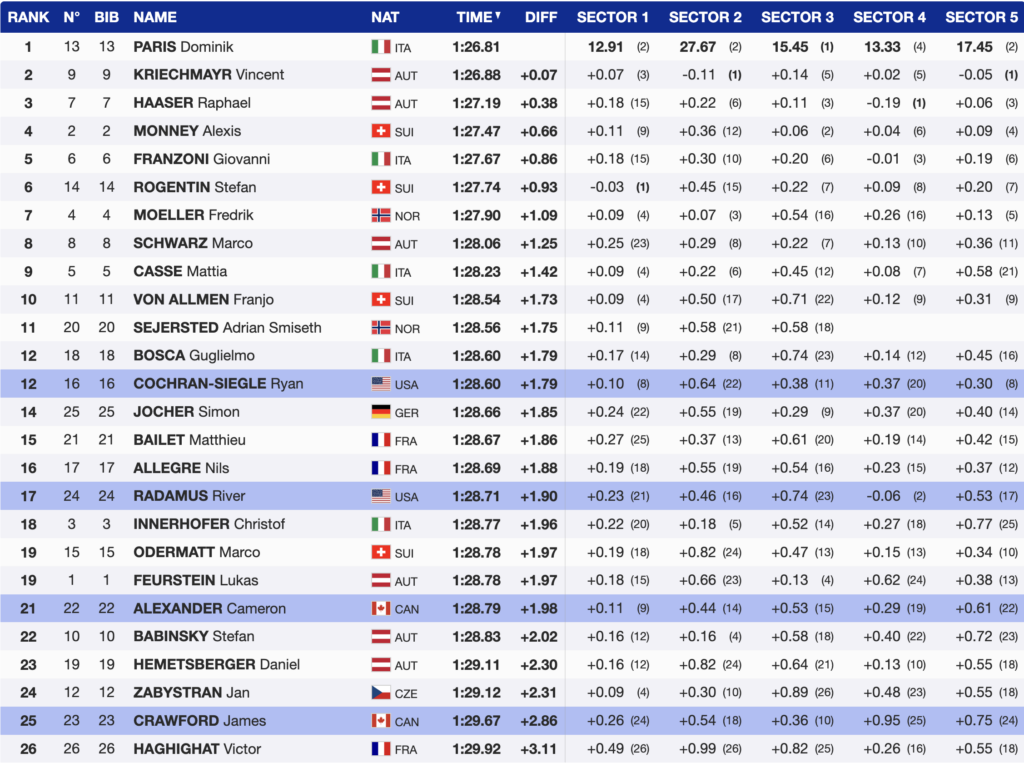
- Early Pace Setters: Starting with bib 2, the young Swiss talent Alexis Monney, born in 2000, delivered a remarkably composed and powerful run. His time of 1:27.47 immediately set a high benchmark, demonstrating his burgeoning potential and placing him in a strong provisional lead after the first five skiers. This early performance hinted at the competitive nature of the field and the excellent form of some of the younger athletes.
- The Austrian Ascent: The race truly ignited with the arrival of the Austrian contingent. Raphael Haaser, sporting bib 7, attacked Olympiabakken with visible strength and determination. He skillfully generated speed from the upper sections and maintained it through the entire course, ultimately taking the lead by a significant 0.28 seconds. His aggressive yet controlled skiing showcased why he is considered a rising force in the discipline. Not to be outdone, his compatriot Vincent Kriechmayr, starting just two bibs later with number 9, responded immediately with a display of brilliance and precision. Kriechmayr, a seasoned veteran known for his fearless approach, pushed the limits, carving out an even faster time and seizing the lead by an additional 0.31 seconds over Haaser. The Austrian duo had established a commanding 1-2 position, setting the stage for what appeared to be an Austrian celebration. Even Olympic Super-G champion Franjo von Allmen of Switzerland, known for his ability to perform on the biggest stages, found himself unable to match the blistering pace set by the Austrians, falling out of podium contention.
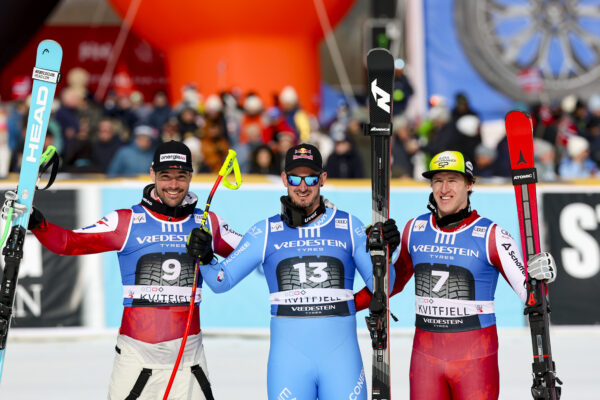
- Paris’s Decisive Strike: The narrative seemed set for an Austrian triumph until Dominik Paris, wearing bib 13, stepped into the starting gate. Fresh off his downhill victory the previous day and already tied for the record of most wins on Olympiabakken, Paris exuded confidence and focus. He initiated his run with characteristic power, meticulously building speed through the initial glides and maintaining it with aggressive precision over the rolling terrain. His exceptional ability to read the course and adapt to the changing snow conditions allowed him to attack the decisive, high-speed sections with unwavering commitment. As he crossed the finish line, the scoreboard flashed 1:26.81, a mere 0.07 seconds faster than Kriechmayr. The crowd erupted, recognizing the sheer grit and skill required for such a narrow, yet decisive, victory. This performance not only secured him the Super-G title but also solidified his legendary status on the Kvitfjell track.
Dominik Paris: The "King of Kvitfjell" Extends His Reign
Dominik Paris’s Super-G victory in Kvitfjell was more than just another win; it was a defining moment in his illustrious career and a powerful affirmation of his unique connection with Olympiabakken. This marked his sixth career Super-G triumph, a testament to his enduring prowess in the discipline. More impressively, it was his third Super-G victory specifically in Kvitfjell, further cementing his reputation as the undisputed "King of Kvitfjell." With this win, Paris set a new record, tallying an incredible eight career victories on this single venue, a feat that few, if any, athletes have achieved on any World Cup track.
Reflecting on his back-to-back triumphs, a visibly emotional Paris remarked, "I didn’t expect that I could do it again today in Super-G. The end of the season couldn’t have gone any better. To finish like this is amazing." His humility belied the sheer dominance he displayed, underscoring the demanding nature of the sport and the constant battle against expectations, conditions, and elite competition. Paris, at 36 years old, continues to defy the conventional wisdom of age in alpine skiing, showcasing that experience, combined with an insatiable drive, can lead to peak performance even late in a career. His powerful, aggressive style, perfectly suited to the long, fast courses of Kvitfjell, has made him a fan favorite and a perennial threat in speed events.
Marco Odermatt’s Historic Season: A Minor Blip in Dominance

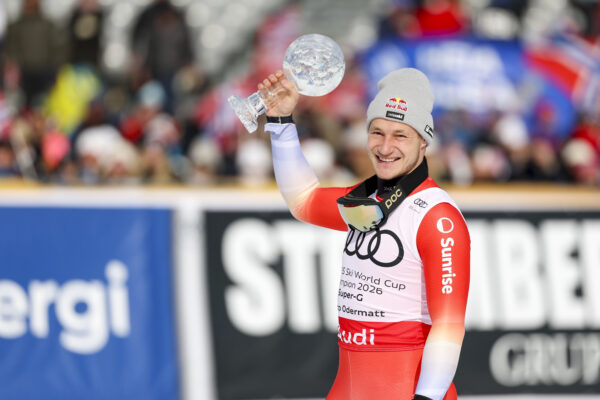
While the spotlight shone brightly on Paris, the men’s Super-G also saw the official confirmation of Marco Odermatt’s unparalleled season dominance. Starting with bib 15, the Swiss superstar had already secured the Super-G, downhill, and overall World Cup titles prior to this race – an extraordinary achievement that speaks volumes about his consistency and versatility across disciplines. However, in a rare turn of events, Odermatt finished outside the points in Super-G, unable to find his characteristic speed across the course and ending his run 1.97 seconds behind Paris.
"Usually it’s always much cooler if you can collect another globe after a good performance," Odermatt candidly admitted, acknowledging the unusual nature of his result. "Today was definitely my worst performance in many years." This minor blip, however, did little to diminish the luster of his season. His consistent accumulation of points from the very beginning of the season created an insurmountable lead, showcasing his strategic approach and unwavering focus. "At the beginning of the season, I collected a lot of points, and that made the difference," he reiterated, highlighting the foundation of his remarkable success. Odermatt’s season stands as one of the most dominant in recent alpine skiing history, and this single off-day serves as a testament to the unpredictable nature of the sport rather than a reflection of his overall superiority.
Final Super-G Season Standings (2026): A Testament to Consistency
The conclusion of the Kvitfjell Super-G also finalized the season standings for the discipline, showcasing the athletes who demonstrated the most consistency and skill throughout the year.
- Marco Odermatt (SUI, 1997, Stöckli) – 425 pts: Despite his Kvitfjell result, Odermatt’s commanding lead from earlier victories secured him the Super-G globe, underscoring his comprehensive dominance.
- Vincent Kriechmayr (AUT, 1991, Head) – 347 pts (-78): Kriechmayr’s second-place finish in Kvitfjell solidified his runner-up position in the season standings, a testament to his veteran consistency and power.
- Raphael Haaser (AUT, 1997, Atomic) – 301 pts (-124): Haaser’s third-place podium in Kvitfjell propelled him to third overall in the discipline, marking a significant step forward in his career.
- Giovanni Franzoni (ITA, 2001) – 285 pts (-140): The young Italian demonstrated impressive potential throughout the season, securing a strong fourth-place finish in the overall Super-G rankings.
- Dominik Paris (ITA, 1989, Nordica) – 257 pts (-168): Paris’s late-season surge, including his Kvitfjell victory, pushed him into the top five, proving that even with fewer starts or inconsistent earlier results, peak performance can dramatically alter standings.
Austrian Podiums: A Strong Showing for the Red-White-Red
Despite Paris’s victory, the Austrian team celebrated a strong collective performance, placing two athletes on the podium.
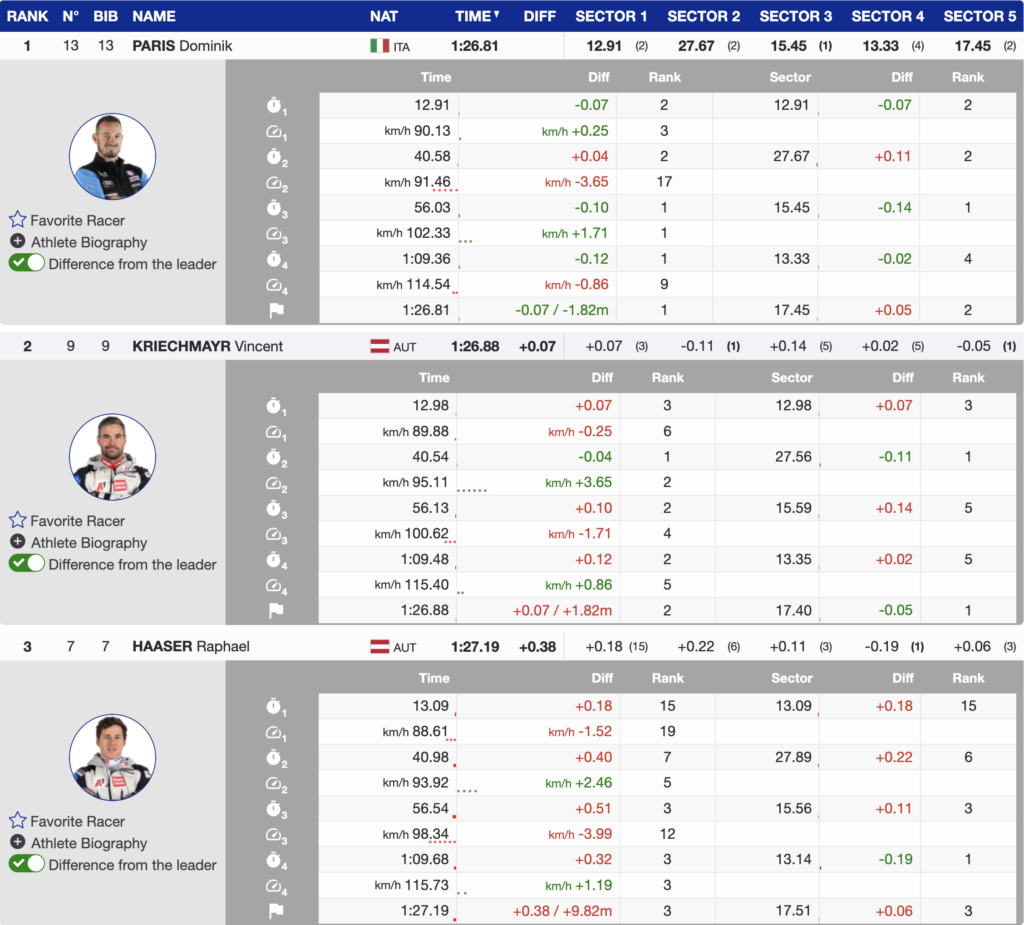
- Vincent Kriechmayr (2nd place): The seasoned Austrian, with his second-place finish, secured his 25th career Super-G podium. It was his second podium of the 2026 season, having also placed second in the season opener in Copper Mountain. Kriechmayr acknowledged the challenging conditions, stating, "It’s nice to be second today. I was a little bit lucky too because the wind was a big part. After bib 15, the guys didn’t really have a chance – there was too much wind in the middle section. You just have to make good skiing, and today I also had a bit of luck." He expressed his fondness for Kvitfjell, adding, "I made my first podium here many years ago, so it’s always a nice place. I’m always happy to be here." Reflecting on his season, Kriechmayr admitted, "It was okay. For sure, I wanted to win a globe and an individual Olympic medal. I didn’t reach those goals, but it is what it is. I can’t change it now." His candid assessment highlights the high standards top athletes set for themselves.
- Raphael Haaser (3rd place): Haaser’s third-place finish marked the seventh Super-G podium of his burgeoning career, underscoring his consistent rise in the discipline. "Of course, the goal in every race is to get one of the top three spots, so I’m very happy with today," Haaser commented. He also noted the environmental challenges: "It was pretty warm, the snow was slushy – it felt a bit like water skiing, but it was okay. In some parts, you could feel a bit of wind, but it’s an outdoor sport – it is what it is." Looking ahead, Haaser expressed satisfaction with his season but recognized the need for further improvement: "The Super-G season was pretty good, pretty consistent, so I’m happy with that. But there’s still a lot of work to do over the summer to be more consistent fighting for the top spots."
Switzerland’s Rare Miss and North American Efforts
For the formidable Swiss team, missing the Super-G podium was a rare occurrence, marking only the second time this season they did not have a representative in the top three. Despite strong performances from Alexis Monney, who finished an impressive fourth, and Stefan Rogentin, who secured sixth place, the Swiss contingent could not quite match the exceptional pace required for a podium spot on this particular day. This minor setback, however, does little to diminish their overall dominant season in speed events, largely spearheaded by Odermatt’s historic achievements.
The North American contingent faced a tough day on Olympiabakken.
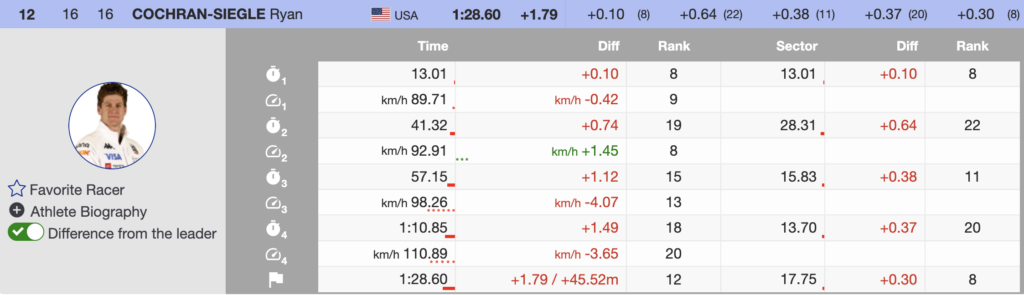
- Stifel U.S. Ski Team: Ryan Cochran-Siegle, the 2026 Olympic silver medalist, struggled to find his rhythm and speed across the course, finishing tied for 12th place, 1.79 seconds behind Paris. Despite the challenge, his result was enough to secure valuable World Cup points and crucial World Cup Start List (WCSL) points, which are essential for maintaining favorable bib numbers in future races. River Radamus, the second and final Stifel U.S. Ski Team skier, finished 17th, narrowly missing the top 15 and the associated points. Starting with a higher bib number (24), Radamus was among the skiers significantly affected by the increasing wind in the middle section of Olympiabakken, which made it progressively harder for later starters to achieve competitive times. "It wasn’t perfect. I made a lot of mistakes, but I was pushing really hard and had some good turns at the bottom," Radamus reflected. He acknowledged the progress made in Super-G this season but also recognized missed opportunities: "The Super-G season’s been good. I’ve had some really good runs that I’m proud of, but I never really put everything together." Looking ahead, Radamus is shifting his focus to the technical events, expressing optimism for the upcoming giant slalom: "I’m excited for the giant slalom. The level of men’s giant slalom skiing is really high right now. I’m still trying to find my form, but I believe it’s in there and hopefully I can give the top guys a run for their money."
- Alpine Canada: Both Canadian competitors, Cameron Alexander and James Crawford, finished outside the top 15, placing 21st and 25th respectively. James Crawford, despite his world-class pedigree and past successes, endured a particularly difficult season, struggling to find the consistent form that has previously placed him among the elite. The challenges faced by the North American teams in Kvitfjell underscore the highly competitive environment of World Cup speed events, where small margins and fluctuating conditions can significantly impact results.
Looking Ahead: The World Cup Finals Continue
With the speed season now officially concluded, the focus of the World Cup Finals in Lillehammer shifts to the technical disciplines. The men’s giant slalom is scheduled for Tuesday, March 24, promising another thrilling competition as athletes vie for final season points and potential podium finishes. This will be followed by the slalom on Wednesday, March 25, marking the grand finale of the 2026 World Cup season. These upcoming races will provide a final opportunity for athletes like River Radamus to make their mark and for the overall champions to celebrate their hard-earned globes, bringing to a close a memorable and action-packed alpine skiing season. The dramatic conclusion of the speed events in Kvitfjell, highlighted by Dominik Paris’s historic double and Italy’s sweep, sets a high bar for the excitement that the technical races are sure to deliver.

