
The winter of 2024-2025 served as a potent reminder that a weak La Niña does not automatically guarantee the deep, mid-winter snowpacks that outdoor enthusiasts and water resource managers eagerly anticipate. This upcoming season, 2025-2026, presents a complex interplay of atmospheric and oceanic influences, demanding a deeper dive into the probabilistic forecasts and historical data to paint a clearer picture of what lies ahead for Pacific Northwest mountain snowpack.
Understanding the El Niño-Southern Oscillation (ENSO) and its Forecast
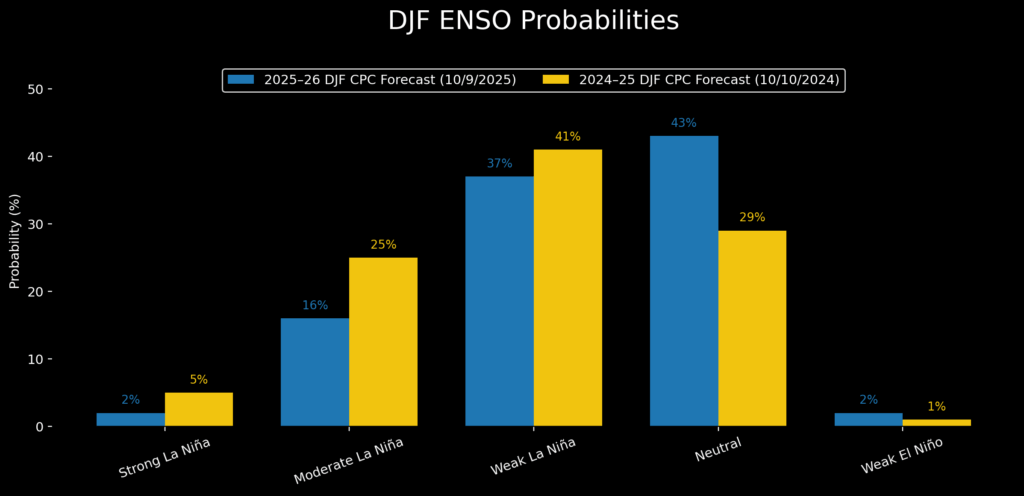
At the heart of global weather pattern modulation lies the El Niño-Southern Oscillation (ENSO), a naturally occurring cycle characterized by fluctuations in tropical Pacific sea surface temperatures. ENSO operates across three distinct phases: El Niño (warm phase), La Niña (cool phase), and Neutral conditions. Examining the October forecasts for mid-winter ENSO probabilities reveals a striking similarity between the upcoming cool season and the most recent one. However, there is a discernible, albeit subtle, weakening of the La Niña signal anticipated for 2025-2026. Both forecasts indicate the highest probabilities for cool-phase conditions during the autumn and early winter months.
The Oceanic Niño Index (ONI) serves as a primary metric for monitoring and predicting ENSO. It quantifies sea surface temperature (SST) departures from the average in the Niño 3.4 region. For the 2024-2025 season, the December-January-February (DJF) ONI registered -0.6°C, a value that just barely tipped into weak La Niña territory. Current data, with the latest weekly SST departure also at -0.6°C, suggests that the region is once again on the precipice of a weak La Niña. Mid-October Oceanic SST models project a November minimum ONI of approximately -0.8°C, with a decrease to around -0.3°C by midwinter (DJF). This projection strongly points towards neutral ENSO conditions as the most probable outcome for the mid-winter snowpack.

Historical ENSO Phase Probabilities vs. 2025-2026 Forecast:
| Season | October Forecast: El Niño Probability | October Forecast: Neutral Probability | October Forecast: La Niña Probability |
|---|---|---|---|
| 2024-2025 | ~10% | ~40% | ~50% |
| 2025-2026 | ~15% | ~45% | ~40% |
(Note: Probabilities are approximate based on visual interpretation of provided figures and general ENSO forecasting trends. Official forecasts from agencies like NOAA’s Climate Prediction Center would provide more precise figures.)
Analyzing the Pacific Northwest Snowpack’s Response to ENSO
To understand the potential implications of these ENSO forecasts, it is crucial to examine how Pacific Northwest mountain snowpack typically responds to varying ENSO phase strengths. The Snowpack Climatology Dataset offers valuable insights into this relationship.
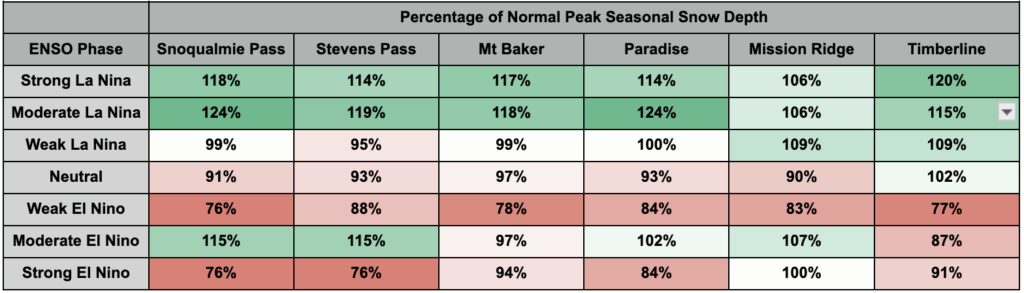
Figure 2: Average Percentage of Normal Peak Snow Depth by ENSO Phase (Cascade Weather Stations)
In winters characterized by weak La Niña conditions, most weather stations tend to register snowpack levels near the historical average. Modest gains are typically observed at locations like Mission Ridge and Timberline. However, it is during moderate and strong La Niña years that a more pronounced positive impact on snowpack is evident, particularly on the west slopes and crest of the Cascades, where peak snow depths can exceed normal levels by 6-24%. Conversely, neutral years generally correlate with slightly below-average snowpack across the region, while El Niño conditions tend to strongly favor reduced snowfall.
Table: Typical Snowpack Response to ENSO Phases in the Pacific Northwest
| ENSO Phase | Average Peak Snow Depth (% of Normal) | Typical Regional Impact |
|---|---|---|
| El Niño | Significantly Below Normal | Reduced snowfall, particularly at lower elevations. |
| Neutral | Slightly Below Normal | Moderate snowfall, variable across the region. |
| Weak La Niña | Near Normal | Close to average snowpack, with some localized variations. |
| Moderate La Niña | 6-24% Above Normal | Enhanced snowfall, particularly on west-facing slopes. |
| Strong La Niña | 10-25%+ Above Normal | Substantially increased snowpack, widespread beneficial conditions. |
The long tails of the DJF distribution of forecast ENSO probabilities for the upcoming winter, with an 18% chance of moderate/strong La Niña and a 2% chance of El Niño, exert the most significant influence on the mean outcome. A focused examination of the average snowpack data from four sites with the longest and most robust historical records—Mt. Baker, Stevens Pass, Snoqualmie Pass, and Paradise—provides a more refined perspective.
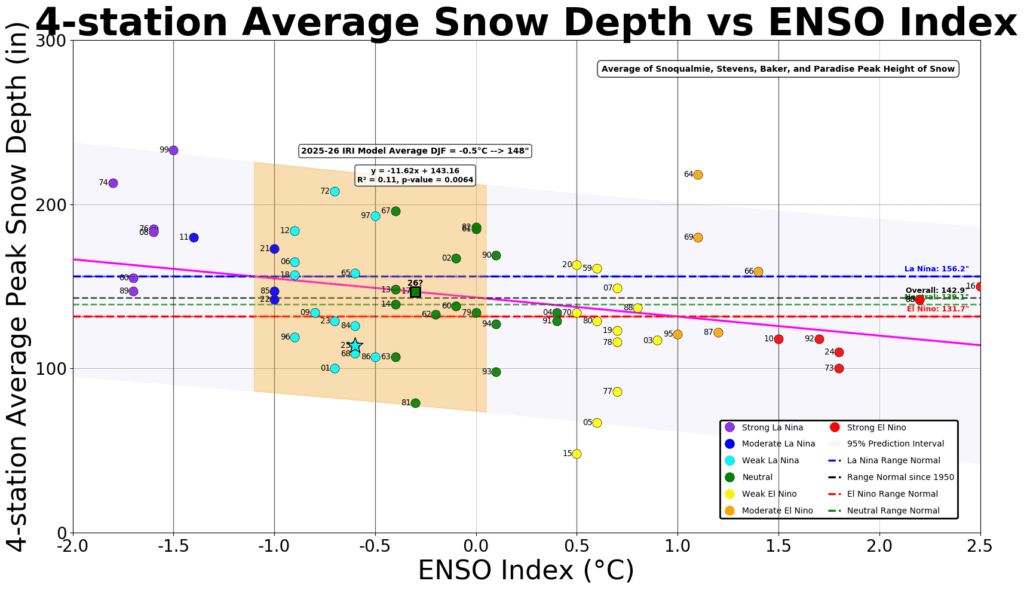
Figure 3: Distribution of ENSO Phase Strength and Corresponding Snowpack Response (Highlighting 2025-2026 Likely Phase)
The 2024-2025 season, for instance, saw an average peak snow depth of 114% of normal, which corresponds to the 19th percentile for ENSO Index values between -1 and 0°C. This was approximately 24% below the regression trendline, with reduced snowpack observed at lower elevation stations, largely attributed to warmer temperatures. To mitigate the influence of longer-term climate trends, an analysis incorporating only 21st-century data reveals a slight reduction in mean snow depth across all ENSO phases. Even with this truncated dataset, the ENSO forecast for the upcoming winter predicts an outcome that is “almost perfectly average.”
The Role of Sea Surface Temperatures (SSTs) and the Pacific Decadal Oscillation (PDO)
Linear best-fit trendlines indicate that ENSO explains only 11% to 19% of the data variability in snowpack, depending on whether 20th-century data is included. This suggests that over 80% of the year-to-year variability in snowpack is not directly attributable to ENSO alone.
Recent discussions have highlighted a marine heatwave observed in September of this year. An analysis comparing SSTs from September and October of 2025 against those of 2024 and 2014 is particularly instructive. While all three seasons have exhibited mostly positive anomalies, this has become a normalized observation due to long-term climate shifts outpacing the 30-year averaging period. However, areas with more pronounced warming warrant closer attention. The 2014-2015 season, despite being a very weak El Niño, was characterized by anomalously warm SSTs just off the coast, a factor scientists have linked to its exceptionally poor snow year. During that period, the 4-station average snowpack reading was less than 50% of the values observed in the 2024-2025 season. Although September 2025 began with notably warm SSTs across the northeastern Pacific, a significant cooling trend has since emerged, bringing proximal waters closer to normal.
Figure 4: Combined ENSO and Nearshore SST Regression Model Explaining Snowpack Variability
When regional West Coast Marine waters, often colloquially referred to as "The Blob," are combined with ENSO phase data, approximately 25% of the inter-seasonal snowpack variability can be explained. The potential for an eastward spread of exceptionally warm waters in the western North Pacific remains a factor to monitor. Crucially, as long as these extraordinarily warm waters remain west of Hawaii, the Pacific Decadal Oscillation (PDO) is likely to remain in its negative phase. The State Climate Office has noted that a negative PDO correlates with cooler and snowier periods. A similar analysis examining the interplay between PDO and ENSO phases explains about 20% of the snowpack variance.
Outlook for the 2025-2026 Winter
The current analysis provides no definitive "magic goggles" for predicting the 2025-2026 winter snowpack with absolute certainty, especially given the anticipated weak La Niña fading into neutral conditions by mid-winter. Using ENSO and regional Sea Surface Temperatures, it is estimated that only about 25% of the variability in a 75-year dataset can be explained. This suggests that a fairly typical Pacific Northwest snowpack can be expected across the region.
While a moderate or strong La Niña remains a low-probability event, its occurrence would significantly tilt the odds in favor of deeper snowpacks. Regional sea surface temperatures have shown a cooling trend, approaching normal levels. However, the presence of warmer waters in surrounding areas may temper the potential for further significant cooling.
Consequently, stakeholders—from skiers and snowboarders to municipalities relying on snowpack for water resources—will be looking for a confluence of favorable conditions: sustained upwelling off the coasts of South America and North America, continued cool-phase PDO conditions, and robust populations of marine life such as sardines and salmon, which often indicate healthy oceanic ecosystems conducive to cooler weather patterns. The coming months will be critical for refining these forecasts and providing more precise guidance on the anticipated winter conditions.
