
The International Ski and Snowboard Federation (FIS) has officially finalized and released the highly anticipated Audi FIS Alpine Ski World Cup calendars for the 2026-27 season, promising an exhilarating winter of elite competition across Europe and North America. This comprehensive schedule outlines a robust program featuring 43 men’s World Cup races spread across 21 prestigious venues and 40 women’s World Cup races at 20 diverse locations. Beyond the regular season, the spotlight will intensely focus on the 2027 FIS Alpine World Ski Championships in Crans-Montana, Switzerland, where both men and women will vie for five coveted medal events, including the challenging team combined. The pinnacle of the World Cup season, where the coveted Crystal Globes are awarded, is set to culminate at the World Cup Finals in Sun Valley, Idaho, following a crucial midseason championship break.
The season is slated to commence with the traditional giant slaloms in Sölden, Austria, on October 24-25, a revered opening that typically sets the tone for the competitive year. The grand finale will then unfold in Sun Valley, Idaho, from March 20-25, bringing an end to months of intense rivalry and crowning the overall champions. FIS officials have underscored that a paramount objective in the calendar’s construction was to achieve a more equitable balance between speed (downhill, super-G) and technical (giant slalom, slalom) events. This strategic distribution aims to ensure that overall contenders, regardless of their disciplinary specialization, are afforded a fair and balanced pathway to clinch the sport’s most prestigious annual prize, the Crystal Globe. This move addresses long-standing discussions within the alpine community regarding the weighting of events and its impact on the overall standings, promoting a more holistic challenge for the athletes and enhancing the integrity of the overall title race.
Crans-Montana Takes Center Stage: A Return to Alpine Glory
The undisputed marquee event of the 2026-27 season will be the 2027 FIS Alpine World Ski Championships, scheduled to captivate the alpine world from February 1-14 in the iconic Swiss resort of Crans-Montana. This grand return to the global spotlight marks a significant milestone for the resort, which last hosted the World Championships four decades ago in 1987. The 1987 event was a landmark for Swiss ski racing, producing memorable performances and etching its name into ski racing history with legendary champions like Pirmin Zurbriggen and Erika Hess claiming multiple medals on home snow. Since then, Crans-Montana has maintained a formidable presence on the international ski racing circuit, consistently hosting World Cup and European Cup races, thereby solidifying its reputation as a premier destination for high-stakes alpine competition. Its legacy of challenging courses, particularly the Piste Mont Lachaux known for its demanding speed events, and passionate crowds makes it a fitting venue for the sport’s biennial championship.
The timing of the championships is strategic, splitting the World Cup season into two distinct phases. Athletes will temporarily shift their focus from the relentless pursuit of Crystal Globe points to the singular ambition of securing world titles. This mid-season pause allows for a reset and a chance for specialists to shine on the biggest stage before the circuit resumes its final, decisive stretch towards the World Cup Finals. The championships are not only a test of individual skill but also a celebration of national pride, with medal tallies often reflecting the strength and depth of a country’s alpine program. The resort’s picturesque setting in the Valais Alps, coupled with its challenging terrain for both speed and technical disciplines, promises a thrilling two weeks of racing. The five medal events, including the dynamic team combined—a relatively newer format gaining traction—will showcase the versatility and depth of talent across the men’s and women’s fields, adding another layer of excitement for fans and strategic consideration for teams. The preparation for Crans-Montana will be a significant undertaking for athletes, requiring specific training cycles to peak at the right time for this prestigious event, distinct from the season-long consistency required for the World Cup overall title.
North American Presence Remains Strong: Bridging Continents for Global Growth
North America is once again poised to play a pivotal role in the early stages of the 2026-27 season, reinforcing the FIS’s commitment to globalizing the sport and tapping into its vibrant fan base across the Atlantic. The continent’s early-season races are crucial for building momentum, offering diverse course conditions, and generating significant media exposure before the European swing begins in earnest. The expansion and consistency of North American stops highlight the strategic importance FIS places on this market for the sport’s continued growth and commercial viability.
On the men’s side, Copper Mountain, Colorado, makes a welcome return to the calendar, hosting a speed and giant slalom weekend in late November. Known for its reliable early-season snow and high-altitude challenges, Copper provides an excellent testing ground for athletes adjusting to competitive conditions. Following Copper, the circuit will move to the legendary slopes of Beaver Creek, also in Colorado, which is set to host an extensive program comprising two downhills, a super-G, and a giant slalom. Beaver Creek, with its iconic Birds of Prey course, is renowned for its demanding speed events and technical sections, pushing competitors to their limits and often yielding dramatic results. The altitude and variable weather conditions in Colorado frequently add an extra layer of challenge, making these races particularly compelling for both athletes and spectators.
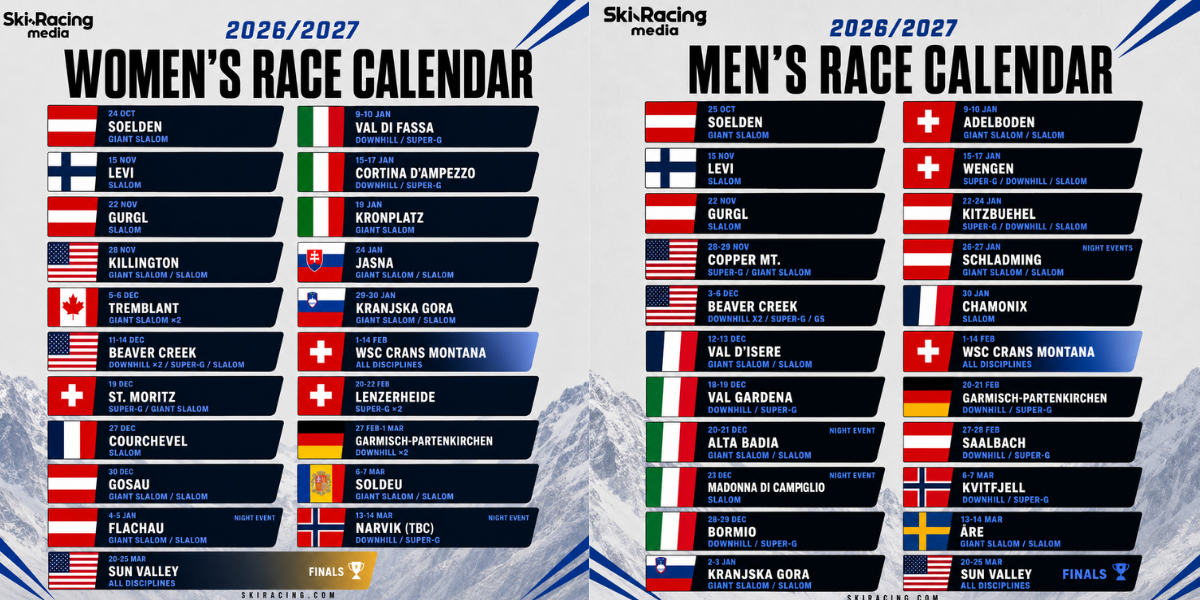
For the women, Killington, Vermont, returns to the calendar after a one-year absence, much to the delight of East Coast ski racing enthusiasts. The resort will host highly anticipated giant slalom and slalom races over the Thanksgiving weekend, an event that has consistently drawn massive, energetic crowds, sometimes exceeding 30,000 spectators, creating an unparalleled atmosphere. Canada’s Tremblant, Quebec, will once again host a giant slalom doubleheader, continuing to establish itself as a significant stop on the women’s tour with its technically demanding courses and strong local support. Additionally, Beaver Creek will welcome women’s speed racing for a second consecutive season, further solidifying its status as a dual-gender venue and offering a comprehensive North American speed block that allows teams to minimize travel within the continent.
In total, North America will proudly host six men’s and seven women’s regular-season World Cup races, culminating in the eight Finals races in Sun Valley, Idaho. This significant presence not only provides crucial early-season points opportunities for athletes but also serves as a vital platform for promoting alpine skiing to a broader international audience, fostering new generations of fans and participants. The logistical efforts involved in transporting teams and equipment across the Atlantic underscore the strategic importance FIS places on these North American events, viewing them as essential for the sport’s global growth and commercial viability. The consistent inclusion of these venues demonstrates a successful partnership between FIS, national federations, and local organizing committees.
New Venues and Notable Returns: A Blend of Tradition and Innovation
The 2026-27 campaign is further enriched by the inclusion of several new venues and the return of significant historical locations, adding fresh storylines and diverse challenges to the competitive landscape. This dynamic blend ensures that the season offers both the familiarity of cherished classics and the excitement of novel experiences for athletes and fans alike, keeping the circuit vibrant and unpredictable.
For the women’s circuit, Gosau, Austria, will make its World Cup debut, a momentous occasion for the resort and a testament to the expansion of opportunities within alpine skiing. Gosau is slated to host races in the coveted post-Christmas slot, traditionally occupied by venues like Lienz and Semmering. This new addition signals a strategic rotation and an effort to introduce new locales to the World Cup stage, potentially bringing new crowds and varied course profiles. Meanwhile, the technical specialists will welcome the return of Jasná, Slovakia, and Garmisch-Partenkirchen, Germany, to the women’s calendar. Jasná is celebrated for its challenging technical courses and passionate local support, having previously hosted World Cup events to great acclaim. Garmisch-Partenkirchen brings a rich history of speed events and a classic Bavarian atmosphere, often providing thrilling races on its Kandahar course.
On the men’s circuit, the return of Bormio, Italy, is particularly noteworthy, following its prominent role as an Olympic venue during the Milano-Cortina Winter Games. Bormio’s "Stelvio" course is infamous for its demanding downhill, a true test of nerve and skill with its icy pitches and technical jumps, and its reincorporation into the World Cup circuit ensures that one of the sport’s most iconic speed challenges remains a staple. Alongside these exciting returns, fan-favorite classics such as Wengen (Switzerland), Kitzbühel (Austria), Adelboden (Switzerland), Val Gardena (Italy), Alta Badia (Italy), and Schladming (Austria) remain firmly entrenched in the schedule. These venues represent the heart and soul of European alpine racing, each boasting unique characteristics, passionate crowds, and a storied history that contributes immensely to the World Cup’s allure. From Wengen’s lengthy Lauberhorn downhill, the longest on the circuit, to Kitzbühel’s legendary Hahnenkamm, known as the "Streif" and arguably the most dangerous race in the world, these events are not just competitions but cultural institutions, drawing massive global viewership and attendance. Adelboden’s "Chuenisbärgli" giant slalom is another spectacle, celebrated for its steep final pitch and fervent Swiss crowd.
Night racing continues to be one of the most defining and spectacular features of the Alpine World Cup, transforming traditional daytime events into electrifying evening spectacles. On the women’s circuit, Courchevel (France) and Flachau (Austria) will once again host their immensely popular night slaloms. These events have become annual highlights, known for their vibrant light shows, roaring crowds, and intense competitive atmosphere under floodlights, often setting records for attendance at technical races. The men’s tour also boasts a strong lineup of evening races, including the 2026 Alta Badia night giant slalom, which often takes place before Christmas and is a technical masterpiece under the stars. The classic night slaloms in Madonna di Campiglio (Italy) and Schladming (Austria) also make their anticipated return. The Schladming night giant slalom, in particular, stands out as one of the sport’s most iconic events, drawing massive crowds that create an almost gladiatorial stadium atmosphere, making it a truly unforgettable experience for both athletes and spectators. The energy generated by thousands of fans under the lights is unparalleled, often creating pressure-cooker situations that bring out the best in the world’s top skiers, leading to dramatic finishes.
A Balanced Fight for the Crystal Globe: A New Era of Fairness
The meticulous construction of the 2026-27 calendar reflects a concerted effort by FIS to foster a more balanced and equitable fight for the coveted Crystal Globes, the ultimate prize for overall World Cup supremacy. This strategic distribution of disciplines aims to reward versatility and consistent performance across all facets of alpine skiing, rather than disproportionately favoring specialists in one area. This move is a direct response to feedback from athletes, coaches, and federations seeking to ensure the overall champion is truly the most complete skier of the season.
The men’s calendar is composed of an even split across the primary disciplines: 10 downhills, 10 super-Gs, 10 giant slaloms, and 13 slaloms. This distribution ensures that speed specialists (downhill, super-G) and technical specialists (giant slalom, slalom) have ample opportunities to accumulate points, making the overall title race a true test of a skier’s all-round capabilities. This balance is particularly significant in an era where athletes like Marco Odermatt demonstrate exceptional skill across multiple disciplines, embodying the ideal of the complete alpine skier. For a pure speed merchant, the 20 speed races offer a solid foundation, while technical gurus can rely on 23 technical events. The slight edge given to slalom events reflects its historical importance and the sheer number of specialists in that discipline, ensuring its prominence.
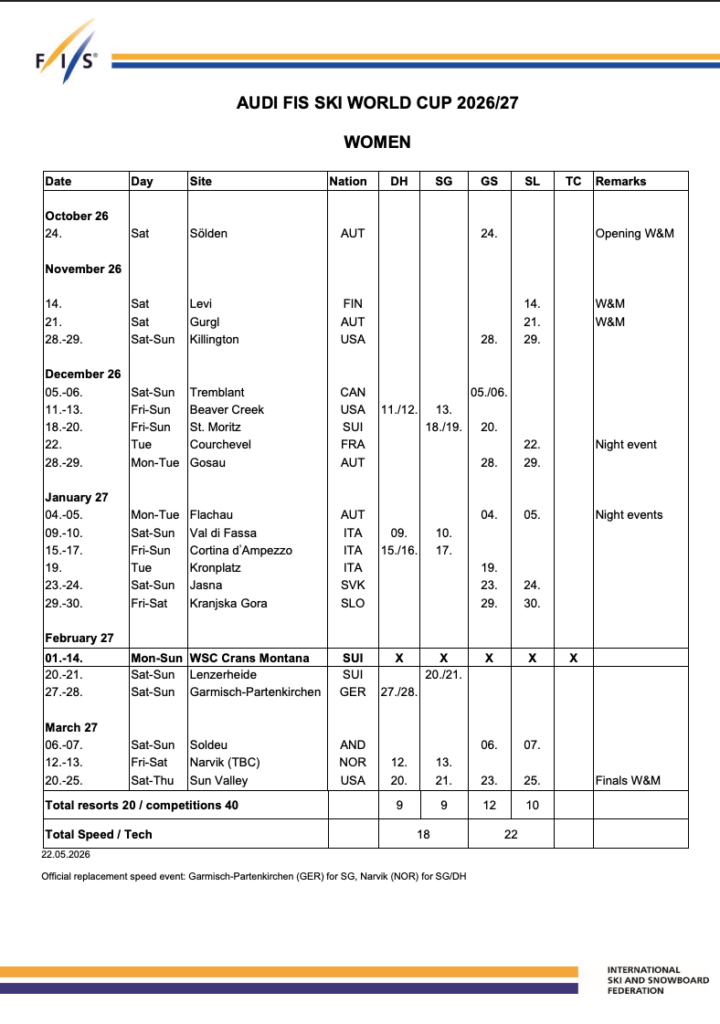
Similarly, the women’s schedule features a thoughtful distribution: nine downhills, nine super-Gs, 12 giant slaloms, and 10 slaloms. While slightly fewer speed events than the men, this still represents a robust offering of 18 speed races, coupled with 22 technical races. This composition ensures that women athletes excelling in various disciplines have a clear path to contend for the overall title. The emphasis on giant slalom and slalom events recognizes the depth of talent and competitive intensity within these technical disciplines on the women’s circuit, which has seen fierce rivalries in recent seasons. The overall objective is to create a championship scenario where the winner is undeniably the most complete and consistent skier of the season, a true testament to their athletic prowess across different challenges and conditions.
This balanced approach aims to address criticisms from past seasons where an imbalance might have inadvertently favored one type of skier over another. By leveling the playing field, FIS hopes to intensify the competition for the overall Crystal Globe, keeping the race thrilling until the very last event in Sun Valley. Athletes and team managers will need to strategize carefully, balancing training and travel to maximize points across the diverse range of races, understanding that consistency across disciplines will be paramount. The calendar’s design reflects an understanding of the evolving nature of alpine skiing, where versatility is increasingly becoming a hallmark of champions.
Logistics, Athlete Demands, and the Road Ahead
The finalization of the 2026-27 calendar is not merely a listing of dates and venues; it represents a monumental logistical undertaking involving hundreds of athletes, coaches, support staff, and event organizers. The extensive travel schedule, spanning multiple continents and diverse climates, places immense demands on athletes’ physical and mental resilience. From the high-altitude challenges of Colorado to the icy pistes of the European Alps, competitors must adapt quickly to varying snow conditions, time zones, and pressures, often facing minimal rest between demanding races.
Team managers will now meticulously plan their seasonal strategies, considering optimal training blocks, equipment preparation, and travel itineraries. For many, the World Championships in Crans-Montana will serve as a crucial mid-season peak, requiring specific preparation that might differ from the relentless pursuit of World Cup points. The transition from championship intensity back to the regular circuit for the final push towards Sun Valley will be a test of mental fortitude and adaptability. Physiotherapists and support staff play an increasingly critical role in maintaining athlete health and preventing burnout over such a demanding schedule.
As the countdown to the 2026-27 season officially begins, the calendar offers an exciting blend of cherished tradition and forward-thinking innovation. It combines iconic classic races that are deeply ingrained in alpine skiing lore with emerging venues that promise fresh challenges and new fan experiences. The expanded North American presence signals a strategic commitment to global outreach, while the World Championship showdown in Crans-Montana adds an unparalleled layer of prestige and drama.
For athletes, teams, and millions of passionate fans worldwide, the road to Crans-Montana and ultimately to the Crystal Globes in Sun Valley is now officially set. The stage is prepared for another unforgettable season of speed, skill, and breathtaking competition, solidifying alpine skiing’s place as a premier winter sport.
Key Dates: 2026-27 Audi FIS Alpine World Cup – A Chronology
- October 24-25, 2026: The traditional season opener with men’s and women’s giant slaloms in Sölden, Austria, signaling the official start of the competitive year.
- November 28-29, 2026: A significant North American weekend featuring men’s speed and giant

