
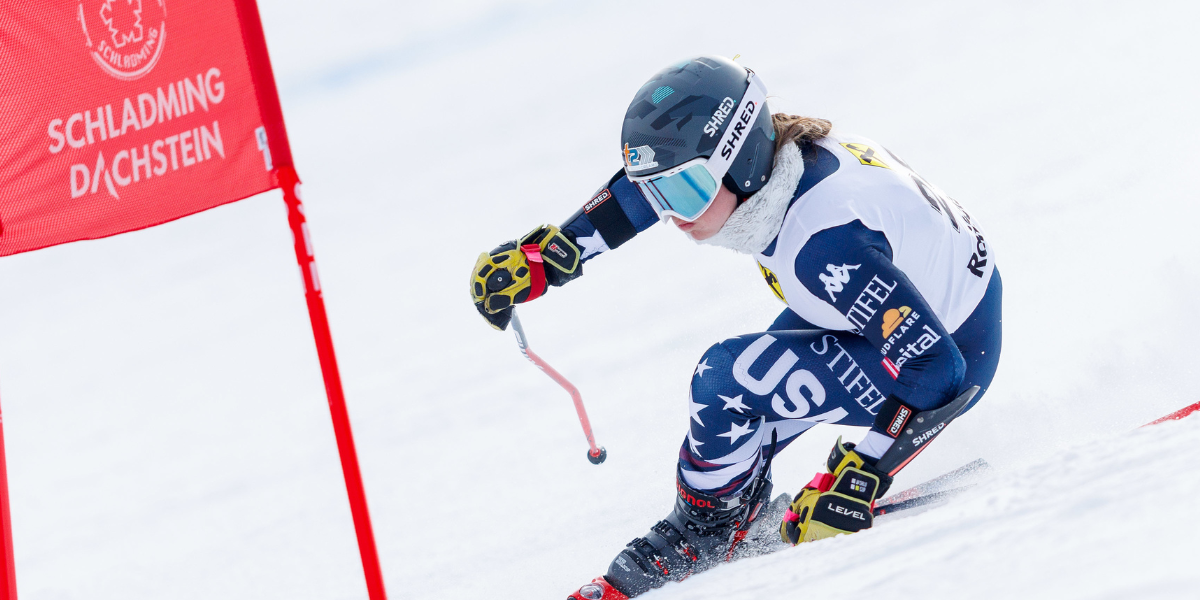
Katie Rowekamp didn’t just make the Stifel U.S. Ski Team; she did it after just one season of FIS racing, an accomplishment that underscores her extraordinary talent and a unique developmental path forged in the Alaskan wilderness and honed in elite training environments. At a mere 16 years old, the Girdwood, Alaska native’s meteoric rise has quickly positioned her as one of American ski racing’s most compelling young prospects, defying conventional timelines for progression in a sport renowned for its demanding learning curve.
A Rookie Season of Remarkable Achievements
Rowekamp’s rookie FIS season was nothing short of phenomenal, marked by a series of breakthrough performances that propelled her onto the national stage. She concluded the season ranked 78th in the world in giant slalom (GS) and 105th in super-G (SG), rankings typically achieved by athletes with several seasons of international competition under their belts. Her prowess extended to the Europa Cup circuit, a critical stepping stone to the World Cup, where she finished an impressive 32nd in the giant slalom standings. Domestically, she secured a personal World Cup super-G start position by finishing second in the NorAm super-G standings and earned a coveted spot on the U.S. team for the FIS Junior World Ski Championships.
Among her most notable achievements, Rowekamp stormed to a seventh-place finish in her very first Europa Cup giant slalom race, starting from a high bib number 54 – a feat almost unheard of for a debutant. She also clinched a NorAm super-G victory at Whiteface, further cementing her reputation as a versatile and potent force across technical and speed disciplines. These results, amassed within a single competitive year, speak volumes about her raw ability, rapid adaptability, and competitive drive, distinguishing her as a standout athlete in her age group globally.
The Alyeska Foundation: Forging Alaskan Grit
Rowekamp’s journey to elite ski racing began far from the structured, meticulously groomed pistes of European training centers. She grew up in Girdwood, a small, snow-laden town nestled at the base of Alyeska Resort in Alaska. Here, skiing was not initially about race gates or perfect conditions; it was an integral part of life, a natural extension of her environment. Winter, as Rowekamp recounted to Ski Racing Media, was often "kind of my off-season," filled with powder days, family outings, and countless hours exploring Alyeska’s diverse terrain. This informal, joyful immersion in skiing cultivated a deep, intrinsic love for the sport, free from the pressures of early specialization.
The unique conditions at Alyeska — notorious for their challenging visibility, rapidly changing snow quality, and unpredictable weather — inadvertently became her first, most impactful training ground. Long before she envisioned Europa Cup points or World Cup starts, Rowekamp learned to navigate heavy snowfall, dense fog, and varied snow surfaces. This upbringing instilled in her a profound sense of adaptability and resilience. Rather than succumbing to frustration on difficult days, she learned to embrace them as opportunities. "Growing up here and being able to turn those days into something that’s fun has helped me know how to get something out of those days," she explained. This mindset, prioritizing enjoyment and learning regardless of external conditions, has become a cornerstone of her competitive approach, a mental edge she carries far beyond the Alaskan slopes.
Refining Raw Talent: The Burke Mountain Academy Chapter
As Rowekamp’s talent blossomed, the need for a more structured environment became apparent. For her U14 years, she transitioned from Alaska to the esteemed Burke Mountain Academy in Vermont, a move that marked a significant shift in her developmental trajectory. Initially, this was not a full relocation; her parents rented a house nearby, allowing her to train during the winter before returning to Alaska for the warmer months. This logistical commitment from her family underscored the burgeoning potential they recognized in their daughter, a sacrifice Rowekamp acknowledges deeply: "I don’t think a lot of other parents would be willing to move their whole lives across the country to help me ski race."
Burke Mountain Academy, renowned for its rigorous academic program and a proven track record of producing Olympic-level skiers, offered Rowekamp a different, yet equally crucial, set of lessons. While Alyeska had instilled adaptability and comfort in challenging conditions, Burke provided the framework for technical precision, high-volume training, and consistent exposure to icy surfaces. "When I first went to Burke, I didn’t know how to ski on ice, and that’s almost all they have," Rowekamp candidly stated, highlighting her rapid acquisition of a fundamental skill. The academy’s famous "Training Hill" and its T-bar lift allowed for an unprecedented volume of repetitions, sometimes up to 14 runs in a single day, refining her technique with relentless consistency.
Beyond the slopes, Burke’s holistic environment fostered personal growth. Moving into the dorms as she progressed, Rowekamp matured, gained independence, and found a supportive community. She described Burke as an "open community where everybody knows each other," a place that encourages individuals to "embrace their weirdness." This acceptance, she believes, allowed her to "relax a little more when skiing and have more fun," demonstrating how a nurturing off-hill environment can directly translate to enhanced on-hill performance and mental well-being.
The Europa Cup Revelation: Oppdal as a Turning Point
While Rowekamp secured several impressive results during her rookie FIS season, including a NorAm super-G victory and qualification for Junior Worlds, one particular race served as a profound turning point: her debut Europa Cup giant slalom in Oppdal, Norway. Starting with bib 54, typically a significant disadvantage in a highly competitive field, she found herself in 29th place after the first run. The accomplishment of merely "making the flip" (qualifying for a second run) was already a source of immense satisfaction.
However, the second run saw a strategic shift in her mindset. "The second run I was just like, ‘Oh yeah, let’s just go for it,’" she recalled. This uninhibited approach paid off spectacularly: Rowekamp won the second run outright and vaulted to an astonishing seventh place overall. This result was not just remarkable for a 16-year-old in her first FIS season; it was an emphatic statement in one of the deepest giant slalom circuits outside the World Cup. It was in Oppdal, standing amidst her father and connecting with her mother via FaceTime, that the previously distant dream of joining the Stifel U.S. Ski Team crystallized into a tangible possibility. "I remember thinking, ‘This is it. I’m in. Let’s go,’" she affirmed. The Oppdal performance was not an anomaly; Rowekamp went on to score Europa Cup points in all three giant slalom races she entered, ultimately finishing 32nd in the overall Europa Cup GS standings, a rare feat for a first-year FIS athlete.
Global Stage and Team Spirit: Junior World Championships
Following her Europa Cup success, Rowekamp continued her remarkable season at the FIS Junior World Ski Championships in Narvik, Norway. Here, she measured her burgeoning talent against the best young skiers from around the globe, securing a 14th-place finish in giant slalom, 27th in super-G, eighth in the team combined event, and 11th in the team parallel. These results were strong indicators of her competitive readiness on a global stage, particularly for an athlete so new to international racing.
Beyond the individual performances, Junior Worlds offered Rowekamp invaluable experience as part of the U.S. team. Sharing the experience with fellow American talents, including Mari Renick, another Stifel U.S. Ski Team rookie, fostered a powerful sense of camaraderie. "Mari and I have known each other for a long time," Rowekamp noted, emphasizing their competitive yet supportive friendship. "Going through the same thing together was really awesome." This team environment, where athletes supported each other while pushing their own limits, created a "super strong, fun bond" that Rowekamp cherished as much as the racing itself. This balance between fierce competition and genuine enjoyment aligns perfectly with her philosophy, rooted in the "fun" she found even in the challenging conditions of Alyeska.
The Path to the Stifel U.S. Ski Team: A Journey of Milestones
Rowekamp’s belief in her potential for the Stifel U.S. Ski Team developed through a series of incremental milestones. The initial spark ignited in Waterville Valley, New Hampshire, where she achieved her first 23-point result in giant slalom. In ski racing, lower FIS points signify better performance, and a 23-point result is a strong indicator of elite potential. "That’s when I realized, oh, this is possible," she stated, recognizing that while it didn’t guarantee anything, it was a crucial step. This gradual accumulation of "small steps and accomplishments" steadily fueled her self-belief.
The Oppdal Europa Cup triumph then transformed this nascent belief into conviction. The sensation of competing at such a high level and achieving a top-tier result made the national team nomination feel undeniably within reach. Adding to her impressive season, Rowekamp’s NorAm super-G win at Whiteface propelled her to second in the overall NorAm super-G standings, which unexpectedly earned her a personal World Cup super-G start position. This particular achievement, revealed to her by her coach Kyle Darling at dinner, came as a surprise, underscoring her focus on performance rather than external rewards. "Hearing about it was really, really cool," she admitted, acknowledging the significance of this unexpected opportunity.
A Versatile Athlete: Defining Rowekamp’s Style and Influences
Katie Rowekamp’s results present a portrait of a remarkably versatile athlete. Her success spans winning a NorAm super-G, earning a World Cup super-G start, placing ninth in NorAm GS standings, and consistently scoring Europa Cup GS points. This balance between speed and technical disciplines is a highly sought-after trait in elite ski racing, offering broader career possibilities and adaptability across different race venues. While she enjoys super-G, her declared love for giant slalom hints at a preference for the technical nuances and strategic demands of the discipline.
Her choice of role models further illuminates the kind of skier she is becoming. She looks up to Lara Gut-Behrami for her phenomenal skiing style and her public stance on emotional expression in sport. Gut-Behrami’s unapologetic authenticity resonates with Rowekamp, who believes "being emotionally connected to the sport is super important." This suggests a desire to race not just with precision but with passion and genuine emotion. Her admiration for Alice Robinson, on the other hand, is rooted in the New Zealander’s strength and aggressive skiing. This combination of influences points towards Rowekamp’s evolving identity as a powerful, aggressive, yet emotionally intelligent and adaptable racer – a formidable combination that bodes well for her future.

The Next Frontier: Mastering Consistency and Mental Fortitude
As Rowekamp embarks on her second FIS season, her focus shifts from simply producing exceptional runs to achieving them with greater consistency. She has identified key tactical areas for improvement: cultivating more depth in her turns, demonstrating better patience, and strengthening her turn building. "Build the turn," she succinctly stated, highlighting a fundamental aspect of high-level giant slalom skiing.
However, the biggest challenge she perceives lies in the mental realm: maintaining a consistent mindset amidst the inherent inconsistencies of ski racing. "Skiing isn’t consistent," she noted, citing the ever-changing conditions, weather, and course sets. Rowekamp has spent recent seasons experimenting with various approaches to preparation, confidence, and race-day mindset, discovering that there is no simple, universal formula for success. She acknowledges that while she has proven her ability to perform at an elite level with "random, just really good runs"—like those in Oppdal, Whiteface, or Junior Worlds—the true test lies in making those performances the norm rather than the exception. This pursuit of mental and physical consistency is a hallmark of athletes transitioning from promising talent to established champions.
This challenge is amplified by the unique nature of ski racing, a sport where "you don’t know how you’re doing when you’re doing it." Unlike many other sports, there’s no immediate scoreboard or live feedback during a run; athletes must rely on feel, instinct, and pre-race strategy. Navigating this constant uncertainty while maintaining the optimal balance of confidence, focus, and aggression is a psychological tightrope walk. For Rowekamp, finding this elusive balance will be a critical step in translating a remarkable rookie season into sustained success.
Embracing the National Team Environment
Joining the Stifel U.S. Ski Team provides Rowekamp with an invaluable support system and a new training environment designed for elite development. She had an early glimpse of this dynamic during a training block in Mammoth, California, where she and Mari Renick trained alongside seasoned members of the women’s speed group. This exposure offered a firsthand look at how experienced World Cup athletes prepare, inspect courses, and handle themselves. "I just thought it was really cool to be surrounded by so many accomplished women who knew what they were doing," Rowekamp expressed, eager to learn through observation and mentorship. She anticipates that a full season immersed in this environment, learning from older and more experienced teammates, will accelerate her growth significantly.
Rowekamp also attended the U.S. Ski & Snowboard rookie camp in Park City, Utah, connecting with new national team athletes across various disciplines. This experience fostered camaraderie among the new alpine women – herself, Beatrice May, Annika Johansson, and Mari Renick – who already shared a prior acquaintance, allowing them to "have a lot of fun" while engaging in team-building activities. The structured support system of the national team includes Foreste Peterson for strength and conditioning, Miha Kürner leading her on-snow program, and her long-time Burke coach, Kyle Darling, joining as an assistant. Her next major on-snow training block is planned for Ushuaia, Argentina, a common pre-season destination for international ski teams.
Balancing Academics and Elite Sport: The Burke Advantage
A crucial aspect of Rowekamp’s sustainable development plan involves her continued enrollment at Burke Mountain Academy. Recognizing the demands of elite ski racing, Burke’s flexible academic structure allows her to stretch her junior and senior years across three academic years. By taking a reduced course load of two or three classes per year, she can dedicate more time and energy to her athletic pursuits without sacrificing her education. "I can focus more on skiing and have more time to put into my sport," she affirmed. This pragmatic approach underscores a long-term vision for her career, ensuring she builds a robust foundation both athletically and academically, rather than rushing through developmental stages.
Looking Ahead: Strategic Choices and Immense Potential
As she enters her second FIS season, Rowekamp faces strategic decisions, including whether to utilize her personal World Cup super-G start position. While the allure of a World Cup debut is strong, her measured perspective shines through. "I’m not sure if I’m going to use it yet," she stated, acknowledging that as a second-year FIS athlete, patience and a focus on long-term development may serve her better. This strategic maturity, prioritizing foundational growth over immediate gratification, is a rare quality in such a young athlete.
Katie Rowekamp’s first FIS season was a testament to what can happen when innate talent meets a unique blend of formative experiences. Her Alaskan roots instilled a rugged adaptability and a joyful approach to challenging conditions. Her time at Burke honed her technical skills and fostered personal growth within a supportive, elite environment. Her breakthrough in Oppdal solidified her belief, and her consistent performances demonstrated her competitive prowess. Now, as she joins the Stifel U.S. Ski Team, the challenge shifts to mastering consistency and leveraging the unparalleled resources available to her. Her journey thus far has not just made her one of the youngest athletes ever nominated to the U.S. Ski Team; it has illuminated precisely why she arrived there so quickly, poised for what promises to be a remarkable career.

