
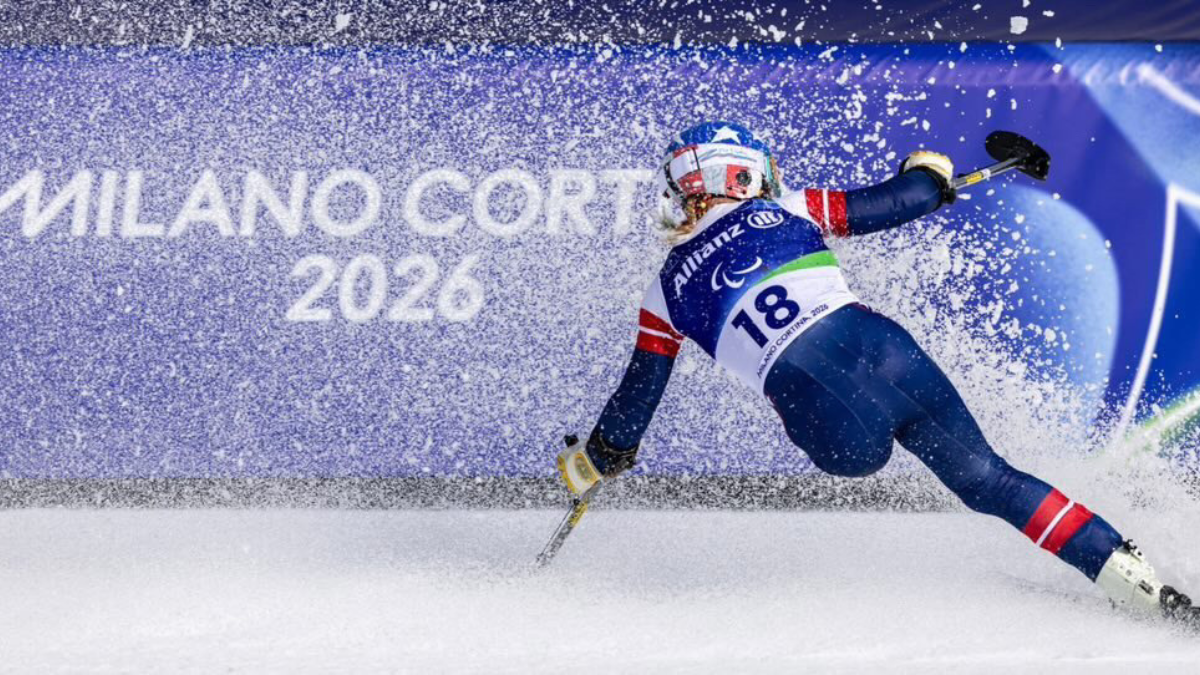
American para-alpine skier Patrick Halgren captivated the world at the Paralympic competition in Cortina d’Ampezzo, transforming a potentially devastating setback into a narrative of extraordinary resilience and triumph. Just two days after a harrowing crash in the downhill event left him crossing the finish line covered in snow, Halgren mounted a remarkable comeback, securing a silver medal in the Super-G. This achievement not only added a coveted medal to his burgeoning career but also significantly amplified attention on para-sport, showcasing an athlete whose profound charisma, infectious humor, and unique perspective resonate far beyond the competitive slopes.
The Dramatic Comeback in Cortina d’Ampezzo
The Cortina d’Ampezzo Paralympics provided a dramatic stage for Halgren’s indomitable spirit. The downhill race, one of the most demanding disciplines in alpine skiing, saw Halgren push the limits, only to suffer a high-speed crash. Despite the intensity of the incident, which left him battered and snow-covered, his determination to complete the run underscored his unwavering commitment. This display of grit set the stage for his subsequent performance. Just 48 hours later, against the breathtaking backdrop of the Italian Dolomites, Halgren defied expectations in the Super-G. The Super-G, or Super Giant Slalom, demands a blend of speed and technical precision, often described as a compromise between the outright velocity of downhill and the more intricate turns of giant slalom. Halgren’s calculated risk-taking and flawless execution propelled him to a silver medal, a testament to his mental fortitude and physical prowess. This medal was more than a personal victory; it was a powerful statement about the capabilities of para-athletes and the thrilling nature of adaptive sports, drawing new eyes to a discipline that continues to grow in global prominence. The event itself, hosted in a region renowned for its challenging terrain and rich skiing heritage, provided a fitting arena for such a compelling story.
Beyond the Podium: A Personality That Commands Attention
Halgren’s impact extends far beyond his athletic achievements. He is a magnetic personality whose presence electrifies any setting. The first encounter with him, two years prior during a World Cup event in Cortina, revealed a glimpse into his distinctive character. Over coffee, amidst the picturesque Italian scenery and the unlikely enjoyment of Czech Moravian pastries, he enthusiastically detailed his plans for the unique braids he intended to wear under his helmet. These braids, grown specifically for the Paralympics, were eventually adorned in the vibrant colors of the American flag during his medal-winning moment, becoming a visual emblem of his patriotism and individuality.
His online presence further solidifies his unique persona. Through social media, Halgren offers intimate glimpses into his "van life," a nomadic existence that underscores his free spirit and connection to the natural world. These posts often blend adventure with a thoughtful, introspective outlook on life, offering a window into the mind of an athlete who values experiences and personal growth as much as competitive success. When approached for an interview, Halgren’s immediate agreement and prompt availability were indicative of his approachable nature. Any initial reservations about capturing the true essence of his larger-than-life persona quickly dissipated. Behind the playful showman, who might at times "play his crutches like an air guitar," lies a genuinely humble, kind, and profoundly intelligent young man. His compelling life story, coupled with a perspective shaped by adversity, leaves a lasting impression on all who encounter him.
A Brother’s Enduring Legacy: The Genesis of a Champion
Patrick Halgren’s journey is inextricably linked to his twin brother, Lucas Sven Halgren, whose life and tragic passing profoundly influenced Patrick’s path. Lucas, after leaving university, embarked on a career at a ski resort. Starting from humble beginnings, parking cars, he diligently worked his way up to becoming a part of the ski patrol. Concurrently, he dedicated his time to volunteering with adaptive skiers, a role that brought him immense satisfaction and, practically, a ski pass. This pass, generously gifted to their father, enabled the elder Halgren, a former skier, to rediscover his passion for the slopes.
It was Lucas who first mastered skiing on one leg, even before Patrick’s own accident. This foresight became crucial when Patrick lost his leg in a devastating motorcycle accident in 2013, an event that also left him in a month-long coma. The accident marked a pivotal moment, forcing Patrick to re-evaluate his future. Initially, he explored various Paralympic sports, believing skiing might be too dangerous given his new circumstances. However, the infectious atmosphere of the ski slopes and the prospect of working directly within a ski resort ultimately drew him back to the sport that would define his professional career.
The brothers shared an extraordinary bond, even managing to work two winters in a single year—one in the United States and another in Australia or New Zealand. This nomadic lifestyle, living in caravans and working side-by-side, fostered an unbreakable camaraderie and a shared love for the mountains. This period, filled with shared dreams and challenges, underscored the deep connection between them.
"Svendit": A Philosophy Forged in Loss
Tragically, eight years ago, Lucas Sven Halgren was also involved in a motorcycle accident, one he did not survive. The loss of his twin brother intensified the sense of duality in Patrick’s life, imbuing it with a new, profound purpose. "It was the moment I realized I wanted to do extraordinary things," Patrick reflects. This tragic event became the crucible in which his life philosophy, embodied by the term "Svendit," was forged.
"Svendit" is more than just a memorial; it’s a guiding principle. "It means having the courage to be self-aware and face adversity—basically, svending it for him," Patrick explains. It encapsulates the idea that true significance comes not from merely believing oneself to be special, but from actively pursuing and accomplishing "special things." Patrick firmly believes his brother was with him at the Paralympics, humorously stating, "we were cheating—he pushed me onto that podium." This sentiment highlights his belief in a spiritual connection that transcends physical presence.
Patrick carries his brother’s memory both metaphorically and literally, through poignant tattoos and "Svendit" stickers that serve as constant reminders. His determination is fueled by the stark contrast between his darkest nightmares and the realization of his biggest dreams. "He died, and I’m still here, living my dream," he states, a powerful testament to his resolve. The emotional weight of his brother’s memory is particularly evident when he speaks of skiing in New Zealand, specifically at the place where Sven skied for the last time, a pilgrimage that holds deeply special meaning for him.
A Life Philosophy: Hard Work, Kindness, and Unwavering Gratitude
Patrick Halgren asserts that the hardships he has faced, particularly the loss of his leg, did not fundamentally alter his character but rather brought forth unexpected opportunities, including the chance to become a professional athlete. "Looking back now, losing my leg was the best thing that could have happened to me," Halgren states with a poignant smile, a perspective that underscores his remarkable ability to find silver linings in profound adversity.
His values are deeply rooted in the lessons learned from his parents, who navigated a challenging life through sheer hard work. They instilled in him core principles: "work hard even when you feel like you can’t anymore, stay nice even when people aren’t nice to you, and always try to be the best version of yourself." This philosophy underpins his approach to competition and life itself. He emphasizes that his pursuit is not solely for medals or victories, as these are outcomes he cannot entirely control. Instead, his focus remains steadfastly on the controllable: his effort and dedication. "That’s what brought me a medal," he concludes, highlighting the direct correlation between hard work and achievement.
Halgren understands that tangible accolades are temporary. "You can’t carry medals or trophies with you everywhere. But you always carry your character and who you are as a person." This profound insight informs his deep appreciation for the network of support that has facilitated his journey—from individuals who provided jobs at ski resorts to those offering various forms of assistance. This gratitude fuels his commitment to embodying the values instilled in him, recognizing that his success is a collective effort.
The "Batman" Effect: Inspiring Beyond the Slopes
Off the slopes, Patrick Halgren’s serious focus on performance gives way to a vibrant and engaging persona. He embraces his uniqueness, understanding that to be truly special requires action, not just thought. For Halgren, this idea carries a deeper meaning: the profound responsibility and joy of inspiring others. "I know – I look a little wild out there, jumping around on crutches and doing crazy things. But I enjoy it," he quips, acknowledging his playful public image. Yet, he balances this with a crucial dose of humility: "If you don’t practice humility, you’ll be cursed by embarrassment."
Over the years, he has witnessed firsthand the inspiring impact of his daily dedication and progress. He likens this influence to a "superpower," invoking the image of Batman. "There are kids out there dying from illnesses who need to see that people with disabilities can do incredible things too," he passionately explains. He reflects on the countless elderly or sick individuals who might have found a moment of joy or renewed hope watching para-athletes push the boundaries of human capability. "That’s the whole point of para sport – to inspire," Halgren asserts, articulating the fundamental mission of the Paralympic movement. Indeed, statistics show a steady increase in global viewership and media coverage for Paralympic events, with athletes like Halgren serving as powerful catalysts for this growing awareness and admiration. The Paralympic Games, since their inception, have evolved into a major international sporting event, consistently breaking viewership records and garnering significant public and corporate support, largely due to the compelling narratives of its athletes.

Focusing on the Controllable: A Masterclass in Mental Fortitude
Halgren’s pragmatic approach to competition and life is characterized by a disciplined focus on what he can control. He consciously steers clear of the common pitfalls of complaining about classification systems, which, while designed to ensure fairness, can be complex and sometimes contentious in para-sport. "I’ve seen too many sad stories of athletes getting trapped in a cycle of complaining, and it completely destroys their motivation," he observes. Instead, his energy is channeled into his personal development and performance. "The only thing I can control is my own performance and becoming the best version of myself," Halgren explains, a philosophy that empowers him to excel regardless of external factors.
He expresses immense pride in representing the United States, a nation that has demonstrated significant awareness and support for people with disabilities, particularly through advancements in accessibility and opportunities. While acknowledging global progress in inclusion, he recognizes that change is a gradual process. He candidly addresses the occasional curiosity of onlookers, remarking, "Sure, people still stare at me sometimes out of curiosity. But honestly, I’d probably stare at myself too – I’m obviously missing a leg. And that’s okay."
Halgren also offers a nuanced perspective on the dynamics of assistance and independence for people with disabilities. While appreciative of kindness – "people are actually very nice. They see someone with a disability and want to help carry a bag or open a door. That’s very kind" – he cautions against inadvertently fostering dependency. "There’s also a very thin line between love and hate. What we often don’t realize is that by always helping, we can unintentionally make people with disabilities dependent." He challenges others to allow individuals with disabilities the space to figure things out independently, even if it means witnessing struggle or failure. "Try it sometime – let someone with a disability figure something out on their own. I’m convinced it’ll physically hurt you to watch. And sometimes that person may fail – but that’s okay. Everyone fails sometimes," he concludes, advocating for genuine empowerment and recognizing that autonomy, even with its risks, is fundamental to human dignity and growth. This perspective aligns with broader disability advocacy movements that emphasize independence, self-determination, and the right to experience life’s full spectrum, including setbacks.
Future Horizons: Ambitions, Mentors, and a Visionary Film
Despite his Paralympic silver, Patrick Halgren remains driven by ambitious future goals. While a World Cup podium has thus far eluded him, it stands prominently on his list, alongside a world title and the aspiration for three Paralympic gold medals at future Games in France (referring to upcoming Winter Paralympics, likely 2030 or beyond). Beyond athletic glory, a deeply personal dream fuels his extraordinary determination: purchasing a house for his mother, enabling them to spend more quality time together. "That’s what I think about when I’m crying during training," he reveals, illustrating the profound emotional anchors that drive his relentless pursuit of excellence.
Halgren’s choice of skiing role models transcends mere technique, focusing instead on the compelling narratives behind the athletes. Bode Miller, the legendary American skier, stands out as a significant inspiration. Halgren admires Miller’s incredible talent and the fact that he "also started from nothing in his own unique mountain environment, kind of independently, and became a globally respected star." He feels a kinship with Miller, believing they share a common thread of having achieved greatness without guaranteed opportunities. Lucas Pinheiro also holds a special place, not only because he shares his brother’s name but also due to a memorable encounter on a glacier in Norway years ago, leading Halgren to even wear Pinheiro’s signature guards.
His inspiration extends beyond skiing to the multifaceted career of Jim Brown, the iconic American athlete who transitioned from professional football to become the first African American action movie star in Hollywood. Having played ball sports himself growing up, Halgren always aspired to emulate Brown’s groundbreaking achievements. Today, Halgren is actively living this dream. He recently co-created "Us and Them – A Disabled Ski Film," a pioneering project filmed entirely in New Zealand’s scenic Otago and Mackenzie regions. What makes this film particularly revolutionary is its "fully disabled crew," a powerful statement of inclusion and capability. This self-funded project directly challenges the prevailing narrative that often elicits pity for disabled individuals in media. Instead, "Us and Them" boldly showcases "what is really possible as a disabled person," seeking to redefine perceptions and inspire a broader understanding of ability.
Patrick Halgren’s journey is a powerful testament to the human spirit’s capacity for resilience, transformation, and profound inspiration. From his dramatic comeback in Cortina to his advocacy for genuine inclusion and his ambitious artistic endeavors, he embodies the very essence of a champion who not only excels in sport but also champions a more empathetic and empowering world. His story is a vibrant reminder that true greatness lies not just in overcoming obstacles, but in leveraging those experiences to uplift and inspire others to redefine what’s possible.

