
The Norwegian orienteering team, stung by a disappointing performance in the individual sprint on Friday, staged a remarkable comeback less than 24 hours later to dominate the sprint relay at the Orienteering World Cup in Locarno, Switzerland. The men’s team, in particular, had underperformed in the preceding individual event, leading to a collective sense of urgency and a determination to redeem themselves on the international stage. This strong resolve was evident in the sprint relay, where the Norwegian quartet delivered a near-flawless performance, ultimately outclassing the entire world elite to secure a commanding victory. The team completed all four legs of the demanding course with minimal errors, a testament to their preparation and execution under pressure.
A Resounding Redemption: Norway’s Sprint Relay Triumph
The atmosphere on Piazza Grande in Locarno, situated near the northern tip of Lago Maggiore, was electric as Norway’s anchor runner, Pia Young Vik, crossed the finish line with a substantial lead. The jubilant Norwegian celebrated the victory, acknowledging the overwhelming support from the crowd. "It was fun, I felt like I had control," Vik stated after her decisive leg, underscoring her confidence and the significant advantage her teammates had built. She had the luxury of not having any competitors close behind her, finishing a remarkable 45 seconds ahead of the first Swedish team, which in turn edged out their compatriots, Sweden 2, in a sprint for second place.
This dominant performance was not a sudden flash in the pan but a carefully constructed triumph, built meticulously from the first leg. Andrine Benjaminsen, tasked with initiating the relay, delivered a remarkably stable opening leg. Despite admitting to feeling a degree of nervousness, a common sentiment for athletes in high-stakes competitions, Benjaminsen performed admirably. "I’m not so used to running the first leg," the Oslo-based runner commented, highlighting a potential area of personal challenge. Nevertheless, she executed her course with precision, handing over to the next Norwegian runner in close proximity to Sweden’s individual sprint winner, Hanna Lundberg, and a surprising Danish second team, spearheaded by Hedvig Gydesen, who was remarkably the first to reach the exchange zone.
Strategic Prowess and Individual Brilliance Fueling the Lead
The crucial advantage that set Norway apart was largely forged on the third leg by Eirik Langedal Breivik. His strategic acumen shone through as he made several astute route choices towards the latter stages of his leg. These decisive decisions not only gained him valuable seconds but also provided Norway with a slender lead entering the final exchange. This tactical advantage was then expertly exploited by the team’s star, Kasper Fosser. Fosser, widely regarded as the world’s best orienteer, was clearly driven by a strong desire for redemption following his uncharacteristic error in Friday’s individual sprint. His performance on the third leg was a masterclass in orienteering, and as he navigated the course, the gap between him and his pursuers widened with each control. The confidence gained from his previous day’s experience, coupled with his inherent talent, allowed him to extend the lead significantly, setting the stage for a comfortable anchor leg.
Fosser’s exceptional performance provided his teammate, Pia Young Vik, with the necessary breathing room on the anchor leg. Vik, who was not part of the Norwegian team that secured the European Championship gold in this discipline in Belgium last autumn, is currently in formidable form. The race was effectively decided even before the final laps, as it became apparent that Norway would clinch victory without any major navigational errors in the closing stages of the relay. The efficiency and precision displayed by each member of the team underscored their commitment to overcoming their previous day’s setback.
Team Dynamics and Emerging Talent
The Norwegian sprint relay success is a testament to the depth and strength of their national orienteering program. The team’s performance in Locarno showcased not only the established stars but also the emerging talent within the squad. Pia Young Vik’s stellar anchor leg solidified her position as a key asset for the Norwegian team, demonstrating her current peak physical and mental condition. Her performance on the final leg was a powerful statement of her capabilities and her significant contribution to the team’s success.
The Norwegian second team, comprising Ane Dyrkorn, Håvard Sandstad Eidsmo, Lukas Liland, and Victoria Høstad Bjørnstad, also demonstrated the program’s depth, finishing in a respectable ninth place, just over two minutes behind the winning first team. This squad, representing Nydalen SK, a prominent orienteering club, highlights the strong club-level competition that underpins the national team’s success. Their performance, while not reaching the podium, indicates a strong pipeline of talent ready to challenge for senior team spots in the future.
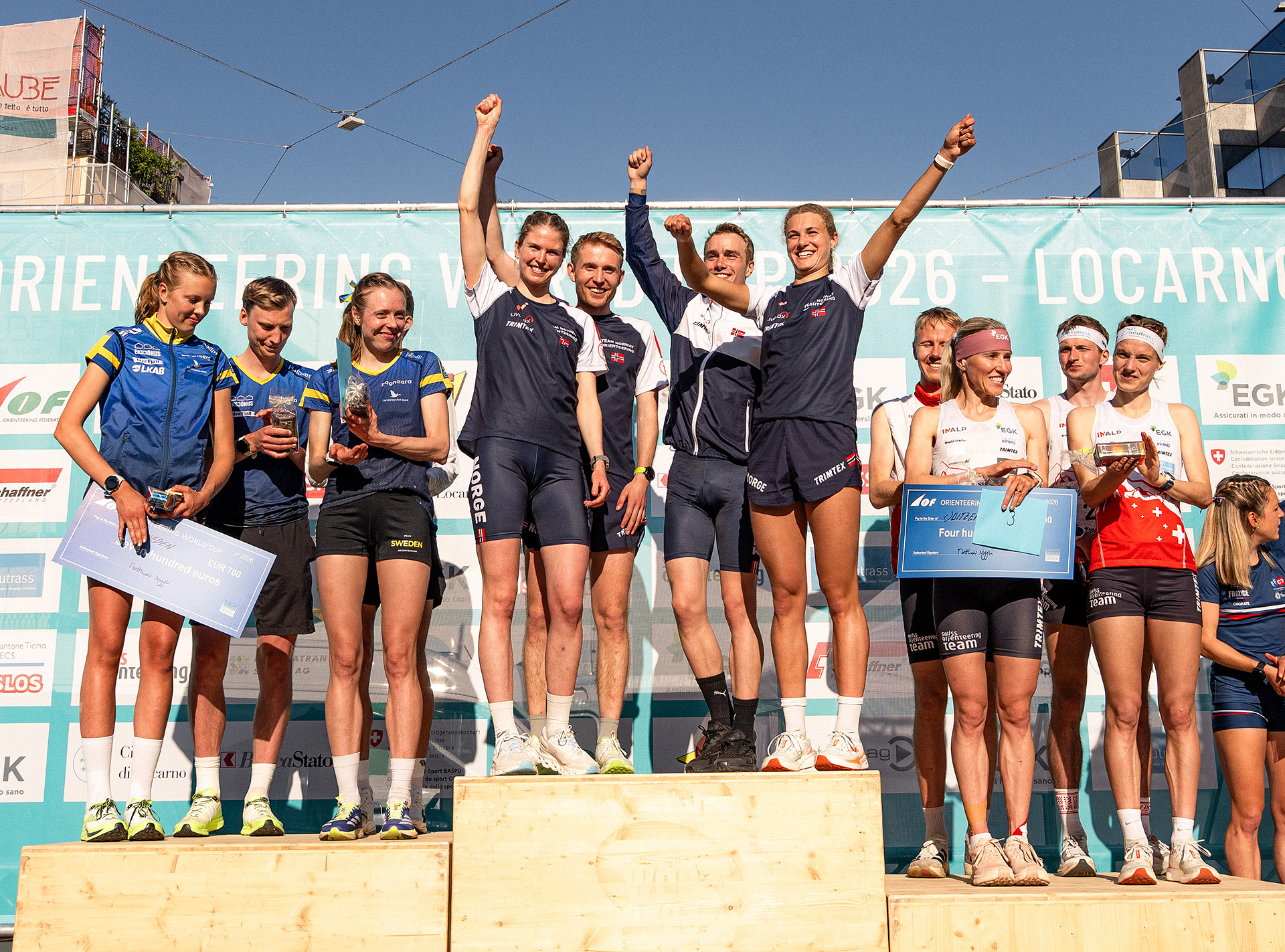
Further down the field, the Norwegian third team secured 24th place, more than four minutes adrift of the leaders. This team consisted of Kristin Melby Jacobsen, Ulrik Astrup Arnesen, Oskar Spets Storhov, and Marie Olaussen. The fourth Norwegian team concluded the competition in 29th position out of 58 participating teams, a mere 24 seconds behind the third team. This quartet included Christine Gjelstad Rebeynård, Sigurd Paulsen Vie, Alfred Bjørnerød, and Frida Haugskott. The presence of multiple Norwegian teams in the top 30 underscores the widespread participation and competitive spirit within Norwegian orienteering.
Context of the Orienteering World Cup
The Orienteering World Cup is the premier international competition series in the sport, culminating in a final event each year. It comprises several stages held in different countries, featuring a variety of disciplines including sprint, middle distance, and long distance races, as well as relays. The Locarno event, serving as the opening stage of the 2026 World Cup season, attracted a strong field of elite athletes from around the globe, eager to earn crucial points and establish early dominance. The sprint relay, a format that demands high speed, precise navigation, and seamless team coordination, is a particularly exciting and dynamic discipline, often producing close and unpredictable finishes.
The individual sprint races held on Friday served as a crucial warm-up and an indicator of current form. While the Norwegian men’s performance was described as "weak," it’s important to note that the sprint discipline in orienteering is notoriously challenging, with even minor navigational errors often leading to significant time losses. The highly technical urban or park-like terrains require exceptional map-reading skills and rapid decision-making under intense physical exertion. The disappointment experienced by the men’s team on Friday undoubtedly fueled their collective determination to perform exceptionally well in the sprint relay, demonstrating their resilience and ability to bounce back from adversity.
Analysis and Future Implications
Norway’s resounding victory in the sprint relay sends a clear message to their competitors: they are a formidable force in international orienteering, capable of overcoming setbacks and delivering top-tier performances. The team’s ability to regroup and dominate after a disappointing individual sprint highlights their strong mental fortitude and the effectiveness of their coaching and training programs.
The success of the sprint relay team will likely provide a significant morale boost for the entire Norwegian contingent as they continue their World Cup campaign. It also reinforces their status as a leading nation in the sport, particularly in the sprint disciplines. The performance of individual athletes like Kasper Fosser and Pia Young Vik further solidifies their reputations as world-class competitors.
For other nations, the Norwegian triumph serves as a benchmark and a motivation. Sweden, who secured silver and bronze, demonstrated their strength as well, indicating a continued close rivalry. The performance of the Danish second team also points to the growing competitiveness of nations outside the traditional powerhouses.
Looking ahead, the implications of this victory are manifold. It will undoubtedly fuel further investment and interest in orienteering within Norway. For the athletes, it validates their hard work and dedication. The psychological advantage gained from such a decisive win can be significant in future competitions. As the World Cup progresses, all eyes will be on Norway to see if they can maintain this winning momentum across all disciplines. The Locarno sprint relay has undoubtedly set a high bar for the remainder of the season, showcasing the best of what orienteering has to offer: speed, strategy, and unwavering teamwork.
Fans of orienteering can continue to follow the action throughout the season. Information regarding upcoming events and how to watch can be found through official channels, including the provided links to langrenn.com for viewing options and event details. The next significant event on the schedule, a knockout sprint on Sunday, offers another opportunity for athletes to showcase their skills in a different format, and the anticipation for another thrilling day of competition remains high.

