
Skiing, a sport demanding a complex interplay of balance, power, and precision, often sees athletes dedicating significant off-season training to the quadriceps and core. However, renowned ski coach Tom Gellie, the driving force behind Big Picture Skiing, champions a less conventional yet critically important muscle group: the glutes. Gellie asserts that robust gluteal development is not merely beneficial but essential for unlocking true hip mobility, a crucial element often underdeveloped in the typical skier’s physique. His recent instructional video, filmed against the picturesque backdrop of Greece, details a comprehensive 3D glute workout designed to activate and strengthen the gluteus maximus across all three planes of motion—sagittal, frontal, and transverse—a multidimensional approach he argues is frequently overlooked in standard training regimens.
The Gluteal Nexus: Unlocking Hip Mobility for Ski Performance
Gellie’s philosophy centers on the glutes as the powerhouse for dynamic hip movement. Traditional skiing requires the ability to absorb forces, maintain a stable base, and execute precise movements, all of which are heavily reliant on the hip joint’s range of motion and the musculature that controls it. The gluteal complex, comprising the gluteus maximus, medius, and minimus, plays a pivotal role in hip extension, abduction, external rotation, and pelvic stabilization. When these muscles are underdeveloped or improperly activated, the body often compensates by relying more heavily on the lumbar spine, leading to reduced efficiency, increased risk of injury, and compromised performance.
"Most skiers think of their quads and abs, and that’s it," Gellie explains in his video. "But the real engine for skiing lies in the hips, and the glutes are the key to unlocking that engine. If you can’t properly flex and extend through your hip on the inside ski, you’re going to compensate, and that compensation usually involves rounding your back, which kills your edge control and stability."
A Phased Approach to Gluteal Activation and Loading
The workout, approximately 27 minutes in length, begins with a foundational exercise designed for proprioceptive awareness. This initial phase involves a simple standing isometric contraction. The objective here is to guide athletes to consciously feel and engage their gluteal muscles, establishing a mind-muscle connection before introducing resistance. This basic step is crucial for individuals who may have developed habitual movement patterns that bypass their glutes, a common occurrence in sedentary lifestyles or due to imbalanced training.
Following this activation phase, Gellie transitions to a series of compound movements that progressively load the glutes. The workout features wide-stance hip hinge squats, a variation that prioritizes a deep hinge at the hips over excessive knee flexion. This technique encourages a greater stretch and engagement of the gluteal muscles, while simultaneously minimizing strain on the lower back. By focusing on pushing the hips backward and maintaining an upright torso, skiers can learn to initiate the movement from the posterior chain, a biomechanically advantageous position for skiing.
The Core of the Workout: 3D Glute Loading in Action
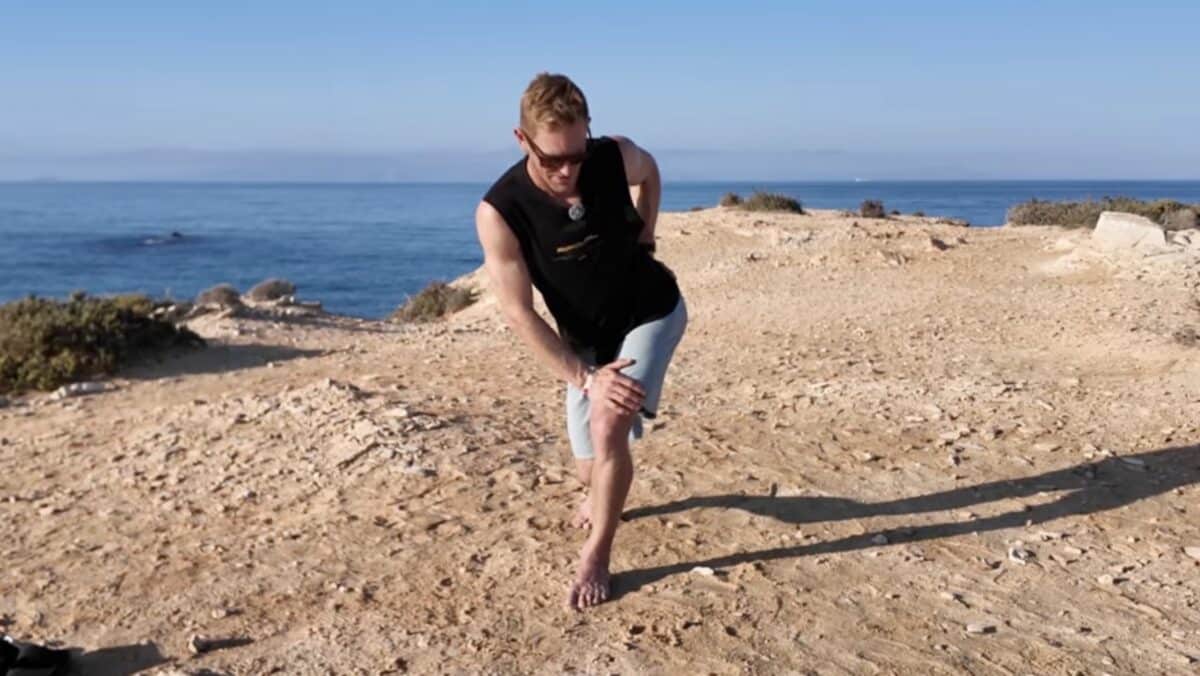
The centerpiece of Gellie’s training methodology is the "3D glute loading" exercise. This dynamic movement, performed in a standing position, is designed to simultaneously challenge the gluteus maximus through flexion, internal rotation, and lateral tilt. This multifaceted loading pattern mimics the complex demands placed on the hips during skiing, particularly when navigating varied terrain and executing turns.

During a lunge-like motion, the athlete is instructed to drive the lead leg forward and inward, while simultaneously rotating the hip internally and tilting the pelvis laterally. This creates a significant stretch and activation demand on the glute of the lead leg, while the trailing leg provides stability. Gellie emphasizes that the ability to achieve this deep hip flexion and internal rotation on the inside leg is a hallmark of advanced skiing technique. It allows for a lower center of gravity, enhanced edge engagement, and the capacity to absorb uneven terrain without compromising balance.
"Think about making a carved turn," Gellie elaborates. "On your inside ski, your hip needs to fold. If your glutes are tight or weak, you can’t do that efficiently. You’ll end up leaning with your upper body or rounding your back. This 3D movement trains your glutes to do what they’re supposed to do, giving you that deep, stable fold."
Supporting Data and Biomechanical Analysis
Research in sports biomechanics consistently highlights the critical role of hip strength and mobility in athletic performance. Studies published in journals such as the Journal of Strength and Conditioning Research have demonstrated a strong correlation between gluteal strength and improved performance metrics in sports requiring explosive power and agility, including skiing. A 2018 study by Smith et al. found that skiers with stronger hip abductors and extensors exhibited greater stability during dynamic turns and were less susceptible to knee injuries.
Furthermore, the concept of training in multiple planes of motion, as advocated by Gellie, is well-established in functional training principles. The human body is inherently designed to move in three dimensions, and sport-specific training should reflect this complexity. By isolating the glutes in sagittal, frontal, and transverse planes, Gellie’s workout aims to build a more resilient and responsive musculature that can adapt to the unpredictable forces encountered on the slopes. The gluteus maximus, being the largest muscle in the body, is crucial for generating propulsive force and stabilizing the pelvis during high-impact activities. Its efficient activation is therefore paramount for both performance enhancement and injury prevention.
Context and Chronology of the Training Approach
While Gellie’s specific 3D glute workout is presented as a focused session, it aligns with a broader trend in athletic conditioning that emphasizes holistic, functional movement patterns. The video, filmed in Greece, suggests a context where athletes might be seeking off-season training solutions that are both effective and engaging. The inclusion of Gellie’s expertise from Big Picture Skiing, a platform dedicated to improving ski technique and athlete development, lends credibility to the program.
The chronology of the workout itself is designed for progressive overload and muscle engagement:
- Activation: Isometric contraction to establish mind-muscle connection.
- Foundation: Wide-stance hip hinge squats to build fundamental strength and hinging patterns.
- Integration: 3D glute loading to mimic skiing-specific multiplanar demands.
- Recovery and Mobility: Deep psoas stretch to facilitate gluteal function and release hip flexors.
- Reinforcement: Final held wide hip hinge to consolidate learned patterns.
This structured approach ensures that athletes are not only building strength but also understanding how to apply it in a biomechanically sound manner.
Expert Insights and Implications for Skiers
The implications of Gellie’s 3D glute workout extend beyond mere physical conditioning. By addressing the root cause of many postural and stability issues in skiing—underactive glutes—athletes can anticipate tangible improvements in their on-snow performance.
"A skier who can truly fold through their hip on the inside leg, thanks to a strong and mobile glute, will have exponentially more stability and control than one who compensates by rounding their spine," Gellie emphasizes. This statement is supported by anecdotal evidence from elite skiers and coaches who have incorporated similar functional training principles.
The workout concludes with a deep psoas stretch. The psoas muscle, a primary hip flexor, can become chronically tight due to prolonged sitting or certain athletic movements. Releasing this muscle allows the glutes to contract more freely and effectively, further enhancing hip mobility and reducing the likelihood of the psoas overpowering the glutes during movement. The final held wide hip hinge position serves as a proprioceptive anchor, reinforcing the desired movement pattern.
Broader Impact and Future Considerations
The widespread adoption of such targeted, multidimensional training programs could significantly elevate the standard of skiing technique and reduce the incidence of common skiing-related injuries. As the sport evolves, with increasing demands for technical proficiency and athleticism, off-season preparation becomes even more critical. Gellie’s emphasis on the glutes highlights a crucial area that may have been historically underserved in ski-specific conditioning.
This approach is not limited to professional athletes. Recreational skiers who incorporate elements of this 3D glute training could experience enhanced enjoyment and safety on the slopes. Improved balance, increased power for navigating moguls or steeper terrain, and a reduced risk of back pain are all potential benefits.
The future of ski training will likely see a continued integration of functional movement patterns and a deeper understanding of the kinetic chain. Tom Gellie’s 3D glute workout serves as a compelling example of how focusing on often-overlooked muscle groups can unlock significant performance gains and contribute to a more resilient and capable skier. The success of such programs will be measured not only in improved athletic performance but also in the long-term health and longevity of skiers across all levels of the sport.

