
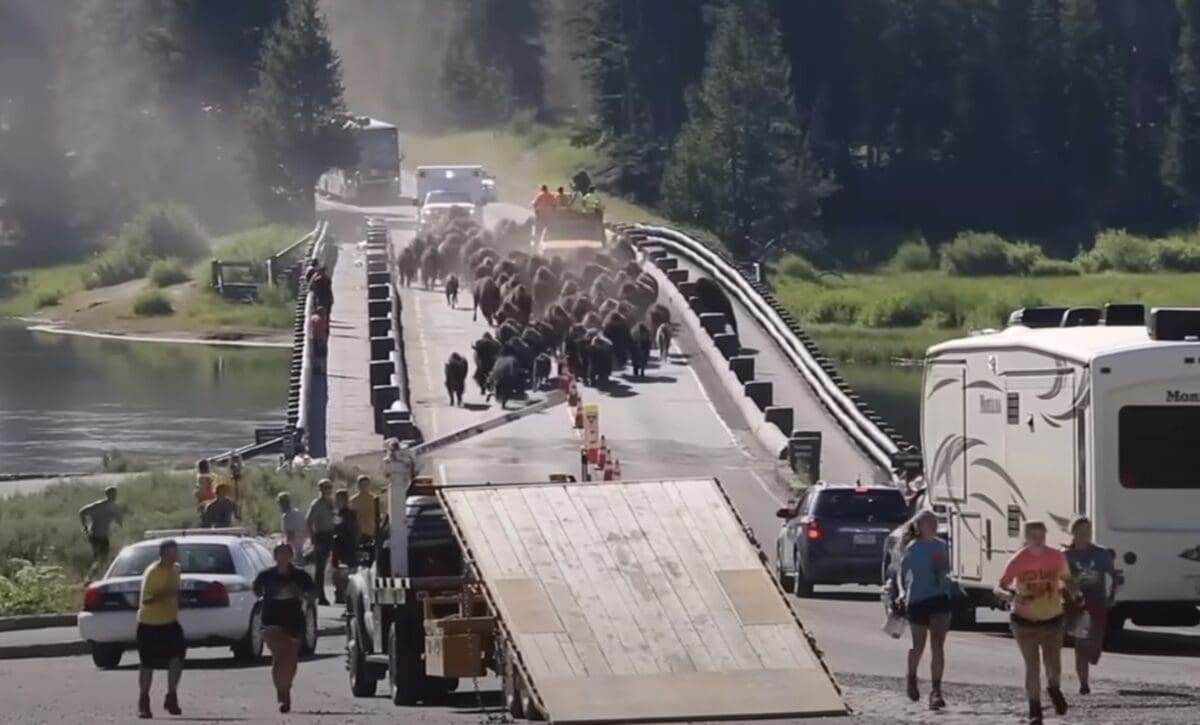
Yellowstone National Park’s iconic bison, a symbol of the American West and the nation’s largest herd on public land, recently provided a stark reminder of their untamed power as a stampede occurred on a park bridge, sending tourists scrambling for safety. This dramatic event underscores the inherent risks of encountering wildlife in their natural habitat and has prompted renewed calls for visitor vigilance and adherence to park safety guidelines. The incident, captured on video and widely shared, highlights the unpredictable nature of these magnificent animals and the critical importance of maintaining a safe distance.
The Unfolding Event: A Bridge Over Troubled Waters
The precise sequence of events leading to the stampede remains under investigation, but witness accounts and video footage depict a breathtaking scene. A large herd of bison, numbering in the dozens, suddenly surged across a bridge within Yellowstone National Park. Tourists, who were observing the bison from a distance that was unfortunately too close for comfort, found themselves directly in the path of the thundering herd. The video clearly shows individuals, including both visitors and park rangers, running to escape the oncoming animals, their movements a desperate attempt to find refuge from the powerful charge. The sheer speed and force of the stampede created a palpable sense of danger, transforming a picturesque wildlife viewing opportunity into a heart-pounding escape.
The image of people running alongside these massive creatures—which can reach speeds of up to 35 miles per hour—is a vivid illustration of the wildness that still defines Yellowstone. While the exact trigger for this specific stampede is not definitively known, park officials often cite human disturbance as a primary cause for such events. Bison, despite their often docile appearance, are wild animals with strong herd instincts. Perceived threats, whether real or imagined, can trigger a flight response, leading to a stampede. This response is deeply ingrained in their evolutionary history and serves as a crucial survival mechanism.
Yellowstone’s Bison: A Living Link to Prehistory
Yellowstone National Park is home to approximately 4,550 bison, a population that holds significant ecological and historical importance. This herd is not only the largest bison population on public lands in the United States but also the only one in the contiguous 48 states to have continuously inhabited the same ecosystem since prehistoric times. This unbroken lineage makes Yellowstone’s bison a living testament to the wild landscapes of North America’s past.
For generations, visitors have been drawn to Yellowstone by the opportunity to witness these majestic animals roaming freely across the park’s vast 2.2 million acres. Bison have become inextricably linked with the Yellowstone experience, their presence a hallmark of a visit to the park. While most encounters are peaceful and awe-inspiring, the recent stampede serves as a potent reminder that these animals are wild and unpredictable. Their sheer size, weight, and speed make them formidable creatures, and underestimating their power can have serious consequences.

Understanding Bison Behavior: Triggers and Responses
Bison stampedes are not uncommon occurrences in Yellowstone, though the scale and proximity to human activity can vary. These events are primarily a defensive reaction, triggered by a perceived threat or disturbance within their environment. When bison feel endangered, their instinctual response is to flee, often in a unified and powerful surge known as a stampede.
Several factors can precipitate such a reaction:
- Predator Presence: While wolves and bears are natural predators of bison, the sudden appearance or aggressive behavior of these animals can trigger a flight response in the herd.
- Natural Disasters: Extreme weather events, such as severe thunderstorms with loud thunder or lightning strikes, can startle bison and incite a stampede.
- Human Disturbances: This is often the most significant factor contributing to bison stampedes involving tourists. Actions such as approaching too closely, making loud noises, attempting to feed them, or even sudden movements by vehicles can be interpreted as a threat. The presence of numerous people or vehicles in close proximity can overwhelm the bison’s comfort zone, leading to a defensive reaction.
- Herding Instincts: Bison are highly social animals and their herd mentality is a powerful force. Once one bison begins to flee, others are likely to follow, creating a cascading effect that results in a full-blown stampede.
The incident on the bridge likely falls into the category of human-induced disturbance, even if unintentional. The sheer number of bison moving together, coupled with the confined space of a bridge, created a high-risk situation for onlookers.
Official Response and Safety Protocols
Following the incident, Yellowstone National Park officials have reiterated their commitment to visitor safety and the protection of wildlife. While the investigation into the specific cause of the stampede is ongoing, the event serves as a crucial moment to reinforce existing safety protocols.
Park regulations mandate specific distances for visitors to maintain from bison. The general guideline is to stay at least 25 yards (approximately 75 feet) away from all bison. For larger animals like bison, bears, and wolves, this distance is extended to 100 yards (approximately 300 feet). These distances are not arbitrary; they are based on the animals’ ability to react to perceived threats and ensure that visitors are outside of their immediate strike zone.
The park’s website and visitor centers provide extensive information on wildlife safety, emphasizing that bison, despite their often placid demeanor, are responsible for more injuries to Yellowstone visitors than any other animal. This statistic is a stark warning that cannot be overstated. Their strength and unpredictable nature demand respect and caution.
In the event of a bison charge, park guidance is clear: run away. While this may seem counterintuitive when faced with a fast-moving animal, human beings are generally not equipped to outrun a bison. However, their agility in tight turns is limited. Seeking cover behind a vehicle or a large natural obstacle, if available, can provide a temporary sanctuary.
Furthermore, visitors are advised to drive carefully around bison. When encountering bison on the road, drivers should pull over and wait for the animals to pass, or maintain a safe distance if they must proceed. Blocking traffic or attempting to drive through a herd can provoke the animals and create dangerous situations.
The Role of Video Evidence and Public Awareness
The viral spread of the video capturing the bison stampede has undoubtedly amplified public awareness of the risks associated with wildlife encounters in national parks. While such footage can be shocking, it serves a vital educational purpose. It provides a visceral understanding of the power and unpredictability of wild animals and reinforces the importance of respecting their space.
Park rangers and wildlife biologists often utilize such incidents to inform and educate the public. The objective is to foster a deeper appreciation for wildlife while simultaneously ensuring that human interactions do not jeopardize the safety of either visitors or the animals. The goal is to promote responsible tourism, where the thrill of seeing wildlife does not come at the expense of endangering oneself or the creatures being observed.
Broader Implications: Balancing Access and Conservation
The Yellowstone bison stampede incident has broader implications for how we approach the balance between public access to natural wonders and the imperative of wildlife conservation. National parks like Yellowstone offer unparalleled opportunities for people to connect with nature, but this access must be managed responsibly.
- Visitor Education: The effectiveness of park signage and educational materials needs continuous evaluation. Are visitors truly understanding the risks? Are the messages clear and impactful? The ubiquity of smartphones and the desire to capture the perfect photo can sometimes override safety considerations.
- Ranger Presence and Enforcement: While rangers are present to guide and enforce regulations, the sheer size of parks like Yellowstone makes constant oversight impossible. Visitor compliance is paramount.
- Understanding Animal Behavior: Continued research into bison behavior, particularly their responses to human presence, is crucial for informing management strategies and safety advisories. This includes understanding how increased tourism impacts their natural patterns.
- The "Wildness" Factor: It is essential for visitors to remember that they are entering a wild environment. The animals are not domesticated, and their behavior is dictated by natural instincts, not by human expectations. The thrill of Yellowstone lies in its untamed nature, and this wildness demands a level of respect and caution.
The bison stampede on the Yellowstone bridge is more than just a dramatic news event; it is a powerful reminder of our place within the natural world. It underscores the need for constant vigilance, informed decision-making, and a deep respect for the power and majesty of wildlife. By adhering to park guidelines and understanding the inherent risks, visitors can continue to experience the wonders of Yellowstone safely, ensuring that these magnificent bison remain a symbol of the wild, for generations to come.

