
The iconic red Aerial Tram at Jackson Hole Mountain Resort stands as one of the most recognizable and awe-inspiring feats of alpine engineering in the world. Ascending 4,139 vertical feet from the base area in Teton Village to the jagged summit of Rendezvous Mountain, the tram delivers skiers, snowboarders, and sightseers to some of the most challenging and celebrated terrain in North America. While passengers frequently find themselves captivated by the sweeping vistas of the Tetons and mentally preparing for the steep descents that await them, the complex mechanical systems operating behind the scenes often go unnoticed. Spanning a nearly five-mile loop of heavy-duty cables, the tram represents a masterclass in modern mechanical and civil engineering, balancing massive loads, extreme weather, and continuous daily operation.
Main Facts and Mechanical Overview
At its core, the Jackson Hole Aerial Tram is a reversible aerial passenger tramway, a design characterized by cabins that travel back and forth along fixed support cables, powered by a continuous hauling rope connected to a massive drive motor. The current iteration of the tram, affectionately known by locals and visitors alike as "Big Red," operates with a passenger capacity of 100 people plus one tram operator.
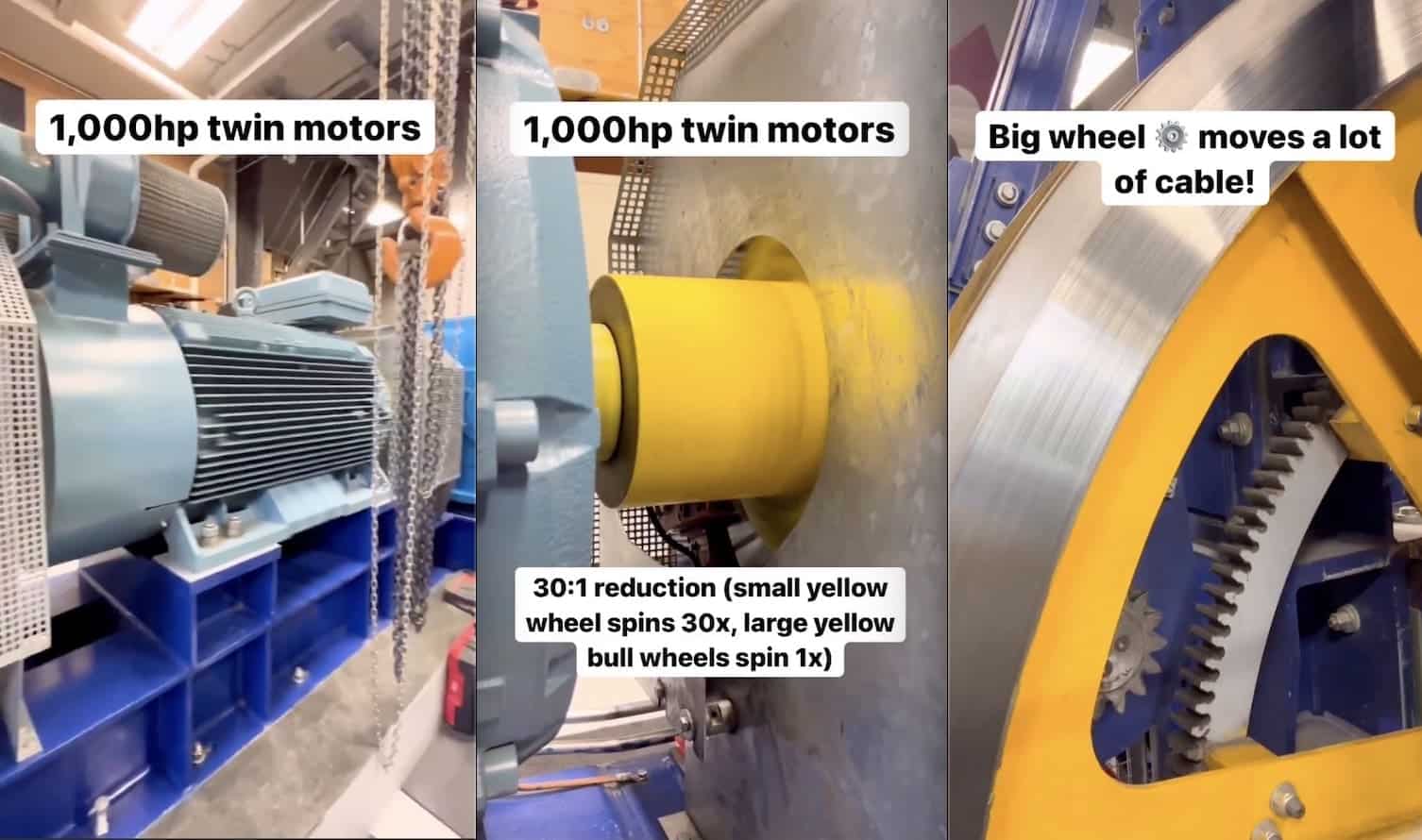
The mechanics required to move this heavy cabin up a punishing alpine gradient are staggering. The system relies on a continuous loop of cable measuring approximately 4.85 miles in total length. This haul rope is driven by a powerful electric motor housed in the upper terminal at the summit of Rendezvous Mountain. As the motor turns, it pulls one cabin upward while simultaneously lowering the other down the mountainside, creating a counterbalance system that significantly reduces the energy required to lift the heavy payloads.
In addition to the haul rope, the tram cabins glide along thick track ropes—often referred to as track cables—which support the weight of the vehicles. These stationary cables are anchored securely in massive concrete counterweight and tensioning pits, allowing the cables to expand and contract with fluctuations in temperature without compromising structural integrity. Hydraulic tensioners and heavy-duty sheaves work in concert along the towers to guide the cables smoothly over the rugged mountain topography.
A Chronology of Innovation: From the Original Tram to Big Red
The history of the Jackson Hole Aerial Tram is deeply intertwined with the development of modern American skiing. The resort’s original tramway began operations in the winter of 1965–1966, fundamentally transforming the region into a world-class destination. For four decades, the original red tram served as the undisputed workhorse of the mountain, carrying generations of mountaineers, ski patrollers, and powder hounds to the legendary summit. That historic system featured a slightly smaller capacity, accommodating up to 63 passengers per trip while maintaining the same signature nine-minute transit time to the top.
By the mid-2000s, after logging tens of thousands of operating hours and millions of passenger rides, the original tram was approaching the end of its projected operational lifespan. Rather than shuttering the iconic service, resort ownership made the monumental decision to invest in a complete overhaul. In 2006, the original tram was officially retired, marking the end of an era for the local ski community.
Construction of the modern tram system commenced immediately following the retirement of its predecessor. Engineers, construction crews, and helicopter pilots battled harsh alpine weather, steep terrain, and tight deadlines to erect the new towers, stations, and cables. The contemporary tram system successfully launched for the 2008–2009 winter season. While it retained the classic nine-minute travel time and the iconic red exterior that homage paid to the original design, the new system nearly doubled the hourly uphill passenger capacity, vastly improving guest flow and reducing wait times during peak periods.
Supporting Data and Operational Metrics
Understanding the scale of the Jackson Hole Aerial Tram requires examining the raw statistics that govern its daily routine. Operating across a vertical rise of precisely 4,139 feet, the tram covers a horizontal distance of approximately 2.5 miles from base to summit in a single span, reaching the top elevation of 10,450 feet above sea level.
The cabins themselves are engineered to withstand extreme environmental forces, including high-velocity winds and heavy snow loads common to the Teton Range. Each cabin weighs several tons empty and is designed to handle maximum payloads consisting of passengers and cargo. The haul rope, which continuously cycles through the upper and lower terminals, is subjected to immense tensile stress, requiring rigorous daily inspections by certified lift maintenance technicians before the public is ever allowed to board.
Safety systems on the tram are multi-layered and redundant. In the event of a primary power failure, auxiliary diesel generators can power the system to safely evacuate passengers to the nearest terminal or tower platform. Furthermore, independent braking systems—including emergency track brakes that can clamp directly onto the stationary track ropes—provide an absolute failsafe against mechanical rollback or overspeed conditions.
Official Responses and Industry Perspectives
Resort leadership and lift operations personnel frequently emphasize that safety and maintenance are the highest priorities governing the tram’s daily routine. Representatives from Jackson Hole Mountain Resort have noted that keeping a lift of this magnitude running smoothly requires a year-round commitment from specialized mechanical engineers, electricians, and ropeway technicians.
During the off-season months, the tram undergoes extensive preventative maintenance. This includes non-destructive testing of the steel cables using electromagnetic inspection equipment to detect any microscopic internal fatigue or wire breakage. Every component of the drive machinery, hydraulic systems, and cabin suspension gear is meticulously dismantled, inspected, and serviced according to strict ANSI (American National Standards Institute) regulations and international tramway standards.
Industry experts often point to the Jackson Hole Aerial Tram as a benchmark for heavy aerial ropeway engineering in North America. Few resorts face the combination of sheer vertical relief, maritime-to-continental weather shifts, and high avalanche-hazard terrain that characterizes Rendezvous Mountain. Consequently, the operational protocols developed at Jackson Hole frequently serve as a case study for other large-scale mountain resorts managing complex lift infrastructures.

Broader Impact and Economic Implications
Beyond its mechanical sophistication, the Aerial Tram serves as the cultural and economic heartbeat of Jackson Hole Mountain Resort. It defines the character of Teton Village and acts as a beacon for advanced and expert skiers worldwide who travel to test their mettle on infamous runs such as Corbet’s Couloir.
The tram also plays a vital role during the summer tourism season, transporting hikers, sightseers, and mountain bikers to the alpine ecosystem above the tree line. This year-round utility stabilizes the local economy, supporting employment for hundreds of seasonal and year-round hospitality, maintenance, and operations workers in the Jackson Hole valley.
As climate patterns shift and tourism demands continue to grow, the infrastructure supporting alpine recreation faces mounting pressures. The longevity and reliability of the Jackson Hole Aerial Tram underscore the importance of forward-thinking capital investment and rigorous maintenance engineering. By demystifying the complex interplay of cables, motors, and counterweights that power the ascent, visitors gain a deeper appreciation for the seamless fusion of human ingenuity and raw wilderness that makes the journey to the summit of Rendezvous Mountain possible.

