
The rapid scaling of renewable energy infrastructure across the globe has been met with a parallel increase in organized opposition, characterized by a sophisticated and well-funded disinformation campaign. As governments and private sectors accelerate the transition toward a decarbonized economy, public discourse has become increasingly saturated with claims that offshore wind turbines diminish property values, solar farms destroy arable land, and wind energy poses an existential threat to avian populations. While some of these concerns stem from genuine public inquiry, a significant portion of the negative narrative is the result of a coordinated effort to stall the adoption of clean energy technologies.
The distinction between misinformation and disinformation is critical to understanding this landscape. Misinformation refers to the unintentional spread of false or misleading information by individuals who believe the claims to be true. Conversely, disinformation is the deliberate creation and distribution of false narratives intended to deceive the public, often to protect specific economic interests or political agendas. In the context of climate change and energy, disinformation acts as a tool for "climate delayism," shifting the focus from systemic solutions to localized, often exaggerated grievances, thereby fragmenting public support for the energy transition.
A Chronology of Energy Industry Influence
The current wave of opposition to renewable energy is not an isolated phenomenon but the latest iteration of a decades-long strategy employed by fossil fuel interests. Historical records and investigative journalism have traced the origins of climate-related disinformation back to the late 20th century.
In the 1970s and 1980s, internal research conducted by major oil corporations, such as Exxon (now ExxonMobil), accurately predicted the trajectory of global warming caused by fossil fuel combustion. However, rather than pivoting toward cleaner energy sources, these entities began funding public relations campaigns designed to cast doubt on the emerging scientific consensus. By the 1990s, organizations like the Global Climate Coalition were formed specifically to lobby against international climate agreements, such as the Kyoto Protocol, by emphasizing economic uncertainty and scientific skepticism.
The 2010s saw a shift from outright climate denial to more nuanced forms of obstruction. As the reality of climate change became undeniable to the general public, the narrative transitioned toward attacking the viability of renewable alternatives. This era saw the rise of "astroturfing"—the practice of creating fake grassroots movements to oppose local renewable projects. Today, the 2020s are defined by the rapid viral spread of disinformation on social media platforms, where unverified claims about the dangers of electric vehicles (EVs) and the ecological impact of wind farms can reach millions of people instantaneously, often bypassing traditional fact-checking mechanisms.
Comparative Data: Electric Vehicles vs. Internal Combustion Engines
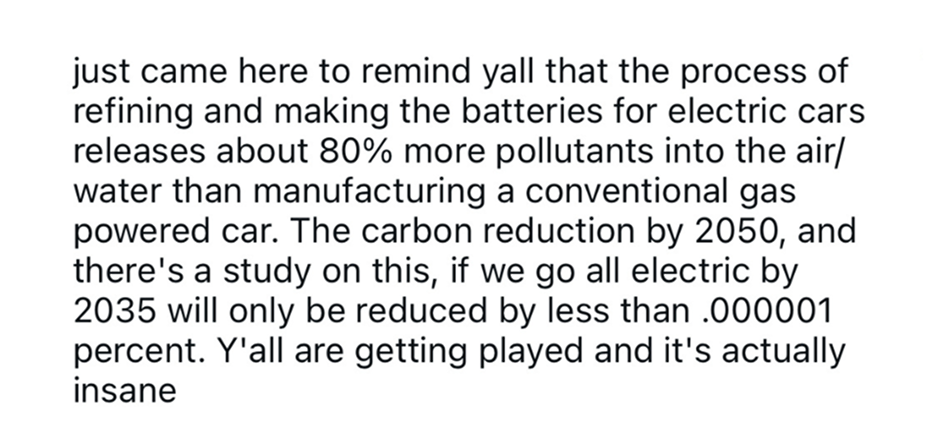
One of the most persistent narratives in the anti-renewable campaign concerns the environmental footprint of electric vehicle production. Critics frequently point to the resource-intensive nature of mineral extraction—specifically lithium, cobalt, and nickel—as evidence that EVs are more harmful than conventional gasoline-powered vehicles.
However, comprehensive lifecycle assessments (LCAs) conducted by academic institutions provide a different perspective. A study by the Massachusetts Institute of Technology (MIT) Energy Initiative found that while the manufacturing process for an EV is indeed more carbon-intensive than that of an internal combustion engine (ICE) vehicle, the total lifetime emissions of EVs are significantly lower. On average, a gasoline-powered car emits more than 350 grams of CO2 per mile driven over its lifetime. In contrast, a battery-electric vehicle (BEV) generates approximately 200 grams per mile.
Furthermore, as the electrical grid becomes greener through the integration of solar and wind power, the "carbon debt" of EV manufacturing is repaid more quickly. Data from the International Energy Agency (IEA) suggests that in most regions, an EV pays back its manufacturing carbon footprint within two years of operation. The environmental impact of mineral mining remains a challenge that requires stricter regulatory oversight and the development of circular battery economies; however, it does not outweigh the systemic damage caused by the continuous extraction, refining, and combustion of petroleum.
The Ecological Impact of Offshore Wind and Avian Safety
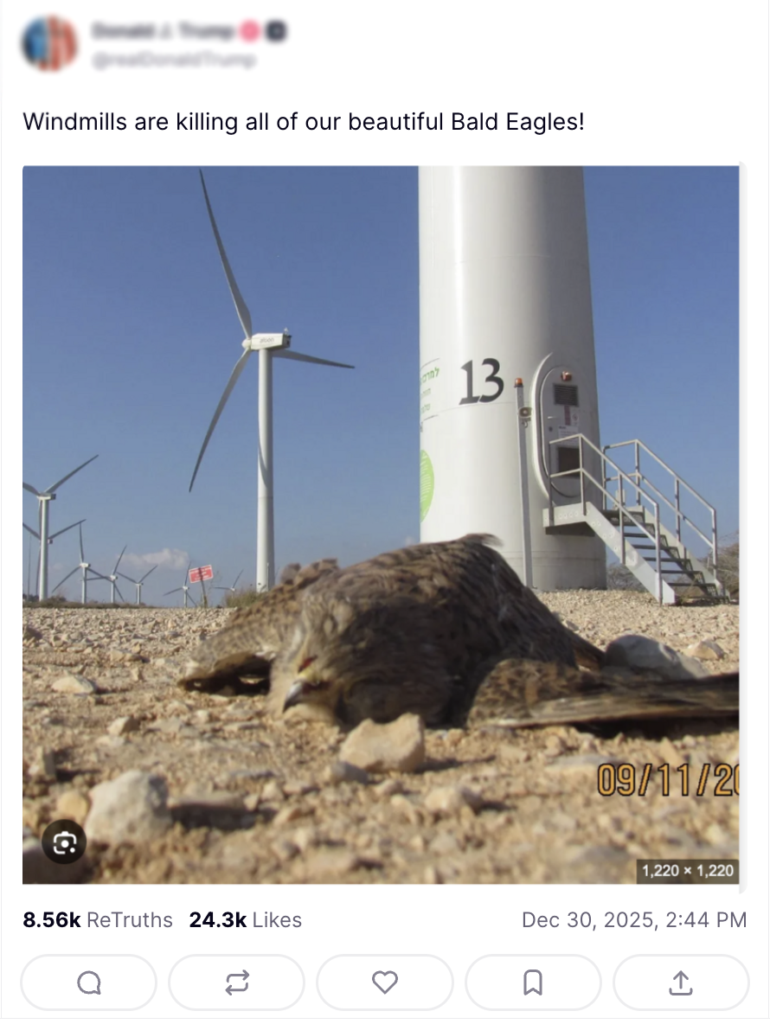
The impact of offshore wind farms on marine and avian ecosystems is another focal point for disinformation. Reports often circulate claiming that wind turbines are the primary cause of mass bird mortality or that the acoustic frequencies from turbine installation are responsible for whale strandings.
Scientific data from the National Oceanic and Atmospheric Administration (NOAA) and the Bureau of Ocean Energy Management (BOEM) has consistently found no evidence linking offshore wind activities to recent whale mortality events. Instead, the primary threats to marine life remain vessel strikes, entanglement in fishing gear, and the broader impacts of climate change, such as warming ocean temperatures and shifting prey distributions.
Regarding avian safety, the American Bird Conservancy and other conservation groups note that while wind turbines do pose a risk to birds, the scale is relatively small compared to other human-made structures. Research published in the Journal of Integrative Environmental Sciences indicates that buildings and communication towers account for hundreds of millions of bird deaths annually, far exceeding the estimated mortality rate associated with wind turbines. Moreover, the transition to wind energy mitigates the greatest long-term threat to bird species: the loss of habitat and nesting grounds due to global temperature rises.
Economic Implications and Land Use Realities
The claim that renewable energy is unreliable or economically detrimental is frequently debunked by market data. The Levelized Cost of Energy (LCOE) for solar and wind has plummeted by over 80% and 40%, respectively, over the last decade, making them the cheapest sources of new electricity generation in many parts of the world.
The "loss of farmland" narrative also faces scrutiny. Solar developers are increasingly utilizing "agrivoltaics," a practice where solar panels are co-located with agricultural activities. This allows for the simultaneous production of energy and crops, or the grazing of livestock, often providing farmers with a stable secondary income stream that protects them from the volatility of crop prices. According to the National Renewable Energy Laboratory (NREL), the total land area required to meet the United States’ energy needs through solar power by 2050 would account for less than 0.5% of the country’s contiguous land mass—an area significantly smaller than the land currently utilized for ethanol production.
Official Responses and Policy Frameworks
International bodies and national governments have begun to recognize disinformation as a major hurdle to climate action. The Intergovernmental Panel on Climate Change (IPCC) highlighted in its Sixth Assessment Report that "rhetoric and misinformation on climate change and the deliberate undermining of science have contributed to misperceptions of the scientific consensus, uncertainty, disregarded risk and urgency, and low public support for climate policy."
In response, some jurisdictions are exploring legislative measures to increase transparency in political advertising and funding. In the United States, the Inflation Reduction Act (IRA) has provided substantial incentives for domestic clean energy manufacturing, aiming to counter disinformation by demonstrating the tangible economic benefits of the transition, such as job creation in the "Rust Belt" and rural communities. European regulators are also implementing the Digital Services Act (DSA), which requires social media platforms to take greater responsibility for the spread of harmful disinformation, including climate-related falsehoods.
Broader Impact and the Path Forward
The persistence of disinformation campaigns creates a "perfection paradox," where any flaw in renewable technology is used as a justification to maintain the status quo of fossil fuel dependency. Professional analysis suggests that the transition to clean energy should not be viewed as a search for a flawless solution, but as a necessary shift toward a system that is demonstrably less harmful and more sustainable than the current model.

To combat the influence of disinformation, experts emphasize the importance of "pre-bunking"—educating the public on the tactics used by bad actors before they encounter false information. This includes identifying logical fallacies, such as the "red herring" (distracting from the main issue with an irrelevant point) or the "straw man" (misrepresenting an argument to make it easier to attack).
As the global community moves toward the mid-century goals of the Paris Agreement, the integrity of the information ecosystem will be as vital as the technology itself. By prioritizing data-driven discourse and holding systemic suppliers of energy accountable, society can navigate the transition with a clear understanding of the risks, benefits, and the urgent necessity of progress. The path to a decarbonized future requires not only the installation of solar panels and wind turbines but also the fortification of public truth against the strategic interests of the past.

