
A harrowing encounter unfolded at Yellowstone National Park on Friday, July 10th, when an elderly man was violently thrown into the air by a bison, sustaining serious injuries. While official details from the National Park Service remain limited, a video circulating online has provided a stark visual account of the incident, underscoring the inherent dangers of wildlife encounters in one of America’s most iconic natural landscapes. The attack occurred near the Bridge Bay Campground, a popular area adjacent to Yellowstone Lake, highlighting the proximity of visitors to potentially volatile wildlife.
The incident began with a different group, as the bison initially charged a group of children. Fortunately, the children were able to evade the aggressive animal, escaping any physical contact. Following this initial confrontation, the bison retreated to a dirt patch, engaging in a wallowing behavior that kicked up a significant cloud of dust. This behavior often indicates an attempt to cool down or remove parasites, and after a brief period, the animal appeared to regain a calmer demeanor.
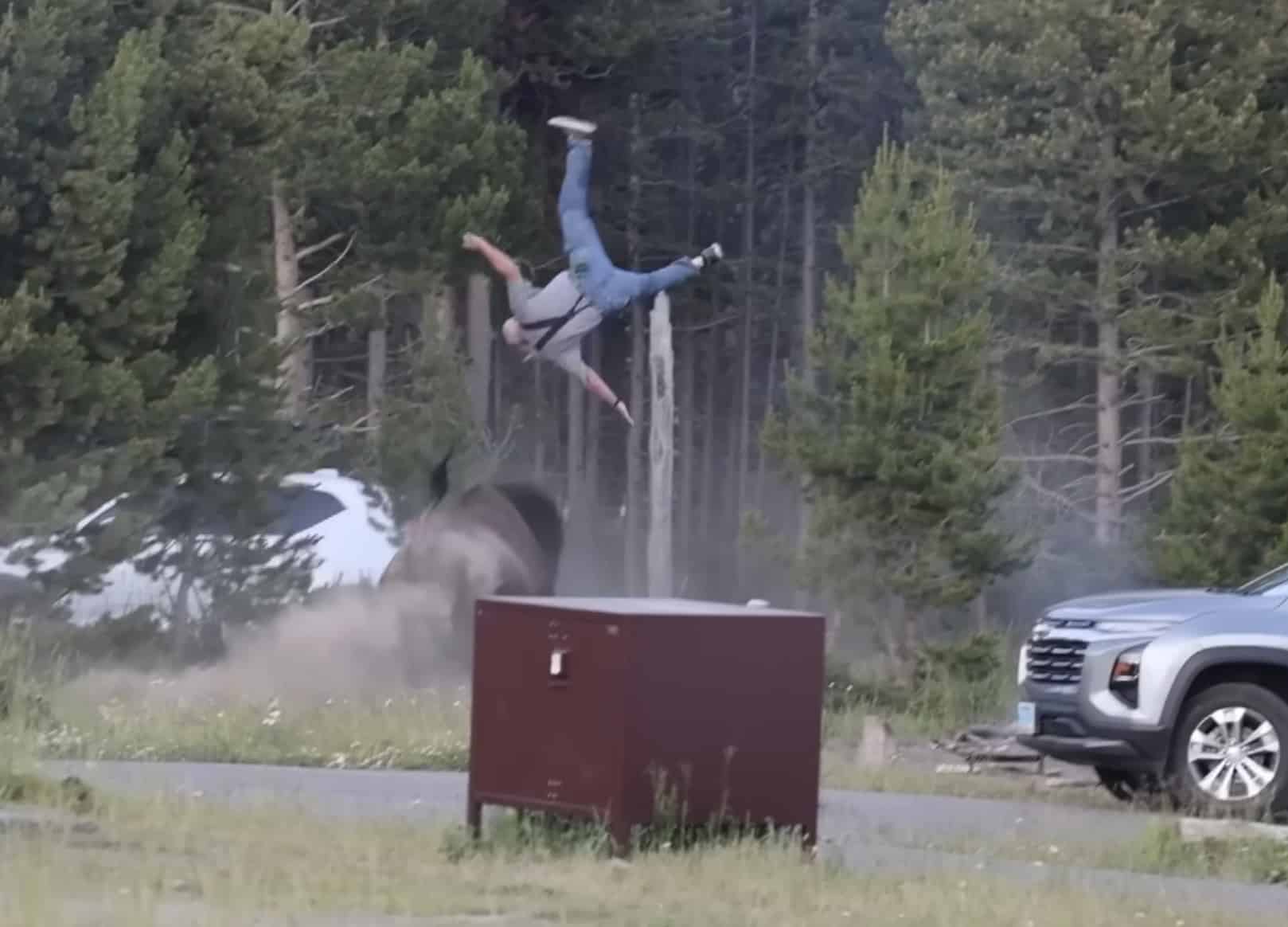
However, this apparent calm was short-lived. A grandfather and his grandson, who were walking south of the Fishing Bridge, entered the vicinity, seemingly unaware of the preceding event. At approximately the same time, a pickup truck approached the scene. The presence of the vehicle appears to have agitated the bison once more, reigniting its aggressive state. The bison charged the truck, which promptly drove away, successfully avoiding direct contact. Unfortunately, the animal then redirected its attention to the grandfather and grandson who were now in its immediate vicinity.
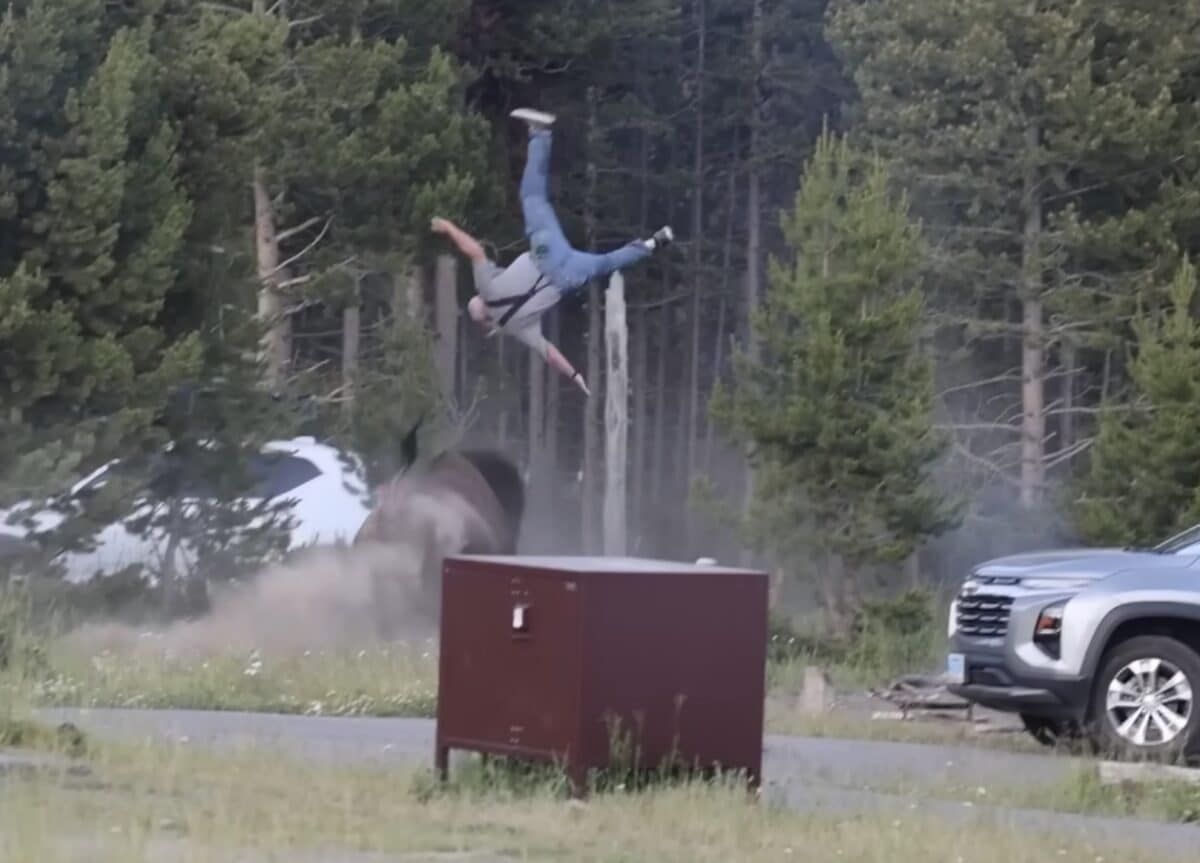
While the grandson managed to escape unharmed, the grandfather was not as fortunate. The video footage captures the terrifying moment the bison launched the elderly man into the air, estimated to be around eight feet. Following the impact, the bison stood over the fallen man, its massive head shaking, a posture that conveyed a clear sense of dominance and potential threat. Alert bystanders, witnessing the dire situation, began shouting at the bison and moved towards it in an attempt to distract the animal from the victim. This intervention was successful, and the bison eventually retreated from the scene.
Emergency medical services were promptly contacted, and 911 dispatchers relayed the urgent situation. First responders arrived on the scene swiftly, assessing the injured man. Despite not exhibiting obvious external signs of injury, the victim was reported to be in significant distress and pain following the brutal assault. Reports indicate he is currently recovering from the serious injuries sustained during the encounter.
Yellowstone Bison: A Persistent Danger
Bison, North America’s largest land mammal, are a quintessential symbol of the American West and a major draw for visitors to Yellowstone. However, their imposing size and seemingly placid nature can mask a formidable power and unpredictable temperament. Statistics consistently show that bison are responsible for more injuries to visitors in Yellowstone National Park than any other animal. This is a critical point for park management and visitor education efforts.
The park’s official policy mandates that all visitors maintain a minimum distance of 25 yards (approximately 23 meters) from bison at all times. This guideline is rooted in the understanding of bison’s territorial nature and their surprising agility. Despite being massive creatures, bison are capable of reaching speeds of up to 35 miles per hour (approximately 56 kilometers per hour), making them remarkably fast and able to close distances with alarming rapidity. In this particular incident, reports suggest that the grandfather and grandson were adhering to a respectful distance prior to the attack. However, the inherent unpredictability of wildlife means that even adherence to safety guidelines does not always guarantee absolute safety. Factors such as the animal’s immediate environment, its current state of agitation, and unforeseen stimuli can trigger defensive or aggressive responses.
Chronology of the Incident:
- Initial Agitation: A bison charges a group of children near Bridge Bay Campground. The children escape unharmed.
- Wallowing Behavior: The bison retreats to a dirt patch and wallows, appearing to calm down.
- Unsuspecting Visitors: An elderly man and his grandson approach the area.
- Vehicle Provocation: A pickup truck arrives, reigniting the bison’s agitated state.
- Secondary Charge: The bison charges the truck, which drives away.
- Targeted Attack: The bison focuses on the grandfather and grandson.
- Elderly Man Injured: The bison tosses the elderly man into the air.
- Bystander Intervention: Onlookers yell and approach the bison to divert its attention.
- Bison Retreats: The bison runs off.
- Emergency Response: 911 is called, and medical personnel arrive to treat the injured man.
Broader Implications and Park Safety
The incident serves as a potent reminder of the critical importance of respecting wildlife and adhering to park regulations. Yellowstone National Park is a wild ecosystem, and visitors are guests in the animals’ natural habitat. The park’s safety guidelines are not arbitrary; they are developed based on extensive observation, scientific understanding of animal behavior, and a history of human-wildlife interactions.

The 25-yard rule is a minimum, and circumstances may necessitate maintaining even greater distances. Factors such as the presence of calves, bison that appear stressed or agitated, or those actively engaged in grazing or resting can all influence the appropriate safe distance. Visitors are encouraged to be aware of their surroundings, observe animal behavior from a distance, and never approach or attempt to feed wildlife. The speed and power of a bison are often underestimated, and a seemingly calm animal can become aggressive in an instant.
This event has renewed calls for increased visitor education and vigilance. While the park provides information on wildlife safety, the sheer volume of visitors can sometimes lead to complacency or a misunderstanding of the risks involved. Educational campaigns that emphasize the unpredictable nature of bison and the potential consequences of approaching them too closely are crucial. Furthermore, reporting any unusual or aggressive animal behavior to park rangers is vital for both visitor safety and the well-being of the animals.
Yellowstone Bison Safety Guidelines Recap:
- Maintain a Minimum of 25 Yards (23 meters) from Bison: This is a non-negotiable safety rule.
- Never Approach or Feed Wildlife: This is dangerous for both you and the animal.
- Be Aware of Your Surroundings: Observe bison behavior from a safe distance.
- Do Not Block Roads or Pull Over for Wildlife Viewing Unless in a Designated Area: This can cause traffic jams and potentially agitate animals.
- Stay on Designated Trails and Boardwalks: This minimizes disturbance to wildlife habitats.
- Report any Aggressive or Unusual Wildlife Behavior to Park Rangers Immediately.
The incident involving the elderly man underscores that while Yellowstone offers unparalleled opportunities to witness majestic wildlife, it demands respect and caution. The power of these animals, particularly a creature as formidable as the bison, should never be underestimated. Adherence to park safety protocols is not merely a recommendation; it is essential for ensuring the safety of all who visit this extraordinary natural treasure and for preserving the wild integrity of the park for generations to come. The National Park Service continues to monitor wildlife activity and provide safety information to visitors, aiming to prevent future incidents of this nature.

