
The proposed 2026-27 FIS Alpine World Cup calendars for both men and women signal a strategic rebalancing of disciplines and an increased focus on North American venues, promising a more tightly contested overall race for the coveted crystal globe. While maintaining the traditional four-discipline structure of alpine ski racing—downhill (DH), super-G (SG), giant slalom (GS), and slalom (SL)—the provisional schedules introduce notable shifts in the distribution of technical versus speed events. This recalibration is poised to challenge existing athlete strategies, elevate the importance of multi-discipline proficiency, and enhance the global footprint of the sport, culminating in a historic return to Sun Valley for the World Cup Finals.
The Evolving Landscape of Alpine Ski Racing Calendars
The FIS Alpine World Cup represents the pinnacle of international ski racing, a grueling season-long circuit that tests athletes across diverse terrains and snow conditions. Annually, the calendar is meticulously crafted by the International Ski Federation (FIS), balancing athletic challenges with logistical feasibility, commercial interests, and fan engagement. Calendars are often provisional, allowing for flexibility as host venues finalize preparations and agreements. The release of a proposed schedule, particularly one with significant shifts, initiates a crucial period of analysis for national federations, teams, and individual athletes, as strategic planning for the upcoming seasons begins.
Historically, the World Cup calendar has seen various iterations, with periods emphasizing certain disciplines or regions. The current proposal for 2026-27 appears to be a deliberate move by the FIS to foster a more dynamic and unpredictable overall competition. By adjusting the number of races in specific disciplines, the federation can subtly influence the type of skier who might emerge as the season’s most dominant force. This often involves promoting versatility, rewarding athletes capable of excelling across multiple event types, rather than allowing specialists to accumulate an insurmountable lead in a single discipline. The inclusion of more North American stops also reflects a broader strategy to expand the sport’s commercial reach and cultivate new fan bases outside its traditional European heartland.
Women’s World Cup: Technical Emphasis and Athlete Adaptability
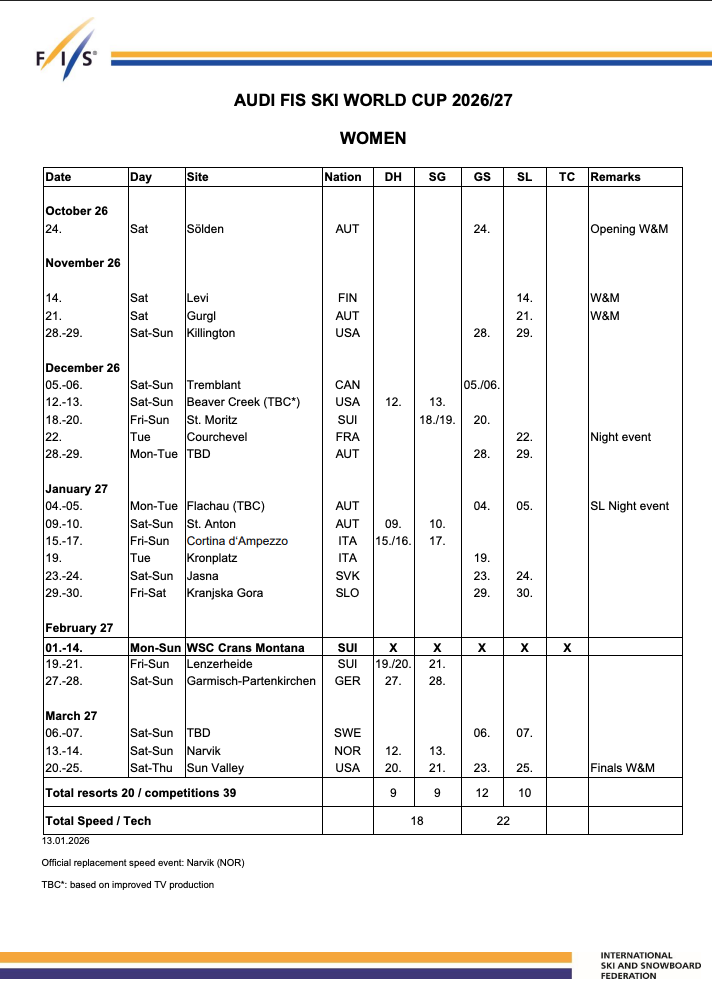
The proposed 2026-27 women’s World Cup calendar features a total of 39 races, with a distinct lean towards technical disciplines. The draft outlines 22 technical events, comprising 10 slaloms and 12 giant slaloms. This stands in contrast to 17 speed races, a figure derived by subtracting the technical events from the overall total (39 – 22 = 17). This composition represents a significant shift from previous seasons, particularly driven by a 20% increase in giant slalom events, adding two additional GS races to the schedule. Furthermore, super-G sees a 12.5% increase, equating to one more SG start than in prior iterations. Slalom maintains its count of 10 races, but its relative influence on the overall standings is somewhat diluted as other disciplines expand.
This redistribution has profound implications for the competitive landscape. For athletes like Mikaela Shiffrin, a titan of technical skiing and arguably the greatest alpine skier of all time, the changes present both opportunities and challenges. Shiffrin’s unparalleled prowess in slalom (holding a record 58 World Cup victories in the discipline) ensures she remains a formidable contender. However, with giant slalom now carrying a larger numerical weight on the calendar, consistent, top-tier performance in GS becomes even more critical for overall title aspirations. While Shiffrin is a proven GS winner with 22 World Cup victories in the discipline, maintaining that elite level across an expanded schedule will demand peak physical and mental conditioning. Her strategic race selection and ability to manage energy across multiple events will be paramount.
Conversely, the calendar appears to reward emerging all-around talents. Emma Aicher of Germany, for instance, stands to benefit significantly. Aicher has steadily established herself as a force in speed events while also demonstrating a growing capability in technical disciplines, notably scoring points in giant slalom. The increase in both GS and SG races directly expands her opportunities to accumulate crucial World Cup points, validating and rewarding her balanced skill set across multiple disciplines. For athletes like Aicher, who are developing a strong profile across the spectrum of alpine events, this calendar provides a clearer pathway to challenging for overall titles, emphasizing versatility over pure specialization. The broader implication for the women’s tour is a heightened focus on holistic performance, compelling athletes to develop and maintain proficiency across technical and speed events to remain in contention for the crystal globe. The overall race is expected to tighten, moving away from reliance on a single dominant strength towards sustained excellence across the full spectrum of the sport.
Men’s World Cup: Tightening the Overall Race for Odermatt and Rivals
The proposed 2026-27 men’s World Cup calendar also introduces a subtle yet impactful shift in discipline balance. While specific race counts were not as explicitly detailed as for the women’s tour in the initial draft, the general thrust indicates a structure with more technical races than speed events. This imbalance inherently creates additional scoring opportunities for specialists in slalom and giant slalom, while simultaneously placing greater pressure and weight on each individual speed race result. This strategic adjustment, though not a radical redefinition of the sport, alters the dynamics of point accumulation throughout the season and the strategies required to protect or build leads.
This shift carries significant implications for current dominant forces like Marco Odermatt. The Swiss sensation has been an almost unassailable figure in recent seasons, consistently dominating in giant slalom, super-G, and downhill. His extraordinary consistency across these three disciplines has allowed him to build substantial leads and secure multiple overall World Cup titles with remarkable authority. However, under the proposed 2026-27 calendar, the reduction in speed races means that each downhill and super-G event becomes even more consequential. Odermatt’s margin for error in these disciplines will shrink, as fewer opportunities exist to compensate for an off-day or a less-than-optimal performance.
Simultaneously, the increased number of technical races provides Odermatt’s closest challengers, particularly those strong in slalom, more chances to accumulate points throughout the season. Athletes like Lucas Braathen, Henrik Kristoffersen, and Manuel Feller, who are perennial contenders in slalom and often strong in giant slalom, will find more avenues to chip away at any lead Odermatt might establish. This doesn’t necessarily place Odermatt at a direct disadvantage in terms of his ability, but it undeniably reduces the buffer that his speed dominance has historically provided. The pressure on Odermatt to perform flawlessly in every start, especially in the now scarcer speed events, will intensify. For his rivals, it means more opportunities to respond to his performances, recover from setbacks, and consistently stay within striking distance in the overall standings. The men’s overall race, therefore, is projected to become a more compressed and intensely competitive affair, moving away from a single athlete’s runaway dominance towards a season-long battle where every race, particularly in speed, is critical.
North American Resurgence: A Dual-Continent Season
A defining feature of the proposed 2026-27 calendar for both men and women is the pronounced emphasis on North American venues. This marks a strategic expansion for the FIS, aiming to bolster the sport’s presence and appeal across the Atlantic. The season will feature multiple race opportunities across the United States and Canada, necessitating two distinct trips across the Atlantic for athletes, coaches, and support staff.
For the women’s tour, the early-season block kicks off with Killington, Vermont, a popular and established stop known for its passionate crowds. Here, giant slalom and slalom events offer immediate chances for athletes to build crucial early points. The tour then moves north to Tremblant, Canada, which will host multiple giant slalom races, extending the early momentum-building opportunities for technical specialists. Later in the season, the schedule tentatively shifts to Beaver Creek, Colorado, listed as "TBC" (To Be Confirmed), where speed races (downhill and super-G) are planned. If confirmed, Beaver Creek would provide a vital test for speed specialists before the tour traditionally returns to Europe for the bulk of the winter season.
The men’s tour also features a robust North American presence. The early stretch begins with Copper Mountain, Colorado, also listed as "TBC," potentially adding another technical opportunity to the early season schedule. Following this, the focus shifts to Beaver Creek, a renowned venue for speed events. Downhill and super-G races there will anchor the early speed season. Given the overall reduction in speed races on the men’s calendar, performances at Beaver Creek will carry increased importance, demanding strong results from speed specialists to keep pace with the points accumulated by technical skiers.
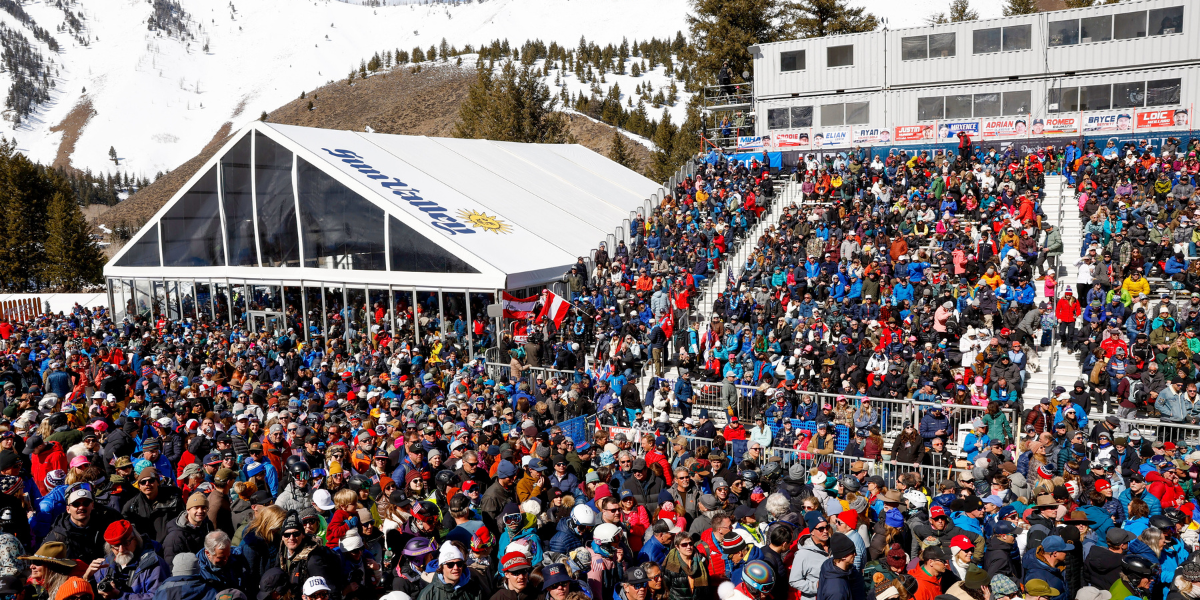
The culmination of this North American emphasis is perhaps the most significant logistical and competitive twist: the World Cup Finals for both genders are slated to conclude in Sun Valley, Idaho. This requires a second, late-season trip back to North America, adding another layer of complexity to athlete management. By the time of the Finals, which traditionally determine the crystal globe winners, athletes will have endured a long, demanding season. Managing travel fatigue, acclimatization to different time zones, and maintaining peak physical form will be paramount. Skiers who have strategically capitalized on expanded opportunities in giant slalom and super-G throughout the season may arrive in Sun Valley with stronger overall positioning, while others will need to maximize every remaining start to clinch titles. The decision to host the Finals in Sun Valley underscores the FIS’s commitment to cultivating the sport in the region and provides a spectacular backdrop for the season’s climax.
The Provisional Nature and Strategic Implications
It is crucial to reiterate that these calendars remain provisional. The "To Be Confirmed" status of several venues, including Beaver Creek and Copper Mountain, indicates that final approvals are still pending. Such provisional announcements are standard practice in World Cup scheduling, allowing for ongoing negotiations with host resorts, local organizing committees, and national federations regarding logistical capabilities, financial agreements, and infrastructure readiness. Factors such as snow guarantees, broadcast rights, and sponsorship commitments all play a role in the finalization process. Any changes could still occur before the official calendar is set in stone.
However, in its current proposed form, this calendar clearly articulates a strategic vision from the FIS. The intent is not to favor one discipline outright but rather to redistribute influence across the season, fostering a more balanced and demanding competitive environment. For athletes, coaches, and support teams, this means a rigorous period of strategic planning. Training regimens will need to adapt to emphasize versatility, and race selection might become more nuanced to maximize point-scoring opportunities across the expanded technical schedule and the high-stakes speed events. The logistical challenges of two transatlantic trips will require meticulous planning for travel, recovery, and equipment management.
The broader impact on the sport could be significant. A more competitive overall race, where multiple athletes remain in contention until the final stages, inherently increases fan engagement and media interest. The enhanced North American presence also serves as a critical growth strategy, exposing alpine skiing to wider audiences and potentially inspiring a new generation of skiers in a key market. Ultimately, the 2026-27 FIS Alpine World Cup season, if this proposed calendar holds, promises to be a compelling test of adaptability, consistency, and strategic prowess, where only the most versatile and resilient athletes will emerge as champions.

