
The upcoming winter in the Pacific Northwest, spanning 2025-2026, presents a complex meteorological puzzle, with early forecasts indicating a potentially weak La Niña or neutral conditions, deviating from the robust, snow-laden winters often associated with stronger cool-phase El Niño-Southern Oscillation (ENSO) events. This nuanced outlook, informed by historical data and emerging climate indicators, suggests a season that may not deliver the deep mid-winter snowpacks many residents and industries hope for. Understanding the intricate dance of ENSO, regional sea surface temperatures, and the Pacific Decadal Oscillation (PDO) is crucial for forecasting the potential snowpack accumulation across the region’s vital mountain ranges.
Understanding the ENSO Cycle and its Pacific Northwest Impact
The El Niño-Southern Oscillation (ENSO) is a naturally occurring climate phenomenon characterized by fluctuations in sea surface temperatures across the central and eastern tropical Pacific Ocean. This cycle alternates between three distinct phases: El Niño (warmer-than-average sea surface temperatures), La Niña (cooler-than-average sea surface temperatures), and Neutral conditions. These phases exert a significant influence on global weather patterns, including precipitation and temperature regimes in the Pacific Northwest.
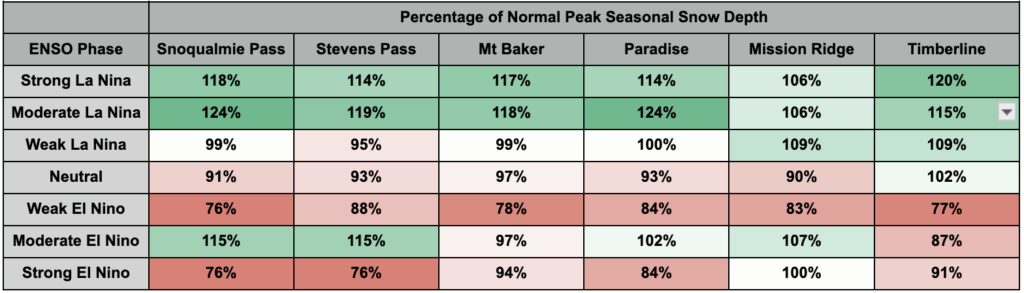
Historically, moderate to strong La Niña events have been correlated with increased snowfall in the Cascade Mountains, often resulting in peak snow depths ranging from 6% to 24% above normal. Conversely, El Niño conditions typically lead to reduced snowfall, while neutral ENSO periods tend to produce snowpack levels near the regional average. However, the strength of these correlations can vary significantly, as evidenced by the 2024-2025 winter season.
A Look Back: The 2024-2025 Winter and its Lessons
The winter of 2024-2025 provided a crucial real-world lesson: a weak La Niña does not automatically guarantee the substantial snow accumulations desired for optimal winter recreation and water resource management. During this period, the Oceanic Niño Index (ONI), a primary metric for ENSO monitoring based on sea surface temperature departures in the Niño 3.4 region, registered -0.6°C for the December-January-February (DJF) period. This value narrowly placed the season within the "weak La Niña" classification. Despite the designation, the resulting snowpack in the Pacific Northwest was not exceptionally deep. Data from the NWAC’s Snowpack Climatology Dataset revealed that at several representative Cascade weather stations, snowpack levels were near or even below average. For instance, the 4-station average peak snow depth recorded in the 2024-2025 season was notably lower than in years with stronger La Niña influences, with some stations experiencing reductions of over 20% below historical trends, particularly at lower elevations, attributed in part to warmer temperatures. This experience underscores the complexity of ENSO’s influence and the need to consider other contributing climate factors.

Forecasting the 2025-2026 Winter: ENSO Probabilities and Nuances
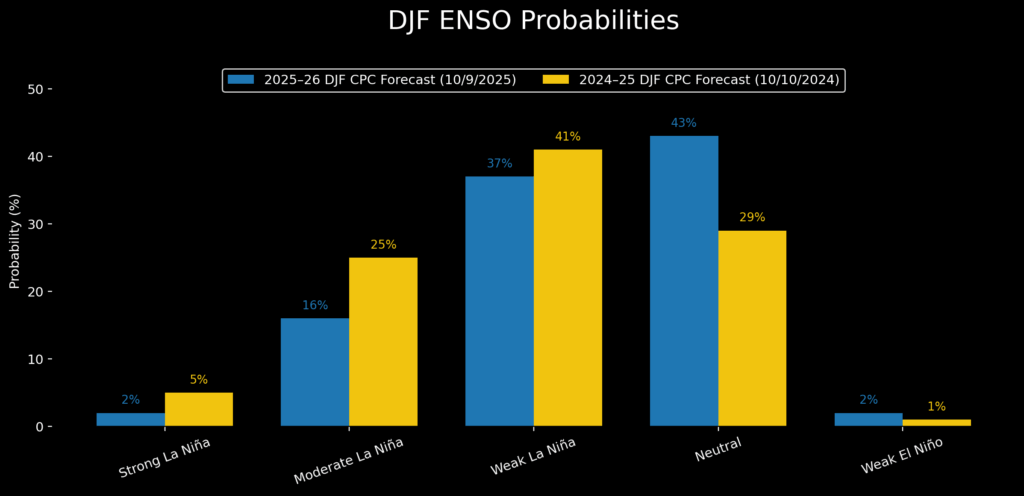
As the Pacific Northwest looks ahead to the 2025-2026 winter, October forecasts for ENSO probabilities reveal a striking similarity to the preceding year’s outlook, with a subtle indication of a weakening La Niña signal. Both forecasts point towards the highest probabilities for cool-phase conditions during the autumn and early winter months.
The ONI for the 2024-2025 season, as mentioned, barely crossed into weak La Niña territory. Current weekly SST departures, as of mid-October 2025, also hover around -0.6°C. Oceanic SST models project a November minimum ONI of approximately -0.8°C, with a projected decrease to around -0.3°C by mid-winter (DJF). This trajectory suggests that neutral ENSO conditions are the most probable outcome for the upcoming mid-winter snowpack.
The DJF ENSO phase probability forecast for October 2025, when compared to October 2024, shows a consistent pattern of high likelihood for La Niña conditions in the early season. However, the probabilities for a moderate to strong La Niña event in the 2025-2026 season are estimated at 18%, with a mere 2% chance of an El Niño event. This distribution implies that the influence of a strong La Niña is unlikely to be the dominant factor in shaping the winter’s snowpack.
Regional Snowpack Response to ENSO Phases
The NWAC’s updated Snowpack Climatology Dataset provides valuable insights into how Pacific Northwest mountain snowpack typically responds to different ENSO phases. This dataset, analyzed across six representative Cascade weather stations, reveals a clear pattern:
- Weak La Niña: In weak La Niña winters, snowpack levels at most stations tend to hover near the average. Only specific locations like Mission Ridge and Timberline have historically shown modest gains.
- Moderate and Strong La Niña: These phases are strongly favored for the west slopes and crest of the Cascades, consistently producing peak snow depths 6% to 24% above the historical normal.
- Neutral ENSO: Neutral years generally result in snowpack slightly below the regional average.
- El Niño: Most El Niño conditions significantly increase the odds of reduced snowfall across the region.
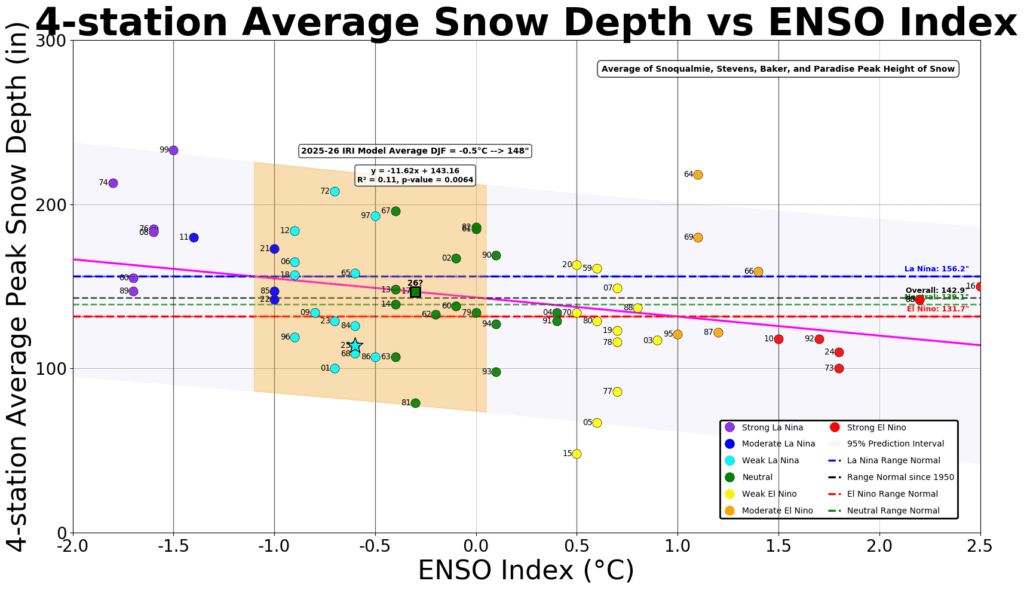
To better understand the most likely outcomes for the upcoming winter, analysts have focused on the average snowpack data from four sites with the longest and most robust historical records: Mt. Baker, Stevens Pass, Snoqualmie Pass, and Paradise.
Incorporating 21st-Century Data and Trend Analysis
To account for potential long-term climate trends that might influence the analysis, a subset of the data including only 21st-century records was examined. This truncated dataset, while lowering the mean snow depth across all ENSO phases, still indicated that the ENSO forecast for the 2025-2026 winter predicts an "almost perfectly average" winter.
Linear best-fit trendlines explain a portion of the data variability when plotting ENSO against snowpack. Including 20th-century data, 11% of the variability is explained, while excluding it and focusing on 21st-century data raises this to 19%. Critically, these figures suggest that over 80% of the season-to-season variability in snowpack is not explained by ENSO alone, highlighting the importance of other climatic drivers.
The Influence of Marine Heatwaves and Sea Surface Temperatures
The role of marine heatwaves and regional sea surface temperatures (SSTs) has gained increasing attention as a significant factor influencing Pacific Northwest weather patterns. Headlines in September 2025 highlighted a marine heatwave event, prompting a comparative analysis of SSTs from September and October 2025 against similar periods in 2024 and 2014. All three of these seasons exhibited mostly positive SST anomalies.
While slightly positive anomalies have become increasingly common due to long-term climate shifts, the intensity and spatial extent of these warm anomalies warrant closer examination. The 2014-2015 season, despite experiencing a very weak El Niño, was characterized by anomalously warm SSTs just off the coast of the Pacific Northwest. Scientists have partially attributed the exceptionally poor snow year during that period to these warm ocean conditions. The 4-station average snowpack reading in 2014-2015 languished at less than 50% of the values observed in the 2024-2025 season.
In contrast, while September 2025 began with very warm SSTs across the Northeast Pacific, these waters have since cooled significantly. Proximal waters off the coast of Washington and Oregon are now approaching normal temperature ranges, offering a potentially more favorable scenario for winter snow accumulation compared to the extreme conditions of 2014-2015.
The Combined Impact of ENSO and Nearshore SSTs
When ENSO phase is combined with data from nearshore West Coast marine waters, often referred to as "The Blob," the model can explain approximately 25% of the snowpack’s inter-seasonal variability. This indicates that while ENSO remains a primary driver, oceanic conditions in the Pacific play a crucial supplementary role.
The potential for an eastward spread of extraordinarily warm waters in the western North Pacific is a factor to monitor. As long as these unusually warm waters remain west of Hawaii, the Pacific Northwest is likely to remain in the negative phase of the Pacific Decadal Oscillation (PDO). The State Climate Office notes that a negative PDO phase typically correlates with cooler and snowier periods for the region. A similar analysis of the PDO’s influence on snowpack variance, when considered alongside ENSO, explains approximately 20% of the total variability.
Conclusion: A Season of Anticipation and Uncertainty
In conclusion, the outlook for the 2025-2026 winter in the Pacific Northwest is one of cautious anticipation. The prevailing ENSO forecast points towards an ephemeral weak La Niña that is likely to transition into neutral conditions by mid-winter. This scenario portends a fairly typical snowpack for the region, neither exceptionally deep nor remarkably deficient.
The probability of a moderate or strong La Niña event, which historically favors deeper snowpacks, remains low. However, should such an event materialize, it would undoubtedly tilt the odds in favor of more substantial winter accumulations.
Regional sea surface temperatures have cooled to near-normal levels, a positive sign for snowpack potential. Nevertheless, the presence of surrounding warm waters may limit the extent of further cooling and could still exert some influence on weather patterns.
Ultimately, the precise snowpack outcome will depend on a confluence of factors. Residents, outdoor enthusiasts, and resource managers will be closely watching for sustained upwelling off the coasts of South and North America, continued cool-phase PDO conditions, and the health of marine ecosystems, including sardine and salmon populations, which can serve as indicators of broader oceanic health and its downstream effects on regional climate. The current predictive models, while offering valuable guidance, underscore that approximately 75% of the season-to-season variability in Pacific Northwest snowpack remains influenced by factors yet to be fully understood or precisely predicted, emphasizing the dynamic and complex nature of our climate.

