
The final men’s giant slalom of the 2025–26 World Cup season is set to unfold in Hafjell, Norway, promising a climactic conclusion to an already electrifying campaign. This marquee event not only serves as the season’s grand finale for the discipline but also presents a high-stakes showdown where the prestigious crystal globe remains mathematically within reach for two exceptional skiers. The stage is perfectly set for a contest that will be decided at the absolute limit, demanding unparalleled strength, impeccable timing, and flawless execution from the sport’s elite, as they vie for glory on Norwegian snow.
The Crystal Globe Showdown: A Season’s Culmination
At the heart of the Hafjell giant slalom lies the fiercely contested battle for the men’s giant slalom crystal globe. Switzerland’s Marco Odermatt, a dominant force throughout the season, currently holds a precarious 55-point lead over Brazil’s Lucas Pinheiro Braathen. Odermatt’s consistent podium finishes and three victories have placed him in a commanding position, allowing him to control his destiny heading into the final race. However, the slender margin means the title is far from sealed, injecting an immense level of tension and excitement into the Norwegian alpine air.
For Lucas Pinheiro Braathen, the challenge is clear yet formidable. His remarkable late-season surge, marked by two pivotal World Cup victories, has brought him back into contention from what seemed an insurmountable deficit earlier in the calendar. To claim the crystal globe, Braathen would realistically need to win the Hafjell giant slalom outright, while simultaneously hoping for Odermatt to finish outside of the top ten. Conversely, a strong top-five finish for Odermatt would likely be enough to secure his title, regardless of Braathen’s performance. The mathematical permutations add layers of strategic depth to an already technically demanding discipline, forcing both athletes to focus on their individual runs while being acutely aware of their rival’s progress. Experts and fans alike are anticipating a masterclass in pressure management, where a single mistake could tip the scales of the entire season. The outcome will not only crown the season’s best giant slalom skier but also etch another chapter into the rich history of alpine racing.
Hafjell: The Alpine Battleground
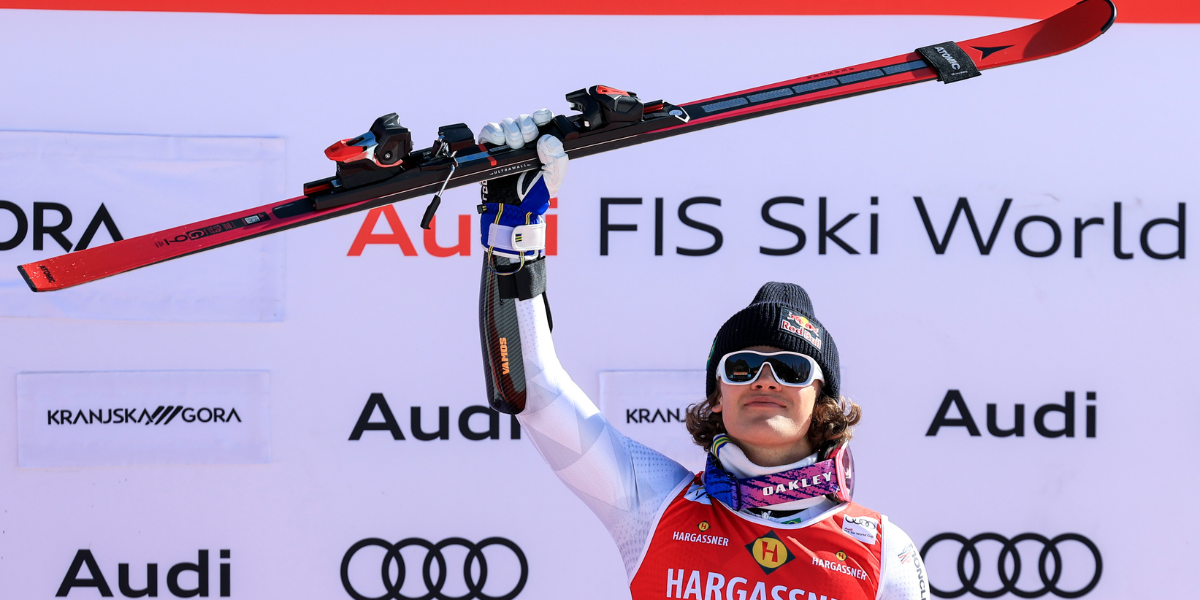
Hafjell, nestled in the picturesque Gudbrandsdalen valley, is no stranger to elite alpine skiing competitions. As a significant venue from the 1994 Lillehammer Winter Olympics, it boasts a legacy of hosting major international events, making it a fitting location for the World Cup Finals. The resort is renowned for its meticulously prepared slopes, offering a challenging yet fair test for the world’s best skiers. The specific course for the giant slalom finale is expected to be firm and fast, conditions that typically reward aggressive skiing and precise edge control.
The selection of course setters, Martin Kroisleitner of Austria for the first run and Rok Salej of Slovenia for the second, adds another layer of intrigue. Each setter brings a distinct philosophy to course design, which can significantly influence the race dynamics. Kroisleitner, often associated with powerful, rhythm-oriented sets, might favor a more open and flowing line, allowing skiers to carry speed. Salej, on the other hand, could introduce tighter sections or more technical combinations in the second run, demanding quick reactions and adaptable technique. The combination of these styles will require skiers to be versatile, adjusting their approach between runs to maximize their performance. The local organizing committee in Hafjell has been working tirelessly to ensure optimal conditions, including meticulous snow preparation and safety measures, reflecting Norway’s deep-rooted passion for winter sports. The atmosphere is expected to be electric, with Norwegian fans eagerly awaiting to cheer on their local heroes and witness alpine skiing history unfold on home soil.
Season in Review: A Dominance Challenged
The 2025-26 men’s giant slalom season has been a captivating narrative of consistent excellence, strategic breakthroughs, and a dramatic late-season surge. Marco Odermatt initiated his campaign with a commanding victory in Sölden, setting an early precedent for his season. He followed this with another win in Beaver Creek and a third-place finish in Val d’Isère, establishing a seemingly unassailable lead. His performances throughout the early and mid-season were characterized by a blend of raw power and clinical precision, which saw him frequently on the podium.
However, the season was not without its shifts. While Odermatt remained a formidable presence, other athletes carved their own moments of glory. Austria’s Stefan Brennsteiner secured a strong win in Copper Mountain, showcasing the depth of the Austrian squad. Loïc Meillard of Switzerland demonstrated his technical prowess with victories in Val d’Isère and Schladming, further highlighting Swiss dominance in the discipline. Marco Schwarz, another Austrian talent, added a win in Alta Badia, underscoring the fierce competition.
The latter half of the season witnessed the remarkable resurgence of Lucas Pinheiro Braathen. After consistent podium placements, including second-place finishes in Alta Badia, Adelboden, and Schladming, Braathen found his winning form at a critical juncture. His triumph at the Olympic Bormio event (though not counting towards World Cup standings, it provided a significant psychological boost) was a precursor to his back-to-back World Cup victories in Bormio and Kranjska Gora. These consecutive wins were pivotal, dramatically narrowing Odermatt’s lead and transforming the final race into a direct head-to-head battle for the crystal globe. This chronological progression of results paints a picture of a dynamic season where initial dominance was met with persistent challenge, culminating in a nail-biting finale.

Key Contenders and Start List Dynamics
The World Cup Finals operate under a unique format, limiting the field to the top performers of the season. This ensures that every competitor is a formidable threat, and the race will be a high-caliber contest from start to finish. The crucial advantage of starting within the top seven bib numbers cannot be overstated. These skiers will benefit from a perfectly pristine track, before any significant degradation from subsequent racers. Given the tight margins characteristic of giant slalom, this clean surface can provide precious hundredths of a second, which often prove decisive.
The top seven, which undoubtedly defines the race’s leading group, includes the crystal globe contenders Odermatt and Braathen, alongside perennial threats like Loïc Meillard, Stefan Brennsteiner, and Marco Schwarz. Henrik Kristoffersen and Atle Lie McGrath, both representing Norway, will also be eager to perform exceptionally on home turf, potentially converting their season’s consistency into a coveted victory. Kristoffersen, with two third-place finishes this season, has shown he has the speed, while McGrath’s early season podium in Sölden demonstrated his capability. Beyond the top seven, other strong contenders like Alex Vinatzer (ITA) and Filip Zubčić (CRO) will be looking to capitalize on any advantage, demonstrating the depth of talent across the field. The early start numbers are not just about speed; they are about setting an untouchable benchmark, forcing later starters to take even greater risks on a potentially more rutted or challenging surface. This dynamic often means that the podium is indeed shaped, if not entirely decided, by the performances of these initial racers.
Rising Stars and National Hopes
While the spotlight firmly rests on the crystal globe contenders, the Hafjell finale also offers a crucial platform for other athletes, including emerging talents and national team stalwarts, to make their mark.
For the Stifel U.S. Ski Team, River Radamus carries the sole national hope in the men’s giant slalom. Starting from a mid-pack bib, Radamus faces the challenging task of delivering an exceptionally powerful first run to position himself within striking distance of the leaders. A top-15 finish at the World Cup Finals is a significant achievement in itself, as only the top 15 finishers score points in this format. Such a result would not only provide valuable World Cup points but also crucially solidify his standing for the upcoming 2026-27 season, building momentum and confidence for future campaigns. Radamus’s performance will be closely watched as an indicator of the U.S. program’s continued development in technical disciplines.

Adding to the excitement is the debut of Junior World Champion Rasmus Bakkevig. Earning his start at the Finals is a testament to his exceptional talent and promising future. Stepping into the season’s best giant slalom field, Bakkevig faces an immediate and steep learning curve. The challenge for him is immense: to break into the top 15 against seasoned World Cup veterans. While scoring points might be an ambitious goal for a debut at this level, the experience of competing alongside and against the world’s best will be invaluable for his development. It offers a unique opportunity to gauge his current level, identify areas for improvement, and absorb the high-pressure atmosphere of a World Cup finale. His participation underscores the pipeline of talent emerging in alpine skiing and the continuous evolution of the sport’s competitive landscape. For both Radamus and Bakkevig, Hafjell represents more than just a race; it’s a pivotal moment in their careers.
Tactical Prowess and Pressure Cooker Environment
The Hafjell giant slalom is poised to be a tactical masterclass, where every turn, every gate, and every hundredth of a second will count. The course setters’ choices for both runs will play a critical role, but ultimately, the skiers’ ability to adapt and execute under immense pressure will be the deciding factor. As ski racing pundits often state, "this race will be decided early." The advantage of a clean track for the top-seeded skiers is undeniable, allowing them to lay down fast times that subsequent racers must then chase on a progressively degraded surface.
The "top 15 score, everyone else leaves empty-handed" rule at the World Cup Finals significantly amplifies the stakes. Unlike regular World Cup races where the top 30 score points, this stringent scoring system means that even a strong performance outside the top echelon yields no reward. This creates an unparalleled pressure cooker environment, where conservative skiing is often punished, and only those willing to push the absolute limit while maintaining control will succeed.
Inferred statements from the athletes ahead of such a high-stakes event would reflect their mental state. Odermatt would likely emphasize focusing on his own skiing, "taking it one gate at a time" rather than dwelling on the points situation, a common strategy for champions. Braathen, riding his late-season momentum, might express confidence in his current form, stating his intention to "leave everything on the hill" and "go for the win." Coaches would undoubtedly stress precision, aggression, and adaptability to their athletes, knowing that the smallest error could be costly. The blend of a challenging course, a compact elite field, and the unforgiving scoring system sets the stage for a dramatic and unforgettable conclusion to the 2025-26 men’s giant slalom season.
How to Follow the Action

Ski racing enthusiasts globally are eagerly anticipating the Hafjell World Cup Giant Slalom Finale. The men’s giant slalom is scheduled for Saturday, March 7th.
For fans in North America, the first run will commence at 4:30 a.m. EDT / 1:30 a.m. PDT, a truly early start for dedicated viewers. The decisive second run will follow later in the morning at 7:30 a.m. EDT / 4:30 a.m. PDT.
Viewers in Great Britain can tune in slightly later, with the first run beginning at 8:30 GMT and the second run at 11:30 GMT. These timings ensure that fans across various time zones can catch the thrilling conclusion of the giant slalom season.
How to Watch
Live coverage and replays of the World Cup Giant Slalom Final will be available via official broadcasting partners and streaming services. In the United States, fans can typically access live feeds and on-demand content through platforms such as Skiandsnowboard.live. Viewers are advised to check local listings and official FIS Ski channels for specific broadcast details in their respective regions.
For comprehensive race information, including the detailed daily program and the official first run start list, fans can download the respective PDF documents provided by the FIS. These resources offer crucial insights into the event schedule, bib numbers, and the precise order of competition, allowing fans to follow their favorite athletes closely.
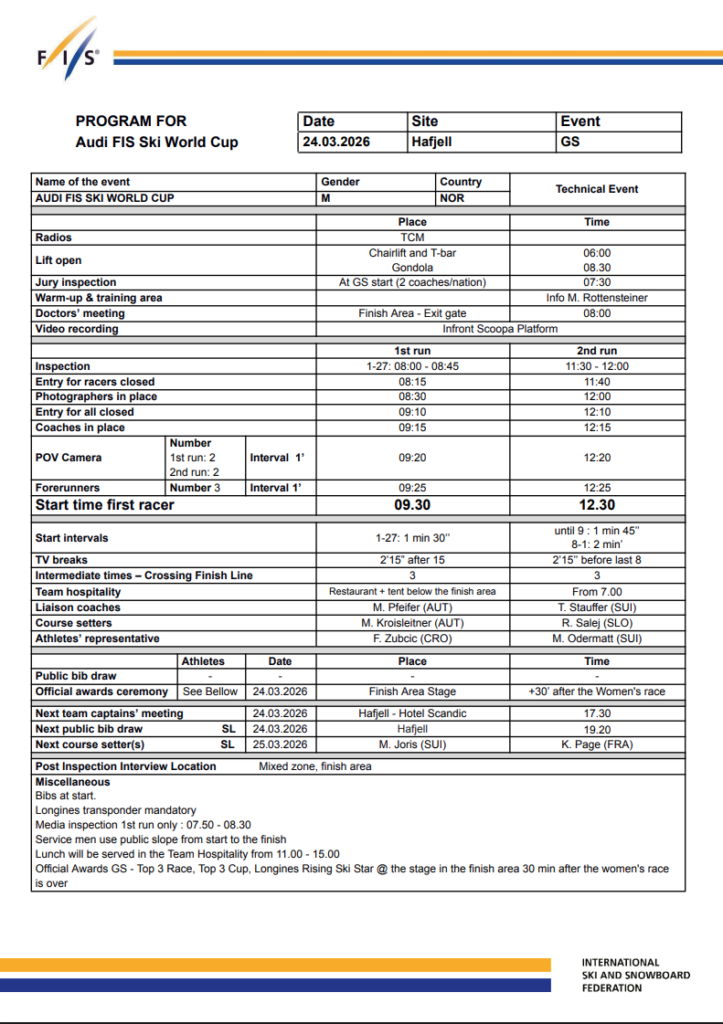
Daily Program: [Link to FIS PDF]
First Run Startlist: [Link to FIS PDF]
As the alpine world turns its attention to Hafjell, all eyes will be on the slopes, waiting to witness who will ultimately seize the coveted crystal globe and etch their name into the annals of World Cup history. The culmination of a season’s worth of training, travel, and competition rests on two decisive runs, promising a spectacle of speed, skill, and sheer determination.

