
Zion National Park, a crown jewel of Utah’s natural wonders, offers a spectacular showcase of geological history etched into its towering sandstone cliffs and sculpted canyons. For those with a keen interest in the earth’s ancient past, Zion is more than just a scenic destination; it is a living textbook of sedimentary processes, ancient environments, and the powerful forces of erosion that have shaped our planet over millions of years. The park’s iconic red rocks are primarily composed of sedimentary layers, each telling a story of deposition, compression, and uplift, painting a vivid picture of a landscape vastly different from the one visitors experience today.
The geological narrative of Zion National Park unfolds across a timescale stretching back an estimated 110 to 270 million years. During this vast epoch, the very ground that now forms Zion was located near sea level and, remarkably, closer to the Earth’s equator. This ancient position played a crucial role in the formation of the park’s signature rock layers. The area was subjected to a variety of environmental conditions, including shallow seas, vast sand dunes, and river systems, each leaving its distinct imprint in the accumulating sediments. These sediments, derived from the weathering and erosion of older rocks, were deposited in distinct layers, forming the stratified rock formations that define Zion’s majestic landscape. It is only in more recent geological time that these ancient strata have been uplifted and subsequently carved by the relentless forces of erosion, primarily by the Virgin River and its tributaries, to reveal the breathtaking scenery we admire today.

Unraveling the Layers: A Chronology of Deposition
The rock layers of Zion National Park represent a significant chapter in the geological history of the Colorado Plateau. This vast region, encompassing Zion and other famed national parks like Arches, Canyonlands, Bryce Canyon, and Capitol Reef, has undergone a complex history of uplift and erosion. Zion’s position within this plateau is particularly significant, as it sits at a critical juncture in the geological "Grand Staircase," a term used to describe the immense sequence of rock layers exposed across southern Utah and northern Arizona.
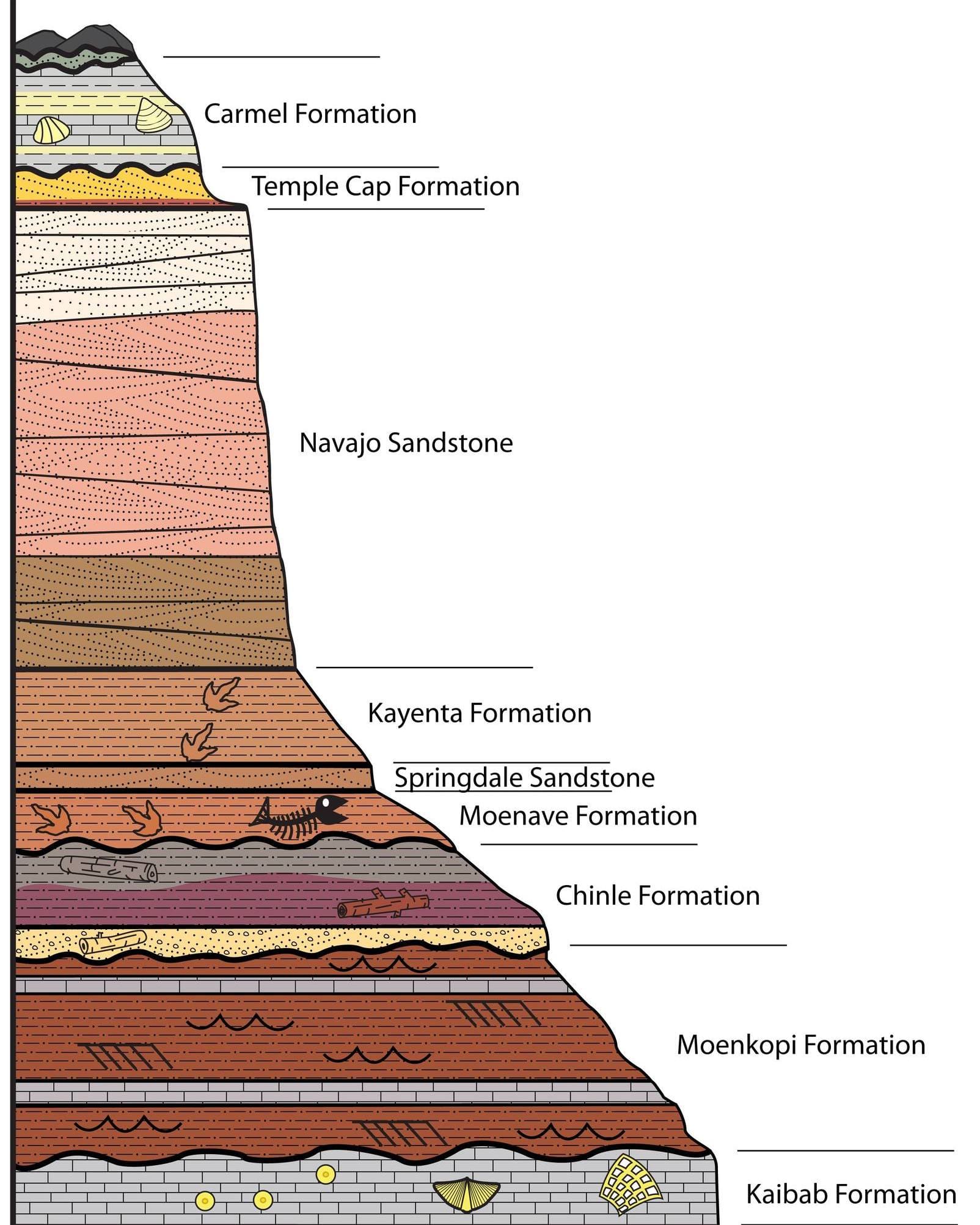
The rock layers within Zion are stacked like pages in a geological history book, with the oldest layers at the bottom and the youngest at the top. This stratigraphy provides an invaluable record of environmental changes over millions of years. The following are the primary rock formations found in Zion, listed from youngest to oldest, each representing a unique period and environment:
- Cedar Mountain Formation: While not as prominent in Zion Canyon itself, this formation represents the most recent depositional period in the broader region, often associated with terrestrial environments.
- Carmel Formation: This formation typically consists of interbedded sandstone, mudstone, and gypsum, indicative of shallow marine and coastal plain environments. It represents a period of fluctuating sea levels and shifting shorelines.
- Temple Cap Formation: This layer is composed of cross-bedded sandstone, hinting at the presence of ancient sand dunes that once covered the region. Its formation suggests a shift towards a more arid, desert-like environment.
- Navajo Sandstone: Arguably the most iconic formation in Zion, the Navajo Sandstone is a massive unit of cross-bedded quartz arenite. Its vast, sweeping curves and towering cliffs are the result of ancient erg environments, where colossal sand dunes, some hundreds of feet high, were sculpted by prevailing winds. This formation is a testament to a vast ancient desert that once dominated the landscape.
- Kayenta Formation: This formation lies beneath the Navajo Sandstone and is characterized by finer-grained sandstones and mudstones, often exhibiting ripple marks. It represents a transition from a wetter climate to the more arid conditions that formed the Navajo Sand dunes.
- Moenave Formation: Similar to the Kayenta Formation, the Moenave consists of shales and sandstones, often red and purple in color, suggesting deposition in river systems and floodplains.
- Chinle Formation: This formation is known for its colorful, variegated shales and mudstones, often containing petrified wood. It indicates deposition in a warm, humid climate with abundant plant life, likely in floodplains and ephemeral lakes.
- Moenkopi Formation: This formation is comprised of reddish-brown sandstones and mudstones, often indicative of tidal flats and shallow marine environments. It represents a period when the sea advanced over the land.
- Kaibab Formation: Forming the rim of the Grand Canyon and appearing at the lowest elevations in some parts of Zion, the Kaibab Formation is a fossil-rich limestone. It represents a shallow, warm sea teeming with marine life, offering a glimpse into Zion’s ancient oceanic past.
The Power of Erosion: Sculpting a Masterpiece
While deposition laid the foundation, it is the ongoing process of erosion that has sculpted Zion’s dramatic topography. The Virgin River, a seemingly modest waterway, has been the primary architect of Zion Canyon, relentlessly carving through the uplifted rock layers over millions of years. The differential resistance of these rock layers to erosion has led to the formation of distinct geological features. The hard, resistant Navajo Sandstone, for instance, forms towering cliffs and mesas, while softer layers are more easily eroded, creating slopes and valleys.

The uplift of the Colorado Plateau, a slow but immense geological event that began tens of millions of years ago, provided the necessary elevation for the rivers to gain erosive power. As the land rose, the Virgin River incised deeper into the rock, creating the magnificent canyon we see today. This interplay between uplift and erosion is a fundamental principle in understanding the formation of Zion’s awe-inspiring landscapes.
Connecting the Geological Dots: The Grand Staircase and Beyond
Zion National Park is an integral part of the broader geological context of the Colorado Plateau. Its geological strata are not isolated but are connected to those found in neighboring parks and monuments. As mentioned, Zion is situated within the Grand Staircase, a region where rock layers are exposed in a step-like fashion. This means that the uppermost rock layer in Zion is actually the lowermost layer found in Bryce Canyon National Park, which lies to the northeast. Similarly, the oldest rocks exposed in Zion are older than those found at the rim of the Grand Canyon, which lies to the south.
This continuous geological column allows geologists to trace the history of the region across vast distances and time periods. The presence of similar rock formations and geological processes in areas like Arches National Park (known for its sandstone fins and arches) and Canyonlands National Park (characterized by deep canyons carved by the Colorado and Green Rivers) highlights the shared geological heritage of the Colorado Plateau. The Grand Staircase-Escalante National Monument, managed by the Bureau of Land Management, further complements this understanding, showcasing an immense and complex geological record that bridges the gap between Zion and Bryce Canyon.
Expert Insights and Visitor Engagement
The National Park Service actively provides resources to help visitors understand and appreciate the geology of Zion. Their online resources, such as the "Rock Layers" section on the official Zion National Park website, offer detailed information and educational materials. These resources often include simplified explanations and visual aids, like the infographics referenced in the original content, designed to make complex geological concepts accessible to the general public.
"Understanding the geology of Zion is key to appreciating its grandeur," states Dr. Eleanor Vance, a geologist specializing in desert landforms. "Each layer of rock is a snapshot of a past world – ancient seas, vast deserts, and dynamic river systems. When visitors grasp this deep history, their experience of the park transforms from merely observing scenic beauty to actively engaging with the earth’s incredible story."
For visitors planning a trip to Zion, familiarizing themselves with the park’s geological narrative can significantly enhance their experience. Recognizing the different rock formations, understanding the processes that created them, and appreciating their chronological order can transform a casual hike into an educational journey through time. The park’s visual landscape, from the towering sandstone monoliths to the intricate patterns of erosion, becomes a tangible representation of millions of years of geological evolution.

Implications for Conservation and Future Study
The rich geological heritage of Zion National Park not only draws millions of visitors annually but also underscores the importance of its preservation. The unique rock formations and the ongoing geological processes are fragile ecosystems that require careful management. Understanding these processes allows park managers to better protect the park’s natural resources and to educate the public about the delicate balance of geological and ecological systems.
Furthermore, Zion continues to be a site of ongoing geological research. Scientists study its formations to gain insights into ancient climates, tectonic activity, and the evolution of sedimentary basins. The park’s well-preserved rock layers serve as a crucial reference point for understanding broader geological patterns across the American West and beyond. As technology advances, new methods of dating rocks, analyzing sediment composition, and modeling geological processes will continue to unlock further secrets held within Zion’s ancient stones.
In essence, Zion National Park is a testament to the dynamic and ever-changing nature of our planet. Its rock formations are not static monuments but living records of Earth’s history, offering a profound and accessible window into the deep past. For those willing to look closely, the rocks of Zion whisper tales of ancient oceans, vast deserts, and the powerful, patient forces that have sculpted the magnificent landscape enjoyed by all.

