
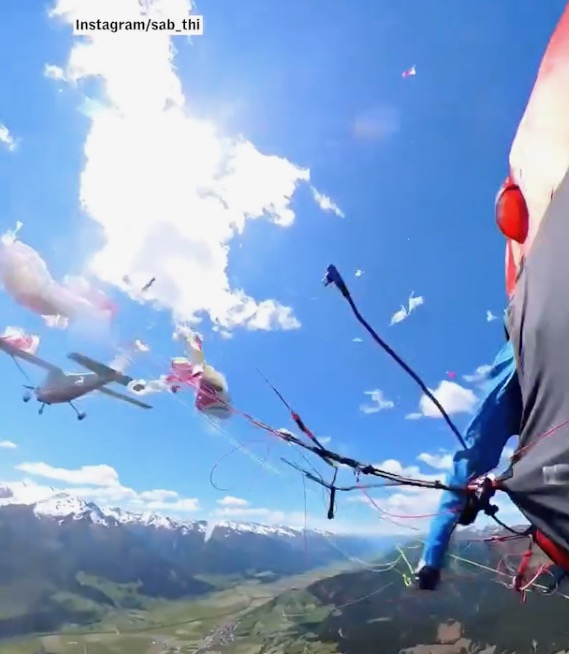
Salzburg, Austria – May 26, 2026 – In a harrowing incident that defied the odds, a 44-year-old Austrian woman, an experienced paraglider, narrowly escaped serious injury when her wing was struck and destroyed by a small motor plane during a flight over the picturesque Piesendorf area of Salzburg on Saturday. The dramatic encounter, captured on video, saw the paraglider plummet hundreds of feet before successfully deploying her reserve parachute, a testament to her training and the life-saving technology. The pilot of the motor plane, a 28-year-old man, has stated he was unable to avoid the collision.
The Incident: A Swift and Terrifying Encounter
The terrifying event unfolded on a clear Saturday afternoon, with the woman enjoying a routine paragliding flight. As she navigated the skies above Piesendorf, a popular recreational area known for its stunning alpine vistas, a small motor plane entered her flight path. The exact circumstances leading to the proximity of the two aircraft are still under investigation, but the impact was immediate and severe.
According to a statement released by the police, "The propeller of the motor plane severely damaged the paraglider, prompting the experienced paraglider to deploy her reserve parachute." The force of the collision caused the paraglider’s main wing to disintegrate, sending her into an uncontrolled spiral. Eyewitness accounts and the available video footage depict a terrifying descent, with the woman spinning rapidly towards the earth.
A Race Against Time: The Deployment of the Reserve Parachute
In such critical moments, swift and decisive action is paramount. The woman’s extensive experience as a paraglider proved to be her greatest asset. With her main canopy compromised, she reacted instantly, activating her reserve parachute. This secondary parachute, designed as a last resort, is a crucial safety feature in paragliding. Its successful deployment arrested her uncontrolled descent, providing a much-needed cushion against the potentially catastrophic impact.
While the reserve parachute undoubtedly saved her life, the force of the deployment and the residual descent likely subjected her to significant G-forces and a jarring landing. However, the fact that she was able to deploy it successfully and that it functioned as intended underscores the reliability of modern safety equipment in extreme aviation scenarios.
Official Statements and Investigation
Authorities were quickly alerted to the incident, and emergency services were dispatched to the scene. The woman, after her successful emergency landing, was airlifted to safety by a police helicopter. Both the paraglider and the pilot of the motor plane were assessed by medical personnel.
"Both she and the pilot escaped serious injury, according to the police," a statement confirmed, offering a significant sigh of relief given the gravity of the mid-air collision. The pilot of the motor plane, aged 28, reportedly told authorities that he was unable to avoid the collision, suggesting a sudden and unforeseen circumstance led to the near-disaster.
An investigation into the precise cause of the incident has been launched by aviation authorities. This will likely involve a thorough examination of flight paths, pilot communications, weather conditions, and the operational status of both aircraft. The focus will be on determining any contributing factors, such as pilot error, mechanical failure, or a breach of air traffic regulations, to prevent similar occurrences in the future.
Context and Background: Aviation Safety in Recreational Areas
The Piesendorf area, like many alpine regions, is a popular destination for both paragliding and small aircraft operations. While generally safe, the inherent risks associated with sharing the airspace necessitate strict adherence to safety protocols and clear communication between different types of aircraft.
Paragliding, while offering an exhilarating experience, requires participants to be aware of their surroundings and potential hazards. Pilots are trained to be vigilant, but the unpredictable nature of air currents and the presence of other aircraft can present challenges. Small motor planes, while more maneuverable, also operate within designated flight corridors and airspace regulations.
The incident raises questions about the coordination and separation of different aviation activities in shared airspace, particularly in areas with significant recreational flight operations. Data from aviation safety organizations often highlights mid-air collisions as a rare but extremely dangerous type of accident. The International Civil Aviation Organization (ICAO) consistently emphasizes the importance of effective air traffic management and pilot awareness to minimize such risks. For instance, statistics from the European Union Aviation Safety Agency (EASA) have shown that while general aviation accidents are infrequent, those involving collisions are often catastrophic.
Chronology of Events (Reconstructed)
- Saturday Afternoon, May 26, 2026: A 44-year-old Austrian woman commences a paragliding flight over the Piesendorf area of Salzburg.
- During the Flight: A 28-year-old pilot operating a small motor plane enters the paraglider’s flight path.
- Mid-Air Collision: The propeller of the motor plane strikes and severely damages the paraglider’s main wing.
- Immediate Aftermath: The paraglider enters an uncontrolled spiral descent.
- Emergency Action: The experienced paraglider successfully deploys her reserve parachute.
- Controlled Descent: The reserve parachute slows the descent, preventing an immediate catastrophic impact.
- Emergency Landing: The paraglider makes an emergency landing in the area.
- Rescue Operation: A police helicopter is dispatched and successfully airlifts the paraglider to safety.
- Medical Assessment: Both the paraglider and the motor plane pilot are evaluated and found to have escaped serious injury.
- Official Statements: Police confirm the details of the incident and the absence of severe injuries. The pilot provides his account to authorities.
- Investigation Initiated: Aviation authorities commence an investigation into the cause of the collision.
- May 27, 2026: The incident is reported, with a video of the event becoming available.
Supporting Data and Analysis
The survival of the paraglider in this scenario is remarkable and highlights several key factors:
- Pilot Experience: The woman’s status as an "experienced paraglider" was crucial. This implies a high level of skill, quick decision-making capabilities, and familiarity with emergency procedures.
- Reserve Parachute Reliability: The successful deployment and function of the reserve parachute underscore the importance of regular maintenance and the inherent reliability of these safety systems. These systems are designed to deploy even under extreme stress.
- Altitude and Time: The fact that the collision occurred at an altitude that allowed sufficient time to react and deploy the reserve parachute was a critical element. If the incident had happened at a lower altitude, the outcome could have been tragically different. Data from paragliding safety organizations often points to altitude as a significant factor in survival rates during emergencies.
- Nature of Damage: While the propeller severely damaged the paraglider, it did not cause an immediate catastrophic failure of the entire flight system, allowing for the deployment of the reserve.
The analysis of such incidents often leads to recommendations for enhanced air traffic awareness training for all aviation participants, particularly in mixed-use airspace. Furthermore, it prompts a review of procedures for maintaining safe separation distances between different types of aircraft. The potential for technology to aid in collision avoidance, such as integrated transponders and proximity warning systems, may also be a subject of discussion in the aftermath of this event.
Broader Impact and Implications
This incident, while thankfully resulting in no serious injuries, serves as a stark reminder of the inherent risks associated with aviation activities, even in seemingly idyllic recreational settings. The video footage, which has gained significant attention, is likely to prompt increased scrutiny of aviation safety practices in popular tourist and recreational areas.
For the paragliding community, it reinforces the importance of continuous training, adherence to safety guidelines, and the critical role of emergency equipment. For the aviation industry, it underscores the ongoing need for robust air traffic management systems, pilot education, and the promotion of a strong safety culture.
The investigation’s findings will be crucial in determining whether any regulatory changes or enhanced safety measures are necessary to prevent future occurrences. The incident is a powerful testament to human resilience and the effectiveness of safety technology when faced with the unexpected, but it also highlights the ever-present need for vigilance and meticulous planning in the skies.
The commitment of platforms like PlanetSKI.com to providing digital ski news and comprehensive information on snowsports extends to covering significant events that impact the broader outdoor adventure community. While this specific incident did not involve skiing, it resonates with the passion for mountain environments and the inherent risks and rewards associated with them. The detailed reporting and focus on safety in such contexts are vital for informing and protecting enthusiasts worldwide.

