
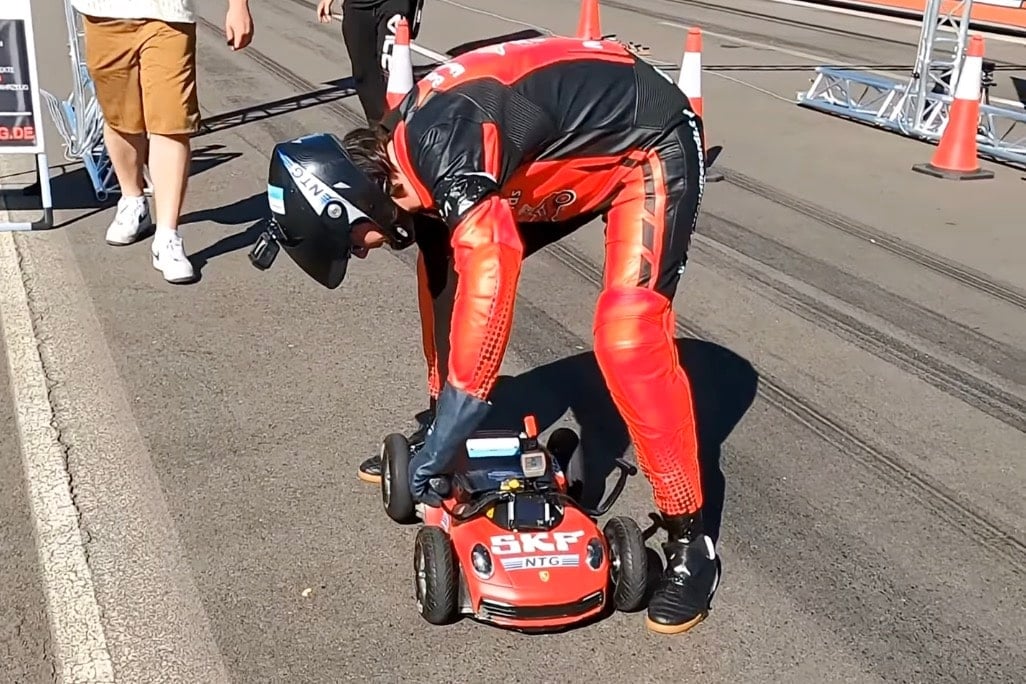
On May 2nd, 2026, the DEKRA test oval at the renowned Lausitzring Super Speed Way in northeast Germany became the stage for an astonishing display of engineering prowess and a bold push against the perceived limits of a childhood icon. What began as a routine test of a newly developed steering system for an electric Bobby-Car (E-Bobby-Car) unexpectedly culminated in the shattering of the world record for the fastest ride-on toy car, with the miniature vehicle, visually resembling a scaled-down Porsche, achieving a blistering top speed of 96.9 miles per hour. This remarkable feat not only redefines the capabilities of such recreational vehicles but also highlights the burgeoning subculture of enthusiasts who are transforming simple toys into high-performance machines.
The genesis of this record-breaking run was not an elaborate plan to conquer speed records, but rather a practical endeavor to refine the handling of a custom-built E-Bobby-Car. The team behind the project, driven by a passion for innovation and a deep appreciation for the iconic Bobby-Car, had invested significant effort into upgrading the vehicle’s powertrain and chassis. The intention was to assess the efficacy of a new steering mechanism designed to offer greater control and responsiveness at higher speeds. However, during the testing phase, the E-Bobby-Car’s performance far exceeded expectations, prompting the team to push its limits further and ultimately leading to the pursuit and attainment of a new Guinness World Record.
The Evolution of the Bobby-Car: From Toddler Toy to High-Speed Machine
The Bobby-Car, originally a simple, leg-powered plastic ride-on toy manufactured by the German company BIG, has been a staple of childhood playrooms for decades. Its distinctive, ergonomically designed shape and bright colors have made it instantly recognizable. However, in recent years, a dedicated community of tinkerers and engineers has emerged, breathing new life into these beloved toys by transforming them into sophisticated, high-performance vehicles. This movement, often referred to as "E-Bobby-Car" or "Motorized Bobby-Car" culture, involves retrofitting the classic chassis with powerful electric motors, advanced battery systems, and robust braking mechanisms.
These modified Bobby-Cars are far removed from their humble origins. Racers often adopt a supine, or lying-down, position within the low-slung vehicle, allowing for a more aerodynamic profile and a reduced center of gravity. This posture, combined with the powerful electric drivetrains, enables these miniature vehicles to achieve speeds that are astonishingly close to those of conventional road cars. The combination of zero suspension, the rider’s proximity to the ground, and speeds that can approach 100 mph creates a thrilling, albeit inherently dangerous, racing environment that demands specialized safety equipment, including full racing leathers, helmets, and protective gear. This niche sport, characterized by its blend of whimsical aesthetics and raw speed, has cultivated a dedicated following among a global community of enthusiasts who are continually pushing the boundaries of what is possible.
Chronology of the Record Attempt
The record-breaking event on May 2nd, 2026, was the culmination of extensive preparation and development. While specific details leading up to the test day are not fully disclosed, it is understood that the team had been meticulously working on the E-Bobby-Car for an extended period. The decision to attempt a speed record was likely a spontaneous one, arising from the vehicle’s exceptional performance during initial shakedown runs.
The chosen venue, the DEKRA test oval at Lausitzring, provided a controlled and safe environment for such a high-speed endeavor. This facility is renowned for its advanced testing capabilities and has hosted numerous automotive speed and safety trials. The long, banked straights of the oval are ideal for achieving and maintaining high velocities, while the comprehensive safety infrastructure at Lausitzring offers a critical layer of security for participants.
The day’s objective, as initially stated, was to evaluate the new steering setup. However, as the E-Bobby-Car accelerated down the track, its inherent speed potential became evident. Data logs from the test likely indicated speeds that prompted the decision to aim for the existing speed record. The team then likely executed a series of controlled runs, incrementally increasing the vehicle’s speed until the target velocity was achieved and officially recorded. The 96.9 mph mark represents the pinnacle of this effort, a testament to the engineering and daring of the individuals involved.
Supporting Data and Technical Specifications
While the original article provides limited technical specifications, the achievement of 96.9 mph on a Bobby-Car chassis necessitates significant engineering advancements. Such speeds require a powerful electric motor, likely a high-performance brushless DC motor capable of delivering substantial torque and sustained power output. The energy source would need to be a robust battery pack, possibly utilizing advanced lithium-ion technology, to provide sufficient voltage and current for extended high-speed operation.
The drivetrain would need to be carefully engineered to handle the immense power and prevent slippage. This might involve a custom gearbox or a direct drive system optimized for high-speed efficiency. Furthermore, the chassis, while retaining the iconic Bobby-Car silhouette, would undoubtedly have undergone extensive reinforcement to withstand the forces generated at nearly 100 mph. This would likely include structural upgrades to the plastic body, as well as the integration of a robust internal frame or roll cage.
The tires also play a critical role. The original plastic wheels would be entirely unsuitable for such speeds. The record-breaking E-Bobby-Car would have been equipped with specialized, high-performance rubber tires, likely similar to those used in go-karting or other forms of motorsport, capable of providing the necessary grip and stability at extreme velocities. The braking system would also need to be highly effective, likely incorporating hydraulic disc brakes, to ensure the vehicle could be safely brought to a halt.
Reactions and Broader Implications
While official statements from the record-setting team are not detailed in the provided content, one can infer a sense of immense pride and satisfaction. The achievement represents a significant milestone in the niche world of E-Bobby-Car racing and a triumph of human ingenuity. The sheer spectacle of a child’s toy hurtling down a racetrack at such speeds is likely to generate considerable excitement within the enthusiast community and potentially capture the attention of a wider audience.
The implications of this record extend beyond bragging rights. It underscores the growing trend of "maker culture" and the innovative spirit that drives individuals to modify and enhance everyday objects for extraordinary purposes. This event could inspire further research and development in the field of electric propulsion and custom vehicle engineering. It also highlights the potential for these modified toys to serve as platforms for testing new technologies and pushing the boundaries of performance in a cost-effective and accessible manner.
Furthermore, the record-setting run brings renewed attention to the unique and thrilling subculture of E-Bobby-Car racing. The inherent absurdity and exhilaration of seeing full-grown adults zipping along mere inches off the ground at near-highway speeds on what appears to be a children’s toy is undeniably captivating. This event may encourage more individuals to explore this unconventional form of motorsports, potentially leading to the establishment of more organized events and competitions.
The safety aspect of this sport cannot be overstated. The speed achieved, while impressive, also brings inherent risks. The success of this record attempt is a testament to the meticulous planning and execution of safety protocols by the team and the venue. As the popularity of this sport grows, so too will the emphasis on robust safety measures, including advanced protective gear and track safety regulations, to ensure the well-being of participants.
In conclusion, the May 2nd, 2026, world record for the fastest ride-on toy car at Lausitzring is a remarkable achievement that celebrates innovation, passion, and the boundless potential of human creativity. It transforms a symbol of childhood innocence into a beacon of high-speed engineering, proving that even the most humble of objects can be reimagined to achieve extraordinary feats. The 96.9 mph journey of this miniature Porsche on the German racetrack is not just a speed record; it is a testament to the power of imagination and the thrill of pushing limits, all within the confines of a beloved toy.

