
The Salomon S/Lab Scrambler Gore-Tex Jacket has officially been designated as the premier backcountry ski shell of the season by a panel of professional gear testers, following months of extensive field evaluations in variable alpine conditions. Engineered specifically for high-output mountaineering, ski touring, and big-mountain objectives, the technical outer layer has drawn widespread industry attention not only for its elite weather protection and breathability, but also for its heavy adoption by elite athletes navigating some of the most dangerous and remote lines in North America.
Main Facts and Technical Specifications
Positioned at the apex of Salomon’s technical apparel lineup, the S/Lab Scrambler Gore-Tex Jacket is engineered specifically to meet the demanding requirements of ski mountaineers and backcountry specialists who log significant vertical footage in volatile climates. Available in sizes ranging from small to double extra-large, the garment features a minimalist, uninsulated three-layer construction designed to serve purely as an impenetrable barrier against wind, moisture, and snow while optimizing internal microclimate management.
The core architectural component of the Scrambler is its advanced membrane technology utilizing PFC-free Gore-Tex ePE (expanded polyethylene) fabric. This material represents a significant step forward in sustainable technical textiles, providing durable waterproof and windproof protection without the environmental persistence associated with traditional perfluorinated chemicals. Despite its robust storm-shedding capabilities, the fabric exhibits exceptional breathability metrics, allowing moisture vapor to escape efficiently during strenuous ascents.
Weighing in at approximately one pound (16 ounces), the jacket is exceptionally lightweight for a full-featured alpine shell. When compressed, it packs down efficiently to roughly the volume of a standard Nerf football, making it an ideal inclusion in a backcountry pack for variable spring tours or technical approaches where shedding layers is necessary.
Fit and Architectural Design
Unlike many contemporary backcountry shells that favor a trim, alpine-hugging silhouette, the Salomon Scrambler is intentionally designed with a looser, longer cut. This architectural choice accommodates dynamic movement without restriction, allowing users to layer aggressively underneath. During field evaluations in frigid environments—such as deep-winter tours in Jackson Hole, Wyoming—testers reported successfully layering the shell directly over bulky down puffy jackets without inhibiting shoulder mobility or compromising the garment’s waterproof integrity. Additionally, the extended drop-tail hem provides enhanced coverage of the lower back and seat, proving particularly advantageous during wet, soggy chairlift rides or extended rest stops in blowing snow.
The hood design is fully adjustable and generously proportioned to fit seamlessly over standard climbing and skiing helmets without restricting peripheral vision or neck movement. However, the jacket’s minimalist ethos requires certain design trade-offs. The cuffs are cut relatively wide, which testers noted can occasionally present compatibility challenges when paired with bulky gauntlet-style gloves. Furthermore, in pursuit of weight reduction and streamlined harness compatibility, Salomon omitted traditional hip-level hand pockets. Instead, the garment features two expansive, harness-accessible Napoleon pockets positioned on the chest, which are deep enough to securely stow climbing skins, topographical maps, or digital devices.
Chronology and Field Testing Origin
The trajectory of the Salomon Scrambler from an elite prototype to an industry-acclaimed commercial product is deeply intertwined with modern big-mountain ski progression. The jacket gained widespread visibility through its prominent use by professional skier Cody Townsend during his multi-year endeavor known as The Fifty Project—an ambitious undertaking to climb and ski fifty of the most classic, challenging, and remote ski mountaineering lines in North America.
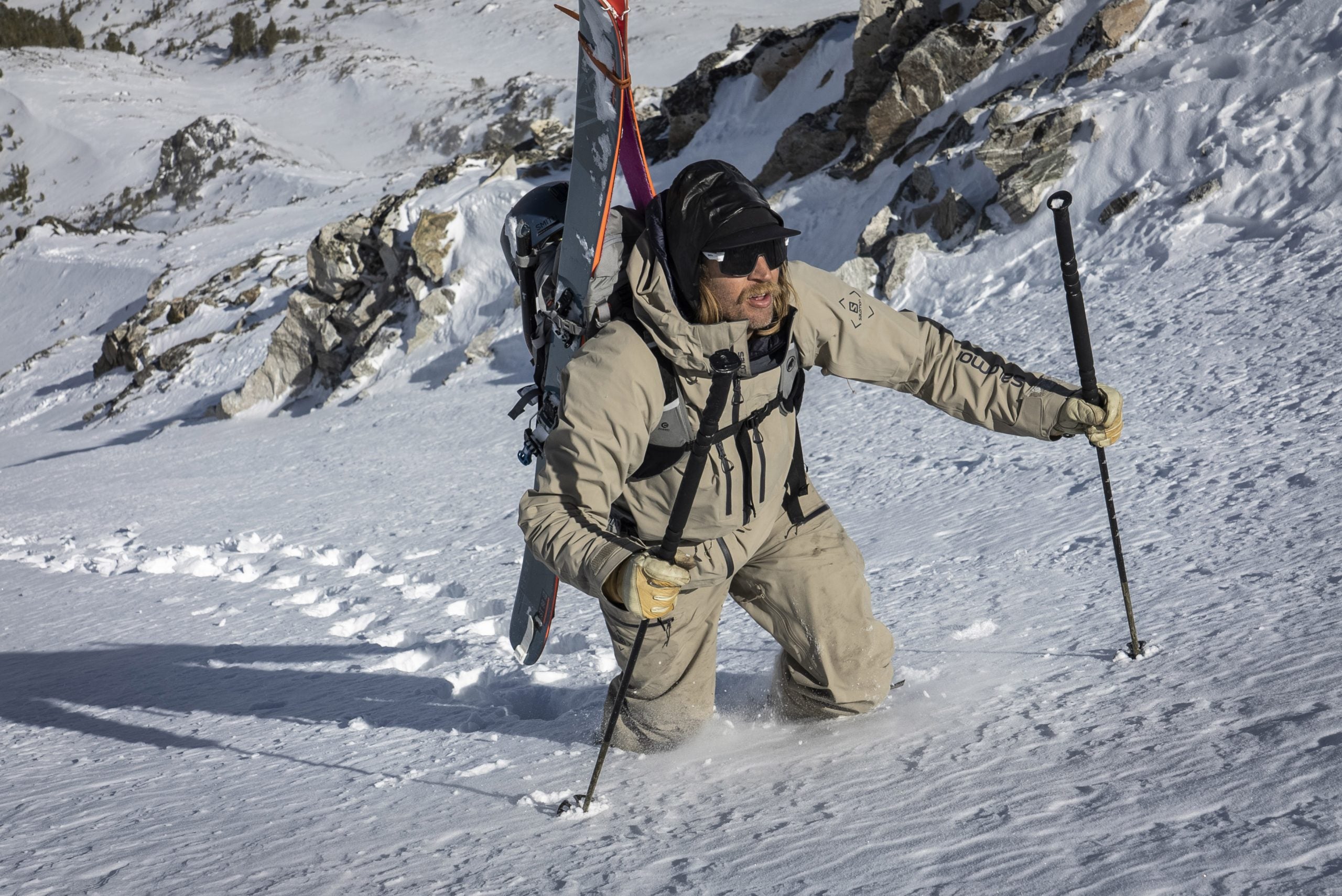
Throughout the production of various episodes of The Fifty Project, Townsend was documented wearing the Scrambler through extreme environmental transitions, ranging from sub-zero winter storms to strenuous, high-exertion bootpacking and grueling bushwhacking approaches in spring conditions. Watching an elite athlete subject a single piece of outerwear to such continuous mechanical and environmental abuse prompted independent outdoor gear testers to secure production models for standardized, multi-month field evaluations.
Testing protocols spanned a variety of geographical regions and topographical profiles, encompassing deep powder days in the Intermountain West, wind-scoured alpine ridges in the Pacific Northwest, and damp coastal storms. Evaluators monitored metrics including moisture permeability, thermal regulation, zipper durability, helmet integration, and packability under duress. At the conclusion of the testing cycle, the panel unanimously categorized the Scrambler as the most capable backcountry shell evaluated throughout the operational season.
Ventilation Innovation: The Oblique Zipping System
One of the most praised attributes of the Salomon Scrambler during field trials was its unconventional ventilation architecture. Standard alpine shells typically rely on traditional pit zips located beneath the arms to dump excess heat during ascents. While functional, pit zips can occasionally interfere with backpack shoulder straps or fail to generate sufficient cross-ventilation during high-exertion climbs.
Salomon addressed this thermodynamic challenge by integrating massive, accessible venting zippers running diagonally along the obliques. Testers observed that this oblique venting system provides superior airflow management compared to conventional pit zips. By positioning the exhaust ports closer to the core and aligning them with natural torso movement, the jacket enables users to regulate their internal temperature more rapidly while on the move, significantly reducing sweat accumulation and subsequent chilling during transitions.
Market Implications and Economic Shifts
The release and subsequent acclaim of the Salomon S/Lab Scrambler arrive at a time of significant evolution within the technical snowsports apparel market. Consumers and manufacturers are increasingly balancing uncompromising weather protection with rigorous sustainability mandates, as evidenced by the widespread industry transition toward PFC-free membranes like Gore-Tex ePE.
While the Scrambler is positioned at a premium price point reflecting its pro-caliber engineering, market analysts note that fluctuations in retail pricing have made high-end technical shells more accessible to advanced enthusiasts. Recent retail data indicates that promotional price reductions—such as discounts reaching up to $275 off the manufacturer’s suggested retail price—have significantly broadened the consumer base for elite-tier alpine gear.
Broader Impact on the Backcountry Consumer
Industry experts suggest that the success of minimalist, high-performance shells like the Scrambler signals a shift in consumer preferences away from heavy, insulated ski jackets toward modular, layering-centric systems. Skiers and snowboarders who log substantial human-powered vertical feet are increasingly prioritizing breathability, weight savings, and packability over traditional comfort features like integrated powder skirts and fleece-lined pockets.
While the absence of hand pockets and the wide cuff design mean the Scrambler may not appeal to the casual resort skier who values traditional comforts, its specialized feature set establishes a new benchmark for professional-grade backcountry equipment. As climate patterns continue to produce variable snowpacks and unpredictable weather in alpine environments, the demand for adaptable, durable, and highly breathable outerwear is projected to remain strong among dedicated mountaineers and backcountry travelers.

