
The landscape of European summer skiing is undergoing a significant transformation as major resorts in Italy, Switzerland, and Austria adjust their operations in response to both technological advancements and shifting climatic conditions. In a landmark development for the Aosta Valley and the Valais canton, the Italian resort of Cervinia has solidified its position as a premier summer destination through its high-altitude link with Zermatt, Switzerland. This expansion comes at a pivotal moment for the industry, coinciding with the announcement that the Hintertux glacier in Austria—long celebrated as the only ski area in the country to offer skiing 365 days a year—will cease its year-round operations starting in the summer of 2026. These diverging paths highlight the critical role of altitude, infrastructure investment, and environmental adaptability in the future of the snowsports industry.
The Matterhorn Alpine Crossing and the Rise of Cervinia
The strategic partnership between Cervinia and Zermatt has reached a new milestone with the full integration of the "Matterhorn Alpine Crossing." This ambitious engineering project, a multi-stage 3S cableway, has fundamentally altered the accessibility of the Theodul Glacier. By connecting Testa Grigia in Italy (3,458m) directly to the Klein Matterhorn in Switzerland (3,883m), the lift allows non-skiers and skiers alike to traverse the border at high altitude without the need for traditional ski equipment or strenuous navigation.
For the summer skiing community, this infrastructure ensures that Cervinia remains a vital gateway to the highest skiable terrain in Europe. The summer ski area, primarily located on the Plateau Rosa, offers approximately 25 kilometers of groomed runs. This makes the Zermatt-Cervinia axis the largest and highest summer skiing domain on the continent. The altitude is a decisive factor; with the majority of the terrain situated above 3,000 meters and reaching nearly 3,900 meters at the Gobba di Rollin, the snow quality remains more resilient against the morning sun than lower-altitude glaciers.
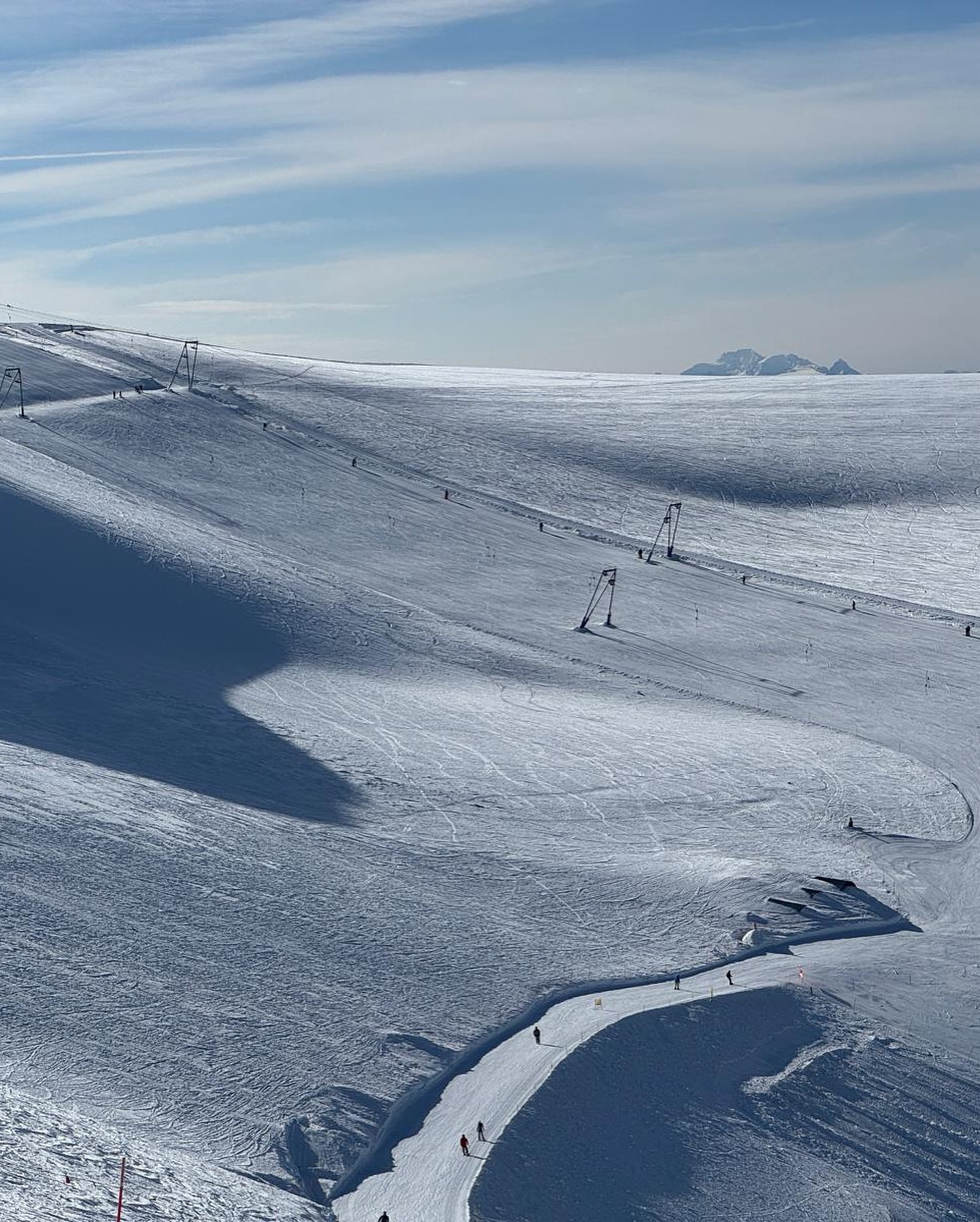
The transition from the Italian side to the Swiss glacier now takes just over 30 minutes. This efficiency has made Cervinia an increasingly attractive base for international ski academies and professional teams. The resort has officially noted that the Plateau Rosa has become a primary "training ground for World Cup national and international teams." While specific slopes are reserved for elite athletes to practice slalom and giant slalom on injected, hard-packed snow, the resort maintains a significant portion of the glacier for "scenic skiing," catering to recreational enthusiasts who wish to experience winter conditions in the height of July and August.
Professional Training and Freestyle Facilities
The importance of the Zermatt-Cervinia summer offering extends beyond recreational tourism. For decades, professional ski racers have relied on Alpine glaciers for summer training to avoid the logistical and financial costs of traveling to the Southern Hemisphere (Chile, Argentina, or New Zealand). As other European glaciers like Tignes, Les Deux Alpes, and Hintertux reduce their summer windows, the pressure on the Matterhorn region increases.
Furthermore, the Snowpark Zermatt remains a cornerstone of the summer operation. Situated on the Plateau Rosa, it is recognized as the largest freestyle facility on a glacier. The park features a comprehensive array of rails, boxes, and a "big air" jump, attracting pro-level riders from across the globe. Organizations such as the Warren Smith Ski Academy have utilized Cervinia as their summer headquarters for several years, citing the consistency of the terrain and the reliability of the lift systems as primary reasons for their continued residency.
The Hintertux Departure from Year-Round Skiing
In stark contrast to the expansion in the Matterhorn region, the Hintertux Glacier in the Austrian Zillertal has announced a significant shift in its operational philosophy. For decades, Hintertux was synonymous with "365 days of skiing," marketing itself as the only resort in Austria where the lifts never stopped turning for skiers. However, the resort recently updated its official communications to indicate that year-round skiing will come to an end in 2026.
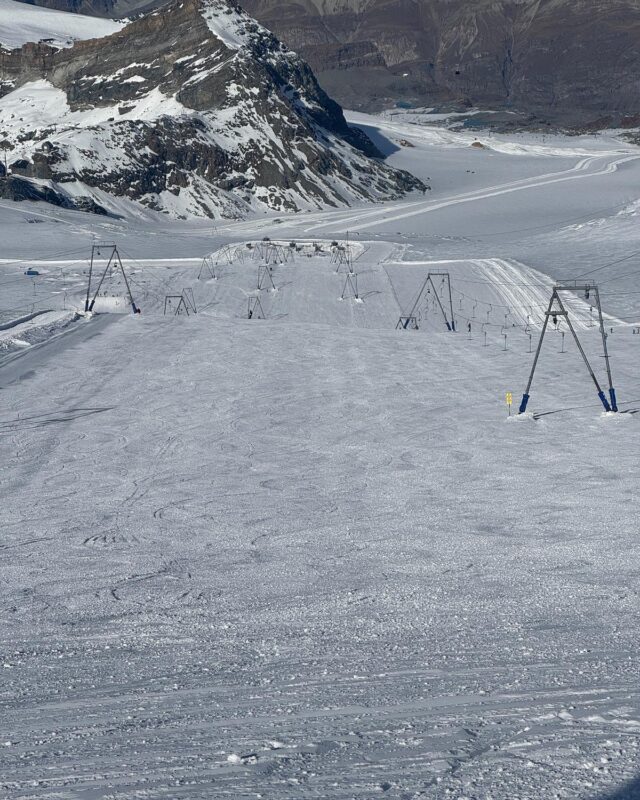
According to the revised schedule, the glacier will remain open for skiing until July 26, 2026, after which the ski operations will shut down for the remainder of the peak summer weeks. Resort officials stated that following the July closure, they intend to "enjoy the glacier summer to the fullest off the slopes," signaling a pivot toward hiking, sightseeing, and environmental tours. Skiing is currently slated to resume in September 2026, with the traditional "Hintertux Park Opening" scheduled for early October.
While the resort has not explicitly confirmed if this is a permanent policy change or a temporary measure for the 2026 season, industry analysts suggest it is a pragmatic response to the escalating costs of snow preservation. The "summer break" allows the resort to focus on glacier conservation efforts, such as the deployment of specialized fleece blankets designed to reflect solar radiation and reduce ice melt.
The Climate Context and Glacial Retreat
The divergence in strategy between Cervinia-Zermatt and Hintertux cannot be viewed in isolation from the broader context of climate change in the Alps. European glaciers have lost significant mass over the last two decades. Data from the Swiss Glacier Monitoring Network (GLAMOS) and Austrian meteorological services indicate that the rate of melt has accelerated, particularly during the record-breaking heatwaves of 2022 and 2023.
In 2022, Zermatt was forced to briefly suspend summer skiing for the first time in its history due to excessive melting and the opening of crevasses that made the terrain unsafe. This event served as a wake-up call for the industry. Since then, Zermatt and Cervinia have invested heavily in snow-making technology and "snow farming"—the practice of stockpiling winter snow under insulated covers to be redistributed on the glacier during the summer months.

Hintertux, while slightly lower in maximum elevation than the Klein Matterhorn, faces similar challenges. The decision to close in late July and August—the hottest months of the year—is likely a move to protect the "eternal ice" from the friction and mechanical stress of ski grooming and traffic when the snow cover is at its thinnest. By closing during the peak of summer, the resort preserves the base layers of ice, ensuring a more stable and higher-quality opening in September.
Economic and Tourism Implications
The shift in summer skiing availability has significant economic ramifications for Alpine villages. For Cervinia, the ability to offer guaranteed summer skiing via the Matterhorn Alpine Crossing provides a unique selling proposition that distinguishes it from other Italian resorts that have largely moved toward mountain biking and hiking. This year-round appeal supports a more stable local economy, allowing hotels, restaurants, and equipment rentals to operate with less seasonal fluctuation.
Conversely, the Zillertal region, where Hintertux is located, is already a powerhouse for summer hiking and biking. The loss of summer skiing at Hintertux, while a blow to the resort’s historical identity, may allow the region to consolidate its resources into "green" summer tourism, which often has a lower overhead and a smaller carbon footprint than maintaining ski runs in 20-degree Celsius weather.
A Timeline of Summer Skiing Contraction
The 2026 Hintertux announcement follows a long-term trend of contraction in the European summer skiing market. To understand the current landscape, one must look at the chronology of the last two decades:
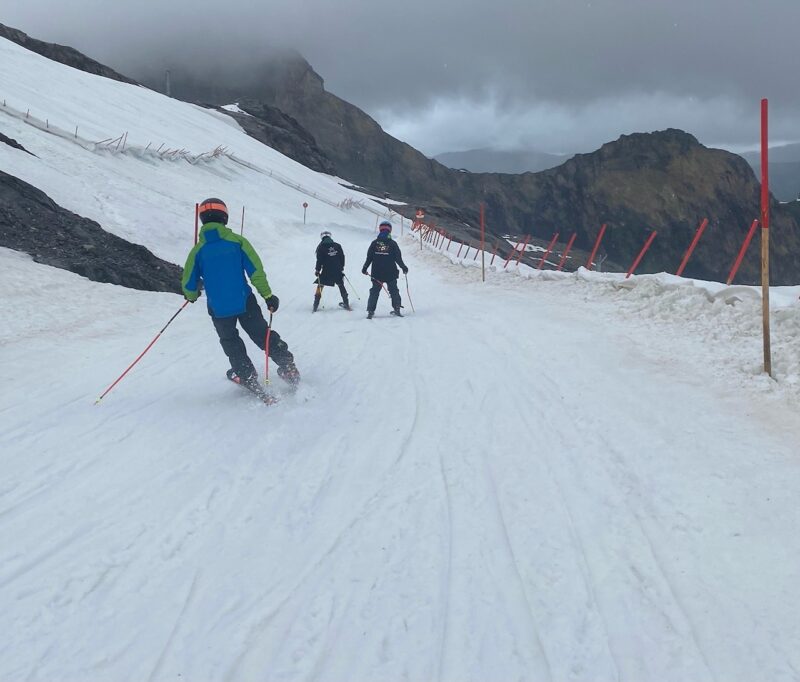
- Early 2000s: Resorts like Val d’Isère, Tignes, Les Deux Alpes (France), and Marmolada (Italy) offered extensive summer seasons lasting into late August or even year-round.
- 2010–2019: Increasing temperatures led to shorter windows. Tignes began closing its Grande Motte glacier earlier in the summer, often by late July.
- 2020–2024: The "summer skiing" season became highly volatile. In 2022, almost every glacier in the Alps, including Saas-Fee and Zermatt, faced temporary closures due to unprecedented melt.
- 2025–2026: The industry reaches a tipping point. Hintertux ends its 365-day claim, leaving the Zermatt-Cervinia link as the primary bastion for high-altitude summer snowsports in the central Alps.
Future Outlook: The Resilience of High-Altitude Hubs
The future of summer skiing appears to be gravitating toward "ultra-high-altitude" hubs. The Matterhorn Alpine Crossing represents the new model: high-capacity, technologically advanced lift systems that reach altitudes where the air remains thin and cold enough to sustain snow. These hubs will likely become the exclusive territory of professional athletes and affluent tourists, as the cost of maintaining these environments continues to rise.
For the average skier, summer skiing is becoming a "scenic" activity rather than a full-day sport. Most summer glacier operations now run from 7:00 AM to 1:00 PM, as the snow becomes too soft and "slushy" for safe or enjoyable skiing by mid-afternoon.
As Hintertux prepares for its first summer break in 2026, all eyes will be on the weather patterns of the coming seasons. If the Alps experience another series of record-breaking summers, even the high-altitude sanctuaries of Cervinia and Zermatt may be forced to further refine their operations. For now, the "Matterhorn Alpine Crossing" stands as a testament to human engineering’s attempt to outpace the warming climate, providing a lifeline for a sport that is increasingly finding itself on thin ice.

