
The latest iteration of the 2026-27 Audi FIS Alpine Ski World Cup calendar drafts has been released, outlining a series of significant adjustments for the women’s tour and more targeted refinements for the men’s circuit. These revisions, building upon the initial draft circulated earlier this spring, provide a clearer, though not yet final, picture of the upcoming season, with particular attention paid to the speed schedule and late-season technical events for the women, while the men’s calendar sees fewer, albeit notable, modifications. Both drafts remain provisional, awaiting the ultimate endorsement from the FIS Council.
Understanding the Audi FIS Alpine Ski World Cup: A Global Alpine Showcase
The Audi FIS Alpine Ski World Cup represents the pinnacle of international alpine ski racing, bringing together the world’s elite skiers to compete across a range of disciplines in iconic mountain resorts globally. Organized by the International Ski and Snowboard Federation (FIS), the World Cup season typically spans from late October to March, featuring races in five primary disciplines: Downhill (DH), Super-G (SG), Giant Slalom (GS), Slalom (SL), and Parallel events. Downhill and Super-G are categorized as "speed" events, emphasizing velocity and aerodynamic skill over long, challenging courses, while Giant Slalom and Slalom are "technical" events, demanding precision, agility, and intricate gate negotiation. The overall World Cup title, alongside individual discipline titles, is among the most coveted achievements in alpine skiing, reflecting consistent excellence throughout a demanding season.
The process of drafting the World Cup calendar is an intricate annual undertaking for FIS, involving negotiations with national ski associations, local organizing committees, broadcasters, and sponsors. Factors such as geographical flow, logistical feasibility, historical performance of venues, weather patterns, and the desire for a balanced schedule across disciplines and continents all play a crucial role. Draft calendars are typically released in stages, allowing for feedback, adjustments, and the resolution of logistical or financial uncertainties before final approval. The current drafts, marked by "TBD" (to be determined) and "TBC" (to be confirmed) notations, illustrate this ongoing, dynamic process of refinement. "TBD" signifies that specific details, such as a host venue or organizer, are still undecided, indicating active discussions or unresolved issues. Conversely, "TBC" implies that an event is tentatively scheduled as listed but awaits formal, final confirmation, often pending contractual agreements or specific operational clearances.
Women’s Calendar: A Season of Strategic Adjustments and New Opportunities
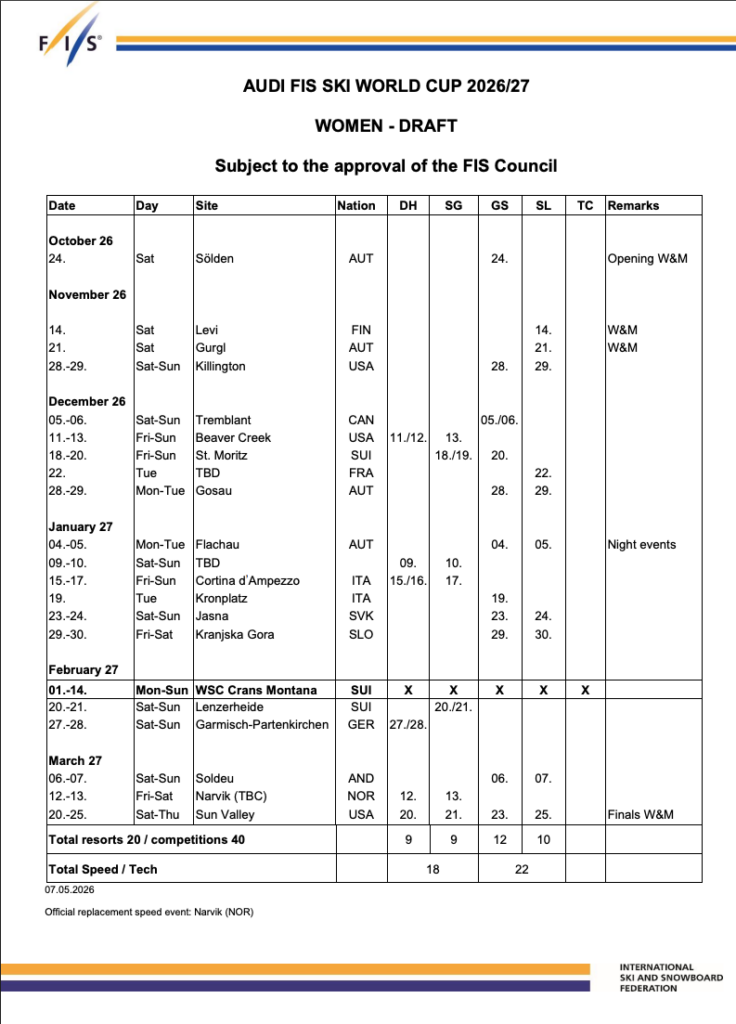
The women’s 2026-27 World Cup calendar draft reveals a more extensive reshuffling compared to its male counterpart, signaling a proactive approach to optimize the competitive flow and potentially offer new challenges for athletes. These changes span the early season, mid-winter, and late-season segments, affecting both speed and technical specialists.
Early Season Dynamics: Beaver Creek Expansion and European Shifts
One of the most significant enhancements in the revised calendar is the expansion of the women’s speed program at Beaver Creek, USA. Initially slated for a single downhill on December 12 and a Super-G on December 13, the updated draft now includes an additional downhill race on December 11. This transforms Beaver Creek into a full three-race speed series for the women, offering an invaluable early-season opportunity for downhill and Super-G specialists to accumulate crucial points. The inclusion of a second downhill race at Beaver Creek solidifies its status as a premier speed venue on the North American leg of the tour, echoing its historical role as a Men’s World Cup staple and World Championships host. This move could also serve to balance the North American presence, providing more high-profile events for the region’s passionate fan base and potentially boosting interest in women’s speed disciplines.
Following the North American swing, the European pre-Christmas technical schedule sees a notable alteration. The women’s night slalom previously assigned to Courchevel, France, on December 22 is now listed as "TBD." This uncertainty suggests ongoing discussions regarding the host venue or potentially the viability of the event at that specific location and time. Courchevel is renowned for its technical races, particularly its night slaloms, and the ambiguity leaves a prominent slot open in the crucial pre-holiday period.
Conversely, Austria’s traditional post-Christmas technical series has gained clarity. The December 28-29 giant slalom and slalom races, initially scheduled for an unnamed Austrian venue, are now officially confirmed for Gosau. This announcement provides certainty for teams and athletes regarding the location of these important early-season technical challenges, allowing for precise logistical planning. Gosau, nestled in the Dachstein Salzkammergut region, is poised to host what are often pivotal races just before the New Year, setting the tone for the technical season ahead.

Mid-Winter Flux: January’s Speed Question Marks
The early January technical races in Flachau, Austria, have been officially confirmed in the updated draft, removing any lingering uncertainties from earlier versions. Flachau is a perennial favorite for its night slalom, known for its electrifying atmosphere and challenging course, making its confirmation a welcome development for technical skiers and fans alike.
However, the women’s speed races originally scheduled for St. Anton, Austria – a downhill on January 9 and a Super-G on January 10 – have been downgraded to "TBD," notably without even a country assignment attached. This creates a significant void in the mid-January speed calendar and raises questions about the future of speed events in St. Anton for the 2026-27 season. The absence of a designated country for these "TBD" races suggests a more fundamental issue than just a venue change, potentially indicating broader challenges in securing an alternative location or the need for a complete re-evaluation of this calendar slot. Such uncertainty impacts athletes’ training cycles and season planning, particularly for those specializing in speed.
February’s Face-lift: Lenzerheide’s Discipline Reconfiguration
The February calendar also features a significant overhaul, particularly concerning Lenzerheide, Switzerland. The original draft had allocated two women’s downhills and one Super-G to the Swiss resort. The updated version completely removes both downhill races, replacing them with two Super-G events on February 20-21. This strategic shift could be influenced by various factors, including snow conditions, venue suitability for multiple downhill runs, or a deliberate attempt by FIS to balance the distribution of Super-G races throughout the season. Lenzerheide, known for its diverse terrain, will now primarily test athletes’ Super-G prowess, demanding a different blend of speed and technical skill than pure downhill. This change will undoubtedly alter the competitive landscape for speed specialists in February.
Late Season: New Destinations and Persistent Confirmations
As the season progresses towards its climax, further changes impact the women’s technical schedule. Soldeu, Andorra, has been added to the calendar, slated to host giant slalom and slalom races on March 6-7. This marks a notable development, as Soldeu replaces a previously designated Swedish venue for these dates. Soldeu has increasingly become a fixture on the World Cup circuit, known for its excellent organization and passionate crowds, having successfully hosted World Cup Finals in the past. Its inclusion brings a vibrant, growing ski nation into a more prominent role for late-season technical events.
Meanwhile, the two women’s downhills planned for Narvik, Norway, on March 12-13, remain on the calendar but are now marked "TBC." While this signifies that the races are still planned, they require formal confirmation. Narvik, an emerging venue in the far north, represents an exciting prospect for the World Cup, offering unique conditions and a picturesque setting. The "TBC" status suggests that while the commitment to host is strong, final logistical or financial agreements are still being ironed out, a common step for new or less established World Cup hosts.
Despite these numerous venue and discipline changes across the season, the total number of races and the overall distribution of disciplines for the women’s tour remain consistent with the initial draft. The calendar still includes 40 total races across 20 resorts, indicating FIS’s commitment to maintaining a robust and comprehensive competitive schedule for the athletes.
Men’s Calendar: Targeted Refinements for Consistency
In stark contrast to the extensive revisions seen in the women’s calendar, the men’s 2026-27 Audi FIS Alpine Ski World Cup draft features significantly fewer changes, suggesting a more settled and consistent structure from the outset. Only two adjustments appear in the newest version released by FIS, both representing targeted refinements rather than wholesale overhauls.
Kranjska Gora’s Slight Shift: A Minor Chronological Adjustment
One of the updates affects the traditional men’s technical races held in Kranjska Gora, Slovenia. The original draft calendar scheduled the giant slalom and slalom races for January 3-4. The revised version now moves these races forward by one day, to January 2-3. This minor chronological shift, while seemingly small, can have implications for teams and athletes regarding travel logistics and preparation, especially coming directly after the New Year period. However, the venue and disciplines remain unchanged, ensuring that Kranjska Gora continues its role as a key technical stop early in the calendar year.
Saalbach Steps Up: A Confirmed Speed Hub
The other significant revision impacts the late-February men’s speed series. The original draft had listed Courchevel, France, as the planned host for downhill and Super-G races on February 27-28, though these events were initially marked "TBC," indicating a need for confirmation. In the updated calendar, these races are now officially assigned to Saalbach, Austria, on the same dates. This change provides certainty for the men’s speed specialists, confirming a solid venue for a crucial late-season speed block. Saalbach, fresh off hosting the 2025 FIS Alpine World Ski Championships, is a well-established and capable host for speed events, making its confirmation a reliable choice for the circuit. This transition from a "TBC" status at Courchevel to a confirmed host at Saalbach highlights the successful resolution of scheduling and hosting agreements.
Similar to the women’s calendar, despite these minor schedule adjustments, the discipline totals for the men’s revised draft calendar remain unchanged. This consistency underscores FIS’s effort to maintain a balanced season across all disciplines for the male athletes, ensuring ample opportunities for specialists in speed and technical events alike. Beyond these two specific changes, the men’s draft otherwise remains largely consistent with the first version published by FIS, indicating a more stable framework for the season ahead.
Broader Implications and The Road Ahead
These calendar revisions, while often viewed as logistical adjustments, carry significant implications across the alpine skiing ecosystem.
Athlete and Team Perspectives: For athletes and their support teams, calendar certainty is paramount. The confirmation of venues like Gosau and Saalbach, or the expansion at Beaver Creek, allows for precise planning of training blocks, travel schedules, and equipment preparation. Conversely, "TBD" statuses, particularly for prominent speed events like St. Anton, introduce an element of uncertainty that can disrupt meticulously planned seasonal strategies. Athletes must remain adaptable, but consistency in the schedule aids peak performance. The increased number of speed races for women at Beaver Creek, for instance, offers more scoring opportunities for speed specialists but also increases the physical demands of the early season.
Host Nation Responsibilities and Economic Impact: Hosting World Cup events is a matter of prestige and significant economic benefit for ski resorts and their surrounding regions. The confirmation of Gosau and Saalbach, and the expanded role for Beaver Creek, are likely met with enthusiasm by local organizing committees, as these events draw spectators, media, and generate tourism revenue. The "TBC" status for Narvik underscores the challenges and investments required to bring new venues onto the World Cup stage, while the "TBD" for other events highlights the competitive nature of securing these coveted dates.
FIS’s Balancing Act: The FIS, in its role as the governing body, continuously strives for a calendar that balances competitive fairness, athlete welfare, commercial viability, and geographical diversity. The revisions reflect ongoing efforts to optimize this balance, responding to feedback, addressing logistical constraints, and leveraging successful venues. The consistency in total discipline numbers across both men’s and women’s calendars, despite individual race shifts, demonstrates a commitment to a comprehensive season for all specialists. The complex interplay of weather variability, venue readiness, broadcast schedules, and national federation interests makes the calendar drafting process a continuous negotiation.
The updated drafts, for both the men’s and women’s Audi FIS Alpine Ski World Cup, now move forward for final deliberation and approval by the FIS Council. This final step is crucial, as the Council’s endorsement will officially cement the competitive framework for the 2026-27 season. The alpine skiing community will eagerly await this final confirmation, preparing for a season that promises both familiar challenges and exciting new competitive landscapes.

