
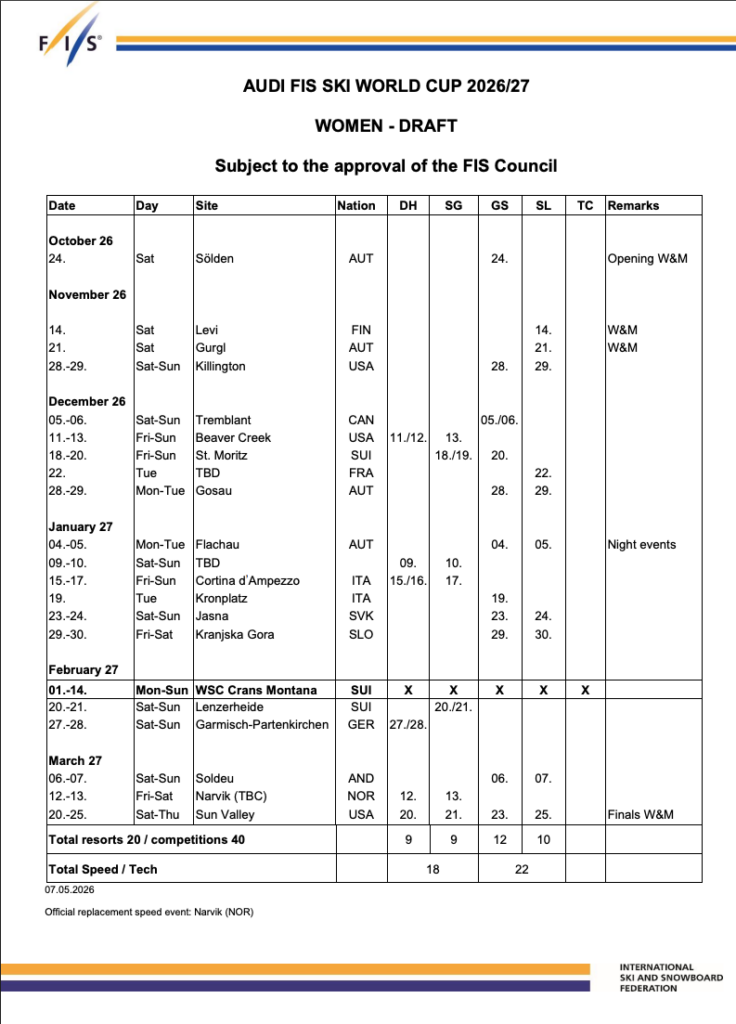
The latest iteration of the 2026-27 Audi FIS Alpine Ski World Cup calendar, released as a draft, reveals a series of significant modifications from its initial spring version, particularly impacting the women’s circuit with notable revisions to speed events and late-season technical competitions. This comprehensive update reflects the intricate and dynamic process of scheduling a premier international sports series, balancing logistical complexities, athlete welfare, and commercial interests across multiple continents.
The Evolving Landscape of Alpine Ski Racing Calendars
The Audi FIS Alpine Ski World Cup represents the pinnacle of international alpine ski racing, attracting top athletes from around the globe to compete in various disciplines: Downhill, Super-G (speed events), Giant Slalom, and Slalom (technical events), along with Combined events and Parallel races. Crafting the annual calendar is a monumental task for the International Ski and Snowboard Federation (FIS), involving extensive coordination with national ski associations, local organizing committees, broadcasters, and sponsors. Each draft calendar undergoes several rounds of review, reflecting ongoing negotiations, venue readiness assessments, and strategic planning. The 2026-27 season, following the 2026 Winter Olympics, holds particular significance as athletes and teams recalibrate their focus on the World Cup globe races.
The current draft underscores the fluid nature of such high-stakes planning, with both confirmed shifts and lingering uncertainties marked by "TBD" (to be determined) and "TBC" (to be confirmed) notations. These designations are critical for stakeholders, offering transparency into which elements of the schedule are still subject to negotiation or final logistical arrangements.
Women’s World Cup: A Season of Significant Shifts
The women’s 2026-27 calendar has seen the more substantial overhaul, signaling strategic adjustments across the season.
Early Season Dynamics: Beaver Creek Expansion and European Adjustments
One of the most prominent changes arrives early in the season, with Beaver Creek, USA, poised to host an expanded speed series. Originally slated for a single downhill, the updated draft now includes a second women’s downhill on December 11, preceding the previously scheduled downhill on December 12. The Super-G on December 13 remains in place, establishing a robust three-race speed block at the renowned American venue. This expansion not only offers more competitive opportunities for speed specialists but also elevates Beaver Creek’s status as a key early-season destination, potentially boosting North American viewership and attendance. For American and Canadian athletes, this provides a valuable home-soil advantage early in the competitive year. Beaver Creek’s "Birds of Prey" course, while historically a men’s stronghold, offers challenging terrain that promises thrilling women’s speed events.
Across the Atlantic, pre-Christmas technical events in Europe have also undergone revision. France’s traditional night slalom, initially assigned to Courchevel for December 22, is now listed as "TBD." This uncertainty leaves a notable gap in the pre-holiday schedule and signals ongoing discussions regarding the host venue. Courchevel, a frequent World Cup host, may still be in contention, or other French resorts could be under consideration. The logistical demands of a night slalom, including lighting infrastructure and crowd management, often contribute to the complexities of venue confirmation.

Meanwhile, Austria’s customary post-Christmas technical series has found a definitive home. The women’s giant slalom and slalom races, scheduled for December 28-29, which were previously assigned to Austria without a specific venue, are now officially listed for Gosau. This confirmation provides clarity for teams and fans, solidifying a traditional segment of the World Cup season known for its passionate crowds and challenging conditions. Gosau’s inclusion will require its organizing committee to rapidly finalize preparations for two high-profile technical races following the festive period.
January’s Mixed Fortunes: Confirmations and Lingering Questions
The transition into the new year brings a mix of certainty and doubt. The early January technical races in Flachau, Austria, previously uncertain, are now firmly confirmed on the updated draft calendar. Flachau is celebrated for its electrifying night slalom, often drawing some of the largest and most enthusiastic crowds of the season. Its confirmation is a positive development for technical specialists and Austrian ski fans.
Conversely, the women’s speed races initially scheduled for St. Anton, Austria – a downhill on January 9 and a Super-G on January 10 – have been downgraded to "TBD" status, notably without even a country assignment attached. This suggests a more significant challenge in securing a host for these dates and disciplines, potentially indicating unresolved logistical, financial, or weather-related concerns at the original venue. The absence of a country assignment opens the door for other nations to potentially step in, though finding suitable speed courses on short notice can be difficult. This uncertainty presents a planning challenge for speed athletes who rely on a consistent schedule to peak their performance.
February’s Face-Lift: Lenzerheide’s Discipline Reshuffle
The February calendar reveals a substantial restructuring of disciplines at Lenzerheide, Switzerland. The initial draft had allocated two women’s downhills and one Super-G to the Swiss resort. The revised version has entirely removed both downhill races, replacing them with two Super-G events scheduled for February 20-21. This strategic shift could be influenced by various factors, including course conditions, safety considerations for downhill, or a desire to diversify the speed program at Lenzerheide. For athletes, this change means a greater emphasis on Super-G technique and less on the raw speed and gliding demanded by downhill. Lenzerheide has a strong reputation for hosting high-quality races, and this adjustment will allow it to continue its tradition with a modified focus.
Late-Season Twists: Soldeu’s Arrival and Narvik’s Provisional Status
As the season progresses towards its conclusion, further adjustments have been made to the technical schedule. Soldeu, Andorra, has been added as a host for giant slalom and slalom races on March 6-7. This replaces a previously listed Swedish venue for those dates, marking a significant win for the small Pyrenean nation which has increasingly demonstrated its capability to host World Cup events. Soldeu’s inclusion offers a fresh venue for the technical specialists and could provide a unique atmosphere as the fight for the globe intensifies. The resort previously hosted the World Cup finals in 2019 and 2023, showcasing its modern infrastructure and commitment to alpine racing.
Meanwhile, the two women’s downhills planned for Narvik, Norway, on March 12-13, remain on the calendar but are now marked "TBC." This indicates that while the races are still anticipated to take place as scheduled, they require final formal confirmation. Narvik’s potential inclusion represents an exciting expansion of the World Cup circuit into new territories, offering a challenging late-season speed test in a scenic Arctic environment. However, the "TBC" status suggests that logistical or financial details are still being finalized, a common hurdle for new or geographically distant venues.

Discipline Totals: A Balancing Act Maintained
Despite the numerous venue and discipline changes, the overall balance of races across disciplines remains consistent with the initial draft. This stability in totals—a testament to the FIS’s commitment to maintaining a balanced program for all specialists—is crucial for the integrity of the overall World Cup standings. Athletes can still plan their season around a fixed number of speed and technical events, ensuring fair competition for the coveted crystal globes. The draft calendar still includes 40 total races across 20 resorts, a robust schedule demanding consistency and versatility from the top contenders.
Men’s World Cup: Fewer Adjustments, Strategic Tweaks
In contrast to the extensive revisions seen in the women’s schedule, the men’s 2026-27 Audi FIS Alpine Ski World Cup calendar has undergone comparatively minor adjustments in its latest draft. This indicates a more stable and perhaps more established foundational schedule for the men’s circuit, with fewer logistical challenges or venue negotiations needing significant alteration.
Kranjska Gora: A Slight Calendar Shift
One of the two changes affecting the men’s calendar involves the traditional technical weekend in Kranjska Gora, Slovenia. The original draft had scheduled the giant slalom and slalom races for January 3-4. The revised version now shifts these events forward by one day, placing them on January 2-3. This minor adjustment, likely made for broadcasting reasons, logistical flow within the broader European technical swing, or local organizational preferences, will have minimal impact on athletes but requires a slight re-timing of their New Year preparations. Kranjska Gora is a classic venue known for its demanding technical courses and passionate Slovenian crowd, and its early January slot is a perennial fixture.
Saalbach Replaces Courchevel for Late-February Speed
The second significant revision on the men’s calendar addresses the late-February speed series. The initial draft had listed Courchevel, France, as the provisional host for a downhill and Super-G on February 27-28, albeit marked with "TBC." The updated calendar now officially assigns these races to Saalbach, Austria, on the same dates. This change signifies a definitive move, potentially resolving the uncertainties that led to Courchevel’s provisional status. Saalbach, a resort with a strong history of hosting World Cup events and having recently held the 2025 World Championships, is well-equipped to host speed events. Its confirmation provides certainty for athletes and teams, solidifying a critical speed block late in the season. For Austria, this adds another prestigious event to its already packed World Cup schedule, further cementing its role as a powerhouse in alpine skiing.
Men’s Discipline Totals Remain Stable
Similar to the women’s calendar, the men’s draft calendar maintains unchanged discipline totals despite these minor schedule adjustments. This consistency is vital for maintaining the competitive balance across speed and technical events throughout the season, ensuring that all specialists have an equal opportunity to contend for the overall and discipline-specific crystal globes. The men’s circuit also maintains a robust schedule, reflecting the depth and global reach of men’s alpine ski racing.
Decoding "TBD" and "TBC": The Language of Provisional Calendars
Understanding the nuances of "TBD" and "TBC" is crucial for interpreting draft calendars. "TBD" (To Be Determined) signifies that specific details, most commonly the host venue or the exact organizer, have not yet been finalized. This often points to ongoing negotiations, unresolved logistical hurdles, or a lack of a confirmed bid. Events marked "TBD" carry a higher degree of uncertainty and may see significant changes in subsequent drafts. For athletes and teams, these are the dates that require the most flexible planning, as training camps and travel logistics cannot be firmly set.
"TBC" (To Be Confirmed), on the other hand, indicates that an event is expected to proceed as listed, with the venue and discipline largely agreed upon, but it still requires a final, formal confirmation. This might involve signing contracts, securing permits, or completing final checks on infrastructure. "TBC" events are generally considered more likely to happen than "TBD" events, but they are not entirely locked in. For organizing committees, moving from "TBC" to fully confirmed status is the final hurdle in a lengthy planning process.
The Broader Implications and Path to Final Approval
The release of this updated draft calendar provides a clearer, though not yet definitive, picture of the 2026-27 Audi FIS Alpine Ski World Cup season. The changes reflect the continuous efforts by the FIS to optimize the circuit, considering factors such as geographical flow to minimize travel, balancing different disciplines, ensuring venue readiness and safety, and maximizing broadcast appeal.
For athletes, these calendar shifts mean a constant need for adaptability. Early season expansion at Beaver Creek offers a significant opportunity for North American speed specialists, while changes in Europe will impact travel and training routines for the majority of the circuit. The uncertainties around "TBD" events, particularly the January speed races, will force teams to maintain flexible plans and contingency strategies. The addition of Soldeu and the provisional status of Narvik highlight the FIS’s commitment to diversifying host nations and exploring new markets for alpine skiing, a strategic move to grow the sport’s global footprint.
Ultimately, this revised calendar remains a draft and is subject to final approval by the FIS Council. This final approval typically occurs at the FIS Council meeting in the late spring or early summer, following further consultation and resolution of outstanding "TBD" and "TBC" items. The dynamic process of calendar creation underscores the complex interplay of sport, logistics, and global cooperation that defines the Audi FIS Alpine Ski World Cup, setting the stage for what promises to be another thrilling season of high-speed action and precision skiing. The skiing world now awaits the definitive confirmation of these plans, eager to see the finalized roadmap for the elite athletes’ journey towards crystal globe glory.

