
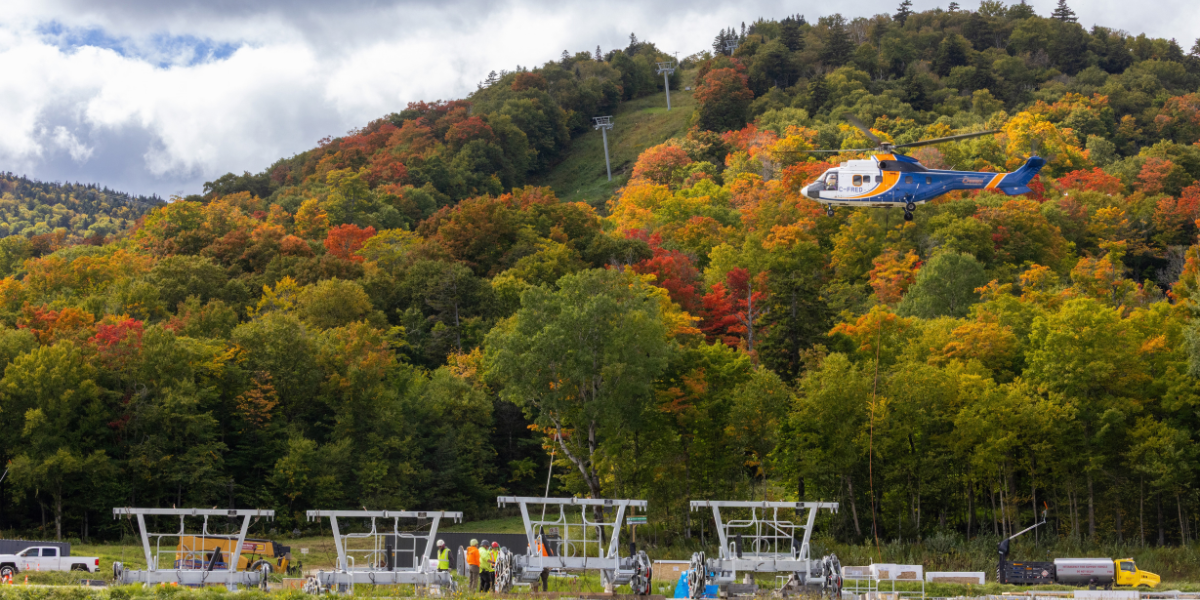
Killington Resort, widely recognized as the “Beast of the East,” successfully reached a pivotal stage in its multi-million-dollar capital improvement program this week as construction crews finalized the structural framework for the upcoming Snowdon Quad chairlift. On September 22, the resort utilized heavy-lift helicopter operations to position the final 10 of 19 total towers, along with their associated crossarms, marking a significant step toward the completion of one of the most anticipated infrastructure projects in the Vermont ski industry.
This $7.2 million investment represents a strategic commitment to the long-term operational resilience of the resort. By replacing the aging Snowdon Triple, the resort is not merely performing a routine maintenance upgrade; it is re-engineering a critical artery of its terrain network. As the project enters its final phase, the resort has confirmed that the lift is slated to begin service during the 2026-27 winter season, providing guests with enhanced capacity and a more robust mechanical system designed to withstand the volatile weather patterns typical of the Green Mountains.
A Strategic Approach to Lift Technology
The decision to install a fixed-grip quad rather than transitioning to a high-speed detachable lift has sparked interest among industry analysts and regular pass-holders. In an era where many major resorts prioritize high-speed transit at all costs, Killington’s leadership has opted for a "reliability-first" design philosophy.
According to internal documentation released by the resort, the Snowdon Quad is engineered to function as a dependable workhorse. While the lift will operate at a slower pace compared to the high-speed Snowdon Six Express nearby, it offers a 33% increase in uphill capacity over the previous triple chair. Furthermore, the new system includes a sophisticated backup power generation capability, allowing for full-speed operation even in the event of a regional power grid failure—a common challenge during severe New England winter storms. This redundancy ensures that even during inclement weather, the core of the mountain remains accessible to skiers and riders.
The project is being spearheaded by Doppelmayr, the global leader in ropeway manufacturing, which also recently completed the installation of the Superstar Six chairlift. The collaboration between the resort and the manufacturer underscores a long-term investment in standardization, simplifying maintenance protocols and ensuring that parts and technical expertise are readily available for the resort’s fleet.
The Chronology of Infrastructure Development
The replacement of the Snowdon lift is the latest in a rapid succession of capital improvements at Killington. The timeline of recent developments reflects the resort’s aggressive effort to modernize its uphill transit assets:
- November 2025: The state-of-the-art Superstar Six chairlift officially opened to the public, setting a new benchmark for speed and comfort on one of the resort’s most iconic trails.
- Early September 2026: Preparatory work commenced on the Snowdon alignment, involving the removal of the legacy Snowdon Triple towers. These components are being repurposed as terrain park features or recycled for scrap, demonstrating the resort’s commitment to sustainable construction practices.
- September 22, 2026: Helicopter crews successfully completed the installation of the final 10 towers and sheave trains, signifying the completion of the heavy structural phase of the project.
- Late 2026/Early 2027: The lift is scheduled for final safety inspections and load testing, with an official opening projected for the 2026-27 season.
Contextualizing the Investment: The Superstar Connection
The Snowdon Quad project does not exist in a vacuum; it serves as a complementary piece to the massive success of the Superstar Six. The Superstar lift serves the primary race venue for the Stifel Killington Cup, an event that has transformed the resort into a global hub for alpine racing. By upgrading the Snowdon lift, Killington is effectively balancing its high-performance race infrastructure with the practical, high-volume capacity required to manage the daily influx of recreational skiers.
The proximity of the two projects suggests a "hub and spoke" strategy. By enhancing the capacity of the Snowdon zone, the resort can better distribute skiers across the mountain, reducing wait times at the base and preventing the "bottleneck" effect that frequently occurs on busy holiday weekends.
The World Cup: A Global Stage in Vermont
While the Snowdon project focuses on the logistics of daily mountain operations, the resort’s global profile remains tied to the Stifel Killington Cup. Scheduled for November 28 and 29, 2026, the event will see the world’s elite technical racers—including global icons such as Mikaela Shiffrin—compete on the Superstar trail.
The return of the World Cup to Vermont is more than a sporting event; it is an economic engine for the region. The race weekend historically draws tens of thousands of spectators, generating significant revenue for the local hospitality and tourism sectors. The timing of the race, occurring early in the season, places Killington at the center of the international alpine conversation. As the technical circuit moves from Sölden and Levi to Vermont, the focus on the Superstar trail highlights the resort’s ability to prepare world-class, ice-hardened conditions before many other North American resorts have even fully opened for the season.
Economic and Operational Implications
For the average consumer, the shift toward a more reliable, high-capacity chairlift is a tangible improvement in the "skier experience." In the context of the Ikon Pass network, which includes both Killington and the neighboring Pico Mountain, maintaining operational reliability is a key metric for customer retention.

Ikon Pass holders, who receive up to seven days of shared access at these resorts, represent a growing segment of the resort’s demographic. Ensuring that the mountain remains navigable, even during high-traffic windows or severe weather events, is essential to fulfilling the value proposition offered to pass holders. The investment in the Snowdon Quad signals that Killington management is focused on the long-term utility of its infrastructure, prioritizing the ability to move guests efficiently over the aesthetic appeal of high-speed bells and whistles.
Furthermore, the integration of modern, energy-efficient lifts contributes to the resort’s broader sustainability goals. Newer lifts, such as the Doppelmayr models being installed, are typically more energy-efficient than their predecessors, utilizing advanced motor technologies that reduce the overall carbon footprint of the mountain’s lift operations.
Looking Toward the Future
As the final components of the Snowdon Quad are tensioned and tested, the focus at Killington will soon shift back to the start of the winter season. The successful installation of the towers marks a major milestone, but it also serves as a reminder of the complex logistics involved in mountain resort management.
From the precise flight paths of the helicopters used during the installation to the intricacies of the mechanical engineering required for a fixed-grip system, the project is a testament to the technical expertise required to operate a major resort in a high-altitude, high-weather environment.
As the leaves turn and the anticipation for the first snowfall builds, the residents and visitors of Vermont can look toward a season that blends the best of both worlds: the high-speed, high-stakes excitement of international World Cup racing on the Superstar trail, and the quiet, reliable efficiency of the new Snowdon Quad. With these infrastructure upgrades, Killington reinforces its position as a pillar of the American ski industry, ensuring that it remains both a premier destination for elite athletes and a reliable, high-capacity home for the broader skiing public for years to come.
While the Snowdon Quad is not expected to be the fastest lift on the mountain, its role in the resort’s ecosystem is arguably more important. By anchoring a central section of the mountain with a system designed for longevity and uptime, Killington is making a statement that the future of the sport is as much about reliability as it is about speed. As the resort prepares for the 2026-27 season, the completed Snowdon Quad stands as a symbol of prudent growth and a commitment to the fundamental promise of the mountain experience: getting people to the top of the slope, no matter the weather.

