
The winter of 2024-25 offered a crucial lesson: a weak La Niña does not automatically guarantee the deep, mid-winter snowpacks that winter enthusiasts and water managers anticipate. This upcoming season, the outlook for the Pacific Northwest mountains hinges on a complex interplay of oceanic and atmospheric patterns, with the El Niño-Southern Oscillation (ENSO) cycle once again taking center stage. Forecasters are closely examining the probabilities and potential impacts of ENSO phases to project snowpack accumulation, while also acknowledging that other significant climate drivers play a substantial role.
Understanding the ENSO Cycle and Its Influence
The El Niño-Southern Oscillation (ENSO) is a naturally occurring climate phenomenon characterized by cyclical fluctuations in sea surface temperatures across the tropical Pacific Ocean. These temperature shifts influence atmospheric circulation patterns globally, significantly impacting weather across continents. ENSO operates in three distinct phases: El Niño, marked by warmer-than-average sea surface temperatures; La Niña, characterized by cooler-than-average sea surface temperatures; and Neutral conditions, where temperatures hover around the long-term average.
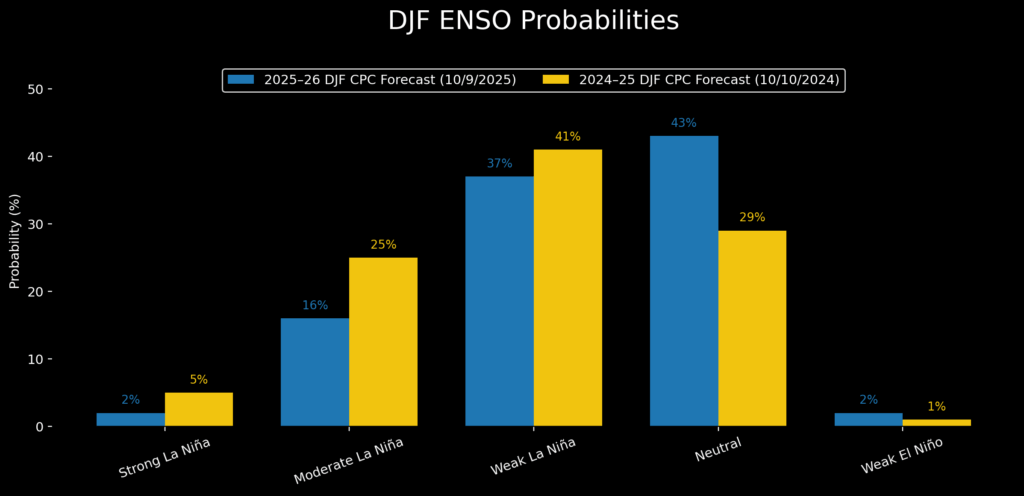
October forecasts for mid-winter ENSO probabilities in 2025-26 bear a striking resemblance to those of the previous year. However, there is a subtle indication of a weakening La Niña signal for the upcoming season. Both forecasts suggest the highest likelihood of cool-phase conditions occurring during the autumn and early winter months.

The Oceanic Niño Index (ONI) serves as a principal metric for monitoring and predicting ENSO. It is derived from sea surface temperature (SST) departures from the average in the Niño 3.4 region of the Pacific. During the 2024-25 winter, the December-January-February (DJF) ONI registered -0.6°C, just barely indicating weak La Niña conditions. Current weekly SST departures are also around -0.6°C, suggesting that the region is once again on the cusp of a weak La Niña. Mid-October Oceanic SST models indicated a November minimum ONI of approximately -0.8°C, with projections for values to decrease to around -0.3°C by mid-winter (DJF). This trajectory suggests that neutral ENSO conditions are the most probable outcome for the mid-winter snowpack.
Historical Snowpack Response to ENSO Phases in the Pacific Northwest
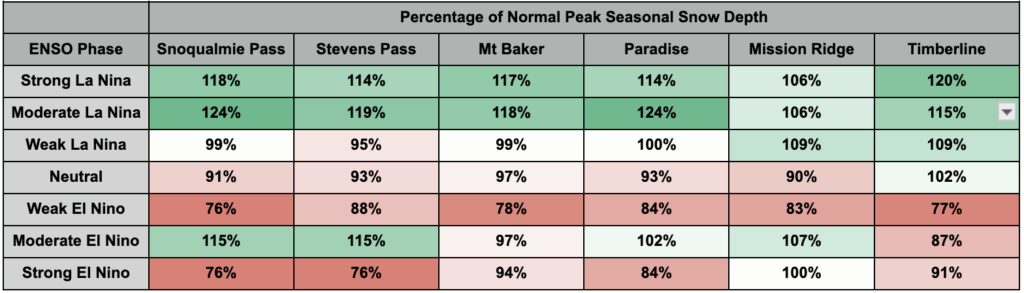
To understand the potential implications of these ENSO projections, researchers have analyzed an updated Snowpack Climatology Dataset, examining how Pacific Northwest mountain snowpack has historically responded to different ENSO phase strengths. This dataset reveals a nuanced relationship:
- Weak La Niña: In winters characterized by weak La Niña conditions, most weather stations typically record snowpack levels close to the average. Only specific locations, such as Mission Ridge and Timberline, have historically shown modest gains in snow depth during these periods.
- Moderate and Strong La Niña: These more robust La Niña events have consistently favored the western slopes and crest of the Cascade Mountains, leading to peak snow depths that are 6% to 24% above normal. These conditions are often associated with enhanced precipitation and cooler temperatures conducive to significant snow accumulation.
- Neutral Years: Neutral ENSO phases generally result in slightly below-average snowpack across the region. While not as detrimental as El Niño years, they do not typically foster the abundant snowfall desired for a robust winter season.
- El Niño: Most El Niño conditions strongly tilt the odds toward reduced snowfall in the Pacific Northwest. Warmer Pacific waters associated with El Niño often lead to increased rain at higher elevations and less frequent, less intense snowfall events.
Evaluating the 2025-26 Outlook: Probabilities and Data Analysis
The DJF forecast distribution for ENSO probabilities for the upcoming winter includes a 18% chance of a moderate to strong La Niña and a 2% chance of El Niño. These probabilities, though seemingly small, carry significant influence on the mean outcomes. To provide a more focused assessment, analysis of the average peak snow depth was conducted using data from four sites with the longest and most consistent historical records: Mt. Baker, Stevens Pass, Snoqualmie Pass, and Paradise.
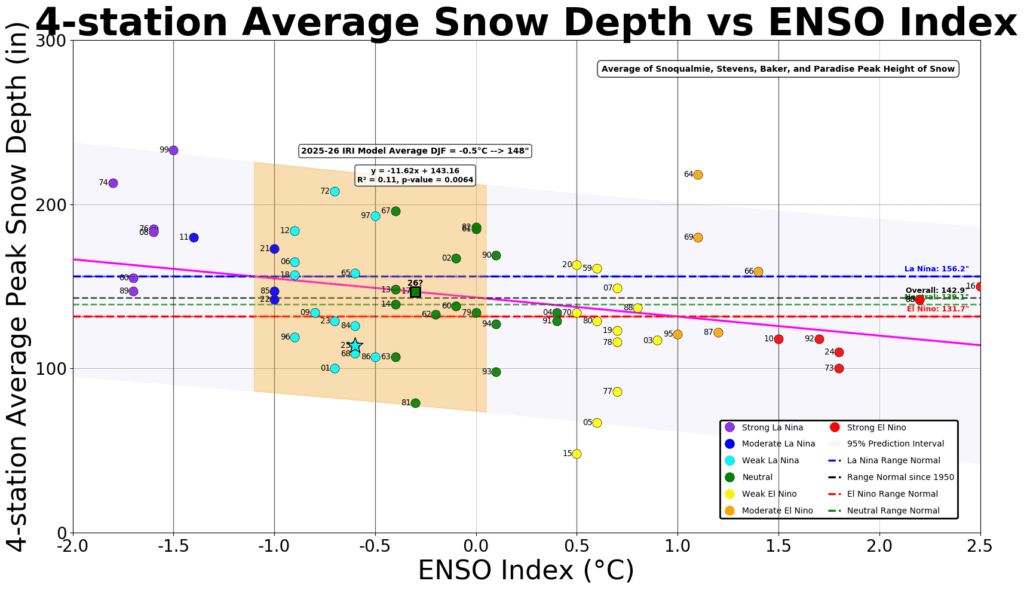
During the 2024-25 season, the average peak snow depth at these four stations was 114 inches. This figure represented approximately the 19th percentile for data within the -1 to 0°C ENSO Index interval and was 24% below the regression trendline. The reduction in snowpack was particularly noticeable at lower elevation stations, largely attributed to warmer temperatures.
To mitigate the potential influence of longer-term climate trends, a subset analysis was performed using only 21st-century data. While this shortened dataset lowered the mean snow depth across all ENSO phases, it did not fundamentally alter the overall prediction. Even with this truncated dataset, the ENSO forecast for the upcoming winter predicts an "almost perfectly average" winter in terms of snowpack accumulation.
Linear best-fit trendlines indicate that ENSO explains 11% of the data variability when considering the entire 75-year dataset, and 19% when excluding 20th-century data. This suggests that over 80% of the season-to-season variability in snowpack is not directly explained by ENSO alone.
The Role of Marine Heatwaves and Pacific Decadal Oscillation (PDO)
Recent discussions have highlighted the impact of marine heatwaves. An analysis comparing September and October SSTs from 2025 against those of 2024 and 2014 reveals a pattern of mostly positive anomalies. While slightly positive anomalies have become more common due to long-term climate shifts, the presence of deeper color anomalies warrants closer examination. The 2014-15 season, despite being a very weak El Niño, was marked by anomalously warm SSTs off the coast, which scientists have partially linked to a particularly poor snow year. During that season, the 4-station average snowpack reading was less than 50% of the 2024-25 season’s values.
Although September 2025 began with notably warm SSTs across the northeastern Pacific, these waters have since cooled significantly, with proximal waters approaching normal levels.
The combination of ENSO phase and nearshore West Coast Marine waters (often referred to as "The Blob") can explain approximately 25% of the snowpack’s inter-seasonal variability. The potential for an eastward spread of extraordinarily warm waters in the western North Pacific remains a factor to monitor.
Crucially, as long as these exceptionally warm waters remain west of Hawaii, the region is likely locked into the negative phase of the Pacific Decadal Oscillation (PDO). State Climate Office analyses note that a negative PDO phase correlates with cooler, snowier periods. A similar analysis examining the interplay between PDO and ENSO phases explains approximately 20% of the snowpack variance.
Implications for the 2025-26 Winter Season
The current meteorological outlook for the 2025-26 winter season in the Pacific Northwest suggests a complex scenario where no single factor dictates the snowpack’s fate. The projected weak La Niña is expected to transition into neutral conditions by mid-winter, portending a fairly typical snowpack for the region.
A moderate or strong La Niña remains a low-probability event, but its occurrence would significantly increase the likelihood of deeper snow accumulations. The current cooling of regional sea surface temperatures to near-normal levels is a positive sign, but surrounding warmer waters could potentially limit further cooling.
Ultimately, the winter’s snowpack will be influenced by a confluence of factors. Winter enthusiasts, outdoor recreation businesses, and water resource managers will be closely watching for sustained upwelling off the coasts of South America and North America, continued cool-phase PDO conditions, and the health of marine ecosystems that support populations of sardines and salmon. These indicators, alongside the ENSO forecast, will collectively shape the winter experience across the Pacific Northwest.
Disclaimers:
This analysis is based on current scientific understanding and modeling. Climate patterns are subject to change, and unforeseen events can influence seasonal outcomes. The information provided is intended for informational purposes and should not be solely relied upon for critical decision-making.

