
The meticulously crafted schedule promises a robust season, featuring 43 men’s World Cup races spread across 21 distinguished venues and 40 women’s World Cup races at 20 unique locations. This extensive calendar is designed not only to challenge the world’s finest alpine athletes but also to ensure a comprehensive and equitable competition for the coveted Crystal Globes. A significant mid-season highlight will be the 2027 FIS Alpine World Ski Championships in Crans-Montana, Switzerland, where both men and women will vie for five prestigious medal events, including the dynamic team combined. The season will draw to a dramatic close with the World Cup Finals held in Sun Valley, Idaho, following the intensity of the championship break.
A Season Defined by Balance and Tradition
The 2026-27 season is set to commence with its traditional high-altitude curtain-raiser: the giant slaloms in Sölden, Austria, scheduled for October 24-25, a locale renowned for its early-season glacier conditions and passionate crowds. From these opening turns, the circuit will navigate a rigorous journey across continents, pushing athletes to their limits in speed and technical events. The grand finale will unfold in Sun Valley, Idaho, from March 20-25, where the season’s champions will be crowned and the illustrious Crystal Globes awarded, marking the culmination of months of intense competition.
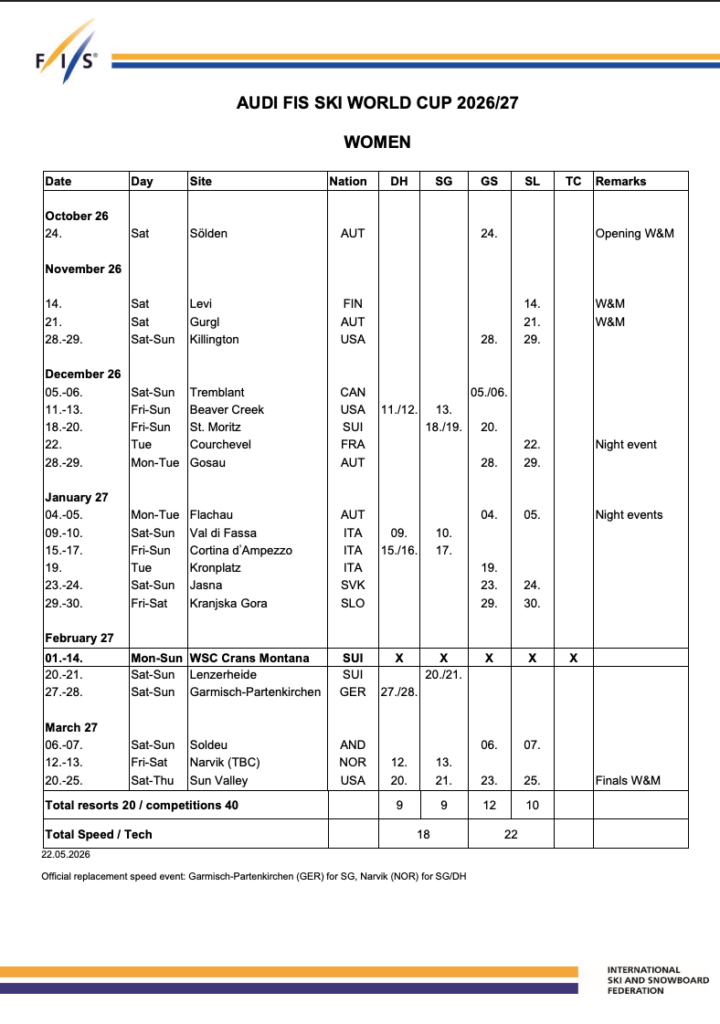
A cornerstone of the calendar’s construction, as articulated by FIS officials, was the deliberate pursuit of a more equitable distribution between speed (Downhill, Super-G) and technical (Giant Slalom, Slalom) events. This strategic balancing act aims to ensure that overall World Cup contenders, regardless of their disciplinary specialization, are presented with a fair and challenging pathway to the sport’s ultimate individual prize. Historically, calendars have sometimes leaned heavier towards one discipline, potentially disadvantaging specialists in others for the overall title. The 2026-27 calendar explicitly addresses this, offering 10 downhills, 10 super-Gs, 10 giant slaloms, and 13 slaloms for the men, and nine downhills, nine super-Gs, 12 giant slaloms, and 10 slaloms for the women. This thoughtful allocation reflects a commitment to a holistic assessment of alpine skiing prowess, rewarding versatility and consistent performance across all facets of the sport.
Crans-Montana: A Return to Alpine Glory
The undisputed centerpiece of the 2026-27 campaign will be the 2027 FIS Alpine World Ski Championships, poised to captivate the global skiing community from February 1-14 in the picturesque Swiss resort of Crans-Montana. This event signifies a triumphant return to the global spotlight for Crans-Montana, which last hosted the World Championships four decades prior, in 1987. Since then, the resort has been a steadfast fixture on the World Cup and European Cup circuits, consistently delivering top-tier racing and demonstrating its capability to host major events.
The 1987 Championships in Crans-Montana are etched into alpine skiing history, having witnessed legendary performances and dramatic contests. The resort’s selection for 2027 underscores its enduring legacy, its modern infrastructure, and its commitment to the sport. Hosting the World Championships midway through the World Cup season introduces a unique dynamic, prompting athletes to shift their focus from the season-long pursuit of Crystal Globe points to the singular ambition of securing world titles. This biennial championship provides a distinct platform for national pride and individual glory, momentarily pausing the continuous World Cup narrative before athletes return to the circuit for the decisive final stretch of the season. For Crans-Montana, it’s not merely a return but a reaffirmation of its status as a premier destination for alpine skiing, promising a spectacle that blends competitive intensity with breathtaking Swiss alpine scenery.

North America’s Enduring Influence
The North American leg of the World Cup circuit continues to exert a significant influence on the early season, offering crucial opportunities for athletes to gain momentum and establish their standings. The continent’s unique conditions, often characterized by colder temperatures and distinct snow types, present an early test for competitors transitioning from summer training.
On the men’s side, Copper Mountain, Colorado, makes a welcome return to the calendar, staging a speed and giant slalom weekend in late November. Known for its extensive training facilities and reliable early-season snow, Copper Mountain provides an ideal setting for athletes to fine-tune their competitive edge. Following this, the circuit moves to Beaver Creek, Colorado, a perennial favorite that will host a comprehensive program including two downhills, a super-G, and a giant slalom. Beaver Creek’s ‘Birds of Prey’ course is legendary for its challenging terrain and high speeds, often producing memorable races that set the tone for the speed season.
For the women, Killington, Vermont, returns to the calendar after a one-year absence, much to the delight of East Coast ski racing fans. Over the Thanksgiving weekend, Killington will once again host its vibrant giant slalom and slalom races, renowned for their enthusiastic crowds and festive atmosphere. Canada’s Tremblant, Quebec, builds on its successful debut by again hosting a giant slalom doubleheader, solidifying its place as a key technical stop. Additionally, Beaver Creek will once more welcome women’s speed racing for a second consecutive season, further diversifying the North American offerings. In total, North America is slated to host six men’s and seven women’s regular-season World Cup races, culminating in the eight Finals races in Sun Valley, Idaho. This strong presence highlights the growing global appeal of alpine skiing and the commitment of FIS to fostering the sport across continents.
New Horizons and Enduring Classics in Europe
The European leg of the 2026-27 calendar expertly blends time-honored traditions with exciting new additions, ensuring a dynamic and geographically diverse season. Several venues will add fresh storylines to the campaign, promising novel challenges and experiences for athletes and fans alike.
For the women’s circuit, Gosau, Austria, is set to make history by hosting World Cup racing for the very first time. This introduction marks a strategic shift, as Gosau will take over the crucial post-Christmas slot, replacing established venues like Lienz and Semmering. This provides an opportunity for a new resort to showcase its capabilities and bring World Cup action to a fresh audience. Furthermore, Jasná, Slovakia, and Garmisch-Partenkirchen, Germany, will make their anticipated returns to the women’s calendar, bringing back venues that have historically delivered thrilling races and passionate support. Jasná, in particular, has developed a reputation for its challenging technical courses and enthusiastic home crowds.
On the men’s side, the iconic Bormio, Italy, will make its return to the World Cup circuit after serving as an Olympic venue during the prestigious Milano-Cortina Winter Games. Bormio’s Stelvio piste is celebrated for its demanding downhill, a true test of courage and skill, and its return ensures that one of the sport’s most revered speed venues remains integral to the calendar. Alongside these exciting developments, fan-favorite classics such as Wengen (Switzerland), Kitzbühel (Austria), Adelboden (Switzerland), Val Gardena (Italy), Alta Badia (Italy), and Schladming (Austria) remain firmly entrenched in the schedule. These venues are more than just race tracks; they are living legends, steeped in history, tradition, and a unique atmosphere that attracts hundreds of thousands of spectators annually. The Hahnenkamm races in Kitzbühel, the Lauberhorn in Wengen, and the Chuenisbärgli in Adelboden are not merely competitions but cultural events that define the alpine skiing season, offering unmatched spectacles of human endurance and precision against stunning backdrops.

The Electrifying Spectacle of Night Racing
Night racing has evolved into one of the most defining and anticipated features of the Alpine World Cup, transforming traditional daytime events into electrifying evening spectacles. Under the glow of floodlights, the atmosphere intensifies, creating an unparalleled fan experience and adding an extra layer of drama to the competition.
On the women’s circuit, Courchevel, France, and Flachau, Austria, will once again host their immensely popular night slaloms. These events have become annual highlights of the technical calendar, known for their vibrant crowd energy and the unique challenge of racing under artificial light. The Flachau night slalom, in particular, often draws capacity crowds, creating a cauldron of noise and excitement that propels the athletes down the course.
The men’s tour also features a strong lineup of evening races, further enhancing the season’s appeal. This includes the highly anticipated 2026 Alta Badia night slalom, a relatively newer tradition that has quickly gained immense popularity. The classic night slaloms in Madonna di Campiglio, Italy, and Schladming, Austria, will also make their triumphant returns. Schladming, in particular, hosts not only a classic night slalom but also the hugely popular night giant slalom, one of the sport’s most iconic events. Known for its packed stadium atmosphere, massive crowds, and often dramatic outcomes, the Schladming night giant slalom is a must-see event, demonstrating the power of alpine skiing to captivate and thrill. These night races not only offer a different visual and atmospheric experience but also provide a unique logistical challenge for athletes, requiring precise vision and adaptability in varying light conditions.
A Balanced Fight for the Crystal Globe: Implications and Strategy
The detailed breakdown of events—10 downhills, 10 super-Gs, 10 giant slaloms, and 13 slaloms for men; and nine downhills, nine super-Gs, 12 giant slaloms, and 10 slaloms for women—is a direct manifestation of FIS’s stated effort to achieve balance. This balance has significant implications for the overall Crystal Globe title race.
Historically, athletes specializing in either speed or technical disciplines could sometimes feel disadvantaged if the calendar skewed too heavily towards the other. The 2026-27 schedule aims to create a level playing field, ensuring that a truly versatile skier, or one who excels consistently in their chosen primary disciplines, has a genuine shot at the overall title. For coaches and athletes, this balanced approach necessitates comprehensive training regimes that cover all four disciplines, even for specialists. It also means that strategic planning for peak performance across the entire season, encompassing both World Cup points and World Championship glory, becomes even more critical. The slight edge in slalom events for both genders acknowledges the high number of participants and intense competition in these fast-paced races. This balanced distribution promotes a more holistic development of alpine talent and ensures that the eventual Crystal Globe winners are truly the most complete skiers of the season.
The Grand Finale: Sun Valley, Idaho
The 2026-27 Audi FIS Alpine World Cup season will culminate in a spectacular fashion at the World Cup Finals in Sun Valley, Idaho, from March 20-25. Sun Valley, a resort steeped in American ski racing history, provides a fitting backdrop for the season’s ultimate showdown. The Finals are unique in that they typically feature only the top athletes in each discipline, leading to highly concentrated and competitive races.
The Crystal Globes, awarded for the overall World Cup title and for each individual discipline (Downhill, Super-G, Giant Slalom, Slalom), represent the pinnacle of season-long excellence. The atmosphere at the Finals is always electric, a blend of celebration for the season’s achievements and intense final battles for those still vying for titles. For Sun Valley, hosting the Finals is a significant honor, highlighting its world-class facilities and its deep connection to the sport. It also provides a valuable platform for promoting alpine skiing in North America, inspiring future generations of athletes and fans. The logistical effort to bring the World Cup circus to Idaho for the grand finale underscores the global reach and ambition of FIS.
Broader Implications and Anticipation
The finalization of the 2026-27 calendar represents months of meticulous planning by FIS, balancing athlete welfare, logistical complexities, commercial interests, and the desire to present the best possible competition. A FIS spokesperson, reflecting on the new calendar, might emphasize the commitment to "providing an optimal competitive environment that challenges athletes across disciplines while engaging fans globally." The inclusion of new venues and the strong presence of North American races also speak to the federation’s efforts to grow the sport’s footprint and diversify its appeal.
For host venues, securing a spot on the World Cup calendar translates into significant economic benefits, boosting local tourism, hospitality, and showcasing their resorts on an international stage. The return of Crans-Montana to the World Championships stage is particularly significant, expected to generate considerable buzz and tourist interest in Switzerland. The constant evolution of the calendar, with strategic additions and returns, demonstrates FIS’s dynamic approach to keeping the sport fresh and exciting.
As the countdown to the 2026-27 season officially begins, the calendar stands as a testament to the sport’s blend of tradition and innovation. It promises a season replete with iconic classics, the excitement of emerging venues, an expanded North American presence, and a World Championship showdown in the historic Crans-Montana. For athletes, teams, national federations, and millions of passionate fans worldwide, the road to ultimate glory, from the opening gates in Sölden to the final Crystal Globes in Sun Valley, is now definitively set. The anticipation for the first turns of the new season is already building, promising another unforgettable chapter in the rich history of alpine ski racing.
Key Dates: 2026-27 Audi FIS Alpine World Cup
- Oct. 24-25: Opening giant slaloms, Sölden, Austria – The traditional high-altitude season opener.
- Nov. 28-29: Men’s speed and GS weekend at Copper Mountain, Colorado / Women’s technical weekend at Killington, Vermont – Kicking off the North American swing.
- Dec. 3-13: Beaver Creek, Colorado, hosts consecutive weekends of men’s and women’s speed and technical races – A crucial early-season test.
- Jan. 15-24: Wengen (SUI), Cortina (ITA), and Kitzbühel (AUT) classics – The heart of the European speed season, featuring legendary races.
- Feb. 1-14: FIS Alpine World Ski Championships, Crans-Montana, Switzerland – The season’s marquee event for world titles.
- March 20-25: Audi FIS Alpine World Cup Finals, Sun Valley, Idaho – The grand finale where Crystal Globes are awarded.
Editor’s Note: The 2026-27 Audi FIS Alpine World Cup calendar was approved at the fall FIS Council Meetings and remains subject to standard operational adjustments throughout the season.

