
Nestled in the Canadian Rockies, Pigeon Mountain, located just off the Trans-Canada Highway near Canmore, Alberta, stands as a silent testament to a ski resort that once promised to be a jewel of the Canadian ski scene but ultimately succumbed to a confluence of challenges, leaving behind a legacy shrouded in mystery. Visible to countless travelers for decades, the mountain’s presence has long ignited curiosity about its development, its operational history, and the reasons for its ultimate demise. The enigma surrounding Pigeon Mountain is compounded by a scarcity of readily available information, with no official trail maps surfacing online from its operational periods, and surviving photographs from its active years being remarkably sparse. This lack of documentation only amplifies the intrigue, transforming Pigeon Mountain from a mere geographical feature into a historical puzzle.
A Brief but Tumultuous Timeline
Pigeon Mountain’s operational history can be divided into two distinct, albeit short-lived, periods. The first chapter began in 1962, with the resort officially opening its slopes to skiers. This initial phase lasted for seven years, concluding in 1969. Following a hiatus of eight years, Pigeon Mountain was resurrected, embarking on its second operational life from 1977 to 1980. This second attempt to establish a thriving ski destination ultimately proved to be its final act. The mountain’s strategic location, with its proximity to Calgary and the renowned Banff National Park, offered immense potential. At its inception, Pigeon Mountain was heralded as the next significant Canadian ski resort, a vision that, unfortunately, never fully materialized.
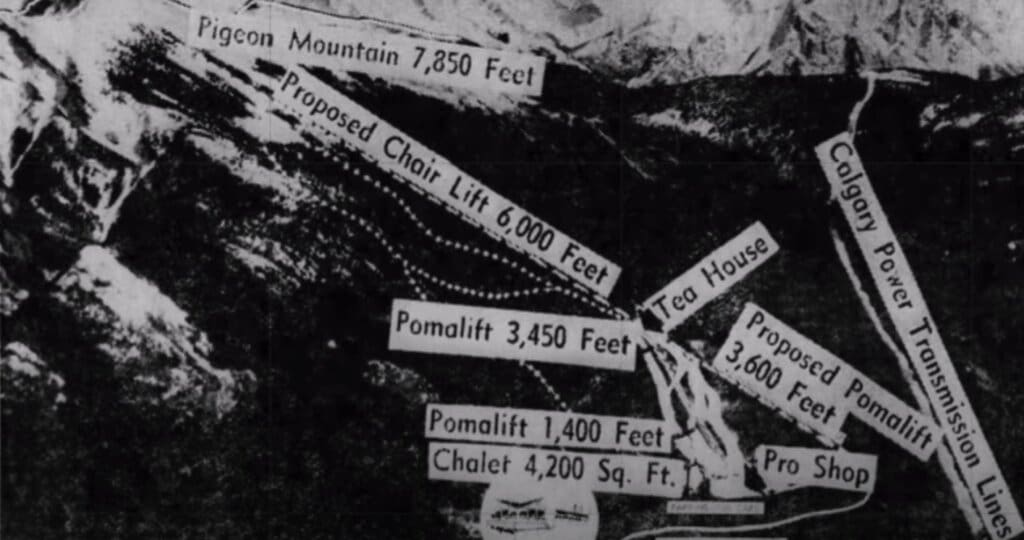
The initial development plans, as glimpsed in a conceptual image created before the resort’s opening, envisioned a comprehensive ski experience. However, the reality that unfolded was far more challenging. The original concept map from 1961, which predates the resort’s operational life, reveals ambitious plans that extended beyond what was ultimately realized. While the lower mountain’s infrastructure was constructed and operated, the full scope of the original vision, which likely included more extensive terrain and amenities, remained largely on paper. This discrepancy between aspiration and execution is a recurring theme in the story of Pigeon Mountain.

The Unforeseen Challenges
The dream of Pigeon Mountain becoming a premier ski destination was systematically eroded by a series of persistent and often insurmountable obstacles. These factors, acting in concert, contributed to the resort’s repeated closures and eventual abandonment.
Insufficient Snowfall
One of the most fundamental requirements for a ski resort is adequate and consistent snowfall. Pigeon Mountain, despite its mountainous location, was plagued by unreliable snow conditions. Its specific microclimate, influenced by prevailing winds and atmospheric patterns, often resulted in insufficient accumulation. This unpredictability made it difficult to guarantee consistent operating days and reliable skiable terrain, a significant deterrent for both potential visitors and investors. Ski resorts in Alberta, particularly those at lower elevations or with specific geographical exposures, are vulnerable to such climatic variations. While Banff and Lake Louise often boast consistent snow, Pigeon Mountain’s specific topography may have placed it in a rain shadow or subjected it to warmer chinook winds more frequently than ideal for sustained snow cover.
Vandalism and Security Concerns
The period of Pigeon Mountain’s operation, particularly its second iteration, coincided with a time when security and remote site management presented greater challenges. Like many abandoned or underutilized recreational facilities, Pigeon Mountain became a target for vandalism. Damage to infrastructure, including lifts and buildings, not only incurred significant repair costs but also posed safety risks. The cost and logistics of adequately securing a remote mountain resort were likely substantial, further straining the resort’s financial viability. Incidents of vandalism can quickly escalate, impacting guest experience and deterring investment.
The Fatal Lift Incident
A particularly tragic event that undoubtedly cast a long shadow over Pigeon Mountain was a fatal lift incident. While details are scarce in publicly available records, the mention of a fatal lift accident during its operational history is a significant factor. Such incidents, while rare in the ski industry, have profound implications. They not only result in the loss of life but also lead to intense scrutiny, potential legal ramifications, and a severe blow to public confidence. Investigations into such accidents are often lengthy and can result in operational shutdowns and costly safety upgrades. The psychological impact on the local community and potential visitors would have been considerable, contributing to a reluctance to patronize the resort. While the exact date and circumstances of this incident are not widely documented, its inclusion in historical accounts of Pigeon Mountain’s demise points to its severe impact.

Inability to Develop Condominiums
The economic model for many successful ski resorts in the late 20th century increasingly relied on the development of associated real estate, particularly condominiums and other forms of accommodation. These developments provided a steady stream of revenue through sales and rentals, offsetting the seasonal nature of the ski business. Reports suggest that Pigeon Mountain faced significant hurdles in developing such residential components. This could have stemmed from a variety of factors, including zoning restrictions, environmental concerns, land ownership issues, or a lack of investor interest in such a project for this particular location. The inability to diversify its revenue streams and create a year-round destination appeal would have severely limited its long-term financial prospects. Without the lucrative ancillary real estate development, Pigeon Mountain was more vulnerable to the fluctuations in its primary revenue source: ski ticket sales.
Economic and Market Factors
Beyond the specific on-site challenges, broader economic and market forces likely played a role in Pigeon Mountain’s struggles. The ski industry is highly competitive, and resorts must continually invest in infrastructure and marketing to remain relevant. The 1970s and early 1980s saw significant investment in established ski areas, and emerging resorts faced stiff competition. Furthermore, economic downturns or shifts in consumer spending habits could have impacted discretionary spending on activities like skiing. The proximity of Pigeon Mountain to established and world-renowned resorts like those in Banff meant it had to offer a compelling and unique proposition to draw visitors. Failing to do so would inevitably lead to a struggle for market share.
The Legacy of Lost Resorts
The story of Pigeon Mountain is emblematic of a broader trend in the history of recreational development. Numerous ski resorts, once filled with the promise of adventure and economic prosperity, have fallen into disuse due to a combination of environmental, economic, and operational challenges. These "lost ski areas" often leave behind intriguing remnants, inviting exploration and speculation. The website nelsap.org, a valuable resource for documenting abandoned ski areas, lists Pigeon Mountain as a site with a complex history. Their archives often contain scant details, mirroring the overall mystery surrounding these forgotten locales. The scarcity of official records from Pigeon Mountain suggests a lack of robust historical archiving by the operating entities, a common issue with smaller or financially struggling enterprises.
The YouTube channel "The Lost Resorts," and specifically the episode dedicated to Pigeon Mountain by user Skier72, has played a crucial role in bringing this story to a wider audience. This video delves into the resort’s brief history, its ambitious expansion plans that never materialized, the multifaceted reasons for its closure, the surviving remnants of its infrastructure, and an analysis of the topography of its former runs. Such content creators are vital in preserving the memory of these lost recreational sites, piecing together fragmented histories through research, on-site exploration, and community input. The analysis of the runs’ topography by Skier72 would offer insights into the intended ski experience, highlighting the potential that was never fully realized.
Broader Implications and Analysis
The narrative of Pigeon Mountain offers several key takeaways for understanding the development and sustainability of recreational tourism, particularly in challenging natural environments.
- The Importance of a Robust Business Model: Pigeon Mountain’s story underscores the necessity of a diversified and resilient business model. Relying solely on seasonal operations, especially in a climate-sensitive industry, is inherently risky. The inability to incorporate year-round attractions or complementary revenue streams, such as real estate development, proved to be a critical vulnerability.
- Environmental Stewardship and Planning: The challenges posed by insufficient snowfall and potentially unfavorable weather patterns highlight the critical importance of thorough environmental and climatic assessments during the planning stages of any large-scale recreational development. While natural factors are unpredictable, understanding a location’s specific vulnerabilities is paramount.
- The Role of Infrastructure and Safety: The fatal lift incident serves as a stark reminder of the paramount importance of stringent safety protocols and well-maintained infrastructure in the tourism and recreation sector. The financial and reputational costs of safety failures can be catastrophic.
- Preservation of Historical Records: The mystery surrounding Pigeon Mountain is partly due to the lack of comprehensive historical documentation. This serves as a broader lesson for all businesses, especially those in the tourism sector, to diligently archive their operational history, marketing materials, and development plans. Such records are invaluable for understanding past successes and failures, informing future endeavors, and preserving cultural heritage.
While Pigeon Mountain may no longer echo with the sounds of skiers carving down its slopes, its silent presence off the Trans-Canada Highway continues to provoke curiosity. It stands as a poignant reminder of ambitious dreams, unforeseen obstacles, and the ephemeral nature of even the most promising ventures in the rugged Canadian landscape. The remnants of its past, however scarce, continue to fuel the imagination and serve as a case study in the complex interplay of ambition, environment, and economics that shapes the legacy of lost places.

