
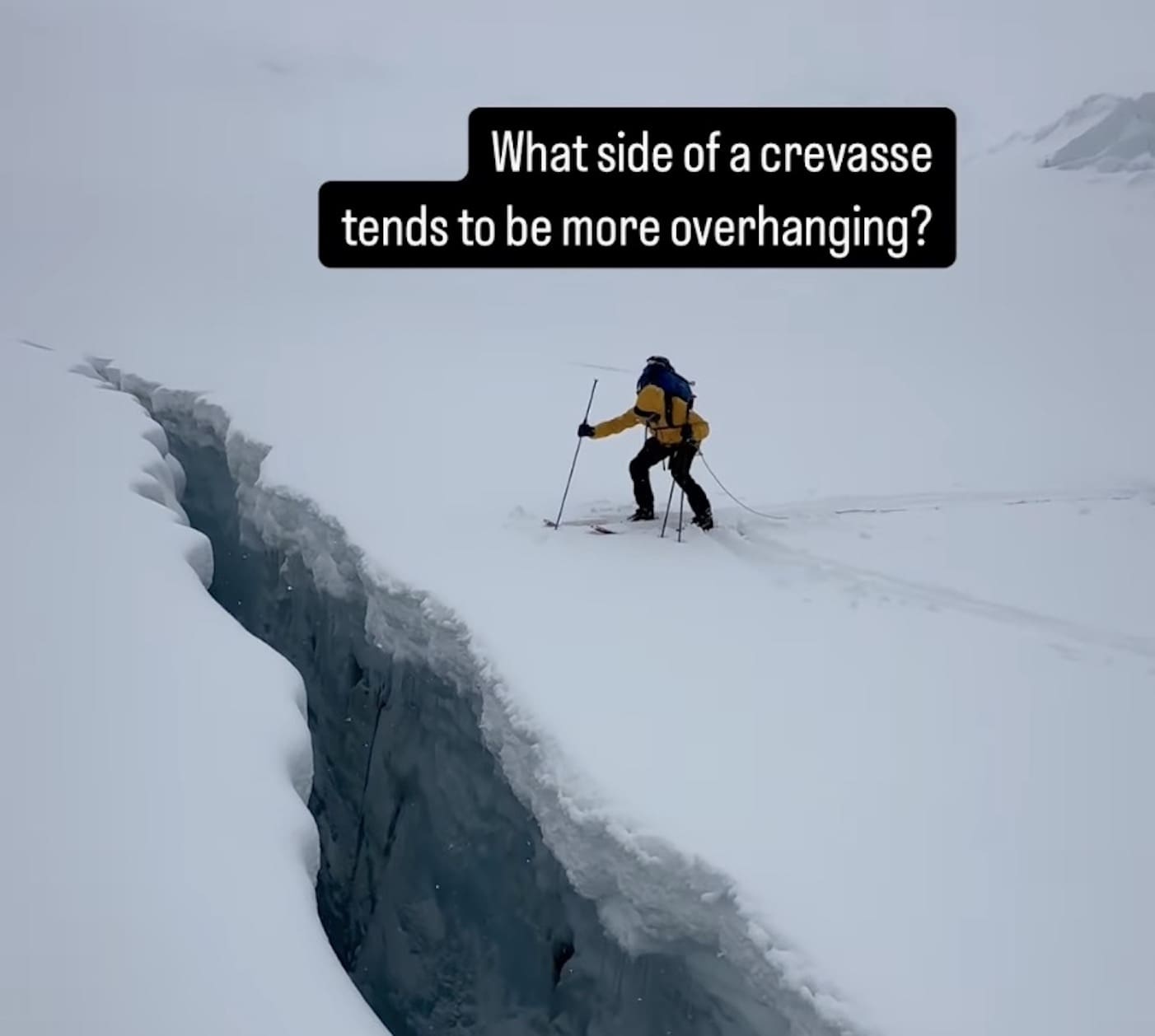
A stark visual demonstration by International Federation of Mountain Guides Associations (IFMGA) certified guide Ben Markhart is underscoring the critical dangers inherent in operating near glacial crevasses. Markhart’s practical, probe-based experiment vividly illustrates how the uphill side of these ice fissures often presents a significantly more overhanging and treacherous profile, emphasizing the absolute necessity for extreme caution and expert knowledge when traversing glaciated terrain. The demonstration, captured and shared to highlight crucial backcountry safety protocols, serves as a potent reminder for all individuals venturing into these environments.
The Visual Imperative: Understanding Crevasse Overhangs
The core of Markhart’s demonstration involves using a probe to test the structural integrity of the snow and ice surrounding a crevasse. By pushing the probe through the snowpack, he reveals the often-deceptive nature of crevasse edges. While crevasses themselves are significant fractures in glacial ice, the snow bridges that can form over them are notoriously unstable. Markhart’s findings consistently show that the uphill side of a crevasse tends to be more prone to significant overhangs, a phenomenon directly related to the glacier’s flow dynamics and the forces at play within the ice.
"Most often the uphill side of the crevasse will be far more overhanging," Markhart explains, underscoring the visual evidence presented. This statement is not merely an observation but a critical piece of actionable intelligence for anyone involved in backcountry travel on glaciers. The uphill side, being the direction from which snow and ice are advancing, can accumulate and form thicker, yet deceptively brittle, snow bridges that extend out over the void below. Conversely, the downhill side might exhibit a more stable, less overhanging profile due to erosion and the way the ice has fractured.
The Science Behind the Danger: Glacial Dynamics and Crevasse Formation
Crevasses are fundamental features of glacial landscapes, forming as a result of immense stresses within the ice. As a glacier flows downhill, different parts of the ice mass move at varying speeds. The surface ice moves faster than the ice at the bed due to friction. This differential movement creates tension, leading to fractures. Where the glacier flows over convexities (like bumps or steep sections), the surface ice is stretched, causing it to crack and form crevasses. Conversely, on concave sections (like dips or flatter areas), the ice is compressed, which can help to close or stabilize existing crevasses.
The specific formation of overhanging edges on the uphill side of a crevasse is a direct consequence of how the ice fractures and how snow accumulates. As the glacier pulls apart, the ice on the upper lip of the crevasse can fracture and then sag downwards, creating an overhang. Snow then accumulates on this sagging ice, and the combination of the hidden overhang and the weight of the snow creates an extremely precarious situation. Probing, as Markhart demonstrates, is a vital technique to assess this hidden danger. It allows individuals to determine the depth and extent of the snow bridge and, crucially, to identify the presence and severity of any overhanging ice.
A Proactive Approach to Glacier Safety Training
Markhart’s demonstration is not an isolated incident but part of a broader commitment to promoting robust backcountry safety. He advocates strongly for hands-on, realistic training, particularly for those intending to ski on glaciers. His philosophy centers on avoidance skills rather than solely on rescue techniques.
"If you want to ski on glaciers I recommend leaning about glacier safety on real glaciers as the margin for error skiing unroped is very small," Markhart states. He emphasizes that while the skills learned in his courses are transferable, they do not replace the experience gained on actual glaciers. This highlights a critical distinction in backcountry education: theoretical knowledge is essential, but practical application in the intended environment is paramount for developing true competence and an intuitive understanding of risk.
Markhart’s glacier safety programs are designed to provide this crucial experiential learning. He offers specialized training that goes beyond basic avalanche safety, delving into the unique hazards of glaciated environments. These programs often involve extended periods on real glaciers, allowing participants to develop a deep understanding of crevasse detection, safe travel techniques, and risk assessment in dynamic ice formations.
The Importance of "Eyes On" and Strategic Positioning
The adage "get eyes on a crevasse lip before you approach" is a cornerstone of safe glacier travel. Markhart reinforces this by explaining his personal approach. While acknowledging that it’s not always feasible to visually confirm every crevasse edge, he stresses the importance of making every effort to do so, especially when approaching from the uphill side. This proactive observation allows for a more informed decision-making process regarding the safest route and where to place anchors or establish a rescue site.
"I’m far more cautious when approaching from the uphill side to try to get eyes on in the first place," Markhart notes. This heightened vigilance on the uphill approach stems directly from the understanding of the overhanging nature of these sections. By prioritizing visual confirmation, backcountry travelers can mitigate the risk of stepping onto an unstable snow bridge that could give way without warning.
Furthermore, Markhart brings up the strategic placement of rescue sites. "I’d also try to place my rescue site on the downhill side as well if possible, even if the skier went in coming from the uphill side," he advises. This logistical consideration is vital. In the event of a fall, having a secure anchor point on the more stable downhill side can be critical for facilitating a rescue operation. It demonstrates a comprehensive approach to safety, considering not just the immediate act of traversing but also the potential for emergency scenarios.
The Transferability and Necessity of Realistic Training
Markhart’s consistent emphasis on learning in a "realistic environment" cannot be overstated. He argues that the subtleties of how real crevasses form and behave are essential for effective rescue. This means understanding the structural integrity of ice, the influence of temperature on snow bridges, and the dynamic nature of glacial movement.
"Until you’ve been in a real crevasse on purpose don’t think you’re ready to go in on accident," Markhart states, conveying the profound difference between theoretical knowledge and practical experience. His "glacier skiing and experience seminar," a five-day program, is highlighted as offering "the best bang for your buck" for learning practical glacier safety. These intensive programs are designed to immerse participants in the environment, providing opportunities to practice essential skills under the guidance of experienced professionals.
The implications of Markhart’s demonstration and his training philosophy extend beyond individual skiers. For organizations that operate in glaciated regions, whether for scientific research, guiding, or expeditionary purposes, the adoption of such safety principles is paramount. A single incident involving a crevasse fall can have devastating consequences, not only for the individuals involved but also for the reputation and operational viability of the organization.

Broader Impact and Implications for the Backcountry Community
The information shared by Ben Markhart has significant implications for the entire backcountry community. As access to remote and challenging environments becomes more democratized through improved gear and information sharing, the responsibility for safety knowledge grows. The visual evidence provided by Markhart’s demonstration can serve as a powerful educational tool, reaching a wider audience than traditional classroom settings.
Supporting Data and Trends:
While specific statistics on crevasse falls can be difficult to aggregate globally, incident reports from mountaineering and guiding organizations consistently highlight crevasses as a significant hazard. For example, in regions like the Alps, Himalayas, and Alaska, crevasse-related accidents remain a leading cause of serious injury and fatality in mountaineering and ski touring. The U.S. National Park Service, for instance, often reports on the dangers of glacial travel in parks like Denali, where crevasses are a constant concern.
Chronology of Awareness:
The understanding of crevasse dangers has evolved over decades. Early mountaineering and exploration often involved significant risks due to a limited understanding of glacial mechanics. The development of specialized equipment, such as ropes, harnesses, and ice axes, along with advancements in crevasse rescue techniques, have improved safety. However, the fundamental dangers posed by the unpredictable nature of glacial ice and snow bridges remain. Markhart’s work represents a continuation of this evolution, focusing on proactive education and a deep understanding of the physical forces at play.
Reactions from Related Parties (Inferred):
While direct statements from other guides or organizations are not provided in the original content, it can be inferred that the wider guiding community would universally support such demonstrations. IFMGA-certified guides operate under a stringent code of ethics and safety standards. Demonstrations like Markhart’s reinforce best practices and contribute to a collective effort to raise awareness and prevent accidents. Emergency rescue services operating in glaciated areas would also likely endorse such efforts, as they directly contribute to reducing the number of incidents they are called upon to respond to.
Analysis of Implications:
The primary implication of Markhart’s work is the critical need for specialized, environment-specific training for anyone venturing onto glaciers. It challenges the notion that general backcountry safety knowledge is sufficient. The demonstration highlights that even experienced individuals can be caught unaware by the subtle but deadly nature of overhanging crevasse edges. This underscores the importance of:
- Continuous Learning: The dynamic nature of glaciers means that conditions can change rapidly, requiring ongoing education and adaptation.
- Risk Mitigation: Emphasizing avoidance strategies, such as careful route planning, probing, and using appropriate travel techniques, is more effective than relying solely on rescue skills.
- Professional Guidance: For those new to glaciated terrain, hiring or learning from certified guides is an invaluable investment in safety.
In conclusion, Ben Markhart’s visual demonstration serves as a powerful and essential educational tool. It underscores the critical, often hidden, dangers of operating near crevasses, particularly the deceptive overhanging nature of their uphill edges. His advocacy for realistic, hands-on training on actual glaciers reinforces the principle that true competence in such environments is built on experience, careful observation, and a profound respect for the forces of nature. This message is vital for ensuring the safety and well-being of all who seek to explore the awe-inspiring, yet perilous, world of glaciers.

