
The snow sports equipment industry has long grappled with a fundamental design paradox: how to engineer a single snowboard that performs with high-precision technical authority across deep powder, hard-packed groomers, and urban park features without forcing the rider to compromise on stability, weight, or cost. For decades, manufacturers have attempted to solve this equation by introducing specialized quivers, requiring enthusiasts to travel with multiple decks tailored to specific snow conditions. However, the modern consumer trend increasingly favors consolidation, driven by rising airline baggage fees, tighter travel restrictions, and the desire for streamlined gear management. Entering this competitive landscape, Rome Snowboards has officially unveiled the Rome Viper, a versatile all-mountain platform designed to bridge the gap between elite-tier flagship performance and everyday rider accessibility. By scaling down the aggressive flex of its top-tier sibling—the Rome Pro—while retaining its advanced geometric foundation, the Viper aims to redefine what snowboarders can expect from a single-deck travel solution.
Background Context and Evolution of All-Mountain Design
The development of the Rome Viper arrives at a critical juncture in winter sports manufacturing. Over the past five years, the snowboard market has experienced a surge in consumer demand for hybrid shapes that defy traditional categorization. Traditional camber profiles offered unmatched edge hold and pop but punished riders in powder and low-speed buttering scenarios. Conversely, early rocker profiles provided exceptional float in untracked snow but lacked the torsional rigidity required for aggressive carving on icy traverses.
Snowboard engineers have spent recent seasons refining hybrid profiles that combine the best attributes of both worlds. Rome’s engineering division specifically focused on addressing the fatigue and technical barriers that everyday riders face when operating stiff, high-performance decks. While elite riders often demand the uncompromising, aggressive response of full carbon reinforcement and rigid flex patterns, the average weekend enthusiast requires a more forgiving interface that absorbs chatter, facilitates effortless turn initiation, and supports creative expression across varied terrain. The Rome Viper was conceptualized to fulfill this specific niche, drawing directly from the research and development pipeline that produced the flagship Pro series, but tailoring the material science to suit a broader demographic of skiers and snowboarders.
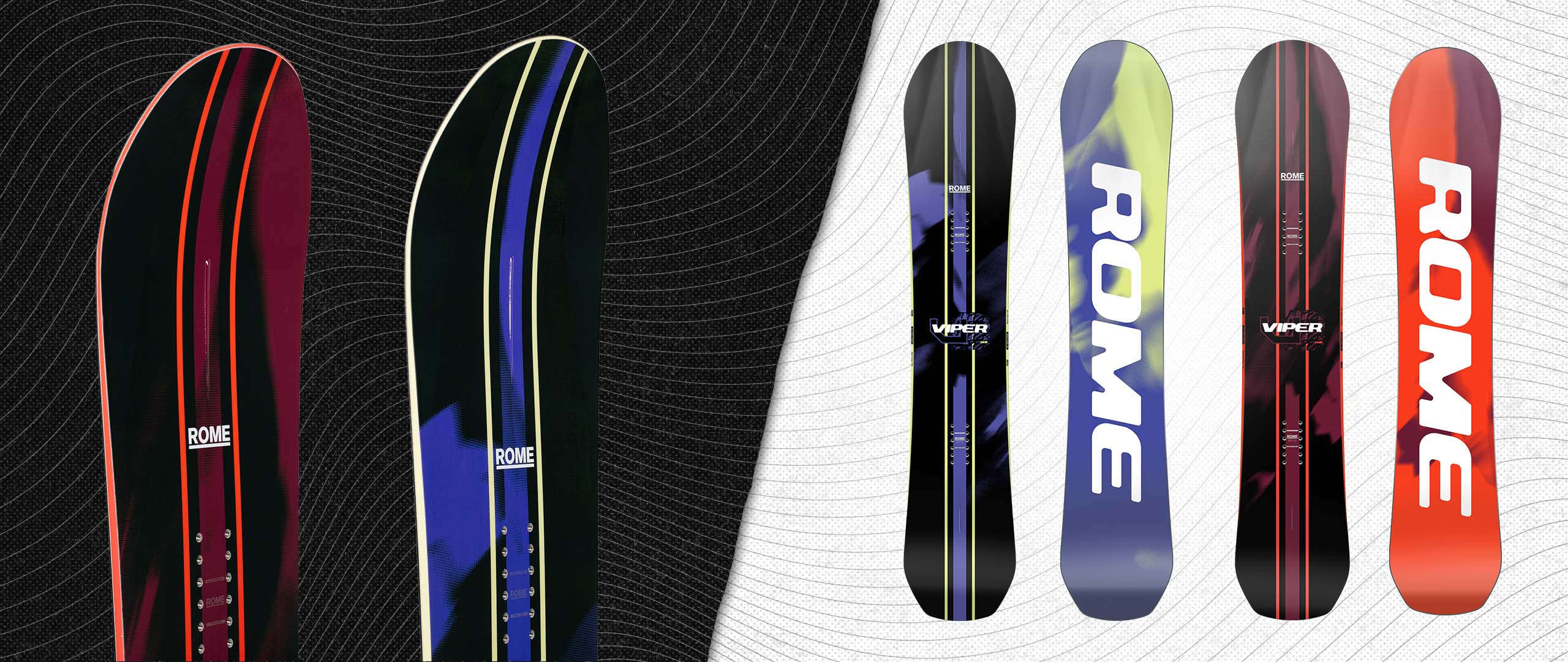
Architectural Breakdown: Shape, Profile, and Sidecut Geometry
At the core of the Rome Viper’s design is a meticulously calculated Directional Twin shape, engineered to provide a slight mechanical advantage in deep snow while maintaining absolute symmetry for switch riding. The nose of the board extends slightly longer than the tail, optimizing surface area for powder floatation, yet the foundational camber profile remains entirely symmetrical. This geometric balance ensures that riders executing rotational tricks, lazy 180s, or switch carving experience zero dead spots or handling discrepancies.
Underneath the rider’s feet lies Rome’s proprietary Fusion Camber profile. This architecture integrates a positive, traditional arc running through the central binding zone, coupled with small pockets of rocker delicately tucked into the contact points at the tip and tail. This hybrid approach yields a dual-nature performance envelope: the cambered center delivers the precision, energy transfer, and edge grip necessary for high-speed carving and icy traverses, while the transition rocker zones introduce a playful playfulness that prevents edge catches and eases buttering mechanics.
Up front, the snowboard features a Directional Diamond 3D nose. This construction utilizes a wide, flat running section that curves gradually in three distinct dimensions. By mimicking the hydrodynamic principles of a surfboard, the 3D nose eliminates the abrupt catching sensation common in traditional flat-nosed boards, allowing the deck to plane effortlessly over deep powder and roll smoothly from edge to edge during turn initiation. At the opposite end, the tail utilizes a Double Kick architecture—a two-part rise that stiffens the rear platform. This structural reinforcement ensures that stomped landings remain secure and stable, eliminating the vague, wishy-washy feedback often associated with softer flex patterns in high-impact scenarios.
To harmonize these elements, Rome implemented its Tri-Radial sidecut technology. By seamlessly blending three separate radii into a single, continuous curve, the sidecut generates a progressive and predictable turn shape. Whether the pilot is executing wide-radius carving turns down an open groomer or making rapid, slashing adjustments in tight tree runs, the sidecut responds with proportional accuracy.
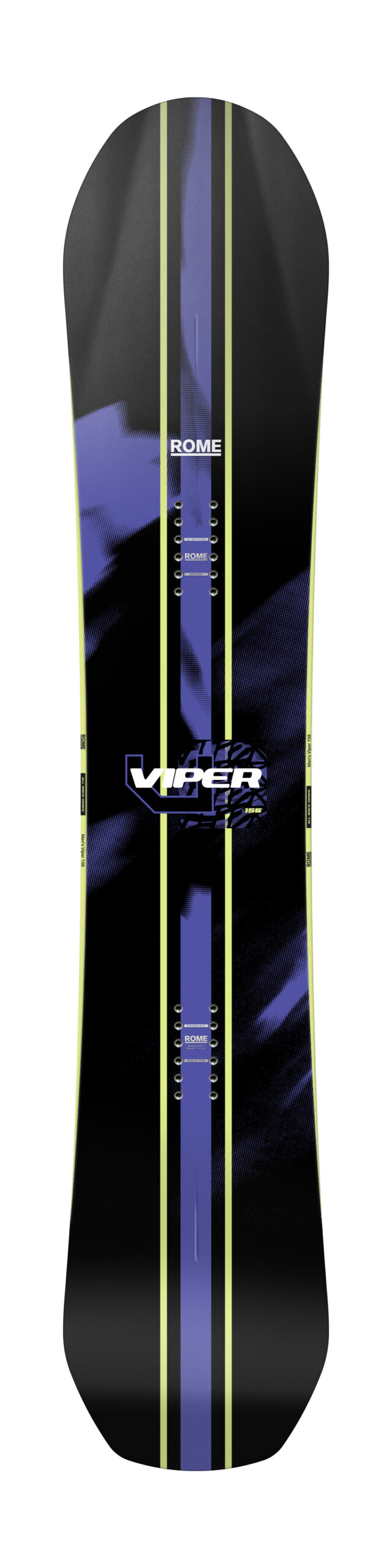
Material Science and Construction: The Bamboo Omega HotRod System
A defining differentiator between the standard Rome Viper and its heavier-hitting Pro counterpart lies in the internal reinforcement framework. While the flagship Pro model relies on full-length carbon HotRods to maximize torsional stiffness and immediate energy transfer, the standard Viper introduces a refined material combination: Bamboo Omega HotRods.
In this configuration, cylindrical bamboo rods are enclosed within specialized carbon sleeves. The sleeve takes on the geometric form of the Greek letter Omega, a structural detail that optimizes the physical properties of both materials. Bamboo inherently possesses a high degree of elasticity and progressive flex, making it exceptionally forgiving for presses, low-speed maneuvers, and dampening vibration. However, when paired with the outer carbon sleeve, the system acquires a rapid, responsive snap. During ollies and dynamic edge transitions, the carbon sleeve accelerates the recovery rate of the bamboo core, delivering explosive pop without imposing the punishing stiffness that can exhaust a rider over a full day on the mountain.
Beneath this internal framework, both the standard Viper and the Pro variant share the SinterStrong base. Engineered as a high-durability, low-maintenance sintered polyethylene option, the SinterStrong base is formulated to retain wax effectively and maintain consistent glide characteristics over extended periods, even when the board misses routine professional tuning and iron maintenance.
Sizing Matrix and Demographic Accessibility
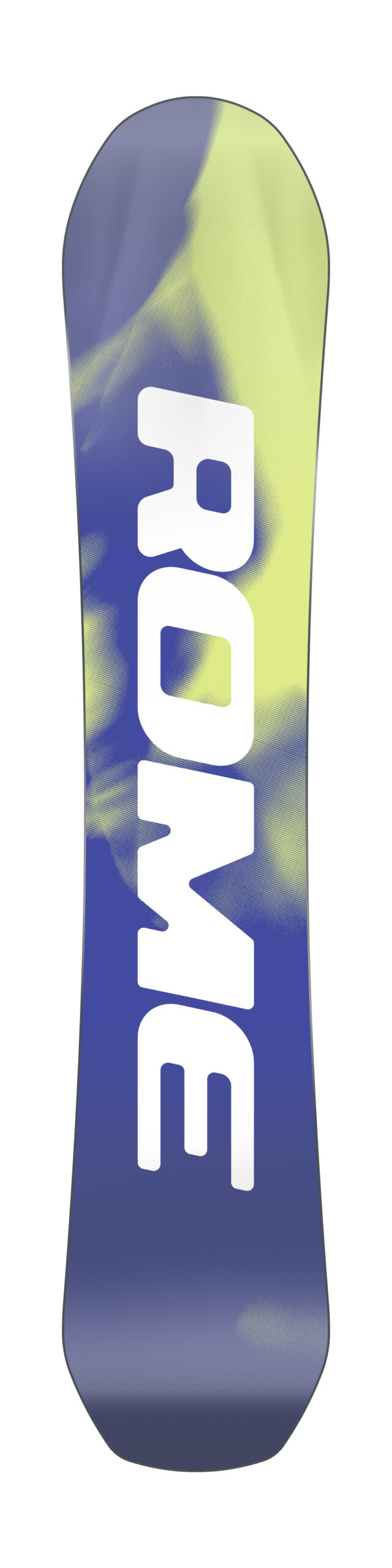
Recognizing the diversity of the modern snowboarding community, Rome has engineered the Viper line to accommodate an exceptionally broad demographic spectrum. The board is manufactured in both dedicated men’s and women’s specific editions, ensuring that ergonomics, stance widths, and flex profiles are optimized for different anatomical builds.
The sizing matrix is remarkably inclusive, starting at a nimble, narrow 142 centimeters for smaller riders and scaling upward to a robust 162-centimeter wide option designed for larger boots and heavier riders. This extensive range reinforces the manufacturer’s positioning of the Viper as a universal travel deck. By offering a comprehensive array of lengths and widths, Rome has effectively mitigated the risk profile for consumers who prefer to travel with a single piece of equipment rather than navigate airline baggage regulations with a specialized quiver.
Field Testing and Professional Evaluation
Rigorous on-mountain testing conducted across varied snow conditions—ranging from wind-scoured hardpack and manicured groomers to untracked backcountry powder bowls—has yielded consistently favorable evaluations from professional testing panels. Testers noted that the board’s mellower flex profile successfully lowers the barrier to entry for intermediate and advanced riders alike, providing a forgiving ride during low-speed maneuvers while retaining a reliable structural backbone when accelerated to higher speeds.
Professional tester Pat Nichols summarized the field performance by highlighting the board’s balanced operational capacity: "Beautiful all-mountain ripper. Great on groomers, lovely in pow. Lots of stability in the tail for landings but still enough torsional flex to have fun and butter around. Good for whatever is in front of ya."

This sentiment underscores the primary engineering achievement of the Viper series: balancing conflicting mechanical demands. Typically, increasing a snowboard’s playfulness compromises its landing stability, while enhancing high-speed carving precision inevitably introduces a harsh, unforgiving ride quality at lower speeds. By utilizing the Bamboo Omega HotRods and the Fusion Camber profile, Rome has navigated this trade-off effectively, delivering a predictable platform across multiple terrain types.
Market Implications and Industry Outlook
The introduction of the Rome Viper carries notable implications for the broader all-mountain snowboard sector. As consumer spending habits face economic scrutiny, recreational gear purchasers increasingly demand multi-functional utility from their investments. Products that require specialized operational conditions or demand steep physical thresholds from their users risk alienation in a crowded retail marketplace.
By positioning the Viper as the accessible, daily-driver alternative to its aggressive flagship predecessor, Rome Snowboards has addressed a clear gap in its product architecture. The board combines advanced aerodynamic and geometric innovations—such as the Directional Diamond 3D nose and Double Kick tail—with a forgiving internal material matrix and a competitive retail price point.
Furthermore, the emphasis on a low-maintenance SinterStrong base and an inclusive sizing strategy ensures that the Viper appeals to both high-frequency season pass holders and occasional vacation travelers. As snow sports enthusiasts continue to prioritize convenience, durability, and cross-condition performance, the Rome Viper establishes a robust benchmark for modern all-mountain engineering, signaling a shift toward inclusive, high-performance versatility in contemporary snowboard design.

