
As the global community accelerates its shift toward renewable energy sources, a parallel and highly sophisticated movement of skepticism and organized opposition has emerged across digital and traditional media landscapes. While the scaling of wind, solar, and electric vehicle (EV) technologies represents a critical pillar of international climate strategy, it has also triggered a surge in narratives designed to instill public fear and legislative hesitation. These narratives—ranging from claims that offshore wind turbines devastate local property values to assertions that solar farms permanently destroy arable land—are increasingly identified by experts as part of a coordinated disinformation campaign. This effort, often funded by interests tied to the fossil fuel industry, seeks to protect the status quo by casting doubt on the reliability, safety, and ecological benefits of clean energy alternatives.
The challenge facing the renewable energy transition is no longer just technological or economic; it is a battle for public perception. Understanding the mechanics of this opposition requires a clear distinction between misinformation and disinformation. Misinformation occurs when individuals share incorrect or misleading information without malicious intent, often due to a lack of specialized knowledge or the influence of social circles. Disinformation, conversely, is the intentional seeding of false narratives by bad actors to distract from systemic solutions, delay policy implementation, or dodge corporate accountability. In the context of climate change, these two forces work in tandem: a strategically placed "dark money" advertisement can spawn thousands of misinformed social media comments, creating a feedback loop that stalls progress at the local, state, and federal levels.
The Historical Context of Energy Narratives
The current landscape of climate disinformation is not a modern phenomenon but the evolution of a strategy that has spanned more than five decades. Internal documents from major oil and gas corporations, uncovered by investigative journalists and academic researchers, reveal that industry scientists were aware of the link between fossil fuel combustion and global warming as early as the 1970s. Despite this internal consensus, several of these entities funded public relations campaigns designed to emphasize scientific uncertainty.
In the 1990s and early 2000s, the focus of these campaigns was primarily on denying the existence of climate change. However, as the physical impacts of a warming planet became undeniable, the strategy shifted. The modern disinformation campaign focuses on "solution skepticism." This involves acknowledging climate change while simultaneously arguing that every proposed solution—be it wind, solar, or electric transport—is too expensive, too unreliable, or more environmentally damaging than the fossil fuels they aim to replace. This shift serves to create a state of "climate paralysis," where the public is convinced that no viable path forward exists.
Chronology of the Modern Anti-Renewable Movement
The intensity of opposition to renewable energy has tracked closely with significant legislative and technological milestones:
- 2015: The adoption of the Paris Agreement catalyzed global investment in renewables, leading to an immediate uptick in digital campaigns questioning the reliability of "intermittent" energy sources.
- 2019-2021: As offshore wind projects were proposed along the U.S. Atlantic coast, a sudden influx of local "grassroots" organizations appeared, many of which were later found to have ties to national conservative think tanks funded by fossil fuel interests.
- 2022: The passage of the Inflation Reduction Act (IRA) in the United States, which provided historic funding for clean energy, triggered a massive surge in disinformation. This period saw the rise of the "wind turbines kill whales" narrative, a claim that federal agencies like the National Oceanic and Atmospheric Administration (NOAA) have repeatedly debunked.
- 2023-2024: The focus expanded to the automotive sector as EV adoption grew. Disinformation targeted the "lifecycle emissions" of batteries, ignoring data that shows EVs are significantly cleaner than internal combustion engines over their operational life.
Analyzing the "Bird and Whale" Narratives
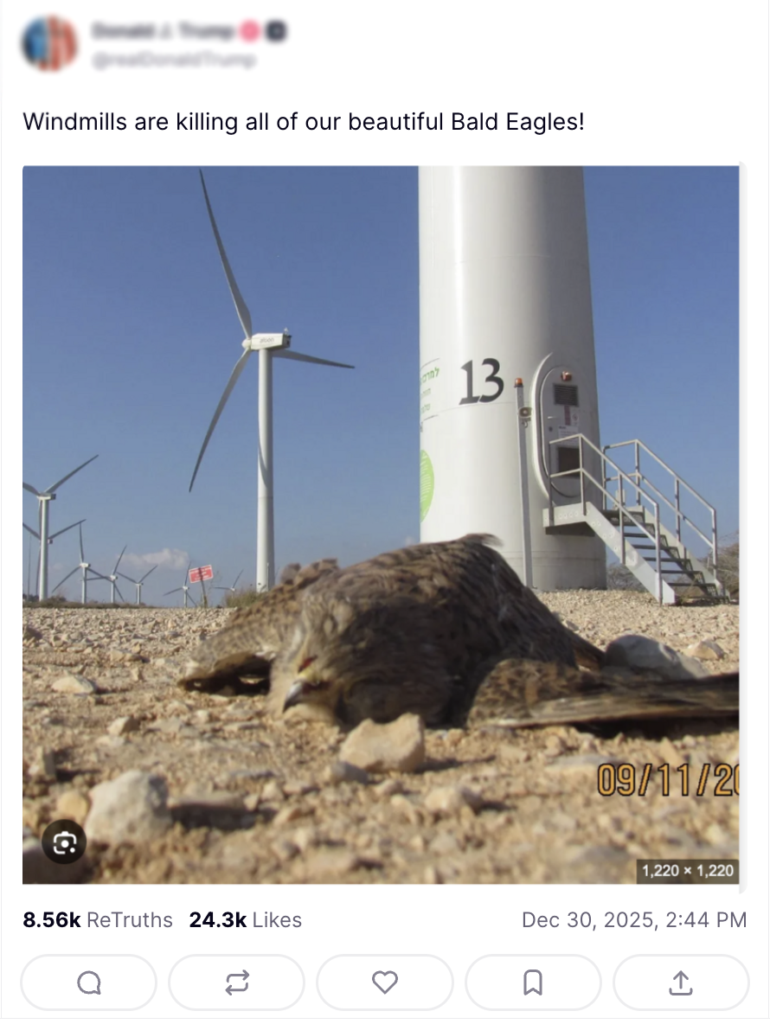
One of the most persistent claims in the anti-renewable arsenal is that wind energy is a primary driver of avian and marine mammal mortality. While it is a fact that birds do collide with wind turbines, the scale of these incidents is often misrepresented to obscure the larger threats. According to the American Bird Conservancy and the U.S. Fish and Wildlife Service, the leading human-caused threats to birds are outdoor cats (responsible for billions of deaths annually) and collisions with building glass (hundreds of millions). In contrast, wind turbines account for a small fraction of one percent of bird deaths.
Furthermore, the National Audubon Society has emphasized that climate change itself is the greatest threat to bird populations, with two-thirds of North American bird species at risk of extinction if global temperatures continue to rise at current rates. By focusing on turbine collisions, disinformation campaigns successfully distract the public from the reality that transitioning to wind energy is, in fact, a conservation imperative for avian life.
Similarly, claims that offshore wind surveys are killing whales have been labeled "baseless" by the scientific community. NOAA and the Bureau of Ocean Energy Management (BOEM) have conducted extensive studies confirming that there is no evidence linking offshore wind activity to recent whale strandings. Instead, these agencies point to vessel strikes, entanglement in fishing gear, and the shifting migration patterns of prey species due to warming oceans as the primary causes of whale mortality.
Lifecycle Data: Electric Vehicles vs. Fossil Fuels
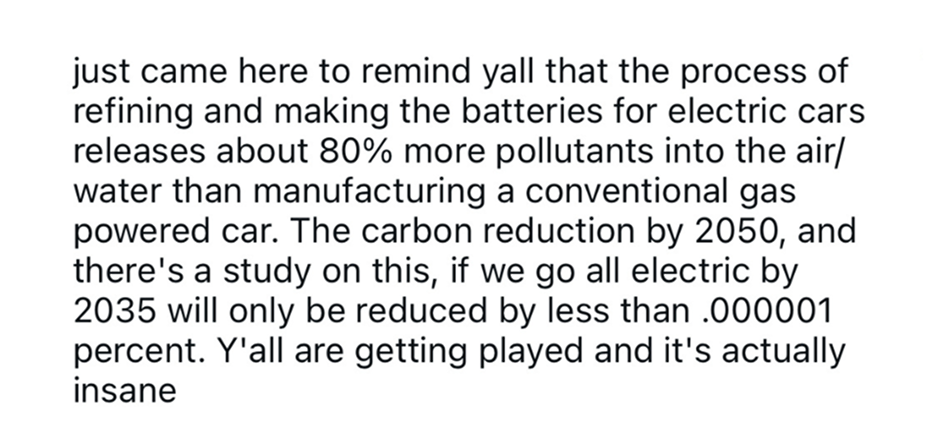
Another cornerstone of contemporary disinformation is the "EV Battery Myth." Critics often argue that the mining of minerals like lithium, cobalt, and nickel makes electric vehicles more carbon-intensive than gasoline-powered cars. To address this, researchers at the Massachusetts Institute of Technology (MIT) conducted a comprehensive lifecycle analysis.
The data reveals a stark contrast: on average, a traditional gasoline-powered vehicle emits more than 350 grams of CO2 per mile driven over its entire lifetime, including manufacturing. Hybrid and plug-in hybrid models average around 260 grams per mile. In contrast, a fully battery-electric vehicle, even when accounting for the carbon-intensive process of mineral extraction and battery production, generates approximately 200 grams of CO2 per mile. As the power grid becomes greener with more renewable inputs, the carbon footprint of EVs continues to decrease, whereas the footprint of gasoline vehicles remains static or increases as harder-to-reach oil reserves are tapped.
The Land Use Debate: Solar Farms and Agriculture
The narrative that solar energy ruins farmland is another strategic "red herring." In reality, solar developers are increasingly utilizing "agrivoltaics," a method where crops are grown or livestock is grazed beneath and between solar panels. Research from Oregon State University suggests that agrivoltaics can actually improve crop yields for certain species by providing shade and reducing water evaporation.
Furthermore, the amount of land required to power the entire United States with solar energy is a small fraction of the land currently dedicated to ethanol production or fossil fuel extraction. According to the Department of Energy, reaching net-zero goals would require roughly 0.5% of the total land area of the contiguous U.S., much of which can be sited on "brownfields" (contaminated former industrial sites) or rooftops, rather than pristine agricultural land.
Official Responses and Expert Analysis
The scientific and policy communities have not remained silent in the face of these campaigns. The Intergovernmental Panel on Climate Change (IPCC) has consistently stated that the rapid deployment of renewables is the only viable path to limiting global warming to 1.5 degrees Celsius. In response to disinformation, many organizations, including Protect Our Winters (POW), have moved toward a model of "pre-bunking"—educating the public on how to spot deceptive tactics before they encounter them.
Experts in media psychology suggest that disinformation works by exploiting "confirmation bias" and "loss aversion." People are naturally inclined to fear the loss of the familiar (gasoline cars, traditional landscapes) and are more likely to believe negative information that supports those fears. To counter this, advocates are encouraged to frame the transition not just as an environmental necessity, but as an economic opportunity. The renewable energy sector now employs more people globally than the fossil fuel industry, and the cost of solar and wind power has plummeted by over 80% in the last decade, making them the cheapest forms of new electricity generation in history.
Implications and the Path Forward
The success or failure of the clean energy transition depends heavily on the ability of the public to discern fact from fiction. If disinformation campaigns succeed in delaying infrastructure projects, the cost will be measured not just in lost economic potential, but in the escalating severity of climate-related disasters, from wildfires to historic flooding.

To become "pillars of truth" for climate progress, citizens are encouraged to:
- Verify Sources: Look for peer-reviewed data and statements from non-partisan scientific bodies like NASA, NOAA, and reputable academic institutions.
- Understand the Motive: Analyze who benefits from the delay of a specific renewable project. Often, the funding for "community opposition" can be traced back to entities with a financial stake in continued fossil fuel consumption.
- Engage Locally: Participate in municipal meetings and zoning boards where renewable projects are discussed. Disinformation often thrives in small, local forums where it can go unchallenged.
- Support Policy: Vote for representatives who prioritize science-based policy and transparency in energy lobbying.
The transition to clean energy is an immense human endeavor, comparable in scale to the industrial revolution. While it is not without challenges or environmental footprints, the data remains undisputed: the impacts of renewable energy infrastructure are a fraction of the damage caused by the continued extraction and combustion of fossil fuels. By stripping away the layers of coordinated disinformation, the reality becomes clear: the path to a stable climate and a prosperous economy is powered by the wind, the sun, and the innovative spirit of a society willing to embrace change.

