
Yellowstone National Park recorded 856,467 recreation visits in August 2026, marking a 3% decline compared to the same month in the previous year, according to official data released by the National Park Service (NPS). The new figures continue a modest downward trend from peak summer visitation records set earlier in the decade, though the park remains one of the most heavily trafficked natural sanctuaries in the United States.
The August 2026 statistics reflect a continuing return toward pre-pandemic and balanced seasonal averages. While popular thermal features like Old Faithful continue to draw thousands of spectators daily, the overall flow of traffic through the park’s multiple gates has seen slight contractions. Park officials and tourism analysts view these numbers as part of a stabilization phase rather than a symptom of waning interest in America’s first national park.
Comparative Monthly Analysis and Historical Context
To understand the scope of the August 2026 figures, it is necessary to examine how they stack against historical benchmarks. The 856,467 recreation visits recorded this past August sit 3% lower than the 881,936 visits logged in August 2025.
Furthermore, the current figures remain notably below the historic high-water mark set in August 2021, when Yellowstone welcomed 921,844 visitors—the busiest August in the park’s storied history. Despite the restrictions and economic shifts of prior years, the immediate post-lockdown travel surge of 2021 established a difficult-to-replicate ceiling for summer tourism.
When evaluating the broader calendar year, cumulative totals show a similar trajectory. Through the end of August 2026, Yellowstone has accumulated a total of 3,491,850 recreation visits. This represents a 2% decrease from the 3,547,967 visits recorded over the same eight-month span in 2025, and a 3% decline from the 3,590,609 visits registered through August 2021.

However, when compared against other recent years, 2026 figures show remarkable consistency. For instance, the park logged 3,494,350 visits through August 2024 and 3,308,924 visits during the corresponding period in 2023. These numbers demonstrate that while peaks from 2021 have not been systematically surpassed, baseline demand for Yellowstone experiences remains robust and predictable.
The 2022 Disruption: A Case Study in Extreme Fluctuation
To put annual fluctuations into perspective, tourism analysts frequently reference the stark anomalies of the 2022 season. Through August of that year, Yellowstone recorded a substantially depressed total of just 2,437,607 visits.
That dramatic drop was not the result of shifting traveler preferences, but rather a catastrophic environmental event. In mid-June 2022, a historic flood battered the region, causing severe infrastructural damage, washing out major roadways, and forcing a total closure of the park from June 13 through June 21. While three northern entrances gradually reopened on June 22, the logistical bottlenecks and localized access restrictions impacted regional tourism for the remainder of the summer season.
The subsequent rebound in 2023 and 2024 highlights the resilience of the local tourism economy and the efficacy of emergency infrastructure repairs executed by the National Park Service and federal transit agencies.
National Park Service Guidance and Resource Protection
In response to sustained high-volume visitation—even amid minor statistical dips—the National Park Service continues to emphasize proactive management, public safety, and resource preservation. Yellowstone spans nearly 2.2 million acres across Wyoming, Montana, and Idaho, encompassing complex ecosystems, fragile geothermal basins, and unpredictable wildlife populations.
The agency has redoubled its efforts to educate incoming travelers regarding responsible outdoor ethics. In its public advisories accompanying the September 15, 2026, data release, the NPS strongly encouraged prospective visitors to plan their itineraries well in advance. Park representatives emphasize that utilizing the official NPS mobile application, reviewing real-time traffic and weather alerts, and adhering strictly to park regulations are essential components of a safe visit.
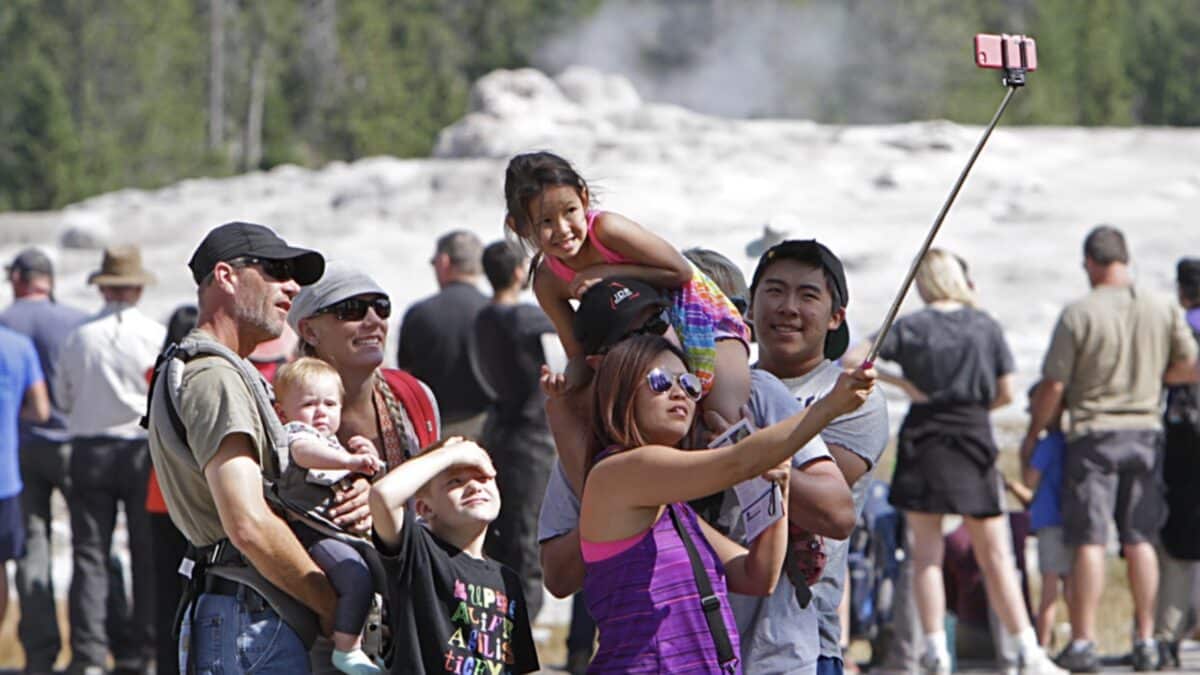
A cornerstone of these educational campaigns is the Yellowstone Pledge. This voluntary initiative asks visitors to commit to safeguarding the park’s natural resources, respecting wildlife viewing distances, minimizing waste, and treating fellow travelers and park staff with courtesy. By promoting these values, park management aims to mitigate the environmental degradation and safety hazards frequently associated with heavy human footprints.
Socioeconomic Implications for Gateway Communities
The minor contraction in Yellowstone’s 2026 summer visitation holds distinct implications for the regional economy. Gateway communities in Wyoming, Montana, and Idaho—such as West Yellowstone, Gardiner, Cody, and Jackson—rely heavily on the influx of summer tourists to sustain local businesses, lodging establishments, guide services, and retail operations.
While a 2% to 3% year-over-year decline in park visits may appear negligible on a macro scale, individual business owners monitor these statistics closely for shifts in consumer spending and length of stay. Tourism experts note that a slight reduction in overall foot traffic can sometimes translate to a more manageable visitor experience, reducing severe traffic congestion on the Grand Loop Road and shortening wait times at key attractions. Conversely, local hospitality sectors continuously balance the benefits of steady, manageable crowds against the revenue peaks associated with record-breaking years.
Future Outlook and Analytical Implications
As Yellowstone transitions from its peak summer months into the cooler shoulder season of autumn, park managers will evaluate the full-year trajectory to adjust staffing, maintenance schedules, and conservation strategies for 2027.
The sustained baseline of approximately 3.5 million visitors through the first eight months of the year confirms that Yellowstone remains a premier bucket-list destination for domestic and international travelers alike. Whether future years will see a return to the historic highs of 2021 or settle into a steady equilibrium near current levels will depend on broader economic factors, currency exchange rates for international tourists, and ongoing investments in park infrastructure.
Comprehensive statistics, historical datasets, and granular breakdowns of visitor demographics remain publicly accessible through the National Park Service Stats website (IRMA), providing researchers, economists, and outdoor recreation analysts with the data necessary to monitor the health and management of America’s public lands.

