
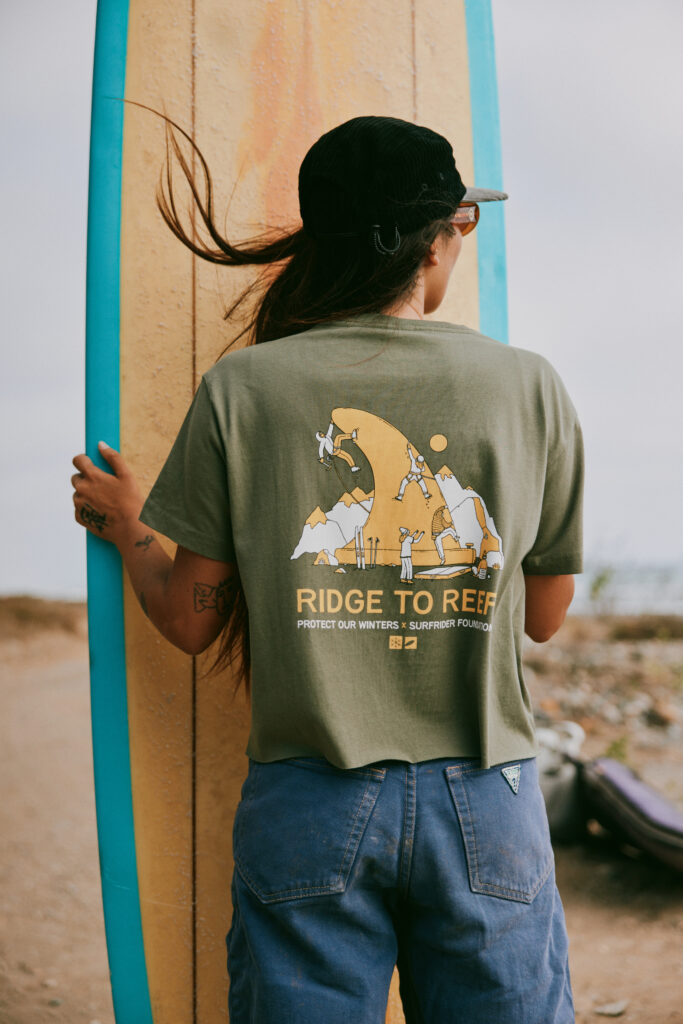
The traditional boundary between alpine environments and coastal ecosystems has long been treated as a geographical formality, yet for the growing collective of outdoor enthusiasts, these landscapes are increasingly viewed as a singular, fragile entity. In a strategic effort to bridge the advocacy gap between these two arenas, Protect Our Winters (POW) and the Surfrider Foundation have launched the "Ridge to Reef" collection. This collaboration features the artwork of Dominic McLeod, a designer whose visual storytelling seeks to mobilize the outdoor community against the accelerating threats of offshore oil and gas extraction and climate-induced habitat degradation.
The Converging Threats to Public Lands and Waters
The collaboration arrives at a critical juncture for environmental policy. As federal and private interests increasingly look toward offshore drilling to meet energy demands, the intersection of marine and terrestrial conservation has never been more relevant. Recent proposals to expand offshore oil and gas leases pose existential threats to coastal integrity, impacting not only marine biodiversity but also the local economies that rely on healthy, accessible environments.
Data from the Bureau of Ocean Energy Management (BOEM) indicates that offshore drilling remains a highly contentious issue, with environmental advocates arguing that the risks of oil spills and habitat disruption outweigh the incremental energy gains. For the outdoor industry—which contributes over $1 trillion to the U.S. economy annually—the degradation of these spaces represents a direct threat to the way of life for millions of Americans who utilize the coastline for recreation and local tourism.
A Chronology of Environmental Advocacy
The historical development of this partnership is rooted in a shared lineage of grassroots activism. The Surfrider Foundation, founded in 1984 by a group of surfers in Malibu, California, was established to protect the coastline from pollution and over-development. Its evolution into a national powerhouse of policy advocacy set a precedent for organizations like Protect Our Winters, founded by professional snowboarder Jeremy Jones in 2007.
Jones, who famously began his environmental journey as a teenage member of the Surfrider Foundation, identified a missing link in the climate conversation: the voice of the outdoor athlete. Since its inception, POW has pivoted from local awareness campaigns to high-level lobbying in Washington, D.C., focusing on systemic climate policy. The "Ridge to Reef" initiative marks a formalization of this long-standing ideological kinship, merging the Surfrider Foundation’s expertise in marine protection with POW’s focus on the "Outdoor State"—a coalition of individuals united by their shared reliance on stable, wild environments.

The Philosophy of Cross-Pollination
At the center of this initiative is Dominic McLeod, an artist whose upbringing in Ojai, California, provided the foundational perspective for the collection. McLeod’s work reflects a "cross-pollination" philosophy, which challenges the siloed nature of outdoor sports. In his view, the modern outdoor enthusiast is no longer a specialist—a climber who only climbs, or a surfer who only surfs—but a participant in a broader, interconnected lifestyle.
"Growing up in Ojai meant the transition from the mountains to the ocean was a daily reality," McLeod noted in a recent interview. "These environments aren’t separate. They are part of the same experience."
This perspective is reflected in the design elements of the Ridge to Reef collection, which intentionally juxtaposes imagery of surf fins, climbing gear, and mountain topography. By blending these symbols, the art aims to dismantle the barriers between disparate outdoor communities, fostering a sense of shared responsibility. This inclusivity is essential for effective climate advocacy, as it invites a broader demographic to engage with complex policy issues without feeling alienated by the perceived rigidity of environmental movements.
Supporting Data and Environmental Implications
The scientific consensus regarding the impact of climate change on these regions is clear. According to the National Oceanic and Atmospheric Administration (NOAA), sea-level rise and ocean acidification are accelerating at rates that threaten both coastal infrastructure and the ecological stability of reef and shoreline environments. Simultaneously, alpine regions are witnessing record-low snowpacks and increased wildfire risk, both of which are direct symptoms of a warming climate.
The economic implications are equally significant. A study conducted by the Outdoor Industry Association found that outdoor recreation supports 4.3 million jobs in the United States. When access to these spaces is restricted by extractive industries or climate damage, the ripple effect on local economies is immediate. The "Ridge to Reef" campaign utilizes the revenue from the collection to fund advocacy efforts aimed at defending public lands and waters against these encroaching threats, effectively turning consumer choice into a tool for legislative pressure.
Official Responses and Organizational Synergy
Representatives from both organizations emphasize that this partnership is as much about cultural shift as it is about fiscal support. By leveraging McLeod’s artistic platform, the groups aim to make environmentalism more accessible to the average outdoor participant.
"You don’t have to be a scientist to contribute to the preservation of these lands," a spokesperson for POW stated during the launch. "You have to be willing to use the skills you possess, whether that is through art, advocacy, or community organization."
This sentiment of "action over apathy" defines the current strategy of both the Surfrider Foundation and POW. Rather than waiting for top-down mandates, the organizations are focusing on mobilizing their combined memberships to demand accountability from policymakers regarding resource extraction. By framing the protection of the environment as a defense of the "Outdoor State," they are attempting to codify a cultural identity that views conservation as an essential component of the outdoor experience.
Broader Impact and Future Outlook
The launch of the Ridge to Reef collection is an indicator of a broader trend within the non-profit sector: the integration of lifestyle brands and artistic collaboration into the core of environmental lobbying. As political measures to extract resources from protected landscapes continue to escalate, the need for a unified, large-scale coalition becomes paramount.
The collaboration serves as a case study for how non-profits can expand their influence by breaking down the walls between different factions of the outdoor world. By creating a visual language that speaks to both the skier and the surfer, the campaign broadens the base of support for critical environmental legislation. The success of this initiative will likely be measured not only by the funds raised for ongoing litigation and lobbying efforts but by the level of engagement seen from younger generations of outdoor enthusiasts who are increasingly seeking ways to align their recreational habits with their political values.
As the organizations move forward, the "Ridge to Reef" model may become the blueprint for future environmental campaigns. By focusing on the intersectionality of climate impact—where the health of the mountain peak is fundamentally tied to the health of the ocean reef—the initiative encourages a holistic view of conservation. This approach acknowledges that the threats faced by the coastline are not isolated incidents but are symptomatic of a broader, systemic challenge that requires a unified, collective response from all who rely on the natural world for their livelihood, recreation, and inspiration.
The collection, now available through the Protect Our Winters online portal, represents a tangible commitment to this cause. With 100% of proceeds directed toward defending public lands and waters, the project functions as a direct mechanism for funding the legal and political battles required to preserve these environments for future generations. Through the lens of art and the framework of collaborative advocacy, the Ridge to Reef initiative underscores a simple but powerful message: the preservation of the wild is not a niche interest, but a shared necessity.

