
On any given winter morning at trailheads across North America—from the rugged slopes of Turnagain Pass in Alaska to the iconic Teton Pass in Wyoming—a familiar ritual unfolds. Before the sun rises, lines of trucks sit idling in the dark. Drivers trade coffee and silence while exhaust fumes dissipate into the sub-freezing air. These individuals are united by a singular pursuit: the search for deep, fresh powder. Yet, there is a profound irony in this scene. The very industry that relies on a stable, cold climate is inherently linked to the carbon emissions that threaten to destabilize it. At 31 degrees Fahrenheit, a mountain offers a pristine day of skiing; at 32 degrees, it delivers rain, sleet, and the degradation of the snowpack. As climate change accelerates, the outdoor community is moving beyond the simple acknowledgement of this paradox, shifting toward an organized, systemic approach to environmental advocacy.

The Evolution of an Environmental Movement
Founded in 2007 by professional snowboarder Jeremy Jones, Protect Our Winters (POW) was established on the premise that the outdoor industry possessed a unique, untapped potential to influence climate policy. Initially focused exclusively on preserving snow-dependent regions, the organization has evolved into a multi-sport, cross-disciplinary force. Over the past two decades, the scope of its mission has expanded to encompass the protection of public lands, the promotion of clean energy, and the defense of democratic processes.
The organization’s growth mirrors a broader shift in the American consciousness. While public concern regarding climate change has historically fluctuated, recent data from the Pew Research Center and the Yale Program on Climate Change Communication indicate a sustained increase in the number of Americans who view a warming planet as a critical issue. This heightened awareness has provided a tailwind for groups like POW, which leverage the cultural capital of athletes, scientists, and outdoor enthusiasts to bridge the gap between abstract scientific data and tangible local action.
The Mechanics of Advocacy and Political Will
The core philosophy behind POW’s current strategy is the concept of "norm shifting." In sociological terms, norms are the unwritten rules that dictate behavior and social acceptance. Just as the adoption of helmets in skiing or the integration of solar panels into residential housing became normalized through sustained advocacy and changing standards, the organization aims to make climate-conscious behavior and policy support the default for the outdoor community.
This is not merely a symbolic endeavor; it is a calculated effort to build political will. Political will is the prerequisite for legislative change, providing the necessary pressure to push renewable energy policies, tax credits, and infrastructure investments through legislative bodies. By mobilizing its community—which includes millions of skiers, climbers, runners, and cyclists—POW translates individual concern into collective political currency.

A Case Study in Grassroots Mobilization
The impact of this approach was clearly demonstrated during the summer of 2026, when the Montana Public Service Commission held hearings regarding resource planning. In a significant display of public engagement, representatives from POW and its allies accounted for nearly one-third of the total attendance. By traveling long distances and physically occupying space in administrative proceedings, these advocates ensured that the outdoor recreation industry—a sector contributing approximately $1.3 trillion to the U.S. economy annually—was represented in discussions that would ultimately determine the state’s energy future.
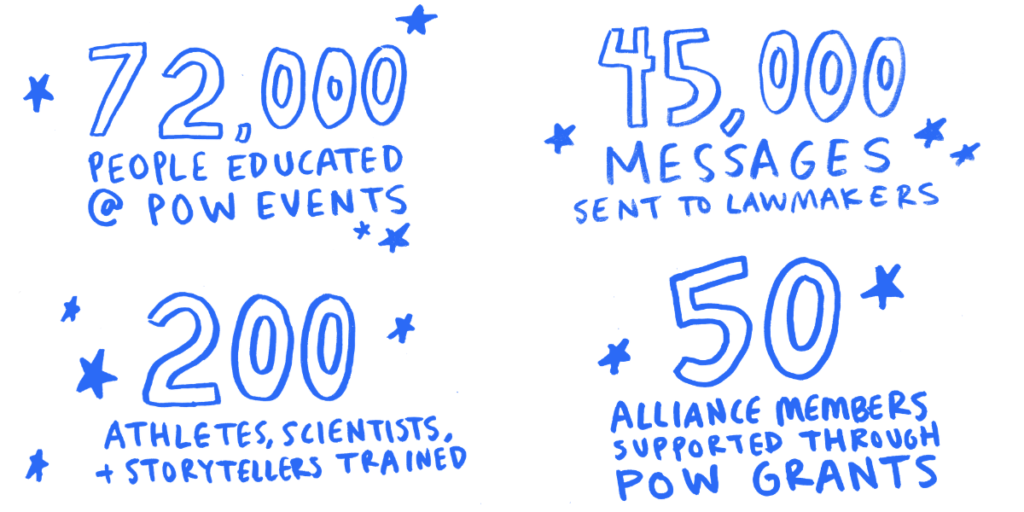
This level of engagement is not an outlier. In the 2026 calendar year, the organization reported that its network of 200 trained athletes, scientists, and storytellers led or participated in approximately 600 distinct climate actions. These initiatives spanned from direct lobbying and educational outreach to large-scale awareness campaigns that garnered millions of impressions across digital and traditional media platforms.

The Three Pillars of Modern Conservation
To achieve its goals, POW structures its operations around three primary pillars: defending public lands, building clean energy capacity, and shifting the power dynamics of who determines energy policy.
Defending Public Lands: The organization works to block fossil fuel expansion on federal lands, arguing that these areas serve as essential carbon sinks and vital habitats. By organizing thousands of petition signatures and coordinating testimony for hearings on regions such as the Arctic National Wildlife Refuge and Bears Ears, POW advocates for the preservation of ecosystems that are currently threatened by extractive industries.

Building Clean Energy: Recognizing that the electricity sector is one of the largest contributors to U.S. carbon emissions, POW has moved from general advocacy to project-specific support. Through community-led efforts in states like Nevada, Colorado, and Montana, the organization has contributed to the realization of 297 megawatts (MW) of new wind, solar, and battery storage capacity. The current stated goal is to reach 500 MW by the end of 2026, with a long-term target of one gigawatt (GW) of capacity by 2028. This transition is essential, given that wind, solar, and battery storage accounted for 93% of all new electricity capacity added in the United States in the previous year.
Shifting Who Decides: The final pillar involves civic participation. Recognizing that the outdoor community has historically been an under-tapped voting bloc, POW has invested heavily in voter registration and mobilization. In the most recent federal election cycle, the group’s outreach reached approximately 7.5 million people. By translating complex legislative issues into accessible language, the organization empowers its supporters to hold elected officials accountable for their environmental records.
The Reality of the Economic Landscape
The urgency of this work is underscored by the economic disparities involved. While the fossil fuel industry maintains an operational budget that dwarfs that of environmental advocacy groups, the outdoor community possesses a different kind of power: social currency. By making the protection of the planet a central tenet of the outdoor identity, the movement forces climate issues into the center of public discourse.
Data supports the efficacy of this strategy. Recent polling indicates that large majorities of the American public support investment in renewable energy and are increasingly concerned about the intersection of climate change and cost-of-living issues. The challenge for organizations like POW is to transform this broad, passive agreement into consistent, active participation in the political process.

Broader Implications for the Future
The implications of this shift are profound. As the outdoor industry matures, it is moving away from the era of individualistic guilt—where the focus was primarily on personal carbon footprints—toward a model of collective, systemic responsibility. The realization that the climate crisis cannot be solved by individual consumer choices alone has led to a focus on structural change.
This does not mean that the individual is irrelevant. Rather, the individual is viewed as a node in a larger network. When an athlete or a local community leader speaks out, they influence the people within their circle, creating a ripple effect that expands the "window of possible action." This is the essence of movement building: the slow, often thankless work of organizing at the local level that eventually creates the political conditions necessary for national, and even international, breakthroughs.

Looking Ahead: The Next Phase of Advocacy
As the world moves toward a potential transition to a carbon-free economy, the outdoor community is positioning itself as a primary stakeholder. Whether through the installation of EV charging stations at trailheads or the advocacy for transmission lines that carry renewable energy to urban centers, the focus remains on building durable, decarbonized systems.
The transition, however, is far from complete. Challenges remain in the form of entrenched interests, slow-moving bureaucracies, and the sheer scale of the required energy infrastructure build-out. Yet, proponents of this model argue that the cost of inaction—measured in lost winters, damaged communities, and degraded natural resources—far outweighs the difficulty of the transition.

In conclusion, the movement led by organizations like Protect Our Winters represents a critical maturation of environmental activism within the outdoor sector. By aligning the passion of those who recreate in the wild with the cold, hard realities of policy and economics, they are attempting to bridge the gap between a warming world and a sustainable future. The success of this endeavor will not be measured by the actions of any single entity, but by the ability of a disparate community to align its interests and influence the systems that govern the planet. For those currently waiting in line at the trailhead, the question of "what comes next" is no longer just a curiosity; it is a call to action. The future of the landscape depends on the ability of its most frequent visitors to advocate for its preservation, turning their love for the mountains into the political will required to keep the winters cold and the planet viable for generations to come.

