
The alpine skies over the Piesendorf area in Salzburg became the scene of a harrowing aviation incident on Saturday, May 25, 2026, when a 44-year-old Austrian paraglider survived a mid-air collision with a small motorized airplane. The incident, which occurred during a period of peak recreational flight activity in the Pinzgau region, resulted in the near-total destruction of the woman’s paraglider wing. Despite the catastrophic failure of her primary flight equipment at an altitude of several thousand feet, the experienced pilot managed to deploy a reserve parachute, a maneuver that ultimately saved her life. Local authorities and aviation experts are now reviewing the circumstances of the encounter, which highlights the ongoing challenges of managing shared airspace in popular mountain tourism destinations.
The collision took place during the afternoon hours when visibility was reported as generally good, though the complex thermals and terrain of the Salzburg Alps often create demanding conditions for both motorized and non-motorized pilots. According to the initial police report released by the Salzburg State Police Directorate, the 44-year-old woman was soaring over the Piesendorf municipality when a small motor plane, piloted by a 28-year-old male, struck her aircraft. The impact was centered on the fabric and suspension lines of the paraglider. Witnesses and investigators noted that the aircraft’s propeller acted as a high-speed cutting tool, instantly shredding the paraglider’s canopy and rendering it incapable of producing lift.
Chronology of the Incident and Emergency Descent
The sequence of events began on Saturday morning as dozens of paragliders took advantage of favorable wind conditions in the Hohe Tauern mountain range. At approximately 2:30 PM, the 44-year-old pilot was established in a flight path over the scenic valley near Piesendorf. Simultaneously, a small motorized aircraft was transitioning through the same sector. Without warning, the two flight paths intersected. The pilot of the motor plane later stated to investigators that the paraglider was not visible in his line of sight until the moment of impact, claiming he was unable to perform an evasive maneuver in time to prevent the collision.
Immediately following the strike, the paraglider entered a violent spiral. Because the primary wing had been severely compromised by the propeller, the woman lost all aerodynamic control. In a matter of seconds, she began a rapid descent that spanned thousands of feet. Drawing on what police described as significant flight experience, the woman successfully executed emergency protocols. She located and threw her reserve parachute—a secondary, round or square-shaped canopy designed specifically for total wing failure. The reserve deployed successfully, arresting the high-velocity spiral and transitioning her into a stabilized, albeit rapid, vertical descent toward the valley floor.
The woman made an emergency landing in a field within the Piesendorf area. While the landing was forceful, the reserve parachute had slowed her descent sufficiently to prevent fatal impact. Local emergency services were alerted immediately by witnesses who had observed the mid-air collision from the ground. A police helicopter was dispatched to the scene, and the woman was subsequently airlifted to a nearby medical facility for evaluation. Remarkably, despite the trauma of the collision and the subsequent freefall, she escaped without life-threatening injuries. The 28-year-old pilot of the motor plane was able to maintain control of his aircraft and landed safely at a nearby airfield; he was also reported to be physically unharmed.
Technical Analysis of Reserve Parachute Systems
The survival of the pilot in this incident is a testament to the rigorous safety standards and training protocols within the European paragliding community. A reserve parachute, often referred to as a "rescue," is a mandatory piece of equipment for paragliders in Austria. These systems are designed to be deployed manually by pulling a handle located on the pilot’s harness. Once the handle is pulled, the pilot must throw the deployment bag into "clean air," away from the tangled remains of the primary wing.
In a mid-air collision involving a motorized propeller, the primary wing often becomes a "streamer"—a tangled mess of fabric and Kevlar lines that can wrap around the pilot or the reserve deployment bag. The fact that the 44-year-old woman was able to clear her reserve in a "spiraling out of control" scenario suggests a high level of composure and technical proficiency. Modern reserve parachutes are designed to open within 60 to 100 feet of vertical drop, but their effectiveness depends heavily on the altitude at which they are deployed. In this instance, the thousands of feet of altitude available provided the necessary "safety window" for the canopy to inflate fully before she reached the ground.
Aviation Safety Regulations and Shared Airspace
The Piesendorf incident has reignited discussions regarding Visual Flight Rules (VFR) and the "see and avoid" principle that governs shared airspace in the Alps. Under Austrian aviation law, as overseen by Austro Control, different classes of aircraft must adhere to specific right-of-way rules. Generally, non-motorized aircraft such as paragliders and gliders have the right of way over motorized aircraft, as they are less maneuverable and have limited ability to change altitude quickly.
However, the "see and avoid" principle remains the primary defense against mid-air collisions. In the mountainous terrain of Salzburg, small planes often navigate narrow valleys where paragliders may be circling in thermals near ridges. Paragliders present a small visual profile, often blending into the background of the mountain rock or forest, making them difficult for motorized pilots to spot from a distance, especially at high closing speeds.
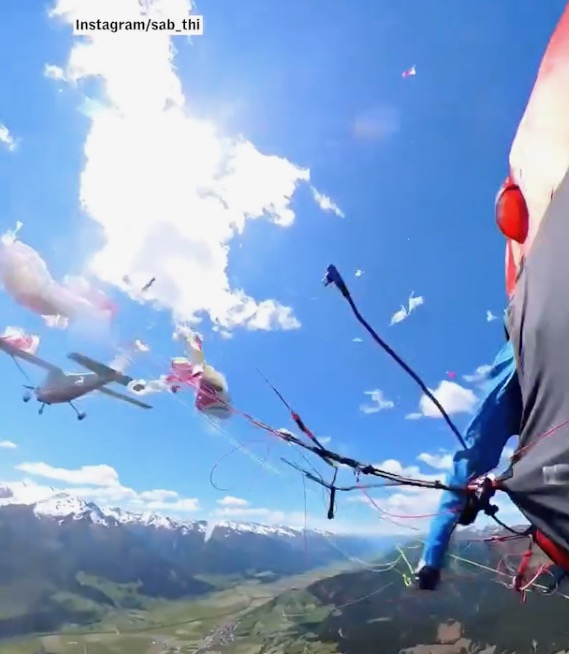
The 28-year-old pilot’s assertion that he was "unable to avoid the collision" will be a central point of the investigation. Investigators will look at the sun’s position, the color of the paraglider wing, and the specific flight paths of both parties to determine if there was a breach of safety protocols or if the incident was an unavoidable "blind spot" occurrence.
Statistical Context and Regional Safety Data
While dramatic, mid-air collisions between paragliders and motorized aircraft are statistically rare in Austria, despite the high density of both types of traffic. According to data from the Austrian Alpine Club and aviation safety boards, the majority of paragliding accidents are attributed to pilot error during takeoff or landing, or misjudging weather conditions (such as turbulence or "lee" side rotors).
Salzburg and the neighboring Tyrol region see hundreds of thousands of paragliding launches annually. In 2023, Austrian mountain rescue services reported a slight increase in paragliding-related interventions, but these were largely due to "tree landings" or minor injuries sustained in rugged terrain. A collision with a motorized aircraft represents an extreme outlier in alpine aviation statistics. For context, there are approximately 15,000 licensed paragliders in Austria, and the country hosts several international competitions where airspace is strictly segregated. The Piesendorf event occurred in "Class G" (uncontrolled) airspace, where the responsibility for separation lies entirely with the individual pilots.
Official Responses and Investigative Procedures
The Salzburg State Police, in coordination with the Federal Safety Investigation Board (BEV), have launched a formal inquiry into the incident. The primary goal of the investigation is to determine whether criminal negligence was a factor. In Austria, aviation accidents involving personal injury or significant property damage are subject to rigorous forensic analysis.
"The propeller of the motor plane severely damaged the paraglider, prompting the experienced paraglider to deploy her reserve parachute," a police spokesperson confirmed in a Sunday morning briefing. The spokesperson emphasized that the investigation would include a review of the GPS flight logs from both the paraglider’s variometer and the airplane’s avionics system. These logs will provide a precise reconstruction of the altitudes, speeds, and headings of both aircraft in the minutes leading up to the impact.
Statements from the local paragliding community have praised the woman’s quick thinking. Many local instructors pointed out that this incident serves as a vital reminder for pilots to undergo regular SIV (Simulierung d’Incidents en Vol) training, where pilots intentionally induce collapses and practice reserve deployments over water to prepare for real-world emergencies.
Broader Impact on Alpine Adventure Sports
The survival of the pilot is being hailed as a remarkable outcome of a potentially fatal situation, but the incident may have long-term implications for how recreational flight is managed in the Salzburg region. There is growing pressure from some local municipalities to implement "electronic conspicuity" requirements for all users of the airspace. This would involve paragliders carrying small, lightweight transponders (such as FLARM or ADS-B Out devices) that would alert motorized pilots to their presence via cockpit displays.
Currently, while many sailplane (glider) pilots use FLARM, it is not mandatory for paragliders. The Piesendorf collision may accelerate the adoption of these technologies within the free-flying community to prevent similar close-quarters encounters. Furthermore, local flight schools may revise their "safety briefings" for visiting pilots to include specific high-risk zones where motorized traffic is known to be frequent.
As the investigation continues, the focus remains on the miraculous nature of the 44-year-old’s survival. The combination of high-quality safety equipment, rigorous training, and a measure of fortune allowed what could have been a tragedy to end as a successful emergency rescue. The woman’s recovery is expected to be full, and the pilot of the motor plane continues to cooperate with authorities as they seek to ensure the continued safety of the Salzburg skies.
For the international paragliding community, the video of the incident—which has since circulated on social media platforms and news outlets like NBC—serves as a sobering educational tool. It highlights the speed at which a routine flight can turn into a life-threatening emergency and underscores the critical importance of the reserve parachute as the final line of defense in aviation safety. Piesendorf remains a premier destination for mountain sports, but for the foreseeable future, the conversation in its landing zones will likely center on the day a paraglider fell from the sky and lived to tell the tale.

