
The snow-capped peaks of Scandinavia recently played host to a paradigm-shifting gathering in the world of action sports as the international snowboarding community converged for the latest iteration of Days of Thunder. Conceived through a collaborative partnership between the legendary American-based Snowboy Productions and Swedish professional snowboarder PJ Gustafsson, the event successfully challenged the conventional, contest-driven architecture of modern competitive snowboarding. Eschewing the high-pressure environment of timers, scoring rubrics, and panel judges, Days of Thunder introduced an ethos rooted entirely in communal progression, creative expression, and shared camaraderie.
Staged at a brand-new, purpose-built location on Swedish soil, the international assembly brought together a diverse cross-section of global talent, ranging from decorated X-Games veterans and national team members to underground icons and multi-disciplinary artists. For four grueling days prior to the public-facing sessions, expert park builders labored under blistering spring sunshine to construct a topography of features unlike anything previously witnessed in the region. The resulting installation featured entirely novel obstacles designed to force riders away from formulaic contest routines and back toward pure, unadulterated board control.
By eliminating the restrictive parameters that dictate traditional snowboarding competitions, the organizers cultivated an atmosphere where athletes from disparate backgrounds could collaborate without the underlying anxiety of placement or elimination. The event’s core philosophy—championing freedom of movement, artistic interpretation, and mutual encouragement—offered a stark contrast to the hyper-commercialized circuit that currently dominates much of the professional snow sports landscape.
The Genesis and Evolution of a Grassroots Movement
To understand the cultural significance of Days of Thunder, one must examine the trajectory of modern snowboarding event production. Over the past three decades, the sport has experienced a steady institutionalization, largely driven by its integration into the Winter Olympic Games and major commercial circuits. While this mainstream integration has elevated the global profile of snowboarding, it has concurrently narrowed the scope of what is celebrated on snow. Modern contests increasingly favor mathematically optimized spin-to-win maneuvers executed on standardized mega-ramps, often at the expense of style, individuality, and terrain exploration.
Recognizing a growing yearning for authentic expression among core participants, Snowboy Productions established a reputation for curating rider-centric environments that prioritize imaginative course design. By partnering with PJ Gustafsson—a fixture of the Scandinavian snowboard scene known for his uncompromising dedication to classic style—the organizers sought to transplant this philosophy into European territory. The inaugural Swedish installment in April established a foundational template, but the subsequent iteration elevated the concept further by relocating to a superior site capable of accommodating more ambitious architectural concepts.
The operational blueprint of Days of Thunder deliberately dismantles traditional contest logistics. There is no registration fee, no prize purse tied to podium placements, and no media scrum demanding soundbites immediately following a run. Instead, the focus shifts entirely to multi-hour, daily film and photo sessions. This production-driven format ensures that the legacy of the gathering is captured through high-grade cinematic documentation rather than fleeting leaderboard standings.
Chronology of the Gathering: From Construction to Climax
The timeline of the event was defined by meticulous preparation, intense physical exertion, and an organic escalation of riding difficulty that culminated in a historic finale.
Phase one began nearly a week before the arrival of the invited guests. A dedicated crew of terrain park architects mobilized at the new Swedish venue, spending four consecutive days shaping dense spring snow into complex, sculptural features. Unlike standard terrain parks built for repetitive laps, this installation incorporated experimental geometry, custom transitions, and distinct structural art pieces designed to test the spatial awareness and adaptability of even the most experienced professionals.
Phase two commenced with the arrival of the invited roster. Hailing from all corners of Scandinavia, the United States, Canada, and Bulgaria, the participants dropped into the venue to test the terrain. The initial 72 hours were characterized by exploratory sessions, with athletes mapping out creative lines and adjusting to the unique physical demands of the novel features. These sessions spanned five hours daily, providing ample time for riders to session specific zones without the artificial urgency of a dropped start gate.
Phase three unfolded over the final weekend, marked by optimal weather windows, stable snow conditions, and an escalating atmosphere of collective inspiration. Observers noted an absence of competitive friction; instead, the collective energy manifested in shared momentum, where one rider’s creative line directly influenced the approach of the next.
Architectural Innovation and Standout Performances
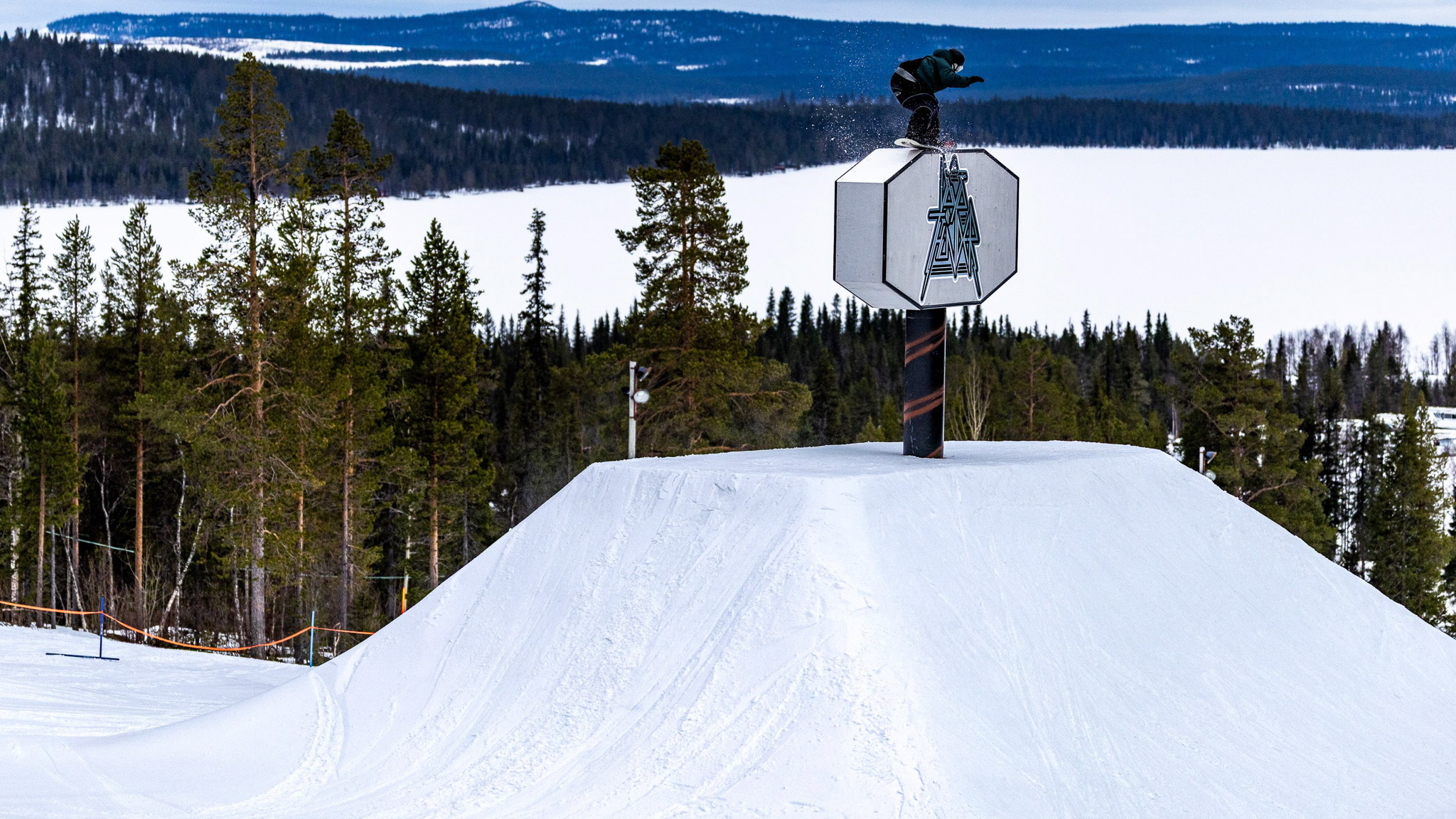
The design of the snow park served as the primary catalyst for the weekend’s breakthrough moments. Among the architectural centerpieces was a massive structural installation affectionately dubbed "Thor’s Hammer," which quickly became the focal point for the most progressive riding of the weekend.
Throughout the multi-day sessions, individual performances highlighted the breadth of talent present. Ruben Rosenfors consistently captivated onlookers with powerful, textbook Method airs executed with classical amplitude in the immediate shadow of the Hammer. Meanwhile, Zenja Potapov utilized his distinct spatial awareness to weave intricate, highly creative lines through the lower sections of the course. The dynamic duo of Kevin Rahko and Nigo Omma Simma utilized the left hip feature to launch massive straight airs and technical 360-degree rotations, demonstrating total mastery of speed management and air awareness.
The communal spirit was further embodied by sibling duo Blanca and Frej Linnes, whose synchronized, fluid descents through the park showcased a rare level of familial and technical harmony. However, the narrative of the weekend ultimately belonged to Finnish upstart Leo Haappalainen.
Haappalainen displayed a progressive trajectory of commitment throughout the event, stepping up the scale and technical difficulty of his tricks with each successive lap. During the final fifteen minutes of the closing session on the final day, Haappalainen elected to attempt a maneuver that had previously been deemed unapproachable by the rest of the roster: riding the top architectural tier of Thor’s Hammer.
Transitioning from initial disbelief to execution, Haappalainen initiated an immaculate 50-50 slide across the apex of the structure before launching a clean Frontflip off the vertical drop within the waning moments of the session. The execution served as a punctuation mark for the gathering, encapsulating the unscripted potential that arises when elite athletes are given the autonomy to push their boundaries safely outside the confines of a scorecard.
Industry Implications and the Future of Alternative Events
The success of Days of Thunder carries notable implications for the broader action sports industry. As traditional competition formats face growing critiques regarding creative stagnation and participant burnout, alternative gatherings point toward a viable, sustainable blueprint for the future.
Industry analysts suggest that events prioritizing shared media production and community over corporate ranking systems resonate more deeply with contemporary audiences, particularly younger demographics who value authenticity and self-expression over algorithmic metrics. By fostering an environment where national team members, stunt professionals like those from the Finnish television circuit, and underground legends share the exact same takeoff, the event effectively flattened social hierarchies within the sport.
Furthermore, the logistical model demonstrated that high-level snowboarding does not require massive stadium infrastructure or extensive broadcast delays to generate significant cultural impact. By channeling resources directly into superior park design and professional media capture, organizers produced high-value content that transcends traditional sports broadcasting.
As the international snowboarding community digests the visual archives and cinematic recaps emerging from Sweden, the blueprint established by Snowboy Productions and PJ Gustafsson is expected to influence upcoming programming across the global winter sports calendar. By proving that progression and pleasure are not mutually exclusive, Days of Thunder has reinforced an essential truth: when the rules are stripped away, the purest form of the sport naturally rises to the surface.

