
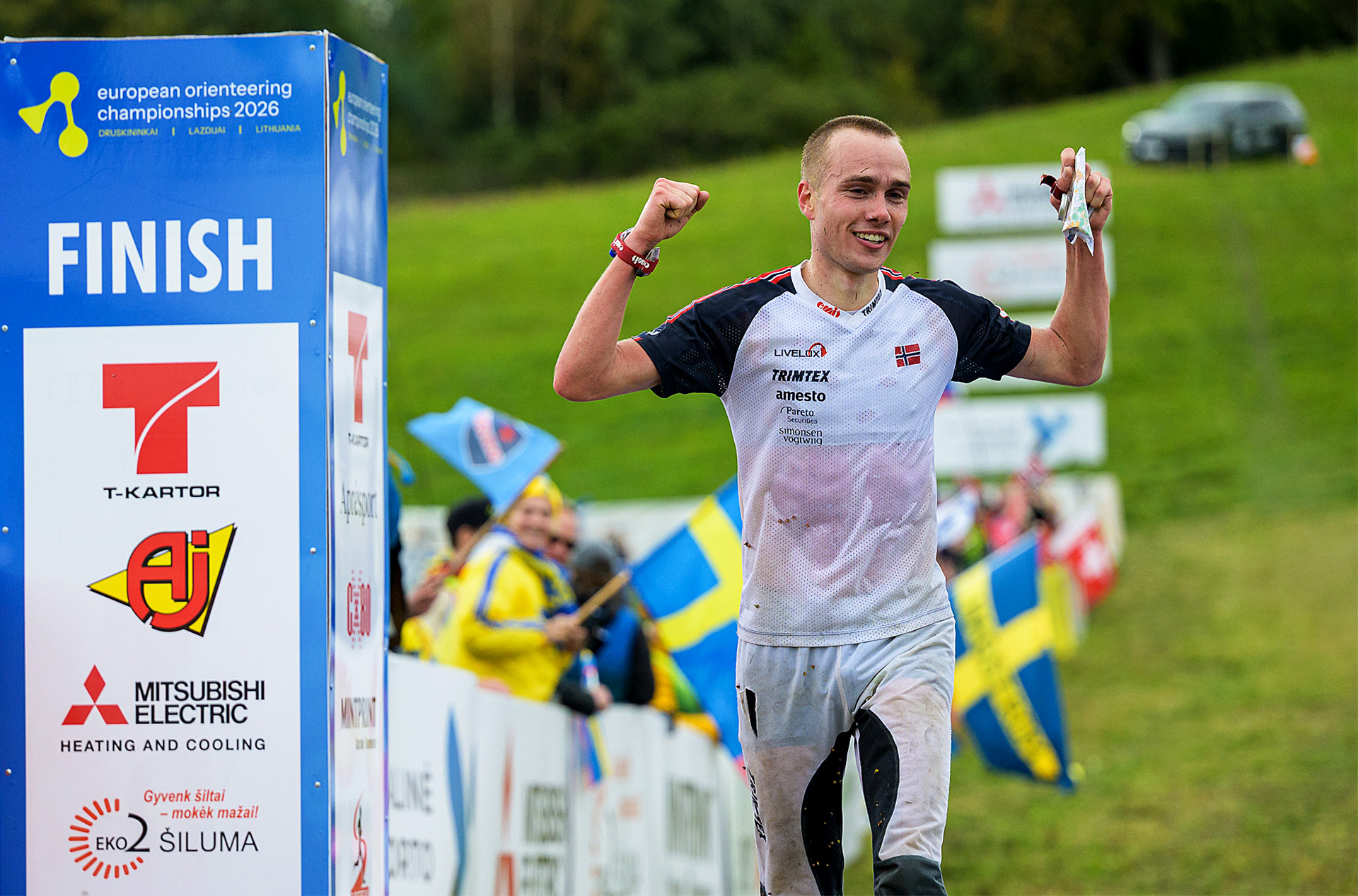
The European Orienteering Championships in the forests outside Druskininkai, Lithuania, have witnessed a masterclass in navigational precision and physical endurance, headlined by Norway’s Kasper Fosser. Fosser, widely regarded as one of the most formidable talents in the sport, secured his second gold medal in three days, emphatically capturing the middle-distance title. This victory marks a significant milestone in his career, as it is the first time he has reached the top of the podium in the middle-distance discipline at a major championship, having previously only achieved similar success at the World Games.
The 6.5-kilometer course proved to be a formidable test for the world’s elite orienteers. Fosser navigated the challenging, verdant terrain with a precision that left his competitors trailing by a significant margin. His winning time of 33 minutes was the only performance to meet the course setter’s projected benchmark, effectively placing him in a class of his own.
A Masterclass in Navigational Strategy
Fosser’s performance was characterized by clinical efficiency. He successfully tracked down the silver medalist from Thursday’s long-distance event, Switzerland’s Fabian Aebersold, while maintaining a clean sheet in terms of navigation errors. By the time he crossed the finish line, he had established a commanding lead of over 90 seconds ahead of the silver medalist, Sweden’s Anton Johansson.
Reflecting on his triumph, Fosser noted the discrepancy between his expectations and the reality of the Lithuanian terrain. "It was an extremely successful day. I knew the potential was there, but the terrain was not exactly as I had anticipated," Fosser stated. "The priority was navigating through the dense green zones and identifying the most efficient routes. Winning the middle distance at a championship, rather than just the World Games, is a major career highlight. I feel I have returned to the high-performance levels of 2021, and I take great pride in that consistency."
Shifting Fortunes and Statistical Context
The middle-distance event in Druskininkai served as a reality check for some of the sport’s established names. Eirik Langedal Breivik, who claimed the World Championship silver behind Fosser last year and had previously secured European Championship gold, struggled to replicate his past dominance. Breivik finished in 20th place, failing to secure a third consecutive major title in the middle-distance category.
The broader Norwegian contingent showed signs of both promise and inconsistency. While Lukas Liland delivered a commendable performance to finish in 7th place, the remainder of the Norwegian men’s team finished outside the top 20. This indicates a continuing gap in performance depth within the national squad, an issue that will likely be the focus of coaching staff as they look toward future international cycles.
The Women’s Final: An Unpredictable Turn of Events
The women’s race provided perhaps the most dramatic narrative of the championships. The pre-race favorites, Sweden’s Tove Alexandersson and Switzerland’s Simona Aebersold, effectively removed themselves from contention for the gold medal after encountering significant navigational errors at the sixth control point.
In their absence, Norway’s Pia Young Vik seized the opportunity. Starting early in the field, she set a pace that placed immense pressure on the remaining competitors. Her finishing kick was decisive, forcing her rivals to chase her time. While Finland’s Venla Harju mounted a spirited challenge, it was ultimately insufficient to surpass the Norwegian.
The gold medal was ultimately claimed by Sweden’s Hanna Lundberg. After a disappointing performance in the long-distance event, which she described as a "catastrophic" outing marked by significant emotional distress, Lundberg engineered a remarkable comeback. Despite visibly fatiguing toward the final stages of the race, she maintained enough momentum to hold off the field. Pia Young Vik secured the silver medal, finishing a mere 16 seconds behind the winner, while Venla Harju claimed bronze, 43 seconds off the pace.
Norway’s Marie Olaussen continued to knock on the door of the podium, finishing in 4th place for the second consecutive race, this time sharing the position with Finland’s Marika Teini. Janne Tjørhom Aasheim, despite an early start, maintained a top-three pace for much of the race before ultimately finishing 10th—her strongest international result to date. Additionally, the event saw a noteworthy performance from local favorite Judita Traubaite, an Olympic-level biathlete representing the host nation, who secured an impressive 8th place finish.
Chronology of the Championships
The European Orienteering Championships in Lithuania have followed a grueling schedule, testing the athletes’ ability to recover between distinct formats:
- Thursday: Long-distance competition, establishing the initial pecking order and highlighting the physical intensity of the terrain.
- Saturday: The middle-distance final, where navigational technicality became the deciding factor, leading to the breakthrough victories for Fosser and Lundberg.
- Sunday: The concluding relay events. These represent the final opportunity for teams to secure medals and will be broadcast live to a global audience.
Looking Ahead: The Relay Stakes
With two gold medals already secured, Kasper Fosser is now eyeing a clean sweep in the upcoming relay. Norway has historically dominated this discipline, maintaining a winning streak that dates back to 2016.
"We have not lost a relay since 2016," Fosser remarked, acknowledging the pressure of maintaining that legacy. "It is a record that we have no intention of breaking this weekend. We are approaching the race with the same focus and intensity that characterized our individual performances."
The relay will serve as the definitive test of the national teams’ collective strength. For Norway, it is a chance to solidify their status as the preeminent power in the sport. For their rivals, particularly Sweden and Switzerland, the relay offers a vital opportunity to disrupt the current momentum and end the championships on a high note.
Broader Implications for the Sport
The results in Druskininkai highlight a trend toward increased parity in international orienteering, despite the continued excellence of established stars like Fosser and Lundberg. The volatility caused by the navigational challenges of the Lithuanian forests suggests that the sport is moving toward a model where versatility and mental resilience under pressure are as vital as raw athletic speed.
The performance of non-traditional contenders, such as the biathlete Judita Traubaite, also suggests that the discipline is attracting multi-talented athletes from other aerobic sports, potentially raising the overall level of competition. As the sport continues to modernize its broadcast presentation—as evidenced by the live coverage of the upcoming relays—the European Orienteering Championships serve as a critical platform for increasing visibility and attracting investment.
For the Norwegian team, the challenge remains to bridge the gap between their top-tier athletes and the rest of the squad. While the success of individuals like Fosser and Young Vik brings prestige, the long-term health of the program will depend on creating a more robust pipeline of high-performing athletes capable of consistently challenging for podium spots.
As the championships conclude on Sunday, the focus will shift from individual brilliance to team cohesion. The relay is not merely an endurance test; it is a tactical exercise that requires synchronization, trust, and the ability to adapt to the changing conditions of the forest in real-time. For the athletes involved, it is the final act of a high-stakes drama that has already redefined the careers of several competitors in the Lithuanian wilderness.

