
French professional mountain biker Kilian Bron has achieved a monumental milestone in extreme sports, successfully climbing and descending Bolivia’s treacherous Huayna Potosí summit on a bicycle. Towering at 19,685 feet (6,088 meters) above sea level, the snow-covered peak and its surrounding glacier presented a hazardous environment that defeated Bron during an initial attempt three years prior. The successful descent marks the culmination of an exhaustive multi-year project across Argentina and Bolivia, capturing the intense physical demands of high-altitude endurance sports and the technical mastery required to navigate sheer glacial ice on two wheels.
The rigorous undertaking is documented in Bron’s latest cinematic release, a comprehensive film project that tracks his journey from lower-altitude South American terrain up to the freezing, oxygen-depleted heights of the Andes. Utilizing a Commencal META V5 mountain bike, Bron tackled shifting snow packs, crevasses, and near-vertical ice sheets that would typically be reserved for elite mountaineers equipped with crampons and ice axes.
Chronology of the Ascent: From Defeat to Redemption
The path to the summit of Huayna Potosí was defined by persistence and meticulous planning following Bron’s failed 2022 expedition. High-altitude mountaineering inherently carries severe risks, including acute mountain sickness (AMS), unpredictable weather systems, and extreme cold. During his initial attempt, logistical and environmental barriers halted his progress, leaving an unfinished objective that heavily influenced his training regimen over the subsequent years.
Preparation for the 2025/2026 expedition required months of cardiovascular conditioning, technical testing of bicycle components in sub-zero environments, and gradual acclimatization to high altitudes. The final push began weeks prior to the summit date, with Bron and his production crew traversing parts of Argentina and Bolivia to acclimate their bodies to the thin mountain air.

On the final ascent, Bron partnered once again with the Cholitas Escaladoras, a renowned collective of indigenous Bolivian women mountaineers who originally aided him during his 2022 campaign. The group, celebrated for scaling major peaks in traditional polleras (layered skirts) combined with modern climbing gear, served as essential high-altitude guides. Their expertise in navigating the complex crevasses and unstable snow bridges of the Huayna Potosí glacier provided the critical margin of safety required for the expedition. After receiving encouragement and traditional send-offs at high camp, Bron transitioned from climbing on foot to maneuvering his bicycle along the narrow, exposed ridges leading to the summit.
Technical and Environmental Challenges of High-Altitude Cycling
Riding a bicycle at nearly 20,000 feet introduces unique physical and mechanical hurdles. At this elevation, atmospheric pressure is roughly half that at sea level, reducing oxygen availability to the human body by approximately 50 percent. This dramatic reduction severely impairs aerobic capacity, decision-making, and muscle recovery, increasing the likelihood of exhaustion and altitude-related illnesses such as high-altitude pulmonary edema (HAPE).
From a mechanical standpoint, bicycle components behave differently in freezing temperatures and thin air. Lubricants can thicken or freeze, suspension fluids change viscosity, and carbon or aluminum frames are subjected to extreme thermal contraction. Furthermore, the terrain on Huayna Potosí offered virtually no margin for error. Descending a glaciated mountain requires continuous braking on slippery surfaces where traditional tire tread is rendered ineffective against blue ice. Bron relied on specialized setups, precise tire pressure management, and absolute balance to control his descent through technical ice falls and steep snow pitches.
Statements and Collaborative Efforts
Reflecting on the psychological and physical toll of the mission, Bron noted the profound impact the mountain had left on him since his setback years prior.
"Without a doubt, the biggest mission I’ve taken on in years," Bron stated regarding the overall scope of the South American expedition. Expanding on the specific challenges of the summit, he added, "The biggest mission of my career. After a failed attempt in 2022, I went back to face the Huayna Potosí: climbing and fully descending this 6,088m summit, on the glacier, by bike. With my entire team, we gave it everything. What I lived through up there has haunted me for a very long time."
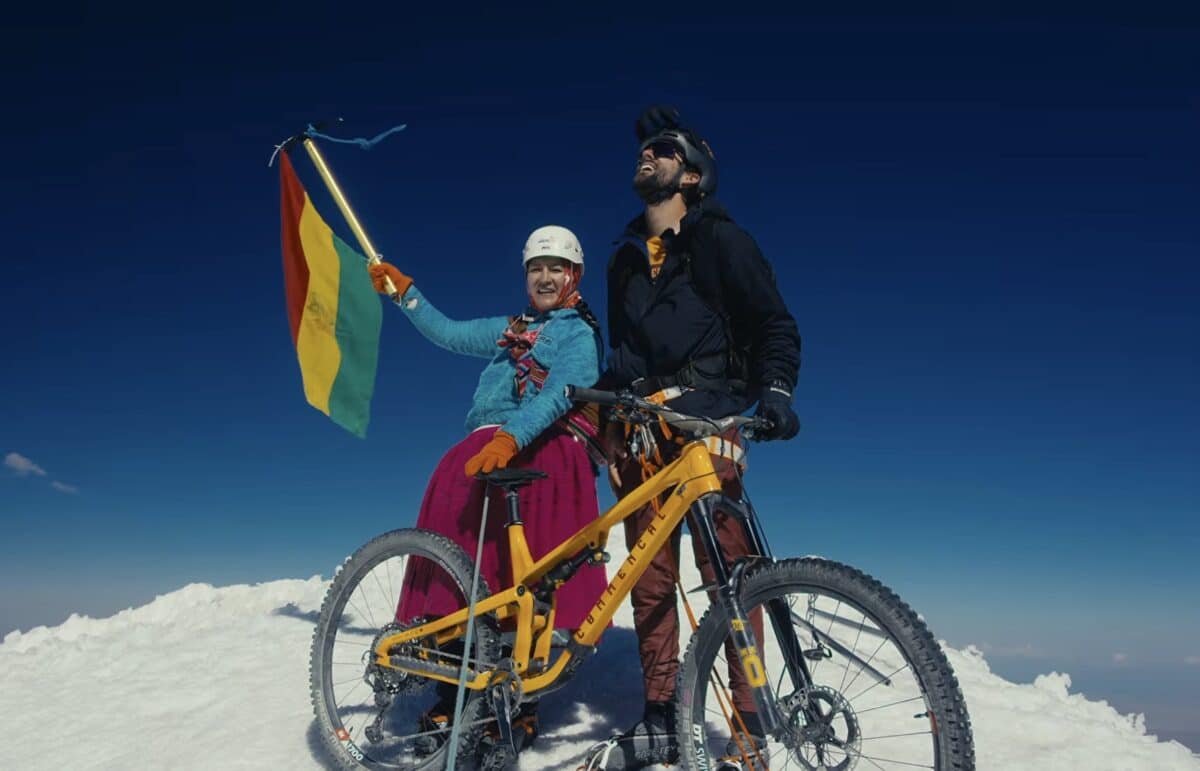
The collaboration with the Cholitas Escaladoras underscored the cultural and community-based aspects of the project. By integrating local indigenous expertise into a high-profile extreme sports production, the expedition highlighted the vital role of Andean guides in safely conducting modern mountaineering feats. Their partnership emphasized mutual respect for the mountain and acknowledged the deep cultural significance that peaks like Huayna Potosí hold for local communities in Bolivia.
Broader Impact and Industry Implications
Kilian Bron’s successful descent of Huayna Potosí pushes the boundaries of what is considered possible in extreme mountain biking, bridging the gap between elite mountaineering and gravity-fed cycling. While disciplines like freeride mountain biking have steadily expanded into alpine environments, successfully navigating a glaciated 19,000-foot peak remains an exceedingly rare achievement.
The feat also serves as a showcase for modern bicycle engineering. Manufacturers closely monitor the performance of equipment subjected to extreme thermal and mechanical stresses during such endeavors, utilizing the data to refine future iterations of all-mountain and enduro frames, suspension systems, and tire technology.
Beyond the technical milestones, the project contributes to the growing genre of adventure sports documentation, offering viewers a transparent look at the logistics, failures, and ultimate triumphs inherent in modern exploration. As extreme athletes continue to seek out uncharted or previously unachievable objectives, expeditions like Bron’s set a new benchmark for risk management, physical endurance, and cross-cultural collaboration in high-altitude environments.

