
Professional mountain biker Nico Vink has achieved a remarkable feat, descending the steep slopes of a Nicaraguan volcano at an astonishing speed of 90.7 miles per hour (145.9 kilometers per hour). This daring ride, captured on video, places Vink among an elite group of individuals who have pushed the boundaries of gravity-powered sports on extreme terrain. The feat was inspired by Markus "Max" Stöckl, who previously set the mountain bike gravel world speed record of 103 mph (165.8 km/h) on the same volcanic slope.
The Allure of the Volcano: A Quest for Speed
The journey for Vink began with the indelible image of Markus Stöckl’s record-breaking descent. Stöckl, a renowned extreme sports athlete, tackled the formidable Cerro Negro volcano in Nicaragua, a challenging 45-degree slope composed of loose volcanic gravel. His achievement in 2017, reaching speeds previously thought impossible on a bicycle, captured the imagination of the mountain biking community and Vink himself. The allure of the volcano’s unforgiving incline and the potential for unparalleled speed became a personal challenge for Vink.
Cerro Negro, located in the Cordillera de Maribios mountain range, is one of Nicaragua’s youngest and most active volcanoes. Its steep, scree-covered slopes present a unique and perilous environment for any descent. The volcano’s geological makeup, characterized by loose volcanic ash and gravel, offers a treacherous yet potentially fast surface. Stöckl’s initial record was set with meticulous preparation, including a specialized aerodynamic suit designed to minimize drag and maximize speed. This contrasts sharply with Vink’s more minimalist approach.
Vink’s Unconventional Approach to Extreme Speed
In contrast to Stöckl’s highly engineered setup, Nico Vink tackled the volcano with a significantly different, and arguably more audacious, strategy. While Stöckl donned a full aerodynamic suit, Vink opted for standard mountain biking attire. This choice immediately highlights the different risk profiles and philosophies at play. The lack of specialized aerodynamic gear suggests Vink was not solely focused on achieving the absolute maximum speed possible but rather on experiencing the raw thrill and challenge of such a descent with a more conventional biking setup.
The most striking detail from the footage is the apparent absence of brakes on Vink’s handlebars. This omission, while not officially confirmed by Vink or his team, has been widely discussed in the comments section of the video. The logic behind removing brakes in such an extreme scenario, though counterintuitive, is that even the slightest application of the brakes on a 45-degree slope composed of loose gravel could lead to a catastrophic loss of traction and a violent crash. At such speeds, a controlled deceleration is incredibly difficult, and any sudden braking action could destabilize the bicycle instantly, resulting in an uncontrolled skid and potentially severe injury. This suggests a profound level of trust in his riding ability and an acceptance of the inherent risks involved.
The Descent: A High-Stakes Performance
The video of Vink’s descent, embedded within the reporting, showcases the sheer intensity of the experience. The camera captures the blur of the volcanic landscape rushing past, emphasizing the incredible velocity. The unstable surface of the volcano requires constant micro-adjustments and an almost intuitive understanding of how the bike will react to the shifting gravel. Without brakes, Vink was entirely reliant on his body positioning, subtle weight shifts, and the bike’s geometry to maintain control.
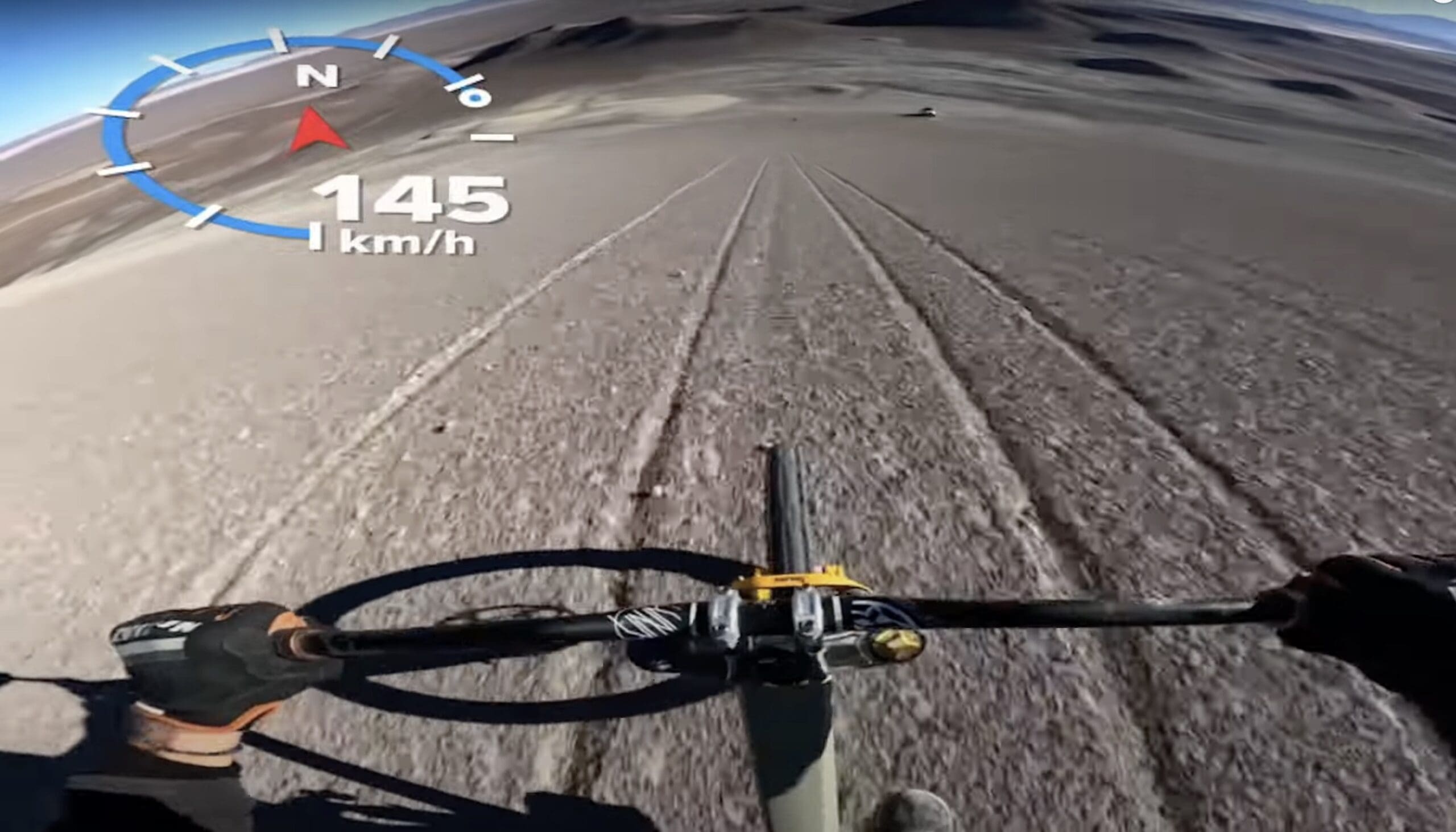
The achievement of 90.7 mph is a testament to Vink’s exceptional bike handling skills, his courage, and his deep understanding of riding on challenging terrain. It demonstrates a level of commitment to pushing the envelope of what is considered possible in mountain biking. The feat not only adds to Vink’s already impressive career in extreme mountain biking but also serves as inspiration for others who seek to test their limits in high-octane sports.
Context and Precedents in Extreme Speed Sports
The pursuit of speed on two wheels has a long and storied history, extending beyond traditional road cycling. Downhill mountain biking, a discipline that involves descending steep, technical courses at high speeds, has seen continuous innovation in both equipment and rider skill. However, descending volcanic slopes with the specific challenges presented by loose gravel and extreme gradients represents a distinct category of extreme sport.
Markus Stöckl’s record on Cerro Negro in 2017 set a significant benchmark. His preparation involved extensive data collection and aerodynamic analysis. He utilized a specially designed full-suspension downhill bike and a custom-made, aerodynamic suit that significantly reduced drag, allowing him to achieve the 103 mph mark. Stöckl’s achievement was the culmination of years of planning and meticulous execution, involving a team of engineers and support staff.
Vink’s ride, while achieving a slightly lower top speed, is notable for its less specialized approach. The decision to forgo brakes and aerodynamic aids suggests a different set of priorities and a willingness to embrace a more primal form of extreme sport. This highlights the diverse motivations and methodologies within the realm of high-speed descents.
Analysis of Risk and Reward
The extreme nature of Vink’s descent raises critical questions about the balance between risk and reward in extreme sports. The potential for catastrophic injury is ever-present. The lack of braking systems means that any miscalculation, unexpected terrain change, or equipment failure could have dire consequences. The loose volcanic gravel can shift unpredictably, creating "washboards" or sudden patches of deeper ash that can easily unseat a rider.
However, for athletes like Nico Vink, the pursuit of such challenges is often driven by an intrinsic desire to test personal limits, to experience the adrenaline rush, and to achieve feats that push the boundaries of human capability. The satisfaction derived from mastering such a perilous environment and achieving a significant speed record can be a powerful motivator, outweighing the inherent dangers.
The "normal mountain biking attire" also implies a degree of confidence in the rider’s ability to absorb impacts and maintain control through sheer skill, rather than relying on protective gear to mitigate the consequences of a fall. This is a calculated risk, a testament to years of experience and training in varied and challenging environments.

Broader Implications for Extreme Sports
Nico Vink’s accomplishment on the Nicaraguan volcano contributes to the growing narrative of human potential in extreme sports. It demonstrates that with exceptional skill and courage, remarkable speeds can be achieved even without the most advanced technological aids. This can inspire a new generation of athletes to explore the possibilities within their respective disciplines.
Furthermore, such feats often bring increased attention to the locations where they occur. Cerro Negro, already a tourist attraction for its unique landscape and volcano boarding activities, may see further interest from adventurers seeking similar thrills. This can have economic benefits for local communities, but also necessitates considerations for sustainable tourism and safety protocols.
The inherent danger, however, also prompts discussions about safety standards and the responsible promotion of extreme sports. While the allure of pushing boundaries is strong, ensuring that athletes are adequately prepared and that risks are understood is crucial. The raw footage of Vink’s descent serves as a powerful visual reminder of the extreme nature of his endeavor.
The Future of High-Speed Descents
As technology continues to advance and athletes hone their skills, the pursuit of speed on extreme terrain will undoubtedly continue. Whether it’s on specialized downhill bikes with advanced suspension and aerodynamic features, or on more minimalist setups like Vink’s, the drive to conquer gravity and achieve new benchmarks remains a powerful force.
Future attempts on Cerro Negro and similar locations may see further innovation in both equipment and technique. The dialogue between technological advancement and raw human skill will likely define the next chapter in extreme speed sports. Nico Vink’s 90.7 mph descent stands as a significant marker, a testament to the enduring spirit of adventure and the relentless pursuit of speed against the backdrop of nature’s most formidable challenges. The image of a lone rider, navigating a treacherous volcanic slope at breathtaking velocity, encapsulates the essence of extreme sports: a potent blend of courage, skill, and the unyielding human desire to go faster, farther, and higher.

